

Pancakes in Paris, page 1


Thank you for purchasing this eBook.
At Sourcebooks we believe one thing:
BOOKS CHANGE LIVES.
We would love to invite you to receive exclusive rewards. Sign up now for VIP savings, bonus content, early access to new ideas we're developing, and sneak peeks at our hottest titles!
Happy reading!
SIGN UP NOW!
Copyright © 2016 by Craig Carlson
Cover and internal design © 2016 by Sourcebooks, Inc.
Cover design by The Book Designers
Cover images © Kamenetskiy Konstantin, VectorShots, squarelogo, Velizar Simeonov, somchaii/Shutterstock
Sourcebooks and the colophon are registered trademarks of Sourcebooks, Inc.
All rights reserved. No part of this book may be reproduced in any form or by any electronic or mechanical means including information storage and retrieval systems—except in the case of brief quotations embodied in critical articles or reviews—without permission in writing from its publisher, Sourcebooks, Inc.
All photographs © Craig Carlson, unless otherwise indicated.
Photograph on p. 71 © by Will Plyler
Illustration on p. 105 © by Philippe Tilikete
Photographs on p. 133 © by Craig Carlson and Tom Craig
Illustration on p. 134 © by Sylvain Deboissy
Photograph on p. 203 © by Brian Downie
Photograph on p. 209 © by P. Alexander Chodak
Photographs on p. 220 © by Craig Carlson and Cedric Roux
This book is a memoir. It reflects the author’s present recollections of experiences over a period of time. Some names and characteristics have been changed, some events have been compressed, and some dialogue has been re-created.
All brand names and product names used in this book are trademarks, registered trademarks, or trade names of their respective holders. Sourcebooks, Inc., is not associated with any product or vendor in this book.
Published by Sourcebooks, Inc.
P.O. Box 4410, Naperville, Illinois 60567-4410
(630) 961-3900
Fax: (630) 961-2168
www.sourcebooks.com
Library of Congress Cataloging-in-Publication Data
Names: Carlson, Craig, author.
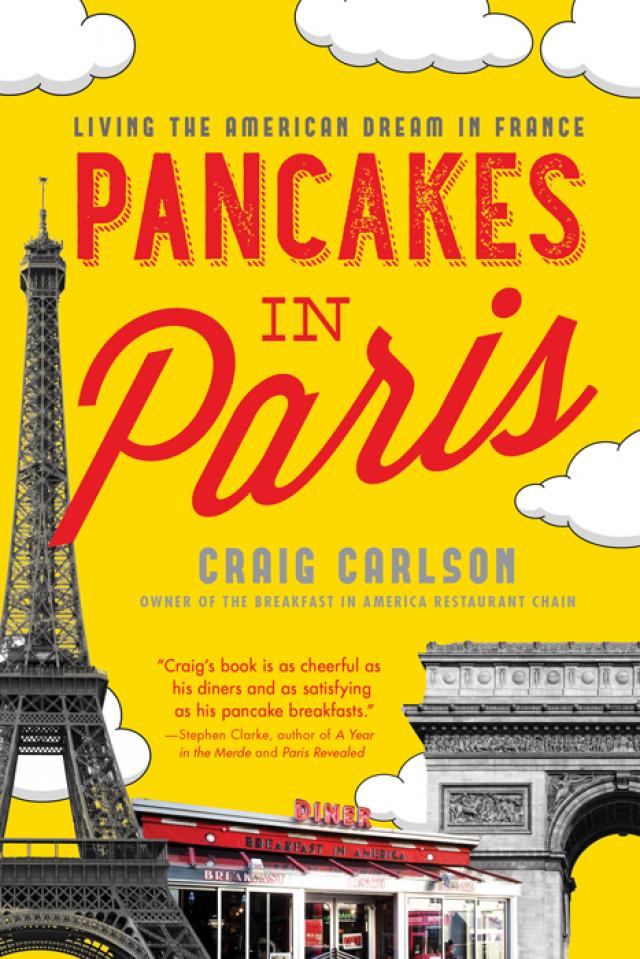
Title: Pancakes in Paris : living the American dream in France / Craig Carlson, owner of the Breakfast in America restaurant chain.
Description: Naperville, Illinois : Sourcebooks, [2016]
Identifiers: LCCN 2016008292 | (pbk. : alk. paper)
Subjects: LCSH: Carlson, Craig. | Restaurateurs--United States--Biography. | Breakfast in America (Restaurant chain) | Diners
(Restaurants)--France--Paris.
Classification: LCC TX910.5.C296 A3 2016 | DDC 647.95092 [B]--dc23 LC record available at https://lccn.loc.gov/2016008292
In loving memory of my grandma Lizzy and her delicious scrambled eggs.
Breakfast in America, Paris.
“I don’t think I knew happiness until I opened the Breakfast in America menu.”
—Stephanie, a homesick American customer
MENU
Prologue
Apéritif
The Road to the Crazy Dream
Chapter 1: The French Connection: How I Ended Up in France
Chapter 2: Paris and Rouen: A Movable Feast
Chapter 3: The Crazy Dream
Starter
If You Build It, They Will Come
Chapter 4: The Business Plan and the Best Kind of R & D
Chapter 5: Merci to the Mouse
Chapter 6: Show Me the Money!
Chapter 7: BIA VF (Version Française)
Chapter 8: Show Me (More) Money!
Main Course
Living My Dream
Chapter 9: My “Diner” with André
Chapter 10: Location Numéro Deux
Chapter 11: Countdown to Opening Day
Chapter 12: Open for Business; Closed for War
Chapter 13: French Fries or Freedom Fries
Chapter 14: French Labor Pains
Dessert
Love Among the Milkshakes
Chapter 15: Life Begins at Quarante (Forty)
Chapter 16: Vive l’Amour
Chapter 17: BIA #2 and Beyond
Chapter 18: Midnight Espresso
Digestif
La Grande Disillusion
Chapter 19: The Peter Principle
Chapter 20: Attack of the Contrôleurs—Part Deux
Chapter 21: Paris Syndrome
Chapter 22: The Big Chill
Chapter 23: It Is a Wonderful Life
Epilogue
Recipes
Acknowledgments
About the Author
Notre Dame as viewed from the pont de la Tournelle.
PROLOGUE
I have the best commute in the world. My scenic walk to work begins on the Left Bank of Paris, where the original Breakfast in America (BIA) restaurant is located, and continues on to the Right Bank—home of the second BIA. Along the way, I get to cross the lovely Seine not once, but twice, thanks to one of my favorite places in Paris, an island located smack in the middle of my route—Île Saint-Louis. With its narrow streets full of quaint shops and restaurants, this tiny island paradise always makes me feel as if I’ve been transported back in time—from the hustle and bustle of a modern city to a sleepy, medieval village somewhere in the French countryside.
But by far the best part of my commute is the view of the Notre Dame Cathedral from the first bridge I cross, the pont de la Tournelle. In my humble opinion, Notre Dame looks best from this angle. With its majestic spire reaching toward the heavens—in sharp contrast with its flying buttresses keeping the heavy stone walls from collapsing to the ground—Notre Dame always reminds me of that mysterious interplay between heaven and earth, between the seen and the unseen.
No matter how much of a hurry I’m in or how bad my day has been, I always take a moment to stop and gaze at this architectural wonder. There’s something about staring at a structure from the twelfth century—still standing strong—that puts things into perspective.
I’m reminded, once again, of what it is that I’ve always loved about Paris. And what brought me here in the first place…
How many people have imagined running off to the City of Light, opening their own café, and starting a whole new life in the most beautiful city in the world? Well, I actually did it. Me, a former Hollywood screenwriter who used to read scripts where the main character dreamed of doing what I did—no small feat considering that I had never owned a business before, let alone a restaurant, with their notoriously high failure rates.
And if that weren’t crazy enough, I decided to open my restaurant in a foreign country with a foreign language and in a city that just happens to be the culinary capital of the world—Paris. But my restaurant wasn’t just any restaurant; it was an American diner, the first of its kind in the city. Yet despite all the odds against me, my little dive, my greasy spoon, became a great success, with lines of customers stretching down the block.
Before I knew it, my diner, Breakfast in America, started appearing all over the national and international press, including CNN, the New York Times, BBC, French television, and more. Here’s just a sample of what they were saying about us. NBC’s Today Show raved on its website, “Breakfast in America is the American place in France.” Frommer’s called us “Paris’s most famous American diner.” T: The New York Times Style Magazine said, “The early trendsetter was Connecticut-bred Craig Carlson.” (Imagine that—me, a trendsetter!) And last but not least, Let’s Go Paris proclaimed, “It doesn’t get more American than this.”
No, it doesn’t. And neither does my story. After all I’ve been through, I could practically be the poster child for the American Dream—except for one petit detail:
In order to live the American Dream, I had to move to France.
Whenever people hear about Breakfast in America for the first time, they always ask me the same questions: How did you come up with the idea? Had you ever owned a restaurant before? Do you speak French? Is doing business in France complicated? Are most of your customers French or American?
On the political side of things, a lot of people want to know if I’ve experienced any anti-Americanism. Or if I’m a socialist. My favorite questions come from those who harbor dreams of moving to France and opening an establishment of their own. Questions like: Is it hard to find the right ingredients? What’s the most popular item on the menu? Do you have to adapt your food for French tastes? Do you miss the States? And the biggie: Are you going to live in France forever?
The more I pondered these questions, the more I realized that I’d never answered the biggest questions of all: my own. How did I get here? What were the chances? One in a million? A billion? In fact, the more I put the pieces of my crazy life together, the more I realize how far I’ve come—and how much I’ve had to overcome—to be who I am today: a successful restaurateur in France.
“Remember, Craig,” my first investor, Todd, once said to me when he saw me with dark circles under my eyes, picking French fries off the diner floor like a zombie, “you’re living your dream. Tell yourself that whenever you feel like you can’t go on: ‘I’m living my dream… I’m living my dream.’”
Over the course of my unconventional restaurant career, there would be many occasions for me to repeat that mantra, especially on that fateful day when, overwhelmed by the stress of doing business in France, I collapsed, unconscious, while jogging along the l
I was living my dream, all right. And it almost killed me.
Apéritif
The Road to the Crazy Dream
Me at age four and a half. Now used on a promotional label for BIA.
Chapter 1
THE FRENCH CONNECTION: HOW I ENDED UP IN FRANCE
“Every man [should have] two countries: his own and France.”
—Thomas Jefferson, paraphrasing Henri de Bornier’s La Fille de Roland
If you had met me as a kid and seen where I came from, you would have never in a million years imagined that one day I would end up living in France. I hardly could have imagined it myself. First of all, nothing about me is French. Rien, nada, zilch. I grew up in upstate Connecticut in a poor immigrant family, one side Polish, the other side Finnish. My three older siblings and I were bounced back and forth between grandparents more than a dozen times before I was nine years old.
The reason? Neither of my parents, who had been divorced for as long as I could remember, were capable of being…well, parents. My father wouldn’t let a little thing like parental responsibility get in the way of his drinking and gambling. And my bipolar mom had trouble staying in one place; every few months or so, she would be hauled off to a mental hospital by burly male orderlies. Each time it happened, no one bothered to explain to me why my mom kept leaving like that, but eventually I figured it out: it was my fault whenever I became “too demanding”—meaning, whenever I craved love or attention—my mom would suddenly disappear to a place called Norwich, a town two hours south of us, that had the biggest asylum in the state.
Because my grandma Mary didn’t drive, our kindly but kooky neighbor, Mrs. Martin, would sometimes take us kids down to Norwich to visit my mom. Racing down Highway 91 in her massive green ’68 Chevy Impala, Mrs. Martin, a Jehovah’s Witness, would tell us fantastical stories about how God and Satan were at war—but not to worry. “One day, God will win,” she’d say, “and the earth will be a paradise again, just like Eden, where we’ll all be able to pet snakes and spiders—and they won’t even bite!”
Eew, I’d think. Some paradise. Can I just have my mom back?
When my mom finally did come back, the family was so tired of taking care of us kids they decided it was our turn to be sent away. Again, with no explanation, we were dropped off for an entire year at a children’s home—or the more sexy Dickensian term, an orphanage. I tried to run away with my older brother, Eddie, but my little legs weren’t quick enough. Eddie did escape, but he got hungry fast and was back at the orphanage in time for his gruel.
Despite all evidence to the contrary, I always felt loved as a kid—just never wanted. My grandma Lizzy, on the Finnish side of the family, was particularly loving—as long as you didn’t ask for anything or overstay your welcome. I was especially fond of her delicious scrambled eggs, the taste of which I’ve never been able to duplicate, not even at Breakfast in America.
As for my Polish grandma Mary, her favorite breakfast was fish sticks and prune juice—there’s a reason why my diner is not called Breakfast in Poland.
Oh, and here’s another reason:
Grandma Mary’s Recipe for Old World Chicken à la Polonaise
1 chicken (any size you can get your grubby hands on)
Salt (if available)
Boil water. Add chicken. Salt.
Serves a Polish family of 12.
Having emigrated from the United States to France, I often think about my grandma Lizzy, who was a first-generation American herself. She loved telling me stories about how her parents had left Finland with nothing more than big dreams of a better life. In fact, the main thing on their minds was how they were going to spend the fortune that awaited them in the New World.
“Everyone in Finland used to say that the sidewalks in America were covered with silver dollars!” my grandma Lizzy loved telling me. “All you had to do was bend over and scoop up as many as you wanted!”
I wish my grandma Lizzy were still alive today. I would give anything to hear her wonderful stories again. And just think of all the stories I could tell her. Stories about how there’s another place where dreams come true, a faraway place, across the sea, in the Old World. A magical place with castles and health care…cafés and free college…demonstrations and endless vacations. Where the sidewalks are covered with silver euros, yours for the taking. All you have to do is bend over and scoop them up—assuming you can find them buried deep beneath a pile of dog shit.
Of course, France wasn’t even on my radar back when I was a kid growing up in small-town Connecticut, and it certainly wasn’t a potential travel destination. But thanks to a twist of fate (or two), all that was about to change.
My first French memory took place in a swirl of suffocating cigarette smoke. It was Sunday morning, and my dad had just picked up my sisters and me from my grandma Mary’s place. Forced to spend quality time with his kids, my dad dragged us along with him to his favorite pub, the Rustic Bar & Grill. Divorced and digging his new lifestyle as a swinging bachelor, “Fast Eddie” (as the ladies called him) had just painted his rusty, old station wagon a vibrant Van Gogh blue with a bright yellow racing stripe running down the side.
As we drove through town in Fast Eddie’s slick, two-toned chick-mobile, my older twin sisters, Colleen and Cathy, slouched in the backseat, hoping none of their friends would see them. Like most teenage girls at the time, they wore their long, blond hair parted in the middle à la Ali MacGraw in Love Story, their faces locked into adolescent sneers. I sat in the front seat and could barely breathe as my dad chain-smoked his way through another pack of More cigarettes.
Up ahead, my dad spotted two of my sisters’ friends walking along the sidewalk. He glanced in the rearview mirror. Seeing how embarrassed my sisters were only brought out the devil in Fast Eddie. He slowed the station wagon down, pulling up beside my sisters’ friends. Then with a big, shit-eating grin, he started waving and honking his horn. My sisters sank down even lower in their seats, shooting death glares at my dad.
That’s when I heard le français for the very first time.
Not wanting anyone to understand what they were saying, my sisters turned to each other and began conversing in their newly acquired, seventh-grade pidgin French.
“La famille est…” Colleen struggled for just the right French word. Then it hit her: “Stupide!” (pronounced stoo-peed).
Cathy nodded enthusiastically. “Ah, oui! Très stupide!”
“Oui, oui! Beaucoup stupide!”
“Oui, oui! Très beaucoup stupide!”
“Oui, oui, oui! Stupide, stupide, stupide!”
As if watching a tennis match, my eyes followed my sisters back and forth. With each “oui” and “stoo-peed,” I nodded in wholehearted agreement. Not to brag or anything, but at barely seven years old, I could totally understand what they were saying. And I hadn’t even taken a single French lesson yet. I guess you could say I had a gift for languages right from the start.
Fast Eddie, on the other hand, had no clue. “Whatever you dingbats are babbling on about,” he said, “enough already!”
The girls snickered. “Oh là là! Papa pas content!”
Non, Papa was not content at all. In fact, he was furious because he wanted my sisters to take Spanish, so they could tell him what the Puerto Rican neighbors were saying about him.
As the cacophony of “ouis” drifted into the air and joined in a dance with the swirling cigarette smoke, my dad turned to me and said with a stern look, “Don’t you ever take that useless language, comprende?”
After such an inauspicious start with the French language, it certainly looked like France just wasn’t going to be in my stars. But then, for some reason, events in my life began pushing me toward France again and again, as if I always belonged there—as if there were something more at work than mere coincidence. Whether one believes in destiny or not, my life certainly makes a strong argument for it.
Case in point, by the time I was nine, one by one, my restless family members got out of town—and as fast as possible. The first to leave were my sisters, who quit high school and joined the Air Force. My brother followed suit. The last to go was my mom, who eloped to Florida with her boyfriend, the charmless Monsieur Ducharme (a second-generation French Canadian). Still too young to run away, I suddenly found myself living alone with my dad in the bad part of town—the curiously named Frenchtown.


