

When it's Hangnoose Time in Hell, page 1


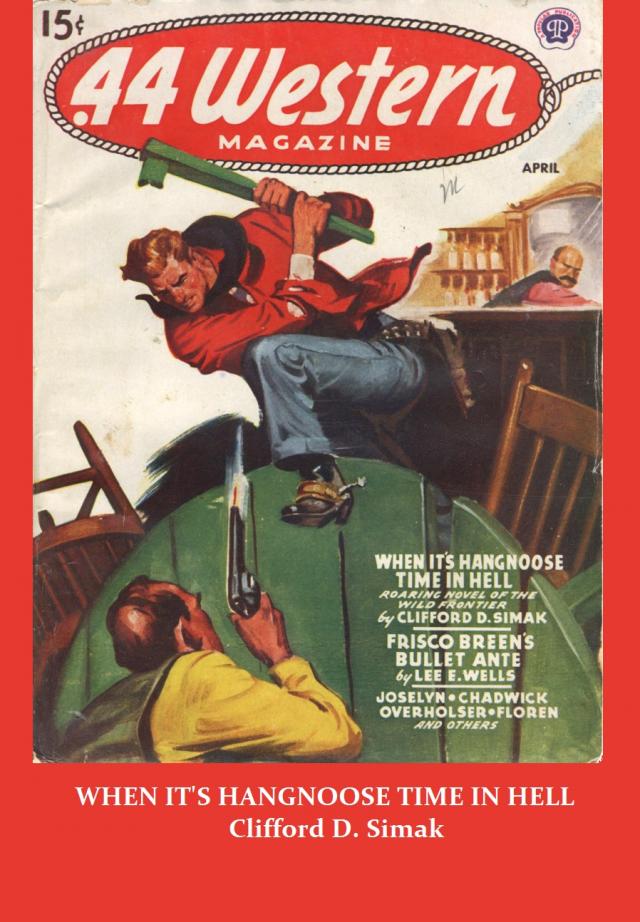
WHEN IT’S HANGNOOSE TIME IN HELL
CLIFFORD D. SIMAK
“July 17, H. Jackson killed by Nelson … Old Henry Dide … July 18, Stover Idled stranger, got 500 dolar…So read the ragged cripple’s “Who’s Who In Hell” of Gun Gulch town. And when square-shooting tinhorn Grant Culver, on the trail of his bushwhacked pardner, read those lines, he knew his own rendezvous with deadly gunflame was only seconds away… .
CHAPTER ONE Death Pays for an Insult
GRANT CULVER was walking along, minding his own business and thinking of Nancy Atwood, when the man bumped into him and sent him staggering off the sidewalk into mud that was Gun Gulch’s main street.
Culver lit flat on his back. His hat flew off and was ground beneath the wheels of a passing wagon. His carpetbag slipped out of his hand and splashed into a water-hole a good six feet away. On the porch of the Crystal Bar a crowd of loafers laughed uproariously, bent over, slapping one another on the back.
Culver sat up, the cold ooze seeping through his clothing, and eyed the laughing crowd. Sort of an initiation, he figured. A joke they played on tenderfeet.
He rose to his feet and singled out the man who had pushed him, a bear of a man who was roaring with laughter.
Culver waded to the boardwalk, mud and water dripping from his clothes. He gained the walk and stood wiping his hands on the front of his coat. The laughter quieted and the man who had bumped him turned around and faced him. Culver studied him, saw the sneer on his face.
“I presume,” Culver said, “that it was an accident.”
The man took his time in answering, his little pig-eyes small and red and watchful.
“Hell, no,” he said. “I done it on purpose.
Deliberately, Culver wiped the back of his right hand against his coat and as the hand traveled down the fabric it became a fist, a fist that struck with savage, blistering speed.
It came so fast the man didn’t even duck. It smacked against his chin with a hollow, thudding sound to lift him from his feet and slam him back. He landed in the mud with a splash that sent yellow water geyser-ing high into the air.
Culver snapped a quick look over his shoulder at the jaspers on the porch, but they had not moved. They stood like frozen men, waiting for the earth to open underneath their feet.
Out in the street Culver’s antagonist had lumbered upright, was heaving himself back onto the boardwalk. He stood there, shaking his hands to rid them of the clinging mud and on the porch back of Culver the silence was deep.
“You win, mister,” Culver told the muddy man. “You made a bigger splash than I did.”
The man lumbered forward a step or two, pig-eyes glaring from above the bushy beard. Then his arm was moving, coming up and crooking, pistoning down for the gun butt at his side.
Culver’s fingers snapped around his six-gun’s grip and spun it free of leather. His wrist jerked to the impact of the recoil.
Out on the sidewalk the bear-like man
straightened out of his gunning crouch, straightened until it seemed that he was standing on his tiptoes, while a tiny stream of red came out of his forehead.
He tottered, the gun dropped from his fingers, then he fell, like a tree would fall, stiff and straight. His head and shoulders splashed into the mud, but his boots stayed on the sidewalk.
Culver turned to face the porch. Slowly he lifted his six and blew across the muzzle to clear away the smoke.
“Perhaps” he suggested softly, “one of you gentlemen wouldn’t mind stepping out into the street to get my carpetbag.’’
They stood still and silent, watching him with steady cold eyes, but he noticed that their hands were very careful not to move toward their belts.
Culver sighed. “I should hate to insist,” he told them.
One of them moved out of the crowd and started down the stairs, hobbling on the wooden peg that served him for a right leg. The peg tapped loudly in the silence as the man inched slowly down the steps.
“Wait a second,” Culver said sharply. “You aren’t the one to do it. You didn’t laugh half loud enough when I was lying out there.”
He singled out a man with his sixgun barrel. “Now, that gent there,” he told the crowd, “was fair beside himself. I never saw a man get so much entertainment out of such a simple thing. …”
“If you think I’m going out to get your bag,” the man roared at him, “you’re loco.”
Culver shrugged one shoulder. “I suppose you have a gun,” he said.
He saw the man’s face go white and drawn.
He blustered. “If you think … . “
“Shoot or wade,” Culver told him, almost indifferently.
Another man spoke quietly, sharply. “For God’s sake, Perkins, go and get it You wouldn’t have a chance.”
Perkins looked around, searching the faces that ringed him in.
His shoulders drooped. “All right,” he said.
HE CAME slowly down the steps, crossed the sidewalk, stepped gingerly out into the mud. The mud was to his knees when he reached the bag, tugged it out of the grip of the clinging gumbo and brought it back. Carefully he set it on the sidewalk, climbed the stairs again.
Culver searched the faces on the porch.
“Satisfied?” he asked.
One or two heads nodded.
“Just want to be sure no one feels he’s been slighted,” Culver told them.
No one seemed to be. He holstered the sixgun, picked up the carpetbag.
“One thing you fellows have to remember,” he told them. “It’s damn bad manners to push strangers into mud-holes.”
He turned and headed down the sidewalk, but behind him came a tapping and a hailing voice. “Just a minute, mister.” He swung around and saw the peg-legged gent hurrying after him. “What can I do for you?” he asked.
Peg-leg fished a notebook from his pocket, flipped the pages, took a pencil stub from behind his ear and wet it on his tongue.
“I wonder if I could have your name,” he said.
Culver started at the question. “Why, I suppose you can. Culver. Grant Culver.”
The man wrote with cramped and laboring fingers.
“From where?” he asked.
“From the Mississippi,” Culver told him. “Sometimes the Missouri.”
“The jasper you smoked out,” said Peg-leg, “was Stover. He had a big time pushing people in the mud. Thought it was a joke.”
He closed the notebook and put it in his pocket, stuck the pencil stub behind his ear. “Thank you very much,” he said and started to turn away.
“Say, wait a second,” Culver told him. “What’s all this about?”
“Vital statistics,” Peg-leg said.
“You mean you get the names of everyone who comes to town “
“Most of them,” Peg-leg said. “Once in a while I miss a few.”
“Have you got a Nancy and Robert Atwood? They should have come in yesterday.”
Peg-leg got out his notebook, thumbed it through. “Yep, here they are. Got in yesterday. Staying at the Antlers Hotel just down the street. Gal’s a looker. Brother’s an engineer and damn poor poker player.”
He snapped the book shut, put it in his pocket. “That will be a buck,” he said.
“A what?”
“A buck. A dollar. A cartwheel. For information. I don’t give out information free of charge.”
Culver gasped. “Oh, I see,” he said. He took a dollar from his pocket, handed it to the man. He took it, touched his ragged hat by way of thanks.
“Anytime you want to know something just come to me,” he said. “If I don’t know, I’ll find out.”
“I wonder—” Culver began.
“Yes. What is it? Want to know something else?” Peg-leg’s hand was dipping in his pocket for the book.
Culver shook his head. “Nope. Just skip it. Some other time, perhaps.”
“Okay,” Peg-leg said cheerfully. He turned around and hobbled down the street.
Culver stared after him, scrubbing his chin thoughtfully with his hand. Then he picked up his bag and headed down the street toward the Antlers Hotel.
GUN GULCH was a seething brew of humanity turned mad by the gold-germ running in its veins. Its one main street was churned to a strip of paste-like, sucking mud by chugging wagon wheels, by the pounding, straining hoofs of horses bringing in the freight that built the false-front stores and stocked them with the needs of the frontier brood.
Back in Antelope town, Culver had been told in way of warning:
“Gun Gulch is a tough town. You walk in the middle of the street and you mind your business.”
And that, he thought, standing at the window of his room, was right. Walk in the middle of the street, unless you got pushed off. Deliberately, by a man with a black beard and pig-eyes that watched every move you made.
The name of the place had been the Crystal Bar. That would be Hamilton’s place. Hamilton might have heard of Farson, might be able to tell him something of him. Certainly, if Farson passed through Gun Gulch, Hamilton would have known it.
Culver frowned, thinking back on his past associations with Hamilton. A man that made a little shiver run up your shoulder-blades. A man whose handshake was like grabbing a flabby fish that was sweating just a little. And the worst of it was that if Hamilton had no word of Farson, he would have to ask the man for a job. That dollar he had given Peg-leg had been almost his last.
Maybe Peg-leg had Farson in his notebook. He had almost asked him and then had decided against it. Hamilton would keep his mouth shut and Peg-leg probably wouldn’t. Culver grinned,remembering the little man tapping along on his wooden peg.
The first lamps of evening were blooming out of the windows along the street, throwing splashes of orange and yellow light across the crowded sidewalks apd out into the muddy road. A wagon went past, piled high with freight. From where he stood, Culver could hear the high, shrill profanity of the teamster above the babble of the street.
Letting himself out the door, he headed for the stairs, had almost reached them when a voice called from the hall behind him. He swung around and saw Nancy Atwood, standing in front of an open door almost opposite his own.
“Grant Culver,” she said, “will you come and say hello to me.”
He Walked toward her, smiling. “I was wondering when I’d see you. A man with a wooden leg told me you had put up here.”
“I do declare,” she told him, “after you’d traveled all the way with us I’d thought you could have kept on until we got to Gun Gulch.”
He shook his head. “I had to stop at Antelope to ask about a man.”
“A friend of yours?” Nancy asked.
“I don’t rightly know. He used to be.”
Pretty, he thought, looking at her. Pretty as a picture with her raven hair piled atop her head. She was wearing a flame-colored dress that left her shoulders bare.
“You’re going out, Grant?” she asked.
“I thought I would. If—”
She silenced him with a gesture of her hand. “You might watch for Bob,” she said then. “I’m just a little—well, a little bit afraid.”
He laughed at her easily. “Gun Gulch may be touch, Nancy, but not as bad as that. Your brother can take care of himself.”
Her voice choked a little. “He’s been gambling,” she said. “He denies it, but I know he has. And he’s so poor at it and we have so little money.”
“And you want me to break up the game?”
“Well, not exactly that. You might see what you can do to get him out of it as tactfully as possible.”
He frowned. “Your brother has a job here?”
She nodded. “Yes, he has. But the man he has to see is out at some diggings somewhere and Bob has to wait until he comes back to town.”
“I’ll see if I can spot him,” he told her.
She smiled at him. “Thanks, Grant,” she said. “Good night.”
He watched until she shut the door, then moved on down the hall and out onto the street of Gun Gulch.
CHAPTER TWO The Man Named Hamilton
THE Crystal Bar was a smoke-blurred din, a place of lights and music, talk and tinkle, with the undertone of feet shuffling on sawdust. For a moment, Culver stood in the door, staring out over the milling crowd that filled the place. The lights blazed from the ceiling, their brilliance softened by the trails of cigar smoke that snaked up in bluish ribbons. Glassware flashed and scintillated on the back bar and the barkeepers moved about almost like dancing men.
Culver moved down the room, going slowly, shouldering his way through the
press of humanity. Foot by foot he worked is way toward the bar.
A bartender growled at him: “What’s yours ?”
“Nothing right now,” Culver told him. “Where can I find Hamilton?”
“What the hell!” The barkeep stopped in mid-sentence, stared at him. His manner changed and he almost fawned.
“The boss said you were to see him just as soon as you come in.”
“Thanks,” Culver said.
The bartender leaned across the bar. “Have one on the house before you go.” He grasped a bottle by the neck, seized a glass.
Culver shook his head.
“Mister,” said the barkeep, “you may not know it, but you’re the talk of the town.”
“How come ?” Culver asked.
“Stover was the fastest gunslick this place had ever seen,” the barkeep told him.
Culver shook his head. “Slow,” he said. “Terrible, awful slow.”
He swung around, pushed his way toward the center of the room.
The shot came like a thunderclap that split across the talk, a burst of blasting noise that drowned out all sound and set the ceiling lamps to swaying on their chains.
The crowd surged back and left a cleared space in the center of the room, a place of scuffed-up sawdust and green tables and smoke-filtered light.
Culver stood stock still, staring at the figure on the floor.
Bob Atwood!
Bob Atwood, who had ridden in the stagecoach with him all the way from St. Louis. Nancy Atwood’s brother.
Culver lifted his eyes and stared at the man who stood behind the table, a man with his hat tilted on the back of his head, teeth showing in a firm, white line beneath the jaunty mustache, and with a smoking gun clutched tightly in his hand.
The man was looking at Culver and from where he stood Culver could see the crinkles deepen at the corners of his eyes.
“So,” said the man.
Culver felt his muscles tightening, fought to relax them.
The man across the table was Perkins, he who had waded out into the street to get his carpetbag.
The gun was coming up, slowly, surely, and there was no chance to beat it. v
“Perkins,” Culver said, “you’re a lousy shot. You just winged your man.”
Perkins’ eyes flickered for a moment toward Bob Atwood on the^ floor and as they did Culver’s arm moved swiftly, arm and wrist and fingers a sudden chain of strength and speed that brought the sixgun spinning from its holster.
Perkins’ hand jerked nervously and his gun belched smoke and fire. Culver felt the whining bullet spin past his head, heard the crash of glass as it slammed into the back bar mirror.
“You had your shot,” Culver told him,
bleakly. “Now, by God, it’s my turn.”
Perkins stood rigid before him, face a deadly white, gun grasped in his hand and tilted toward the ceiling. Slowly, deliberately, Culver’s thumb pulled back the hammer and the click of the sixgun’s mechanism was a harsh and startling sound. Perkins whimpered. His hand suddenly was shaking and the gun dropped from it.
Without a word, Culver holstered his own gun, turned to the man upon the floor. Atwood was sitting up, hand clutching his shoulder, staring at Culver.
Culver crossed to him. “Can you get up ?” he asked.
Atwood nodded. “He dealt from the bottom of the deck,” he said. “I caught him at it.”
CHAPTER THREE Wanted—A Spy!
HAMILTON reached into the bottom drawer of the battered desk, came up with a box of cigars. “Light up, Culver.”
Chewing the end off the smoke, Culver studied the man. About the same as ever, he decided. A little harder, a bit more vicious, slightly older than he’d been back on the river. But he was the same Calvin Hamilton.
“Sorry about your friend,” Hamilton said. “Hope he will be all right.”
Culver struck a match. “Got him back to the hotel and put him to bed. Got a doctor for him right away.”
Culver ran the match back and forth across the tip of the cigar, eyes taking in the room. An old iron safe behind the desk, a couple of chairs, carpet on the floor, framed sporting prints scattered on the walls.
Hamilton leaned back in the creaking armchair, inserted his thumbs in the armholes of his vest.
“Surprised to see you here,” he said. “River dry up?”
Culver shook his head. “Out looking for a man. Supposed to have come here. Name of Mark Farson. Maybe you heard of him.”
Hamilton rocked slowly in the chair, brow furrowed. “Can’t say I did,” he declared. “But I might have missed him. There are so many people. Someone I should know?”
“Guess you wouldn’t,” Culver told him. “Came after you had left. Got to be pretty friendly with him.”
Culver snapped the match stick in two, flipped it from him with his thumb. “Figured he was about my best friend, I guess. Would have gone through hell barefooted for that kid.”
Back of the desk, Hamilton’s eyes squinted shrewdly. “Loan him some money?”
“Worse than that,” said Culver. “Heard of Gun Gulch, you see. Heard it was a ood town. So we pooled our killings and e came out here ahead to sort of look it over. He was to let me know if it was worth investing.”


