The Dregs of Empire: A Tale of the Sun Eater, page 1


Copyright © 2023 by Ruocchio Ventures.
All Rights Reserved.
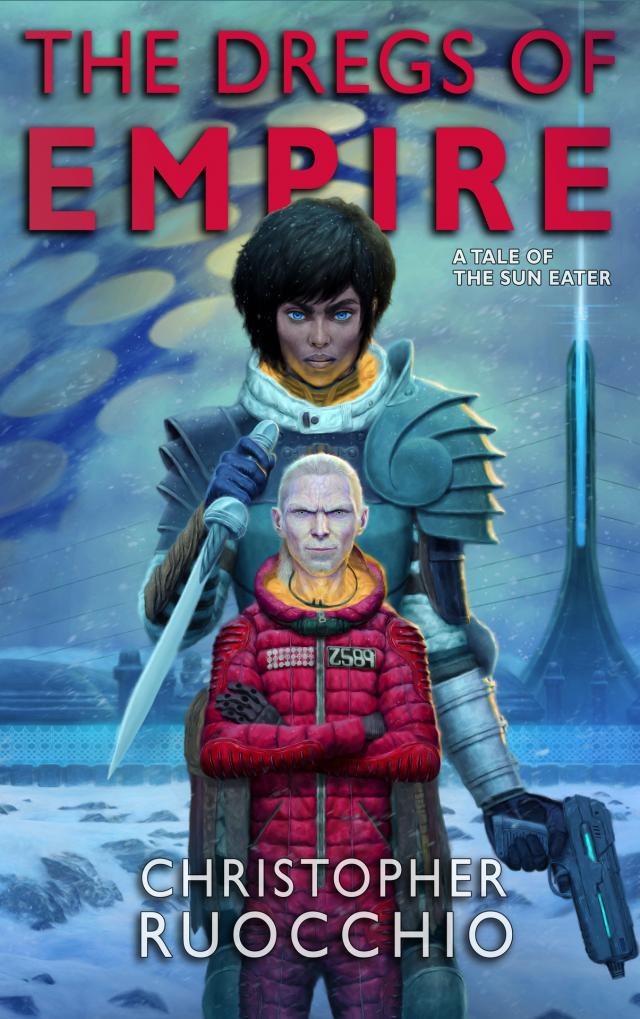
Cover Art by John Barry Ballaran.
Cover Design by Jenna Ruocchio.
Page Design by The Logical Choice.
Published through Amazon Kindle Direct Publishing.
All characters in this book are fictitious.
Any resemblance to persons living or dead is strictly coincidental.
The scanning, uploading, and distribution of this book via the Internet or any other means without the permission of the author is illegal and punishable by law. Please purchase only authorized electronic editions, and do not participate in or encourage the electronic piracy of copyrighted materials. Your support of the author’s rights is appreciated.
To BookTube, most especially to Mike. You saved the series, you really did.
CONTENTS
COVER
TITLE PAGE
COPYRIGHT
DEDICATION
EPIGRAPH
AUTHOR’S NOTE
THE PRISON PLANET
THE DUKE
A MAN’S WORLD
THE PARACOITA
THE WAY OF THINGS
THE TRAITORS
FARSIDE
OUTBORN AND MISBORN
A FRIEND
OF VULTURES
THE COLD
PRINCESS OF THIEVES
THE SUBTERRANE
STRATEGY AND TACTICS
THE DREGS OF EMPIRE
KNOCKING ON HEAVEN’S DOOR
TOWER OF THE GODS
TO CRACK THE SKY
ALSO BY
“. . . until the day when God shall deign to reveal the future to man, all human wisdom will be contained in these two words: Wait and hope.”
– Alexandre Dumas
AUTHOR’S NOTE
Until this point, I have been very laissez-faire about when my readers should dive into the supplemental works in the Sun Eater universe. “You can read The Lesser Devil at any time!” I said (though it proves a superior reading experience if read after Empire of Silence). “Some of the stories in Tales of the Sun Eater, Vol. 1 are set after book two in the series, but don’t let that stop you!”
This time, I will not say any such thing or be so relaxed.
This book is best enjoyed after having read Ashes of Man, which is the fifth book in the main series. The events of this novella follow directly on the fate of one of the supporting cast members—Lorian Aristedes—at the conclusion of that volume. But it is not for reasons of spoiler-sensitivity that I make this recommendation. It is because the action of this book—and more, the character motivations—depends on those earlier books more than does either The Lesser Devil or Queen Amid Ashes.
All of this is to say that this ought not to be your first Sun Eater experience. Readers should consider this a sequel to Ashes of Man and not a fully standalone work.
I hope you enjoy the book.
—Christopher Ruocchio, August AD 2023
CHAPTER 1
THE PRISON PLANET
“That’s enough!” cried the senior guard. “I said that’s enough, Tollak! You’ll kill him!”
“You saw him!” said the other guard, the big, fat one with the scarred face. “The imp tried to curse me. Gave me the evil eye, he did!”
The four guards scuffled as three moved to restrain one. The man on the floor hardly noticed. He did not move. He did not want to. Memory of the assault flashed across his mind, revealed like the contours of storm clouds at night by the brief flash of lightning. He should have seen it coming, shouldn’t have antagonized the big bastard.
They had been just about to leave him be . . .
That mouth of yours will get you into trouble one day if you don’t glue it shut.
How many times had Mother said that to him when he was young?
Hers had been the voice of experience, he supposed, though she had opened her legs, not her mouth—though he supposed she’d opened that, too. That had been the beginning of her troubles. He had been the beginning of her troubles. Her child that should never have been.
“What’s so fucking funny, imp?” It was the fat guardsman’s voice, the voice of the man who’d struck him down, kicked him half to pieces.
The man on the floor lay still. Had some sound escaped him? Some gasp or cry of pain?
The idiot had thought it laughter.
Or maybe it had been laughter. It was a joke, after all. All of it . . .
A dumb joke.
“I said that’s enough there, Tollak!” said the first guard, and dimly the man on the floor saw the way he put himself between the fat man and where he lay upon the cold concrete of his cell. “Don’t you know who this is?”
“Don’t matter, do it?” asked the one called Tollak. “He’s here, ain’t he?”
“He was the Halfmortal’s right hand, the one what captained his ship!”
“Bullshit,” Tollak spat. “The Halfmortal’s captain was a giant, everyone says.”
“Mayhaps they was being ironical,” said the third guard, the one who had stayed in the door the entire time. His eyes—black beads—swept over the prisoner where he lay on the floor in his scarlet fatigues, evidently unimpressed with whatever it was he saw there.
“Can it, Prem!” Tollak snarled, rounding on the man in the door. “Ironical. Shit! The Halfmortal’s a traitor anyway. Tried to kill the Emperor, he did!”
“You’re wr—wrong,” said the man on the floor. “Hadrian didn’t . . . . He’s not . . .”
The captain—the one who had restrained Tollak until that moment—turned and buried the toe of his boot in the prisoner’s belly. “That’s enough from you!” he said. “You be quiet, you know what’s good for you.”
The downed man hardly felt the blow. He hardly felt anything, but that was hardly anything new. His was a . . . complex relationship with pain, one that had little to do with external reality.
“Captain, my arse,” said Tollak. “The Halfmortal’s catamite, more like. The size of him!”
“Have some respect, man!” said the captain, the man who had most recently attempted to stave in his ribs. “You heard the commandant! This here’s Lorian Aristedes!”
Aristedes. The man on the floor flinched to hear his name—his mother’s name—in the mouth of such a creature as the prison guard. Had that been mockery in the man’s tone? Did he share his comrade’s disbelief, his incredulity, that this was Commander Lorian Aristedes? Or did he know that Lorian was who he said he was?
Aristedes.
Mother would be so proud to see him then. There.
On Belusha . . .
“Lorian Pelagius Maurice Aristedes,” the intake officer had said when they had floated him in for his interview earlier that day. “Formerly commander, SCO-Aught-Four, LSN AP-74.58255.7, on loan to the Imperial Red Company under Lord Marlowe, Hadrian A, RVO. Formerly assigned chief tactical officer, ISV Tamerlane. Discharged and sentenced for the crimes of conspiracy, kidnapping, abetting the escape of a convicted criminal, and high treason. Is that correct?”
“No, sir,” he had said from his float-chair, hands chained in his lap.
The intake officer’s eyes had narrowed. “No?”
“I either abetted Lord Marlowe’s escape,” he’d answered, “or I kidnapped him. I said at the time the charges were incoherent. I told the court martial they should pick one.”
The silence that had followed that rejoinder had been deep enough to drown in. But Lorian was well-used to such silences. His mere presence so often caused them.
The intake officer—a humorless, mustachioed fellow bald as an egg—had struck the bench with his gavel. “Out of order!” he’d said. “I’ll have no further games from you.”
“Or you’ll what?” Lorian snapped. “Lock me in prison?” He had looked pointedly around the room then, with its sterile white walls, white furniture, more medica than gaol. The guards shifted in agitation to his either side, and he could sense the discomfort in his nurse—the chamber’s only woman—where she stood fidgeting with the controls to his float chair.
It had been that remark that had earned him his beating—of that much, he was sure. It had been Tollak and Prem and the nameless captain who had escorted him from the medica to the intake audience, from that audience to his cell.
He had felt every eye on him, felt his skin crawl with their attention, their scorn. He knew what they were thinking—their every thought—each as unoriginal as the last.
Mutant. Misborn. Degenerate. Cacogen.
Intus.
Freak.
He knew what they saw: a little man, hardly larger than a child, all skin and bones and white as a ghost, as a corpse, as one of the Cielcin xenobites that made war on man’s worlds and Empire. Hardly five feet high, little more than three cubits, and scarcely seven stone. The nurses had shaved his lank, white hair away, so that the barest down coated his veiny scalp, and his pale, near-colorless eyes might have seemed blind, were it not for the sharp way he glared in turn at each of the stuffed shirts gathered there to judge him—as if any one of them could.
“You do not deny it, then,” the intake officer had said. “Do you wish to enter a plea?”
Lorian had mulled then upon his answer, upon his crime.
His real crime had been substitution. He had offered himself as sacrifice, as scapegoat, taking the place of his liege lord, his commandant . . .
His friend.
Hadrian Marlowe had struck the Emperor full in his face, had cracked the Imperial nose and dented the august visage whose profile adorned every hurasam and sovereign minted in the Milky Way for the last thousand years. They would have to cut new dies, Lorian had reflected. To match the Emperor’s new nose . . .
The charge had been high treason. High treason, blasphemy, and attempted regicide. That first had been true—assaulting the Imperial person was to assault the Empire itself—and Hadrian had done that thing. What he had done was blasphemy because the Emperor was a god, the incarnation of the Imperium itself, and the reincarnation of its founder, his avatar and voice. But attempted regicide?
Nonsense.
Hadrian would as soon cut off his own hand as betray William Caesar. His good hand, no less, the hand of flesh. In striking His Radiance, Hadrian had acted out of anger, out of anger and grief. Valka was dead, and Caesar had minimized her sacrifice and her person, and offered Hadrian his daughter as recompense, little understanding Hadrian’s heart or the passions that burned there.
Lorian was a strategist, and a good one. But it did not take a tactical genius to understand the Emperor’s mistake.
How many men had Hadrian Marlowe fought and maimed to defend the honor of his paramour? His mistress? The Tavrosi sorceress whom Imperial law had prevented him ever taking to wife?
A dozen? Two dozen? More? Lorian had himself held the man’s cape at six such monomachies and watched as Marlowe fenced with lords and captains of the Empire. He could recall one particularly bloody occasion in which his commandant had slashed the throat of one particularly peacocking swordsman for the crime of attempting to fondle his lady at a fete to honor the restoration of Imperial rule on Aptucca. What had his name been? Dominic? Donric? Daunoras?
For all his genius and nominal divine vision, His Radiance, the Emperor, seemed little to understand his champion’s not-so-secret heart.
And Lorian had paid for it, conspiring with Bassander Lin and the Prince of Jadd to spirit Hadrian away. He prayed his friend and liege was safely then on Jadd—where no Imperial knife or injunction could reach him. He prayed that Lin was safe, that Lin had escaped all suspicion, that he—Lorian, and Lorian alone—had taken the fall for this bit of mischief.
The Emperor had condemned Hadrian Marlowe to live out his days on the prison planet of Belusha.
But Lorian had gone in his stead.
When the Emperor’s servants had found Hadrian, the Halfmortal, gone from his cell, Lorian had handed himself over to Imperial justice.
“How do you answer these charges?” Caesar himself had asked the question, seated on the camp stool they had set out for his makeshift throne.
Lorian had answered with his customary lip. “Unrepentantly, Honorable Caesar.”
That had sealed his fate.
Unrepentantly . . .
That word resounded in the hollows of his skull, seemed to echo against the hard, white walls of his cell.
Unrepentantly . . .
The guards had gone, had left him battered and bruised, fugue-sick and unfed on the floor of his cell. Though the pain of his beating was remote, hidden beneath the blanket of interminable numbness that was his everyday existence, Lorian did not dare to move. He was not sure he could—though his cot waited above him, not two paces away.
It might have been two light-years.
Unrepentant.
It would be better on the cot, he knew, but the odds were good that Tollak and Prem and the nameless others had broken at least one of his ribs. His breath was ragged in his own ears, still wet and phlegmatic with the fluid of cryonic suspension.
He could not have been conscious for more than four hours.
He was certain there was a law—a naval regulation at the very least—against putting any man through legal or medical examination so shortly after he was revived from his icy sleep. He was equally certain that no one cared, that neither law nor regulation, neither protocol nor common decency, applied to him any longer.
He was on Belusha, and Belusha was as near to hell as God and Earth’s Emperor could contrive in this life. Lying on the cold floor of his cell, Lorian Aristedes might have felt fear, if he could have felt anything at all. Most times he thought of his deformity as a curse, a brand and weight he carried for his mother’s sins—and the sins of his past lives. But there and then, it was a kind of blessing.
The beating and the stress of coming down from fugue had done its job, triggered the body’s inflammatory responses, and those responses had acted on his nervous system. He knew he should have felt pain, should have felt the beating, the throbbing in his rapidly swelling eye.
He felt nothing instead. A creeping numbness like a blanket of thick down—or snow—covering him entirely. Only the faintest electric tingling conveyed anything like pain into his brain.
Pain would be better, some little piece of him reflected.
Pain was eloquent. Pain was precise. Pain could convey specificity, communicate the nature of his injuries in a language he could understand. Until the pain returned—and it would return, it always returned—he had no way of knowing if they had broken any of his bones, dislocated any of his joints.
There was nothing to do but wait.
Maybe I’m dying, that little part of him thought. Dying would be good.
His quest was finished in a sense. He had saved Hadrian from his fate, from this fate. That was a goodly trade, a trade worth making. He was only an officer—a good officer. Hadrian was a hero. No mere knight, no simple gurram, but a sword-saint, a khandasattva—though he hardly knew it. Vima, the great sage, wrote that among the warriors of the uninitiated there could be found those capable of what their Nipponese brothers called the mushin no shin, the mind without mind. Though Hadrian knew but little of the Arthur-Buddha and less of the Eightfold Path and its knightly virtues, he was so near to revelation. Lorian had seen him do things—things no mere man could do. He had watched a bullet pass clear through the man’s heart and leave no wound, saw him leap from a winged Irchtani and fall five hundred feet to the deck of a Cielcin artillery platform without getting hurt. On Berenike, he had seen his liege endure the blast of the enemy’s orbital laser. On Senuessa, he had held the gates of the Archduke’s private bunker all alone against at least a hundred of the Cielcin xenobites.
And on Perfugium . . . on Perfugium, he had reached through a holograph recording and smashed the windows from behind the alien commander’s throne with nothing but an act of will.
It seemed strange to Lorian that a man so ruled by his passions, so subject to the winds of the heart, should be so near enlightenment—and yet he was.
That made him a man worth fighting for, a man worth serving, worth dying for.
And Lorian knew he would die. If not there on the floor of his cell, then later.
He was on Belusha, and no one left Belusha alive if he was not freed by the Emperor’s order. And Belusha was hell. Not the Last Hell, the pit that awaited those who—rejecting the Path—fell from samsara to ultimate perdition. It was only a little hell, a lesser hell, one he would escape from if only into the next life.
Maybe I’ll be taller, he thought, and a laugh shook him, bringing with it the first stabbing flash of pain.
They had certainly broken one rib, then. One rib at least.
Adding injury to insult, eh? Don’t they know that’s rather the wrong way round? he asked himself.
Mayhaps they’re being ironical.
With exquisite care, Lorian turned his cheek and pressed it against the cold, hard floor, peered up at the bed above him with one watery eye. It would be so much better, so much more comfortable and easier on his body, if he could clamber up there. The crisp, white corner of the pillow poking out over the edge of the cot was noble and more desirable than any woman’s breast. He reached for it with one gangling hand. The familiar sense of revulsion twisted in his guts at the sight of the pale, too-long fingers; the translucent skin; the veins like squiggles of blue ink.
Somehow, when he pictured his hands, he always imagined something sun-leathered and strong. Fingers to crack stones, knuckles to break teeth—not the sickly, too-long things God and his mother had given him, their joints so often reinforced by intricate braces of titanium wire.