

Worlds Long Lost, page 1


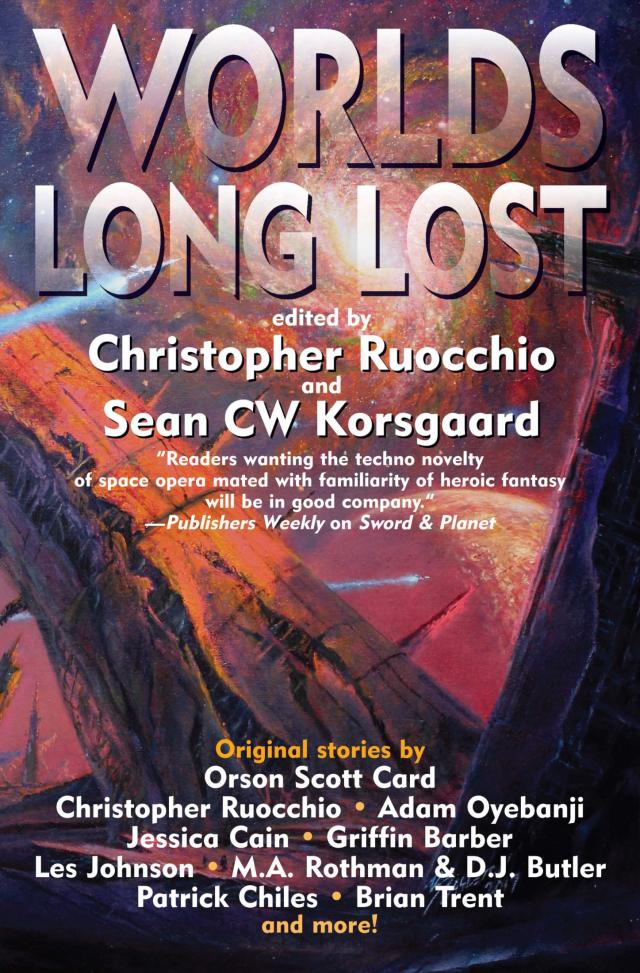
Table of Contents
INTRODUCTION
THE WRONG SHAPE TO FLY by Adam Oyebanji
MOTHER OF MONSTERS by Christopher Ruocchio
RISE OF THE ADMINISTRATOR by M.A. Rothman and D.J. Butler
MERE PASSERS BY by Les Johnson
NEVER ENDING,EVER-GROWING by Erica Ciko
THEY ONLY DIG AT NIGHT by Sean Patrick Hazlett
HOWLERS IN THE VOID by Brian Trent
THE BUILDING WILL CONTINUE by Gray Rinehart
re: something strange by Jessica Cain
THE SLEEPERS OF TARTARUS by David J. West
DARK ETERNITY by Jonathan Edelstein
ROCKING THE CRADLE by Patrick Chiles
GIVING UP ON THE PIANO by Orson Scott Card
RETROSPECTIVE by Griffin Barber
AUTHOR BIOGRAPHIES
WORLDS
LONG LOST
edited by
Christopher Ruocchio
and
Sean CW Korsgaard
Baen
WORLDS
LONG LOST
edited by
Christopher Ruocchio and Sean CW Korsgaard
ALL-NEW STORIES OF ANCIENT ALIEN ARTIFACTS FROM TOP NAMES IN SCIENCE FICTION & FANTASY
The universe is older and more alien than we can ever understand.
We were not alone. The farther we push into the universe, the more obvious it becomes. The signs are everywhere: canals and pyramids on Mars, old roads on the moons of Jupiter, ruined cities on worlds about the nearer stars. The galaxy once teemed with life, or so it seems. Which begs the question: What happened to it all?
These stories explore the ruins of lost civilizations, solve ancient mysteries . . .and awaken horrors from beyond the dawn of time.
Featuring stories by Orson Scott Card, Griffin Barber, Adam Oyebanji, Jessica Maguire, Patrick Chiles, and an all-new entry in the Sun Eater universe from editor Christopher Ruocchio. Join us for your next adventure to Worlds Long Lost!
BAEN BOOKS
edited by
CHRISTOPHER RUOCCHIO
Sword & Planet
WITH SEAN CW KORSGAARD
Worlds Long Lost
WITH TONY DANIEL
Star Destroyers
World Breakers
WITH HANK DAVIS
Space Pioneers
Overruled!
Cosmic Corsairs
Time Troopers
WORLDS
LONG LOST
edited by
Christopher Ruocchio
and
Sean CW Korsgaard
WORLDS LONG LOST
This is a work of fiction. All the characters and events portrayed
in this book are fictional, and any resemblance to real people or incidents
is purely coincidental.
Copyright © 2022 by Christopher Ruocchio and Sean CW Korsgaard
All rights reserved, including the right to reproduce this book or portions thereof in any form.
A Baen Books Original
Baen Publishing Enterprises
P.O. Box 1403
Riverdale, NY 10471
www.baen.com
ISBN: 978-1-9821-9230-3
EISBN: 978-1-62579-886-2
Cover art by Bob Eggleton
First printing, December 2022
Distributed by Simon & Schuster
1230 Avenue of the Americas
New York, NY 10020
Library of Congress Cataloging-in-Publication Data
Names: Ruocchio, Christopher, editor. | Korsgaard, Sean CW, editor.
Title: Worlds long lost / edited by Christopher Ruocchio & Sean CW
Korsgaard.
Description: Riverdale, NY : Baen Books, 2022.
Identifiers: LCCN 2022041571 | ISBN 9781982192303 (trade paperback) | ISBN
9781625798862 (ebook)
Subjects: LCSH: Science fiction, American. | LCGFT: Science fiction. |
Short stories.
Classification: LCC PS648.S3 W657 2022 | DDC
813/.0876208--dc23/eng/20220901
LC record available at https://lccn.loc.gov/2022041571
Printed in the United States of America
Electronic version by Baen Books
www.baen.com
10 9 8 7 6 5 4 3 2 1
Story Copyrights:
Introduction by Christopher Ruocchio appears here for the first time. © 2022 by Christopher Ruocchio. Published by permission of the author.
“The Wrong Shape to Fly” by Adam Oyebanji appears here for the first time. © 2022 by Adam Oyebanji. Published by permission of the author.
“Mother of Monsters” by Christopher Ruocchio appears here for the first time. © 2022 by Christopher Ruocchio. Published by permission of the author.
“Rise of the Administrator” by M.A. Rothman and D.J. Butler appears here for the first time. © 2022 by M.A. Rothman and D.J. Butler. Published by permission of the authors.
“Mere Passers By” by Les Johnson appears here for the first time. © 2022 by Les Johnson. Published by permission of the author.
“Never Ending, Ever-Growing” by Erica Ciko appears here for the first time. © 2022 by Erica Ciko. Published by permission of the author.
“They Only Dig at Night” by Sean Patrick Hazlett appears here for the first time. © 2022 by Sean Patrick Hazlett. Published by permission of the author.
“Howlers in the Void” by Brian Trent appears here for the first time. © 2022 by Brian Trent. Published by permission of the author.
“The Building Will Continue” by Gray Rinehart appears here for the first time. © 2022 by Gray Rinehart. Published by permission of the author.
“re: something strange” by Jessica Cain appears here for the first time. © 2022 by Jessica Cain. Published by permission of the author.
“The Sleepers of Tartarus” by David J. West appears here for the first time. © 2022 by David J. West. Published by permission of the author.
“Dark Eternity” by Jonathan Edelstein appears here for the first time. © 2022 by Jonathan Edelstein. Published by permission of the author.
“Rocking the Cradle” by Patrick Chiles appears here for the first time. © 2022 by Patrick Chiles. Published by permission of the author.
“Giving Up on the Piano” by Orson Scott Card appears here for the first time. © 2022 by Orson Scott Card. Published by permission of the author.
“Retrospective” by Griffin Barber appears here for the first time. © 2022 by Griffin Barber. Published by permission of the author.
INTRODUCTION
Like most children, I was a long time learning to distinguish fiction from reality. (Indeed, some never outgrow the condition—which is one of those amusing thoughts that will hit differently for each individual reader.) I distinctly remember believing that Sherlock Holmes was a historical figure—never having heard of Sir Arthur Conan Doyle—and that Camelot could be found on a map. Leaving aside the matter that there was a Camulodunum and was probably some kind of Arthur, one of the more interesting ways this inability to distinguish fact from fiction manifested was in a childhood obsession with the lost continent of Atlantis. By the age of twelve or thirteen, I found myself the owner of several volumes of conspiracy-theory-rich pseudohistory on the subject. My parents, delighted that I was so interested in reading—and in “serious” reading, no less—were happy to encourage me. And so I learned all about the ringed city and crystal skulls and—more usefully—about Knossos and the Minoans, and about the way the Greeks of the misnamed “Golden Age” believed the Minoan sites were built by cyclopses (whence cometh the word “cyclopean,” so beloved of H.P. Lovecraft).
In time, I came to learn that Atlantis was only ever a thought experiment of Plato’s, and not something widely believed in by the Greek world. Unlike Camelot, there wasn’t even a kernel of true history at the bottom. It was an ancient fiction, and regarded as fiction even in antiquity. I was crushed. This discovery was far worse than the discovery that my parents were acting in the role of Santa Claus at age nine, because my parents at least were creating magic for the benefit of my brothers and me. I think about how many people throughout history took the Atlantis myth seriously, about how many people went looking for it, or used the myth as the basis for their insane eugenic ideologies.
Overnight, the History Channel’s Ancient Aliens show went from a deeply interesting and meaningful exploration of humanity’s entanglement with extraterrestrial forces to a waste of time. If I wanted to watch hours of fiction devoted to ancient aliens, I was just going to watch Stargate, and boy, do I love Stargate.
Which brings us to the matter of this collection.
It doesn’t matter that Atlantis never existed, or that aliens probably haven’t visited Earth (I am pretty sure most UFOs are the result of waveguiding, but I could be convinced. Consider me agnostic on the alien visitors question), leastways for the purposes of the science fiction writer. What matters is that it makes for fertile ground in which to plant a story. As I say, I adore Stargate, and even Ancient Aliens is fun if you take it for the pseudodocumentary it is. There’s still something of the old world romance in such stories, of a time when the world still had unturned stones in it.
That’s part of what makes them so much fun.
But now, with the edges of Earth’s map almost all filled in and the monsters painted over, we had to move our lost cities off world. If the aliens never visited us, we would have to visit them. Since there were no alien god
This is my last Baen Books anthology—at least for the foreseeable future. The last one on my docket when I resigned my job in May of 2021. Anthologies usually start from a premise. The editor says, “Hey, you know what would be fun? A sword and sorcery anthology!” and rolls with it. This one started—in suitably archaeological fashion—with a lost artifact. We were turning through old files at the Baen offices when we discovered a piece of unused art, a landscape by the great Bob Eggleton, one we’d long ago paid for the rights to use, but that had languished in some obscure folder.
“What can we use this for?” asked Toni Weisskopf, Baen’s publisher—my old boss—with the air of one inquiring what the purpose of some cracked amphora might have been, unearthed in some Achaean tomb.
It depicted jagged pillars of stone rising from the barren surface of an alien world, a galaxy turning in the skies above as rockets left blue contrails against a rosy sky. Like all of Eggleton’s paintings, there was a magic in it, a call to adventure.
“Ancient aliens, maybe?” I suggested, peering over her shoulder. “Like...xenoarchaeology stories.”
“That’ll do.”
It’s taken some time to excavate these stories from the minds of their various authors. May of 2021 was already a long time ago, and that day when we unearthed Eggleton’s painting from beneath years of mounded paperwork is even further gone. There’s something bittersweet in this book then. I started working for Baen in my senior year of college, in January of 2015. I was just an unpaid intern then, doing the job for college credit. They hired me about a month after I graduated, about a week after I sold Empire of Silence to DAW Books and became a writer.
A lot happened for me in the years since. I met my wife, got married. I published five novels (the fifth, in fact, shares a release day with this anthology), two novellas, more than a dozen short stories. I edited eight anthologies, released two of my own short story collections...and even quit my day job.
But this is the end, my last official task as Junior Editor for Baen Books, and I hope you will forgive this little bit of self-indulgence at the end of this intro. It’s fitting, too, that Sean is coediting this one with me. He took over my seat in the Baen offices, and so I figured I should drag him along and show him the ropes.
So read on, dear Reader. Both Sean and I hope you enjoy the stories here.
And know that when you close this book at its ending, that I closed the book on a long and happy chapter of my life. I’ll let Sean take it from here. He’ll be the one introducing the stories in this book!
—C.R.
May, AD 2022
THE WRONG SHAPE TO FLY
Adam Oyebanji
Few questions in science fiction have been asked and answered more times and by more authors than “Are we alone in the universe?” or “Is there other intelligent life among the stars?” Many of the stories that fill the subgenre of tales about ancient aliens, ruins on other worlds, long dead progenitor races offer a grim answer to those questions: Yes, but you just missed them on the way out. Yet in a way, finding those ruins or remnants are almost as miraculous as first contact, perhaps not the answer you wanted, but an answer all the same.
This story from Adam Oyebanji explores some of the biggest things that need to occur for that miracle to happen at all. The dozens of things that can wipe out life before it can spread from the planet that spawned it. The matter of perfect timing across the vast distance of space. Recognizing something as result of an alien intelligence at all, and not just a bit of space junk or cosmic coincidence. The tragedy of had things gone just slightly differently, you might have found a civilization rather than a tomb...and the reflection that you just as easily could have never known they’d existed at all.
***
Perhaps it had been birthed from the nightmares of a child. A profusion of spindly, asymmetric limbs, sprouting in every direction from a gold-sheathed, polyhedral torso. A vast, blind eye protruded from its front.
There was no mouth.
“What is it?” asked Cho Abi Sorocaba, broker of planets.
His host, Ree Aba Jen, tried hard to hide her amusement, and failed.
“An embarrassment, my lord. Hiding in plain sight for many years.”
“It doesn’t look like an embarrassment, mistress. It looks...intriguing.”
The object of the planet broker’s attention was surrounded by a small army of construction bots. Or, more accurately, de-construction bots. The sculpture, trapped inside a transparent dodecahedron like an arthropod in amber, was being removed from a plinth. A truck waited nearby to take it away, engine idling under the soft light of the local sun, the name of which Cho always struggled to remember. He was a broker of planets after all, not stars.
The object was like nothing Cho had ever seen. Its ungainly dimensions were far from auspicious. The transparent casing, while no doubt necessary to protect the sculpture from the ravages of weather, also served to conform the installation’s shape to the harmonious requirements of Maidagan. Dodecahedrons were always propitious. Combined with the elegant shape and size of the plinth, the overall presentation amounted to a powerful token of good fortune.
The bots broke the connection between dodecahedron and plinth. There was a sharp hiss of collapsing vacuum. Or perhaps it was the sound of escaping luck. Unable to stop himself, Cho made the sign of the Protector, cursing himself for his superstition. He turned away, hiding the gesture from his escort, and strode purposefully toward the gilded commercial headquarters that was his destination. He didn’t have to look back to know that the object was being swung smoothly onto the bed of the truck, or that the truck would be extending the necessary arms and straps to secure it in place.
“How can a work of art be such an embarrassment as to be removed from the grounds?”
Ree chuckled.
“Because it’s not merely a work of art, my lord. At least, that is not what it was sold as. My Lady Morota and the board paid several million jigu for an archeological artifact. An abstract representation of the Drekkar Supreme Deity.”
Cho’s response was an incredulous guffaw.
“Any fool can see that this is nothing like a Drekkar deity—or anything Drekkar, for that matter.”
“Hence the embarrassment, my lord.” Ree ushered him into the building.
It was unfortunate for Cho that his business that day required him to meet Morota face to face. He spent far too much energy fighting the urge to ask her—in front of a number of functionaries—how she could have been so foolish in her acquisition of ancient artifacts. In the end, he brokered the sale of three planets to Naiyami Corporation for rather less than he had hoped.
“Come,” Morota said, clearly pleased with the day’s business, “join me for a drink on the ledge. You too, Ree.”
“Yes, my lady.”
“And less of the ‘my lady,’ Ree. We are done with work for the day.”
“Yes, my lady.” Ree grinned. Morota made a sound of mock exasperation.
The ledge was a broad terrace that ran along the outside of the building. Cho knew better than to look over the edge. It was a long way down and there was no railing. He knew that if he stared too long, the urge to jump would become irresistible.
“I feel,” Morota said, after drinks had arrived, “that you have been distracted all day. Any particular reason?” There was a twinkle in the chair’s eye. Cho realized, with a sudden and crushing certainty, that he’d been played.
“The artifact,” he confessed. “The one that was being removed from the grounds this morning. I couldn’t understand how it could ever have been mistaken for a Drekkar.”


