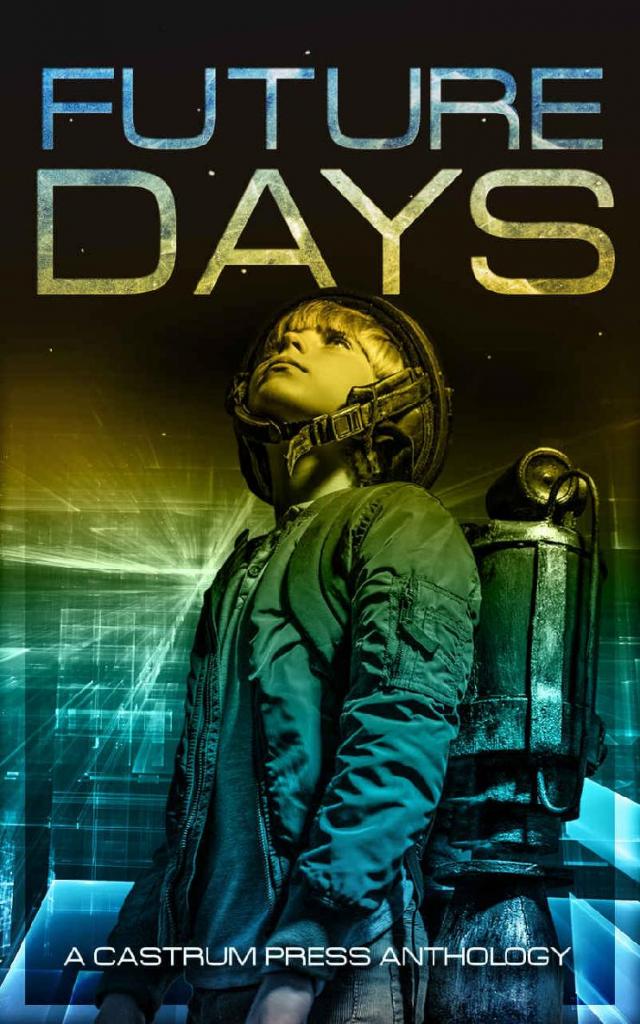
Future Days Anthology, page 15
part #1 of The Days Series


He has a degree in classical studies from Lampeter University, Wales. He has found this invaluable to his growth as a science fiction and fantasy writer in that he soon discovered how varied and peculiar human cultures can be.
Connect with here: www.castrumpress.com/james-worrad.
Custodian
Johnny Pez
Holger Kurtz, Custodian of the starship Jolene, became interested in the Battle of Borodino, the name of which he found striking. This led him to Tolstoy’s War and Peace, and he decided in due course to learn Russian, so he could read it in the original language (or languages, since some of the dialogue in the original was in French, which Kurtz already understood). Having quickly mastered the Cyrillic alphabet, Kurtz was working on vocabulary and grammar when his daily inspection of Jolene’s instruments brought the rock to his attention.
The rock was about the same size and shape as Manhattan, and although its official name (as per established protocols) was Jolene 140622, ’that was how Kurtz thought of it. Manhattan was no threat to Jolene herself; it was far outside the ship’s relativistic frame of reference and would approach no closer than 6000 astronomical units. It was an unusual object, nevertheless. It was a lot bigger than your typical chunk of interstellar debris, and it was traveling at nearly two-thirds lightspeed. A data search showed that Manhattan was the largest natural object ever found to be moving at such a speed. There was a distinct possibility that at some point a scientific expedition would be organized to study it, and Kurtz, who took a proprietary pride in Jolene, was pleased that the ship would be immortalized in this way.
Kurtz plotted the rock’s projected course through space, and ’that was when the trouble began.
In about four years’ objective time, Manhattan would pass through the heart of the Calypso system, and there was a seventeen percent chance that it would impact with Calypso III, last reported human population thirty-three million. Something, Kurtz knew, would have to be done about Manhattan, and Jolene was in the right time and place to do it.
Of course, Kurtz knew with a sinking feeling, it would mean bringing one or more members of Jolene’s crew out of Shimizu.
✽✽✽
Nilanjana Dasgupta tried to mask her dislike for Holger Kurtz; she feared that she wasn’t succeeding. It wasn’t uncommon for a ship’s crew, and especially the captain, to dislike the Custodian; in fact, Dasgupta couldn’t think of a single fellow captain who didn’t share her feelings.
Jolene was accelerating out of the solar system, on course for the Bevilacqua system, and the time had come for the crew to enter Shimizu, the scientific miracle that held the crew in stasis during the long journeys between the stars. One by one, they had entered the main capsule, and medical officer Yuliya Petrenko had made them disappear until only she, Dasgupta and Kurtz had remained. Then, by longstanding tradition, Petrenko had entered and Dasgupta had operated the controls, and it was just her and the Custodian.
At first, Dasgupta knew, some shipping lines hadn’t bothered with Custodians. They counted on automated machinery to de-Shimizu the crew after the journey; usually it did, but sometimes it didn’t. Sometimes the ship didn’t bother decelerating, or never turned up at all. It wasn’t long before the ICC had made Custodians mandatory, but it was cheaper to use two Custodians than four, and cheaper still to use just one, and that was how it was on most ships these days.
It took a special kind of person to live and work alone for the five or ten or twenty years that went by during interstellar journeys. Specifically, it took a person who didn’t like other people. Custodians were a breed apart, and they liked it that way. Dasgupta couldn’t help worrying that a Custodian would decide he liked being alone too much to end the voyage and bring the rest of the crew back. As far as she knew it had never happened, but she worried anyway.
She didn’t like the name, either, which legend said had been decided by a Czech bureaucrat with a fondness for Juvenal, whose Latin was better than his English. Watcher or Guardian would have been more reassuring, she felt; Custodian sounded like someone whose main job was unclogging plumbing.
“Keep an eye on her, Mr. Kurtz,” she’d said to him as she entered the main capsule. A typical Custodian, he hadn’t answered her, and his eyes tended to wander away from her face. As she always did when she entered a Shimizu capsule, she wondered whether she would ever leave it.
There was a kind of whiteness that seemed to last no longer than an eyeblink, yet seemed to last longer than the universe itself, and Nilanjana Dasgupta found herself looking once more at the walls inside the Shimizu capsule. The door opened and she stepped out, and one look at Kurtz told her something was wrong. He was visibly older than he’d been when she stepped in, but not by enough. If they were in the Bevilacqua system, he ought to be over a decade older, but she guessed no more than three years had passed for him.
“What’s wrong, Mr. Kurtz?” she asked.
Just as before, his eyes refused to remain on her face. They wandered around her general vicinity as he said, “Located an object, Captain, and it’s on a collision course for Calypso III. Come up to the bridge and have a look.” He didn’t bother to wait for a reply before turning and walking away. Dasgupta sighed and followed.
The ship smelled different. It always did when you came out of Shimizu. The smells of the crew faded over time, until finally the only smell left was the Custodian’s. Each one was different, and Kurtz, she was surprised to note, smelled like cinnamon.
Dasgupta had captained Jolene through four (now four-and-a-third) crossings, but she had never walked through the ship while it was in mid-journey with just the Custodian for company, and she was unnerved by the haunted-house feel of it. That wasn’t so bad, but Dasgupta had seen too many works of fiction set in haunted houses, so she was subconsciously expecting some hell creature to jump out at her from the shadows. For the first time in her life, Dasgupta found herself wishing she’d developed a taste for Jane Austen adaptations.
She felt relief when they entered the bridge. She was still uneasy enough to order the lights brought up. Kurtz squinted at the bright light and scowled, and Dasgupta almost apologized before she remembered that she was the captain, dammit, and Kurtz was just a glorified night watchman with a severe personality defect.
Kurtz gestured toward the instrument panel, then retreated to the other side of the bridge. Dasgupta kept control by reminding herself that his condition made Kurtz indispensable.
She quickly located the object and noted Kurtz’s name for it with amusement. It was appropriate enough, so she decided to adopt it herself. Just as Kurtz had stated, Manhattan was due to enter the Calypso system, and there was a nontrivial chance that it could impact Calypso III.
“We’ll have to alter course,” she said out loud, not specifically to Kurtz but to the bridge in general. “Rendezvous with the object and change its trajectory until it’s no longer a threat.”
The only acknowledgement from Kurtz was a soft sigh.
Not without a certain amount of sadistic pleasure, she added, “We’ll have to de-Shimizu the rest of the crew, of course.”
Kurtz sighed again.
✽✽✽
Yuliya Petrenko, senior (and only) medical officer on the starship Jolene, was endlessly fascinated by the view outside the ship. Normally, of course, the crew was in Shimizu while the ship accelerated to near lightspeed and decelerated again, so they never saw the universe in a relativistic frame of reference. Petrenko was in the break room now, and had the walls tuned to the visual inputs that studded the ship’s outer hull, so it was just like being in an observation lounge (if anyone was ever extravagant enough to build a ship with an observation lounge). All the classic features (her medical training made her want to say symptoms) of relativistic speed were there – the red-shifted aft stars, the blue-shifted stars to forward, and the foreshortening effect that caused the stars to cluster near the ship’s prow. It was an effect that Custodians called “the rainbow”.
The entrance to the break room opened, and the Custodian entered. He glanced around at the walls, then ignored them (and Petrenko herself, of course) and shuffled over to the food dispensary. Petrenko was surprised at Kurtz’s nonchalance, but only for a moment. For the Custodian, the sight of the relativistic universe would have been a familiar one. In fact, Custodians spent most of their lives seeing the rest of the universe in various states of relativistic distortion.
Petrenko carefully refrained from looking at Kurtz as he withdrew food from the dispensary and sat at the break room table. With the crew out of Shimizu, Kurtz was under considerable stress, which made him Petrenko’s primary patient. Petrenko had offered to put Kurtz himself into Shimizu for the duration of the Manhattan project, but the Custodian had been adamantly opposed. That was when Petrenko learned, to her surprise, that the Custodian thought of Shimizu as degrading. A look in her medical database confirmed that this was a general attitude among Custodians. If the rest of the crew wanted to subject themselves to the humiliation of hiding away while the ship reached relativistic speeds, that was up to them, but a Custodian had his pride.
Petrenko had a sudden urge to obtain experimental verification of this startling fact. Turning to the Custodian, she said, “Mr. Kurtz, do you mind if I ask you about something?”
Kurtz looked up, clearly annoyed at having his meal interrupted. Then, with a visible effort, he composed his features and said, “You can ask.”
Gesturing around at the view of relativistic space, Petrenko said, “What do you think of all this?”
As if suspecting a trap, Kurtz said, “‘All this’ meaning...?”
“Relativistic speeds,” Petrenko answered. “It’s something you’ve experienced much more than any of the rest of us. Do you think this has given you any insight into the phenomenon?”
After staring at his food for a long time, Kurtz finally spoke. “I suppose,” he said slowly, “that it gives one a sense of the variability of the universe.” There was another long pause, which Petrenko knew better than to interrupt. At last, Kurtz continued, “I’ve noticed that people who spend their lives at rest tend to think of the universe as something solid and inflexible, a sort of solid foundation that the rest of existence rests on. When you watch the rainbow come and go, you can see that it’s not. The universe expands and contracts. The universe shifts.
“People in the past understood this better than we do. Their lives weren’t as settled as ours. They suffered wars and famines and disease outbreaks and other disasters. They knew that the universe wasn’t solid.”
Kurtz ended his speech and resumed eating. It was easily the longest time Petrenko had ever heard him, or any other Custodian, speak. “Thank you for talking to me,” she said to the Custodian. Kurtz didn’t respond.
✽✽✽
Bai Lu was surprised to see the Custodian on the bridge of the Jolene as they prepared to alter the ship’s course. She had assumed that he’d be hiding away in his cabin or something when the rest of the crew assembled here. Had Captain Dasgupta ordered him? Would Kurtz have obeyed her if she had? Maybe Petrenko would know. She’d have to ask her when they were done here.
“Engine status,” Dasgupta said.
“Engines are operating normally,” Bai answered. “Current acceleration one point zero gee.”
“Reduce acceleration to zero,” Dasgupta ordered.
“Reducing acceleration to zero, confirmed,” Bai answered as she adjusted the controls at her station. For the first time since leaving Earth orbit, Jolene’s engines throttled back until the ship was in freefall. It was a strange sensation.
“Alter course to one forty-three oh two thirty-four by sixty-three twenty-two fourteen by three oh three fourteen fifty,” Dasgupta ordered.
Bai already had the new course memorized, so she was able to reel off the coordinates in reply while adjusting the settings. A little showy, but it would look good in her next crew evaluation report. It was always good to keep the peer review board suitably impressed.
“Increase acceleration to two-point five gee,” Dasgupta ordered.
With a tiny sigh, Bai answered, “Increasing acceleration to two-point five gee, confirmed,” and the moment of freefall was over, replaced by more than twice their ordinary weight. Jolene would spend the next 858 hours at the new acceleration, until they had matched velocities with Manhattan. Bai would have preferred to go back into Shimizu for the duration, but for some reason Petrenko had recommended that they remain active, and Dasgupta had gone along with the suggestion.
“Good work, Ms. Bai,” Dasgupta said as Bai shut down her station controls. “That’s all for now. Crew dismissed.”
Bai staggered a little as she rose from her station and made her way down the companionway to the next deck. As she stumped her way down the corridor to the break room, she caught up with Petrenko. “What’s the big idea?” she demanded.
The medical officer at least had the decency not to pretend she didn’t understand the question. “I thought we needed to develop more unit cohesion,” Petrenko told her. “The crew’s never performed a mission like the Manhattan project, and I thought we needed to learn to work together more closely. The captain agreed.”
Bai glared at her. “So we’re going to be cooped up in this metal can for thirty-six days at two and a half gees as a bonding exercise?” Despite the twenty-odd centimeters the medical officer had on her, Bai felt quite capable of beating the daylights out of her, and a strong urge to do so.
Then she noticed Kurtz standing a few paces away, passively-aggressively waiting for them to get out of his way. She stood aside for him and waited for him to pass. When he was out of earshot, she asked, “And what was he doing on the bridge? It felt like he was watching me.”
“He was,” said Petrenko. “He was there to monitor you during the maneuver.”
Bai felt her outrage over the prospect of five weeks of burdensome weight give way to outrage over this new affront. “Him monitor me?’ she hissed.
“Who do you think maneuvers this ‘metal can’ during turnover when we’re in Shimizu?” Petrenko responded. “And he’s damn good at it, too. I’ve seen the records of his last three turnovers, and his simulation scores, too. Custodians log thousands of hours of simulation training. They’ve got plenty of time on their hands, and they make effective use of it.”
“Since when did you become such an admirer of the Custodians?” Bai sneered. She was expecting a hot denial from the medical officer, but she didn’t get one.
“Since I had it brought home to me just how much we rely on them,” Petrenko said unapologetically. “We treat it as a joke or an embarrassment. They have what should be a major personality dysfunction, but it turns out to be extraordinarily useful. They hold our civilization together.
“And they’re completely reliable. We used to lose about five percent of our ships to accidents or unknown causes, but since the use of Custodians was mandated on interstellar flights, we haven’t lost a single ship. Not one!”
Bai didn’t think she’d ever come across anyone so eager to defend the Custodians. She was a little ashamed to admit that she did view the Custodians as a joke or an embarrassment. “All right,” she said. “I grant you that they do a decent job, and I’ll even grant you that it’s an important job. But I still reserve the right to be uncomfortable around them.”
Now Petrenko was sardonic. “Far be it from me to rob you of your discomfort, Ms. Bai.”
Bai gave her a parting glare. She had changed her mind, and decided that her bunk was a more congenial destination than the break room. Despite herself, though, she found that she was thinking about the Custodians as she clumped her way down the companionway to the next deck.
✽✽✽
Ayodele Olatunji wasn’t happy to see the rock hovering overhead. Of course, “hovering” wasn’t a strictly accurate way to describe the situation. Manhattan was slowly tumbling on its axes while plowing through space at .63 of the speed of light, and Jolene had matched its speed and trajectory over the course of thirty-six grueling days of acceleration. Now, in a completely different but equally uncomfortable situation, the ship was in freefall while the rock tumbled along ten kilometers away.
Those thirty-six days had been spent gathering as much data as possible on Manhattan, and on working out how to divert it away from the Calypso system. If it weren’t rotating, they could just use Jolene’s drive to push it out of the way. Since it was rotating, they’d have to be more creative.
“We’ve got plenty of power,” Olatunji said. “The problem is applying it.”
Holger Kurtz nodded as he studied the tumbling rock from his bridge station. The Custodian had proved to be a good sounding board as Olatunji considered various means of dealing with Manhattan. He didn’t try to make small talk; he just sat and listened, and very occasionally made sensible comments.
A readout gave motion figures for what they had designated as Manhattan’s three axes of rotation. “Just halting the rotation on one of the axes would make the problem a hundred times simpler,” Olatunji added. “Well, ten times simpler anyway.”
A long pause while Olatunji sat and thought. “Perhaps a precisely-timed energy burst at just the right spot on the surface would halt the rotation of one axis.”
“Or shatter it,” Kurtz said quietly.
Olatunji nodded ruefully. “Or shatter it,” he admitted.
Another long pause.
“Or maybe,” Olatunji said, “shattering it is just what we want.”
Kurtz turned away from the rock’s image to look at Olatunji, which for him was equivalent of another person saying What the hell?
“Split it in two,” Olatunji explained, “and let each fragment’s inertia carry it away from the Calypso system. Let the rock’s angular momentum work for us instead of against us.”
Kurtz looked thoughtfully back at Manhattan.
✽✽✽