

Schooled in Magic 25: The Demon's Design, page 1
part #25 of Schooled in Magic Series


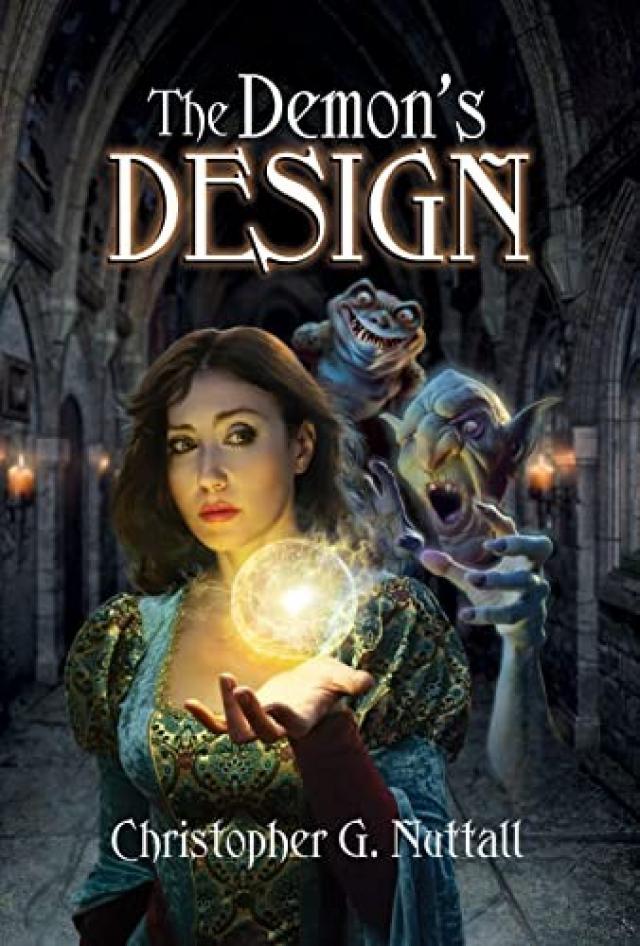
The Demon's Design
(Schooled in Magic XXV)
Christopher G. Nuttall
Twilight Times Books
Kingsport Tennessee
The Demon’s Design
This is a work of fiction. All concepts, characters and events portrayed in this book are used fictitiously and any resemblance to real people or events is purely coincidental.
Copyright © 2023 Christopher G. Nuttall
All rights reserved. No part of this book may be reproduced, stored in a retrieval system or transmitted in any form by any means electronic, mechanical, photocopying, recording or otherwise, except brief extracts for the purpose of review, without the permission of the publisher and copyright owner.
Twilight Times Books
P O Box 3340
Kingsport TN 37664
http://twilighttimesbooks.com/
First Edition, June 2023
Cover art by Brad Fraunfelter
Published in the United States of America.
Table of Contents
Preface
Historian’s Note
Prologue I
Prologue II
Chapter One
Chapter Two
Chapter Three
Chapter Four
Chapter Five
Chapter Six
Chapter Seven
Chapter Eight
Chapter Nine
Chapter Ten
Chapter Eleven
Chapter Twelve
Chapter Thirteen
Chapter Fourteen
Chapter Fifteen
Chapter Sixteen
Chapter Seventeen
Chapter Eighteen
Chapter Nineteen
Chapter Twenty
Chapter Twenty-One
Chapter Twenty-Two
Chapter Twenty-Three
Chapter Twenty-Four
Chapter Twenty-Five
Chapter Twenty-Six
Chapter Twenty-Seven
Chapter Twenty-Eight
Chapter Twenty-Nine
Chapter Thirty
Chapter Thirty-One
Chapter Thirty-Two
Chapter Thirty-Three
Chapter Thirty-Four
Chapter Thirty-Five
Chapter Thirty-Six
Chapter Thirty-Seven
Chapter Thirty-Eight
Chapter Thirty-Nine
Chapter Forty
Epilogue
Afterword
Appendix: Demons
Preface
As you know, I have tried my best to keep each volume of this series as stand-alone as possible … with varying levels of success. Given that, as of writing, there are twenty-five mainstream novels, eight novellas (two not published yet; follow me online for updates), three short stories and a collection of background notes, there are obvious limits to how stand-alone any later book can be.
Jane, Daughter of Gerald, mentioned in the introduction, made her appearance in The Muckraker’s Tale, published in Fantastic Schools IV. Adam and Lilith made their first appearance in The Cunning Man and developed elements of magitech, some of which are referred to in this volume, in The Infused Man and The Conjuring Man.
Please feel free to check them out for a whole new look at the Nameless World.
CGN.
Historian’s Note
The below article was written by Jane, Daughter of Gerald (aka The Muckraker) and published in The Whitehall Times, shortly after the defeat of the Sorcerer Void and the end of the Void Wars. Lady Emily has not commented on the article.
What Can One Say About Lady Emily?
The strangest thing about Lady Emily is how little how little we know about her.
This may seem odd, to many of my readers, but there is a point. The average aristo child, born to a family magical or mundane, makes an impact from the moment they draw breath. Their naming day is a public event, their birthdays are more about their parents than themselves, their achievements, no matter how minor, are feted as if they were the greatest or most unique achievements in the history of mankind. They are pawns in their family’s endless battles for power and prestige, their lives mapped out in many ways before they reach their first birthday. Indeed, in many ways, one can track the shifting ebb and flow of power politics by noting who is invited to birthday celebrations, who is considered a suitable ward, whose children are considered acceptable candidates for betrothal and so many other hints of favor and disapproval shown by the parents. It is easy to mock such treatment of one’s children, but it served a vitally important purpose: A family that did not constantly tend to its own position was a family that would soon find itself declining into irrelevance. yet, there is no recorded trace of Lady Emily’s existence until she turned sixteen.
There are stories aplenty about her, true, but few hard facts. Her father is believed to be the Sorcerer Void–one of the most powerful and feared sorcerers in the world even before he mounted his bid for ultimate power–yet it has never been confirmed. Void is listed as Lady Emily’s guardian, a position with the rights and responsibilities of fatherhood, and yet one suggesting more distance between them than one would expect if they were father and daughter. It would not be out of character for Void, a man who worked hard to bury his own family of origin, not to reveal the existence of a child, but it is odd. If nothing else, his daughter should have had a chance to meet her extended family.
If her father’s identity is uncertain, her mother’s is a complete mystery. There are few hints of Void having any sort of close connection to anyone, save Emily herself. He did have a relationship of sorts with Princess Iolanthe of Parsee, but by all accounts the relationship was not sexual, and in any case, the timing doesn’t work out. He also took a female apprentice, Lady Barb, who could have given birth to Emily, but again the timing rules against it. Lady Barb’s apprenticeship ended under mysterious circumstances, but there is no serious suggestion that she fell pregnant by her master or that she gave birth to anyone. It is possible, of course, that Void impregnated one of his maids – perhaps the most likely scenario – yet this would be somewhat out of character. For all the fear and awe he inspired, there is no suggestion he ever took advantage of anyone. The blunt truth is that we simply don’t know.
As far as anyone can tell, Emily appeared out of nowhere.
Her early career is well known, although it is difficult – even now – to sift through the rumors and parse out the truth. Emily arrived at Whitehall – riding on a dragon, of all things – and rapidly established herself as one of the school’s most remarkable students, fighting and defeating a necromancer in her very first year. She would also go on to befriend Princess Alassa and Countess Imaiqah of Zangaria, finding herself – by accident or design – in the middle of the struggles for power threatening to tear the kingdom apart. It is safe to say that, in a single year, Emily achieved more than nearly anyone else in recorded history ever did in their entire lives. She rose from complete obscurity to become one of the most famous people in the world.
Her greatest achievement, however, was the New Learning. Emily introduced, through her friends, a whole new system of letters and numbers, followed by dozens – perhaps hundreds – of technological innovations that changed the world. The printing press, the steam engine, the guns that allowed us to stand up to the necromancers, then the aristos ... they all stemmed from Lady Emily’s fertile brain. She made no attempt to keep this learning from spreading – indeed, she rewrote the laws of her barony to encourage sharing ideas and designs – earning herself the enmity of nearly every other aristo and many senior magicians. If this worried her, she kept it to herself.
It did raise questions, of course. King Jorlem of Alluvia, who would later lose his throne and his head to a revolution, argued Lady Emily was embarking on a long-term plan to take control of the entire world, something that would have seemed fanciful before she appeared. Academic Adana, an intellectual in the service of King Randor of Zangaria, suggested that Emily was little more than a figurehead, a pretty face introducing ideas developed by a committee of inventors to ensure the real developers remained unknown. His analysis of Emily’s early work argues that her inventions were suspiciously mature and showed no hint of passing through a series of experimental stages before the final design was shared with the entire world. This is, of course, easily explained. The early models Emily introduced were not, of course, finalized. As she said herself, her designs – the steam engine in particular – have long since been superseded by designs worked out by others, who took her work and improved upon it. She did not create a finished product, and neither did any of the inventors who followed in her footsteps.
Emily’s career continued to develop, as the years rolled on. She defeated a necromancer in the Cairngorms, took possession of the nexus point at Heart’s Eye (defeating another necromancer in the process), fought in the Zangarian Civil War (rumors she’d somehow lost her powers in the aftermath of the war were rapidly disproven), founded a university at Heart’s Eye, led a campaign to invade the Blighted Lands and defeat the remaining necromancers (and succeeded so well the depraved magicians no longer pose any sort of threat), all the while continuing to turn out newer and better innovations, both magical and mundane. It should have led to a world of peace and prosperity.
It did not.
The Allied Lands had always been held together by the threat of necromantic invasion. The sudden end of the threat unleashed social pressures that threatened to tear the edifice apart, pressures – we later discovered – that were stoked by Void himself, intent on taking over the Allied Lands to save them from themselves. Emily found herself both blamed for the chaos – somewhat unfairly; she had nothing to do with problems that existed years before she was born – and charged with stopping him, even though it required her to take up arms against her (presumed) father. She was, for better or worse, successful. Void was defeated, but many of the problems that had empowered him remained.
I do not know Lady Emily personally. Few do. She has a reputation for being friendly, but reserved – and also, according to some of her classmates, a little odd, as if she’d been born and raised somewhere very different. Indeed, this is a mystery. A young woman raised in an aristocratic family or a sorcerous household would not display the compassion and respect Lady Emily does for those beneath her, nor would such a young woman devote any effort to helping them climb to heights of wealth and power they might have thought beyond them. A common-born child might have had a different outlook on life, but she wouldn’t have the lack of automatic respect for the aristocracy that is clearly visible in Lady Emily. It has been suggested she was raised by someone other than Void, but who? What sort of upbringing could create someone like her?
I don’t know, but it doesn’t matter. All that matters is that she’s here, giving us all hope for a better future. I look forward to following her future career with great interest.
Prologue I
IF EMILY HAD BEEN ASKED, IN the quiet time before the end of one war and the start of another, what she most enjoyed about being Void’s apprentice, she would have said – without hesitation – their fireside chats. They sat on armchairs in front of a roaring fire, drinking hot chocolate and talking about everything from advanced magical theory to the hidden history of the Nameless World and enjoyed each other’s company. Void could and did discourse on many subjects for her, drawing links between fields of study that none of her tutors had ever hinted might be connected, answering her questions in a manner that left her eager for more. It was…
She wondered, at times, if it was what having a father was supposed to be like. Her father had vanished shortly after her birth, and her stepfather had showed little – and then too much – interest in her. It was hard to know what she should feel, when she’d been denied the sense of a paternal figure looking out for her, someone who would always be on her side no matter what. She had never been sure if she should envy the girls who did have fathers, from the strict and overbearing to the relaxed and permissive. She knew, now, that she’d had reason to be jealous. Even the strict fathers had at least cared about their daughters. And she was sure Void cared about her.
“It is hard to be sure if there really was a genuine prediction,” Void said, a few nights after her return from Dragora. She’d asked him about her adventures in Dragora and one thing had led to another. “The fortune teller could easily have told Duke Hardcastle what he wanted to hear.”
Emily nodded. Duke Hardcastle had been told he couldn’t be killed by a man, a prediction that had at least one obvious loophole and a second that hadn’t been apparent, right up until the moment the duke’s preteen nephew had knifed him. It had struck her as very much the sort of thing a demon would say, if it had been summoned to illuminate the duke’s future when he’d been a young man. The prediction might have been completely accurate, yet also misleading. But then, she’d met the duke. He’d been enough of a misogynist to completely dismiss any possibility of a woman killing him.
But it wasn’t a woman who killed him, she reflected, wryly. She’d fought the duke to a standstill, but he’d held his own until he’d been stabbed in the back. It was a boy who was not yet a man.
“If it was a genuine prediction, it came from a demon,” Void continued, echoing her earlier thoughts. “But demons are untrustworthy. The prophecy could easily have been worded to steer the duke towards his eventual fate.”
Emily leaned forward. “Is it possible it really was a genuine prediction?”
“It is impossible to say,” Void said. “Summoning demons is forbidden for a reason. The knowledge of how to summon, bind and compel the entities is in few hands, partly because a simple mistake is enough to doom the caster. It’s quite possible to accidentally offer the demon more than intended, allowing it to snatch hold and drag you into the darkness. I knew one magician who called a demon and demanded a series of services, which had to be paid for with his life. I don’t believe he even had the satisfaction of getting what he’d asked for in return.”
“Be careful what you wish for,” Emily murmured.
“Precisely,” Void agreed. “If you do summon a demon, you can trade a little of your life essence for a glimpse into the future. That’s about all you can do, these days, unless you want to take your life into your own hands. The more you demand from a demon, the more it will insist on receiving in return.”
“And they don’t even state the price in advance,” Emily said.
“No.” Void stared at his hands for a long moment, his thoughts elsewhere. “The DemonMasters of old must have had a solution, at least a temporary one, but we don’t know how it worked. We do know that their demons eventually broke free and consumed them when the demons weren’t trapped and bound until some fool freed them. There was… someone, a very long time ago, who trapped a demon in his tomb and bound it to protect his body after his death. It was unable to leave the tomb, but free to do whatever it liked to anyone who forced their way into the chamber.”
Emily shivered. “What happened?”
“It’s still there, as far as I know,” Void said. “Other demons were accidentally freed, over the years, and wreaked havoc until they ran out of energy and fell back into the darkness. Or… there are legends, true, of people finding powerful entities trapped in bottles and being granted wishes in return for freeing them, but they almost always ended up worse off after the wishes were twisted against them. It’s difficult to tell how many of those stories are true, at least in some aspects. The legends tend to grow in the telling.”
I met the DemonMasters, Emily recalled. She’d been thrown back in time, a year and a thousand years ago, to see the final days of the DemonMasters and the dawn of a new age of magic. None of them were sane, even the ones who thought they had it under control.
She shivered again, feeling the magic run through her blood. It was hers, as much a part of her body as her arms and legs. The thought of being dependent on an outside source of power was terrifying, for all the reasons she’d heard and many more besides. The DemonMasters hadn’t been evil, but the entities they’d summoned and bound had steadily corrupted and weakened them to the point their peers had to kill them before they were lost to the madness. It was like dealing with something that had a will of its own… no, they did have wills of their own. And the ability to glance into the future and determine just what to say to steer someone to their doom.
Her eyes narrowed. “Is there any way to defend against demons?”
“Their sight is difficult to block,” Void said. “They are not common spies on the same level as ourselves, even ones who have somehow gained access to our blood, but creatures who look at our world from right angles to reality. They can look around most of our defenses” –his lips twitched – “like a flying witch, hovering high overhead and peering down at whatever is hidden inside the walls. No matter how high you build them, the witch can always fly higher. But places of great power, such as nexus points, or places shielded by naked iron, have always been relatively safe. Demon logic seems to prevent them from peeking into such places.”
Emily considered it. Nexus points existed at all times at once, enabling time travel… although, without the proper spells and waypoints, anyone who tried would be jumping randomly, unsure if they were going to be propelled hundreds of years into the future or stranded thousands of years in the past. It made a certain kind of sense that the demons wouldn’t be able to see inside them, not when all the potential timelines were jumbled up inside the nexus point. And pure iron…? She frowned, inwardly. Why was that important?


