

All for All (Cast Adrift, #3), page 1


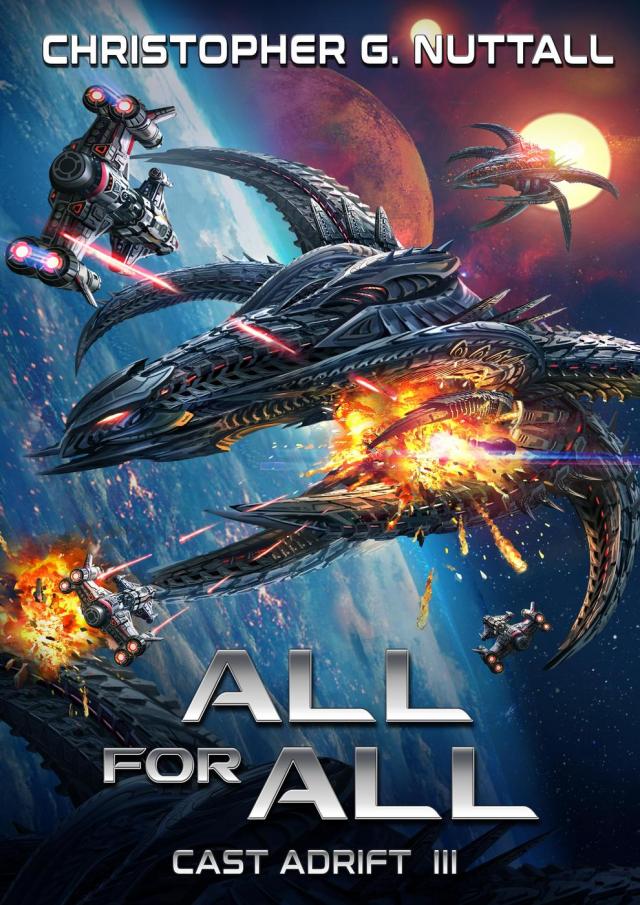
All for All
(Cast Adrift III)
Christopher G. Nuttall
Book One: Cast Adrift
Book Two: Standing Alone
Book Three: All for All
http://www.chrishanger.net
http://chrishanger.wordpress.com/
http://www.facebook.com/ChristopherGNuttall
Cover By Tan Ho Sim
https://www.artstation.com/alientan
All Comments Welcome!
Contents
Cover Blurb
Prologue I
Prologue II
Chapter One
Chapter Two
Chapter Three
Chapter Four
Chapter Five
Chapter Six
Chapter Seven
Chapter Eight
Chapter Nine
Chapter Ten
Chapter Eleven
Chapter Twelve
Chapter Thirteen
Chapter Fourteen
Chapter Fifteen
Chapter Sixteen
Chapter Seventeen
Chapter Eighteen
Chapter Nineteen
Chapter Twenty
Chapter Twenty-One
Chapter Twenty-Two
Chapter Twenty-Three
Chapter Twenty-Four
Chapter Twenty-Five
Chapter Twenty-Six
Chapter Twenty-Seven
Chapter Twenty-Eight
Chapter Twenty-Nine
Chapter Thirty
Chapter Thirty-One
Chapter Thirty-Two
Chapter Thirty-Three
Chapter Thirty-Four
Chapter Thirty-Five
Chapter Thirty-Six
Chapter Thirty-Seven
Chapter Thirty-Eight
Chapter Thirty-Nine
Chapter Forty
Afterword
How To Follow
If You Liked This ...
Cover Blurb
Humanity has won a great victory, liberating their homeworld from the alien Pashtali and convincing many of the alien Great Powers that Earth is much more than a vassal state of a decaying empire, easy meat for the first invader who comes along. But the war is far from over. The Pashtali are gathering their forces, closing down their border wars with smaller powers while the greater ones sit on the sidelines, readying their navy for a final confrontation with Earth. The end cannot be long delayed.
There is one hope left. Allying themselves with the other smaller powers, the Solar Navy sets off on a final desperate campaign to break the aliens once and for all, or lose everything on the final throw of the dice.
Prologue I
From: A Short History of Galactic Civilisation V.XXVI. Alphan History University (Terran Campus). 505PI.
Earth’s isolation from galactic affairs, as far as anyone knew, came to an end when the Alphans, the de facto masters of the known universe, invaded, occupied and subjugated the planet. The human race did its best to fight back, and there were three major and over a hundred minor revolts during the first two hundred years, but against an enemy with massive technological superiority and the willingness to use it ruthlessly the revolts were futile. The Alphan Viceroyalty had plenty of carrots and sticks at its disposal, as the humans noted, and had few qualms about using them. There was no reason to think that humanity would ever see independence, let alone become a great power.
Indeed, by the time of the First and Second Lupine Wars, humanity had become one of the most useful client species in known space. Humans served Alphans as soldiers, spacers and industrial workers, as well as hundreds of roles the Alphans were unwilling or unable to perform themselves. Human starship designers lacked the first-rate tech of their alien masters – some advanced weapons and drive systems were kept solely in Alphan hands – but they put together modular freighters that revolutionized interstellar shipping and, it was later discovered, could be rapidly converted into cheap and surprisingly effective warships. Human traders, free and independent, wandered far from the Alphan Empire and brought back tales of wonders beyond the rim of explored space. Human researchers, even, pushed the limits of the tech assigned to their species, sometimes working on ways to improve it and, at others, figuring out how to duplicate the tech forbidden to them (and not get caught).
The Alphans did not notice. They had other problems. The First Lupine War was a brief set of skirmishes, just another border clash with an up-and-coming junior race that thought it could take on the masters of the known universe; the Second Lupine War was a determined attempt to destroy the Alphan Empire that came alarmingly close to success. The Lupines were technologically inferior, but they had the numbers and a willingness to take horrendous losses in order to wear down their enemies. If humanity had not fought beside its masters, adapting tactics and technology to meet their foes on an equal basis, the war might have ended in complete disaster. As it was, the Alphan Empire emerged victorious ... but broken, bleeding, and with a whole string of new problems. The worst, they came to realise, was simple. What were they to do with the human race?
There was no way to avoid the problem. The humans had fought well and no longer saw themselves as subordinates. The demand for a greater share of power within the empire was becoming irresistible. Even loyalists thought human service deserved a great reward. The Alphans found themselves caught between two fires. If they accepted humans as equals, their empire would very rapidly become a human empire. The economic dislocation alone would be utterly disastrous. But if they refused, they would face another – and perhaps final – rebellion. The days when the human race was confined to a single planet were long gone. Now, humans had starships, modern weapons and a powerful presence right across the empire. The Alphans decided, reluctantly, to cut their losses and grant the human race its independence.
It was a shock. The economic dislocation of being cast adrift on a sea of interstellar troubles was quite bad enough, but the perception of weakness was worse. The Vulteks – a client race of the spider-like Pashtali – invaded human space, intent on crushing the newborn star nation before it could rise any further. But the humans had learnt their lessons well and, in a stunning military campaign, turned the tables on their attackers and defeated them. The Pashtali saved their clients from total defeat, but humanity had clearly won the war. The Galactics ceded control of a sizable chunk of territory to Earth.
This region – known as the Occupied Zone – rapidly turned into a millstone around humanity’s collective neck. The countless settlements within the zone had rarely, if ever, bent the knee to the Vulteks. They had no intention of letting the human race take control without a fight, even though humanity had made it clear they had no intention of imposing total control. Worse, it provided an excellent opportunity for the Pashtali to bleed the Solar Navy, and damage humanity’s reputation in front of the other powers, without ever quite showing their hand.
And then, the unexpected happened.
Multispace storms are far from uncommon, but the storm that blew up along the threadlines between Earth and the Alphan Empire was unprecedented. This storm made it difficult, if not impossible, for ships to move between the two powers, largely isolating the human race from its former patrons. (Indeed, there were suggestions – then and later – that the storm wasn’t natural.) The Pashtali saw their chance and moved, feinting at the Occupied Zone to draw a chunk of the Solar Navy into a trap and then striking directly at Earth itself. The war seemed on the verge of being lost.
But the human race struck back, adapting its tactics and accepting massive losses to destroy the enemy ships or force them to surrender. The Pashtali broke and ran, saving what they could, but – in the aftermath – it became clear they were far from defeated. They were still a Great Power, they still badly outnumbered their enemies, their technology was still more advanced ...
Humanity had won a great victory. But the war was very far from over.
Prologue II
There had been a time, Ambassador Yasuke had read in the history logs, when ambassadors lived so far from their governments that they had the power to sign binding agreements without having to ask permission first. Those ambassadors had been trusted to understand what was going on and make the right decisions, before time ran out and their decisions no longer mattered. It had been true, back in the glory days, that military commanders – too – had wide authority to react as they saw fit. In hindsight, after the carnage of the last war, Yasuke suspected that deferring such decisions to the homeworld had been a mistake. Too many commanders, in the opening days, had tried to call home for orders, orders that hadn’t arrived until it was far too late.
The humans learnt from our experience, he reflected, as he waited for the secure communications link to be checked and rechecked by operators on both ends of the line. If their commanders had waited for orders, the war would be over by now.
It was a chilling thought. The Pashtali had come very close to victory. They’d ignored most of humanity’s colonies, few of which had any real industrial base, and driven straight at Earth, using their new crossroads technology to take their enemies in the rear. That had been a surprise. The Alphans had known, only a few months ago, that they were the only ones who could enter and exit multispace without a crossroads. They hadn’t imagined the Pashtali could do it too ... Yasuke muttered a human curse, savouring a word that had no direct equivalent in his tongue. Every race that thought itself a great power – and even those who
The room darkened, the holographic projector displaying the chairman’s face. A faint flicker of static crossed the image, a grim reminder that the conversation was heavily encrypted and yet vulnerable to interception. The Pashtali would be doing everything in their power to hack into the network and there was no way to be sure, now, they weren’t listening to every word. He would have sooner returned home and spoken to his government in person, but there just hadn’t been time. Hopefully, the encryption would minimise the risk.
“Ambassador,” the chairman said. He was alone. That was generally a good sign. “We have reviewed your proposal.”
Yasuke nodded, then waited.
“It is risky,” the chairman said. “Do you really think we should take the risk?”
There was a time, Yasuke thought coldly, that we didn’t shy away from risk.
He kept that thought off his face. The chairman – and the government – had too many problems. The mighty fleet of warcruisers had been badly weakened – in the time it took the Alphans to produce a single ship, the Lupines had turned out hundreds – and the empire was in full retreat, granting clients independence and abandoning colony worlds. The empire was still mighty, still capable of defending itself, but the days they could send an entire fleet thousands of light years from home were gone. And they wouldn’t be coming back.
“I believe I argued my case quite clearly,” he said. “The humans have won a major victory, true, but the war isn’t over. The Pashtali will regroup, concentrate their forces and resume the offensive ... if they have time. And they will win. The balance of power is firmly in their favour.”
“Perhaps,” the chairman agreed. “But what does this have to do with us?”
Yasuke wasn’t sure if the chairman hadn’t read his report, or if he was merely getting the matter on the official record, but he wasn’t inclined to waste time worrying about it. If the chairman wanted to play games, that was fine as long as Yasuke got what he wanted out of the deal.
“The Pashtali are a Great Power,” he said, calmly. “If they succeed in enslaving humanity, or even occupying their worlds and banning them from spaceflight, they will be on our borders, in a position to threaten us. They have already cracked the secret of slipping in and out of multispace without a crossroads. What else do they have?”
“I was informed their crossroads tech is inferior to ours,” the chairman said.
“Yes,” Yasuke agreed. “But that doesn’t mean it can’t be effective.”
He leaned forward. “But if we assist the humans now, we will have a friendly power on our border, the Pashtali will be weakened and we will have fewer problems in the future.”
“The humans cannot win,” the chairman said.
“The Pashtali have already poured out a vast amount of blood and treasure,” Yasuke countered. “Sooner or later, even they will cut their losses.”
“They may,” the chairman agreed. “But will that be in time to save our former clients?”
“Our allies,” Yasuke corrected. “We aren’t their masters any longer, but we can be their allies.”
“And they will draw us back into the mainstream,” the chairman said. “We need time to consolidate.”
“Which we can only gain by assisting the human race,” Yasuke insisted. “The Pashtali will not rest on their laurels, once they have crushed humanity and occupied their worlds. They will come for us. They must. They want to rule the known universe and the only way to do that is to defeat us, before we rebuild and return to the galactic mainstream.”
If we ever do, his thoughts added, silently. We don’t want to admit it, even to ourselves, but we may have given up.
It was hard to keep his face impassive. They’d ruled the known galaxy for centuries. The thought that the Alphans could be defeated, that they could accept de facto decline, was unthinkable. And yet, the idea haunted him. The Pashtali wanted to build an empire. They had a vigour Yasuke’s ancestors had shared, one their descendants had lost. And they might never find it again.
“The humans must win,” he said. “And they cannot do it without our help.”
“So you have said,” the chairman observed. There was a long, chilling pause. “We have debated the issue. We will assist the humans. But only to a point.”
He leaned forward. “Remember that, Ambassador. Only to a point.”
Yasuke bowed, hiding his relief. “Yes, Mr. Chairman. I will not forget.”
Chapter One
Trojan, Deep Space
“Sir?”
Captain Leo Patel looked up from his datapad, keeping his face under tight control. The sensor operator looked too young to be a responsible adult and he kept thinking, at times, that the navy had raided the nurseries and junior schools for recruits. It was going to hurt the Solar Navy badly, in the months and years to come, that far too many military recruits and training officers had been pulled out of the pipeline and sent to the front, but there was no choice. Too many officers and crewmen had died in the Battle of Sol, too many ships destroyed or damaged beyond immediate repair. The human race had never been so close to absolute defeat.
“Yes, Carola?”
The sensor operator glanced at him. Leo signed inwardly. Sensor operators were meant to keep their eyes on their consoles at all times, just in case something changed so quickly their original report was no longer accurate. Leo had been in the navy long enough to know a situation could go from controlled to absolute chaos in the blink of an eye, then be made worse by an officer responding to the first reports and not realising things had already slipped out of control. He made a mental note to discuss the situation with the academy officers, when they returned home. They could reduce their focus on spit and polish and concentrate, instead, on honing the skills the recruits needed to survive.
“Captain,” Carola said. “I picked up a brief flicker of sensor distortion, closing from the rear.”
Leo sucked in his breath. They were on a well-travelled shipping line, running through the Occupied Zone – the former Occupied Zone, his mind whispered – and leading straight to Terminus. There’d been surprisingly little traffic when they popped out of the last crossroads and set course for the next, something that bothered him. There should have been a lot more starships ploughing the spacelanes. And the fact everything was so quiet suggested ... what?
Everyone might be keeping their heads down and hoping to remain unnoticed, he thought, rather drolly. The independent shippers tried to remain politically neutral, although – with a handful of wars burning through the galaxy – that wasn’t always possible. Or someone might be deliberately suppressing unwanted trade.
He studied the display, refusing to allow his concerns to show on his face. The Pashtali had kicked the human race out of the Occupied Zone, before driving on Earth in a desperate bid to win the war before humanity could rally and fight back. They’d come far too close to succeeding before their fleet had been forced to surrender. And now ... his eyes narrowed as the sensor flickers grew stronger. The Pashtali had been ominously quiet for the last six months. The intelligence crews hadn’t known what to make of it. Leo suspected he knew, now, what the spider-like aliens had been doing.
“Captain?” Carola looked up, again. “Should I do a sensor focus?”
“No.” Leo didn’t have to think about it. Whoever was coming up behind them didn’t know – yet – that they’d been detected. A regular merchantman wouldn’t have picked up even the slightest hint of their presence until they were well within firing range. Trojan’s sensors were the finest money could buy and even they hadn’t noticed until it was too late to evade contact and pretend it was just a coincidence. “Let them think we haven’t spotted them.”
His mind raced. He knew better than to think there was no contact. It wasn’t uncommon for random energy flickers to trigger alarms, but the contact was too solid – too artificial – to him to cling to the delusion. Anyone creeping into attack position was almost definitely hostile ... hell, the rules of engagement laid down by the Alphans and enforced by the rest of the Galactics would be on his side if he opened fire first and asked questions later. There was no obligation to let a hostile ship get into point-blank range, not when the first salvo might be the last. Better to protect his own ship by opening fire on the enemy and swearing blind he’d never seen their ship.


