

Standing Alone (Cast Adrift Book 2), page 1


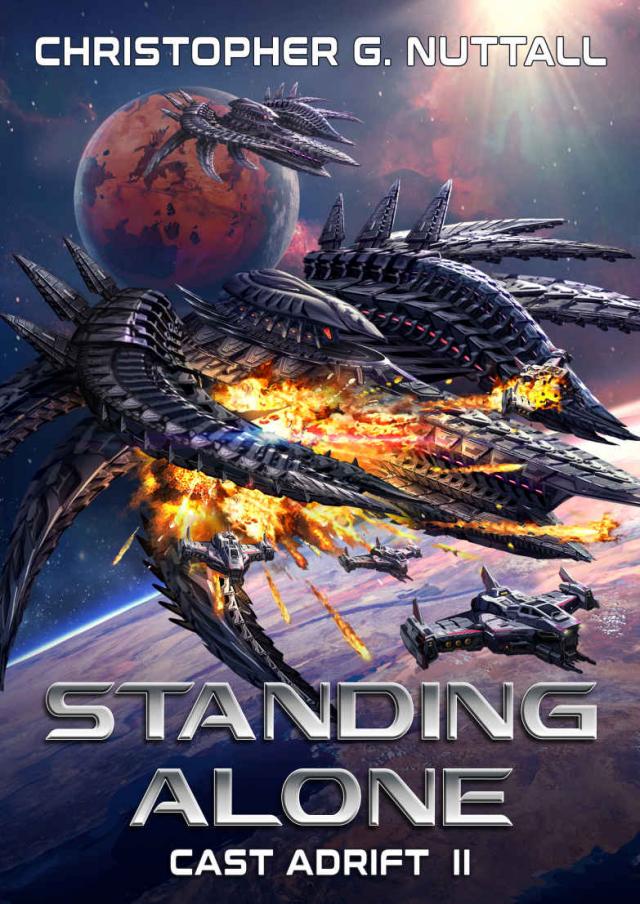
Standing Alone
(Cast Adrift II)
Christopher G. Nuttall
Book One: Cast Adrift
Book Two: Standing Alone
http://www.chrishanger.net
http://chrishanger.wordpress.com/
http://www.facebook.com/ChristopherGNuttall
Cover By Tan Ho Sim
https://www.artstation.com/alientan
All Comments Welcome!
Cover Blurb
Five years ago, the human race became independent as the Alphan Empire conceded it could no longer sustain its grip on Earth and withdrew, casting an unprepared humanity adrift on an interstellar sea of troubles. Since then, humanity has struggled mightily to secure its position in a galaxy full of hungry predators, many of whom see Earth as nothing more than a prize to be won.
Now, one of the galaxy’s superpowers has set its sights on Earth, launching a covert campaign to weaken and isolate the human race before it moves in for the kill. As their plan comes into the open, and the scale of the threat becomes apparent, the human race finds itself caught between a war it cannot win and shameful submission to dangerously inhuman race ...
... And if Earth loses the war, humanity’s short-lived independence will come to an end once again.
Prologue I
From: A Short History of Galactic Civilisation Volume XXVI. Alphan History University (Terran Campus). 505PI.
Precisely how isolated Earth was from galactic society, prior to the Alphan Invasion and Conquest of 1PI, has been hotly debated over the years. The invasion and attendant devastation did a great deal of damage to humanity’s records, as might be expected, but rumours of pre-invasion non-human contact persisted for several decades. The Alphan Viceroyalty was concerned enough about some oddly specific rumours to invest considerable effort in trying to determine what, if any, truth lay behind the stories; the investigation produced little beyond rumours of crashed alien spacecraft and bodies held in top secret facilities, none of which could be confirmed to exist (or had ever existed). If there was pre-invasion contact, it almost certainly passed unnoticed.
Regardless, Earth’s isolation from the galactic mainstream came to an end when the Alphan Conquest Fleet decloaked in orbit and opened fire. The human defences, such as existed at the time, were unable to do more than irritate the invasion force, which swiftly wiped out all mobile forces on the planet’s surface before landing troops to take possession of important strategic points and impose their will on the human race. Human resistance was formidable, in places, but with possession of the high orbitals firmly in enemy hands the outcome was inevitable. Most human nations surrendered within two weeks of the invasion and die-hard resisters found it impossible to prevent the invaders from going wherever they wanted, whenever they pleased. The Alphans had good reason to believe that humanity would become just another subject race, one to exploit for everything from raw materials to military manpower.
At first, it seemed they were right. Humans rapidly entered service at all levels of industry. Many humans had no qualms about taking on the dirtiest and riskiest of jobs, from mining asteroids in interstellar wastelands to skimming gas giant atmospheres for rare gases and minerals. Others joined the Alphan military and served in various units, fighting to maintain and even expand the alien empire. It seemed likely, as humans inched their way further and further into the interstellar civilisation, that they would eventually carve out a place for themselves in society. Indeed, to some extent they did. Humanity was encouraged to settle and develop seven star systems within a handful of light years of Earth, while Earth’s steadily-growing orbital industry and merchant fleet - primitive compared to their masters, but larger with every passing year - took humans right across explored space and far beyond. The Alphans believed it would go on forever.
It did not.
First, as humanity became more and more important to the empire’s economy, they started to demand a say in how the empire was governed. The Alphans were unsure how to handle the matter and, eventually, ended up angering both sides. The growth of a representative human government, with very limited powers, bolstered the demand for more rights within the empire, even as it ensured it would be harder to convince the empire to grant anything of the sort.
Second, the Alphan Empire fought two wars in quick succession with the Lupines, an alien race technologically inferior to the Alphans but possessed of vast numbers and determination that more than evened the odds. It was conceded, in the wake of the Second Lupine War, that only human involvement had saved the Alphans from an expensive and potentially catastrophic defeat. And it was felt, on Earth, that humanity deserved - now - to be considered true partners in empire, equal to the Alphans themselves.
The Alphans hesitated. It was impossible for them to concede equality to a race that hadn’t so much as settled its own moon, let alone started to explore multispace, before encountering alien life. They had a tendency to regard humanity as not only primitive, but foolish. Unlike many other races trapped in gravity wells, the human race could have climbed out before the invasion took place. And yet, they were uneasily aware of how greatly they depended upon human labour. The Alphan Empire had invited millions of humans to emigrate. If those humans turned into a threat, the results would be disastrous.
After much debate, they chose to cut their losses. Earth and its neighbouring worlds were granted independence. The Earth Defence Force - composed of humans who had once fought beside their Alphan masters - was released into Earth’s control. The Alphans waited long enough to ensure a reasonably stable passing of the torch, then pulled out of the Human Sector completely. Humanity was on its own.
It did not take long for predators to come calling. The Vulteks, a primitive race that had been uplifted by the Pashtali, challenged the human navy and, after convincing themselves the human race was a paper tiger, launched an invasion. The enemy thrust their way to a crossroad star system, where their fleet was trapped and destroyed in a desperate battle. Unwilling to give the Pashtali any time to support their clients, the EDF took the offensive and fought its way to the Vultek homeworld. The Pashtali arrived barely in time to save the Vulteks from a brutal defeat, ensuring that humanity’s victory would be incomplete. It was, however, more than enough to ensure Earth would take its place amongst the galaxy’s major players. As peace descended, the human race looked to the future ...
... And, as five years passed, came to realise the peace was unlikely to last.
Prologue II
From: Captain Thomas Anderson, CO James Bond
To: First Admiral Adam Glass, Commander Solar Navy (Earth Defence Force)
Subject: Galactic Geopolitics
Admiral,
As per your request, I have submitted my formal report to the EIS prior to writing this message. I must warn you that a considerable amount consists of nothing more than speculation, of whispers and rumours that may have no more substance than the claim the Elder Gods are about to return and judge us all for our sins. My tour of the neighbouring star systems has been informative, as the report says, but I cannot substantiate much. I have had to leave certain details out of the official report because they cannot be confirmed.
We had hoped, despite everything, that the Alphans would rally their people to the cause and stabilise their empire. They haven’t. Since granting Earth independence, the Alphans have done the same to three more races, two of which are primitive and unlikely to offer any real challenge to their masters if they decided they wanted to rebel. From what I’ve heard, the Alphan Empire is in full retreat. A number of important crossroads, economically as well as militarily, have simply been abandoned. It is only a matter of time before one of the other Galactics moves in and takes them. I doubt we could secure them ourselves, even if we had the deployable forces, if a more powerful race wanted them.
It is impossible, as of writing, to get a solid idea on how much military hardware remains in Alphan possession, but I’ve heard rumours that suggest warcruiser losses in the war were far higher than we supposed. I have been unable to confirm these rumours - and some of them are nothing more than whispers and wishful thinking - yet it is clear the Alphans no longer have the will to patrol the space outside their core worlds. They have stepped down everything from crossroad custom stations to deep space outposts and, if some of the wilder rumours are to be believed, even evacuating their personnel from multispecies worlds. It is clear they’re withdrawing as much as possible to their core worlds.
This raises a worrying issue, sir. Who is going to be the next galactic hyperpower?
It is not an easy question to answer. The Alphans were the power, as far as they and everyone else were concerned. They possessed enough firepower to make life difficult for the remaining Galactics, even if they had to fight them all at once. It was they who enforced Galactic Law, such as it is. As of writing, going by official reports, there is no power capable of taking their place. Unofficial reports suggest the major powers are rapidly building up their forces. The Alphans have created a power vacuum and their rivals are moving to take advantage of it.
I think, off the record, that the Pashtali will be the major threat. They took no part in either the Lupine Wars or the Vultek War, save at the very end. They have long wanted to replace the Alphans as the predominant power in explored space, seeing the Alphans as a bunch of lucky bandits, if I may make so bold, rather than the destined masters of the known universe. Quite aside from that, they also regard us as threats; they have good reason to fear what we, and our neighbours, will do if given time. I’m surprised they haven’t put pressure on us already. Given the Alphan retreat, that may be about to change.
Political suggestions are a little outside my bailiwick, but I do have some observations...
Chapter One
ESS Magellan, Deep Space
There were people, Captain Ashleigh Harlem had discovered on the first day she’d reported for survey training, who couldn’t endure multispace. They looked through portholes at the eerie shimmering lights of multispace and recoiled, or threw up, or started screaming. Indeed, the Alphans based their claim to superiority on the simple fact that they found multispace almost homey, to the point they knew far more than any other race about manipulating the fabric of multispace and the threadlines running through it. It was the Alphans, alone amongst the Galactics, who could drop out of multispace wherever they liked. It had given them a priceless tactical advantage.
She sat in her command chair and studied the displays as Magellan picked her way through the endless energy surges and gravitational eddies. They weren’t that far from the shipping lanes, but they might as well have been on the other side of the galaxy. Her sensors weren’t picking up any other ships, not even patrolling cruisers and destroyers prowling the edge of the core worlds. Alphan space, she reminded herself. The days when the core worlds had been her core worlds were long gone. It was strange, almost eerie, that they’d seen so few ships during the deployment. There’d been a time when the threadlines were practically crowded with starships, from freighters carrying raw materials back to the core to warships patrolling the edge of explored space. Now ...
Interstellar trade will recover, she told herself. And when it does, we will need accurate charts once again.
It wasn’t easy, but she forced herself to relax. She’d been in the interstellar survey service from the day she’d graduated, hoping - against all logic and reason - that she’d be granted a chance to take a ship beyond the furthest reaches of explored space. Updating charts and keeping a wary eye on energy storms in multispace was important - she wouldn’t have been in the survey service if she hadn’t understood just how important - but it wasn’t a chance to plunge into the unknown. She’d grown up on tales of brave explorers - Alphans - who had steered their ships along previously unexplored threadlines, locating and logging star systems that could be claimed and exploited by their empire. She’d heard stories of strange sights and encounters within multispace, including incomprehensible artefacts from long-gone races and godlike entities guarding the gates to heaven or hell. Most of the stories were absurd, the sort of tall tales spacers told when they wanted to make their profession sound glamorous; she’d discovered, over the years, there was more truth in them than any groundpounder believed. Who knew what might be lurking beyond the next threadline or on the far side of an unexplored crossroads? She wanted to be the first to see the unknown ...
Her lips curved into a grim smile. Soon. The human race was free again, free to explore without the guiding hand of their former masters. She’d been told, in confidence, that as the Solar government asserted itself, humanity would start sending survey ships into the unknown, in hopes of finding inhabitable colony worlds or making first contact with new alien powers. She had every intention of being one of, if not the, commander on a deep space exploration mission. She’d spent her entire life preparing for the plunge into the unknown. She was ready.
She put the thought out of her mind as she studied the console. The multispace topography - one of her instructors had once compared it to crawling across the ocean bed - seemed unchanged. The random energy fluctuations of multispace barely registered on the sensors. She was almost disappointed - and yet, something nagged at her. The economic slowdown had affected everyone, with fewer and fewer ships setting out on speculative trading missions, but there should have been more ships in the threadline. She frowned as she studied the edges of the clear route, her ship slowing along the edge of the threadline as her sensors probed the energy storms beyond. Multispace was merciless - any solid matter within the threadline fell down to the crossroads and into realspace - but surely there should have been more.
It was worrying.
Her fingers danced across the console, bringing up the long-range sensor readings and comparing them to the records on file. It had been too long since the last survey mission. The Alphans - who’d once conducted the missions as a matter of routine - seemed to have lost interest in carrying them out, although they’d reacted badly when some of the other Galactics had offered to do it for them. Or so Ashleigh had been told. It couldn’t be easy to have an up-and-coming younger race offering to do something for you, even if one was grimly aware of one’s advancing age. Ashleigh’s grandmother had never liked her children and grandchildren treating her as an invalid, right up to the end of her life. The Alphans must feel the same way. They’d been masters of the known universe for so long that they had to find it hard to adjust to a universe that no longer automatically deferred to them.
And I wouldn’t be pleased if Ensign Simmons claimed he knew better than me, she reflected, with a hint of amusement. Even if he did, it wouldn’t make me happy.
She kept her eyes on the display as the starship sped on. It was a routine mission. She did not, technically, have to be on the bridge. There was no reason to think they’d come under attack - they were deep within explored space - or encounter something her XO couldn’t handle. She knew she could go back to her cabin and do her paperwork - that was one thing that hadn’t changed, in the years following Independence - or even write proposals for deep space exploration. Who knew? The First Speaker and his government needed a success, now that the lustre of independence had been replaced by the urgent need to carve a place for humanity in a hostile universe. Perhaps they’d support a deep-space exploratory mission ...
A low shudder ran through the ship. Ashleigh looked up, sharply, as red lights flared on the display. Multispace was rarely quiet - energy surges and twisted gravity waves were far from uncommon, seemingly flickering and flaring out of nowhere and vanishing as quickly as they’d come - but they were still some distance from the edge of the threadline. They were certainly closer to it than a freighter would dare, yet ... her eyes narrowed as another wave of gravitational force crashed into the hull. It shouldn’t have been there at all.
“Lieutenant Ellis,” she said, calmly. It was unexpected, but hardly anything her crew couldn’t handle. They’d trained on the assumption they’d be flying into unexplored and uncharted territory. “Report.”
Lieutenant Ellis didn’t look up from his console. “We just crossed a gravity wave, Captain,” he said, in a tone that suggested he didn’t believe his own words. “The wave is actually twisted, to the point we hit it twice ...”
Ashleigh leaned forward as the display updated rapidly. Multispace was weird. For every threadline that cut years off one’s journey, there was one that added centuries. It was quite possible to follow a threadline that linked two neighbouring stars together, only to discover the journey would have been quicker if the ships had remained in normal space. She’d heard stories of spacers who’d spent a week in multispace, only to discover - when they reached their destination - that decades had passed. It was rare, but it happened. She’d even heard rumours of threadlines that led into the past.
Although those rumours are probably untrue, she reflected. It would break causality into rubble.


