

The Jamaica Station, page 1
part #3 of Carlisle & Holbrooke Naval Adventures Series


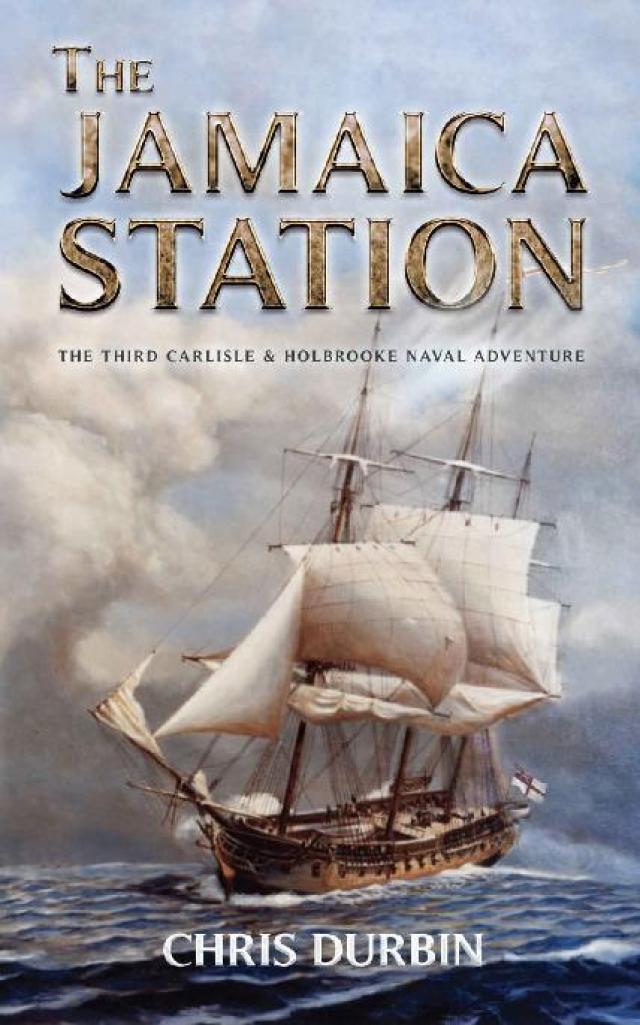
The Jamaica Station
The Third Carlisle & Holbrooke
Naval Adventure
Chris Durbin
To
The Royal Navy’s
Principal Warfare Officer’s Course
Number 184
HMS Collingwood
October 2017 to October 2018
The Jamaica Station Copyright © 2018 by Chris Durbin. All Rights Reserved.
Chris Durbin has asserted his rights under the Copyright, Design and Patents act, 1988, to be identified as the author of this work.
No part of this book may be reproduced in any form or by any electronic or mechanical means including information storage and retrieval systems, without permission in writing from the author. The only exception is by a reviewer, who may quote short excerpts in a review.
Editor: L.M. Durbin
Cover designed by Book Beaver.
This book is a work of fiction. Characters, places, and incidents either are products of the author’s imagination or are used fictitiously. Any resemblance to actual persons living or dead, or to events, or locales is entirely coincidental.
Chris Durbin
Visit my website at www.chris-durbin.com
First Edition: 2018
◆◆◆
Contents
Contents
The Seven Years War
Principal Characters
The Caribbean and Gulf of Mexico 1757
The Windward Passage 1757
Cape François 1757
Prologue: Nuestra SeÑora del Rosario
1: Weather Warnings
2: The Tempest
3: Salvage
4: Port Royal
5: His Excellency
6: The Reception
7: Grand Cayman
8: Ocean Currents
9: The Dutchmen
10: Privateers or Pirates?
11: A Desperate Fight
12: St. Augustine
13: The Angelini Cousins
14: The Caicos Islands
15: Ambush
16: Counter-attack
17: The Lone Pine Tree
18: Cape François
19: Rear Admiral Cotes
20: A Mystery Solved
21: The Admiral’s Strategy
22: Commodore Forrest
23: Jacques
24: Council of War
25: The Battle
26: Hope Frustrated
27: British Privateers
28: The Volunteer
29: L’Outarde
30: The Operational Art
31: A Sloop-of-War
Historical Epilogues:
Nautical Terms
Bibliography
The Author
Feedback
◆◆◆
The Seven Years War
1757 – Britain’s Maritime Strategy Starts to Bite
The Seven Years War is known to Americans as the French and Indian War, but that name doesn’t do justice to the scale of the conflict, even though the spark that ignited the powder keg was indeed lit on the frontier lands of the American continent. The British colonies along the American eastern seaboard and the French colonies that flanked them to the north and south both wanted access to the heartland of the continent. The French in Canada and Louisiana planned to link up along the line of the Ohio and Mississippi rivers and started building a series of outposts along those two waterways. To the English-speaking people of America, those forts threatened to confine them to the narrow strip of land between the Atlantic and the Appalachians, condemned eventually to fall under the influence of the encircling French.
That is how the war started, but it quickly spread, and by its end in 1763 it was being fought in North and Central America, the West Indies, West Africa, India, the Pacific Ocean and throughout Europe. It drew in all the great empires and kingdoms of the Old World, and it was sustained by the traditional dynastic jealousies and suspicions of the ruling houses of the continent.
In 1755, Britain staggered towards its third major conflict in the century with only a small professional army and a navy that, as an economy measure, was mostly laid up in the harbours of the south coast and the rivers and creeks of the Thames estuary. The predictable result was a series of disasters in 1755 and 1756. At sea, Britain lost its principal Mediterranean stronghold at Minorca, and with it the ability to keep a watch on the French fleet at Toulon. Amidst the outcry that followed, Admiral Byng achieved notoriety as the only British admiral ever to have been judicially executed, throwing the country into turmoil and causing the collapse of the government.
By the end of 1756, the government was being led by William Pitt as the de facto Prime Minister. Pitt understood that so long as Britain used its financial power to build an overwhelming navy to support its colonies and its merchant fleet, then in the long run, whatever France may do on the continent, she could neither gain new territories nor hold those she already owned. Pitt kept the French in check in 1756 while he oversaw a massive increase in the British fleet. He used his new maritime power first to ensure the security of the kingdom; then, in 1757, he went on the offensive.
◆◆◆
This is the fictitious story of Captain Edward Carlisle, a native of Williamsburg, Virginia and his first lieutenant, George Holbrooke, of Wickham in Hampshire. In early 1757 their frigate Medina is ordered to the Jamaica Station to carry out Anson’s strategy of waging commerce warfare against the French in their West Indian possessions.
If any of Carlisle or Holbrooke’s exploits – either ashore or afloat – seem a little unlikely, then I recommend that you read Augustus Hervey’s Journal which was published in 2002 by Chatham Publishing. Hervey spent much of the Seven Years War at sea in command and was present at several battles and other operations, including the disastrous battle of Minorca. When you read his startlingly frank account of those times, you’ll agree that a novelist has no need of overstatement when writing of the Royal Navy of the mid-eighteenth century.
◆◆◆
Principal Characters
Fictional Characters
Captain Edward Carlisle: Commanding Officer, Medina.
Lieutenant George Holbrooke: First Lieutenant, Medina.
John Hosking: Sailing Master, Medina.
Reverend John (David) Chalmers: Chaplain, Medina.
Able Seaman Jackson: Captain’s Coxswain, Medina.
Able Seaman Whittle: A follower of Captain Carlisle’s from his home in Virginia.
Lady Chiara Angelini: Captain Carlisle’s wife.
Enrico Angelini: Cousin to Lady Chiara.
Black Rod: Chief-of-Household of the Angelini family, real name unknown.
Jacques Serviteur: Freed French slave.
◆◆◆
Historical Characters
The Duke of Newcastle: Prime Minister of Great Britain from 1754-1756 and 1757-1762.
The Duke of Devonshire: Prime Minister of Great Britain from 1756-1757.
William Pitt: Leader of the House of Commons from 1756-1761.
George Haldane: Governor of Jamaica, 1756-1759.
Lord George Anson: First Lord of the Admiralty from 1751-1756 and 1757-1762.
Vice Admiral George Townshend: Commander-in-Chief Jamaica Station until July 1757
Rear Admiral Thomas Cotes: Commander-in-Chief, Jamaica Station from July 1757.
Rear Admiral Thomas Frankland: Commander-in-Chief, Leeward Islands Station.
Captain Robert Faulknor: Commanding Officer Marlborough, Flag Captain to Admiral Cotes.
Captain (Commodore) Arthur Forrest: Commanding Officer, Augusta.
Captain Maurice Suckling: Commanding Officer, Dreadnought.
Captain William Langdon: Commanding Officer, Edinburgh.
Don Alonso Fernández de Heredia: Governor of Florida 1755-1758.
Countess San Clemente Elena Marin de Villanueva e Hijar: Don Alonso’s wife.
Maria Magdalena Fernandez de Heredia y Marin de Villanueva: Don Alonso’s daughter.
Capitaine de Vaisseau Guy François de Coëtnempren, Comte de Kersaint: Commander of the French squadron at Cape François.
◆◆◆
The Caribbean and Gulf of Mexico 1757
The Windward Passage 1757
Cape François 1757
Prologue: Nuestra SeÑora del Rosario
Wednesday, eighth of June 1757.
Nuestra Señora Del Rosario, at Sea. Tobago west-northwest 40 leagues.
Don Alonso Fernández de Heredia watched as the two sleek, predatory ships manoeuvred to windward. He was confident of their identity – they were Dutch privateers from St. Eustatius – and he was almost sure of their intentions, for Don Alonso wasn’t a great believer in coincidences. However, Spain wasn’t at war with the Dutch Republic. In fact, Spain was in the unusual state of not being at war with anyone, so those two ships were operating beyond the laws of nations. Perhaps they considered themselves privateers, but with Spain at peace with the world, a better description would be pirates. St. Eustatius was five hundred miles to the northwest, at the far end of the Antilles. That tiny island had a reputation for free-trading, and in Don Alonso’s opinion, and in the opinion of Spain, free-trading in the Caribbean was only a short step away from piracy.
The governor of Florida wasn’t a man to let a few cannon balls ruin his day; after all, in his time he’d been at war with all the major nations of Europe, on land and at sea. He’d fought the Dutch before, sometimes winning and sometimes losing. However, today he ha
No peace beyond the line, the English, the French and the Dutch were fond of saying. That old axiom may have been overtaken by treaties a century ago, but if these Dutchmen wanted to fight, he was confident that Argonauta could teach them a lesson. He snapped his telescope closed and with a gesture that was part anger and part frustration he walked over to the starboard quarterdeck rail and waved to the man-of-war that hung close on his beam.
The captain of the Spanish naval frigate, Argonauta, was watching the two predators warily and keeping himself between them and the defenceless merchant ship that he was escorting. It had been an uneventful passage so far, and with luck, they’d reach Pensacola in Spanish Florida in something over two weeks. They anticipated a pleasant time in the sheltered anchorage while the governor reviewed the rebuilding of the new city after the destruction of the hurricane five years ago. Then it would be a gentle two-week passage to St. Augustine on the Atlantic coast, following the well-trodden path of the Spanish treasure fleets. There they’d deliver Don Alonso and his family to his seat of governance and return home to Cadiz.
◆◆◆
‘Captain,’ shouted Don Alonso, ‘We will go ahead, you are to prevent those two pirates following us. If you need to fight them, then you may do so, but don’t let either of them get past you into the Caribbean.’
‘Yes, Your Excellency,’ replied the captain, barely able to suppress his delight at being let loose from the slow Nuestra Señora Del Rosario. He would deal with these two Dutchmen in short order and by the grace of God may even take a prize or two. He remembered with pleasure that the governor of a colony held the presidency of the Vice-Admiralty court and could condemn prizes out of hand, war or no war. Acting under the orders of the governor himself, there would be little doubt of the findings of the court. ‘I will overtake you before you enter the Caribbean Sea,’ the captain shouted back, speaking pedantically to avoid misunderstanding, ‘but in case we are delayed, please ensure that the master doesn’t deviate from the navigation plan.’ He gestured with his hands, ahead and slightly to starboard. ‘South of Jamaica, then take a departure from Grand Cayman for the Yucatan Channel. The current will be with you on the west side of the channel.’
‘Go with God, Captain,’ Don Alonso replied with a wave.
With that, the captain of Argonauta turned to his sailing master and delivered a rapid volley of orders. A trumpet blared, and the frigate burst into life. The port-lids were thrown open, the guns were run out, the sheets hardened in and the helm put to leeward. The sleek fighting machine turned to confront its impudent pursuers.
On board the Nuestra Señora Del Rosario, there was barely a ruffle in the calm ordering of the day. The merchant ship didn’t deviate from her course, her few guns weren’t cleared away, and she continued her peaceful voyage, leaving the hard business of war to the professionals of the navy. An hour or so later, Don Alonso and his family heard some gunfire to windward, but even through the telescope, it was too far to see any details of the fight. That was the last that the governor of Florida saw or heard of Argonauta, apart from some sailors’ tales that filtered through many months later. Tales of a wild fight and wilder weather; pirates, shipwreck and survival and the last days of one of King Ferdinand’s newest and best frigates.
◆◆◆
1: Weather Warnings
Thursday, sixteenth of June 1757.
Medina, at Sea. Point d’Abacou, Hispaniola north 15 leagues.
The sailing master shook his head warily. ‘I don’t know, sir,’ he said, ‘I don’t like the look of this swell, not one little bit.’ Hosking leaned down the slope of the deck, tightly gripping the hammock cranes until he could almost reach the solid, oak-built binnacle. Then he let go his hold and launched himself the final few feet. That a man with the sailing master’s years at sea should need to perform these manoeuvres merely to move around his own quarterdeck was an eloquent testimony to the unsteadiness of the ship. The quartermaster turned and winked covertly at the two steersmen who somehow managed to keep their expressions wooden. In truth, they were concentrating mentally and physically on keeping their course and had little time for old Eli’s games.
‘Southeast-by-east, sir,’ Hosking announced after studying the steering compass and staring over the larboard beam. The regular, modest and predictable series of waves from the east-northeast was being overlaid by a long, low swell from the direction of the Windward Islands. Medina was steering southwest-by-south with the wind two points on her larboard quarter. The steersmen were wrestling with an interesting three-dimensional dynamic puzzle. The frigate’s stern rose comfortably to the first two waves created by the trade wind, but then the sequence was lost as the third was interrupted by this new swell approaching from further around on the beam. It had the effect of pushing the stern back into the wind, but the force with which it did so was unpredictable, being dependent upon the exact point that the swell intersected the wave.
‘Could we be in for a hurricane, Mister Hosking?’ asked Captain Carlisle, cupping his hands around his mouth, ‘it seems a little early in the season.’
‘But not unheard of, sir, oh dear me no. The season starts in May, although they’re rare in the first two months and generally not as dangerous as later in the year, around August and September.’ He looked at the dog-vanes mounted on the hammock cranes, then up at the commissioning pennant streaming away on the starboard bow. ‘The wind hasn’t changed yet, so we should have twelve hours before it hits us, if indeed it does.’
Carlisle looked around at the sparkling sea and the towering ranks of canvas ascending to the blue sky, broken here and there by pure white clouds. The weather looked perfect, the central Caribbean at its best. It was hard to believe that they could really be in for a hurricane in less than a day. ‘Well, it’s best to be prepared. What do you think of our course?’
‘Until we see the wind changing, we won’t know how to avoid the eye, if it is a hurricane,’ Hosking said touching the binnacle for luck. ‘If the wind veers or stays steady from the northeast, then we’re on the dangerous side and need to beat up to the northwest. If it backs, then we’re safer, but in that case, we should head south, as we’re doing. South also gives us more sea-room; I recommend that we maintain our heading until we see how it develops.’
Carlisle took another look around the horizon and let his eyes rest on the eastern skyline. He didn’t want to be known as a captain who was spooked by every change in the weather, but on the other hand, a hurricane wasn’t to be taken lightly. He felt another exaggerated lift and twist as Medina responded to the confused sea and, momentarily losing his grip on the railing, skidded across the deck to be brought up against the broad shoulders of old Eli, the quartermaster.
‘Thank you, Eli, much obliged,’ he said.
‘That’s nothing, sir,’ replied the quartermaster. ‘You wait until that old hurricane catches us, then we’ll all be dancing around the deck. I’ll have to take a turn around the binnacle with my pigtail,’ he said, shaking the half-yard of tightly-plaited grey hair that hung down his back.
Carlisle smiled. If Eli thought a hurricane was coming, then it probably was. His mind was made up by that insignificant incident. If he was wrong, then at least he was in good company. Carlisle looked over his shoulder at the midshipman of the watch.


