

Haunted Hallways, page 1


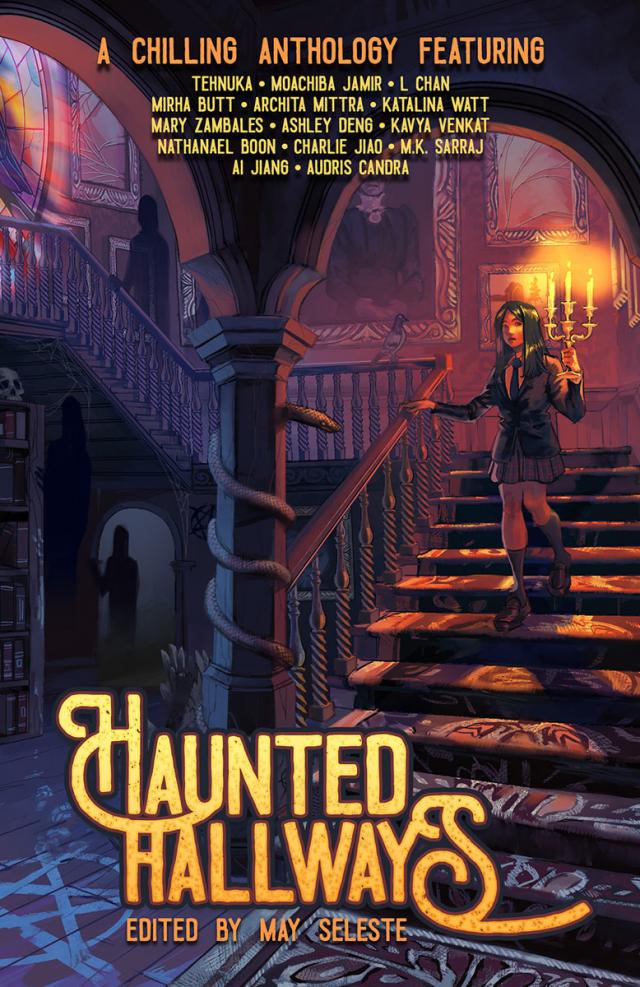
HAUNTED HALLWAYS:
THE MALLORY THORNE SCHOOL OF EXCELLENCE
All stories within are copyright © 2024 their respective authors. All rights reserved.
Published by Outland Entertainment LLC
3119 Gillham Road
Kansas City, MO 64109
Founder/Creative Director: Jeremy D. Mohler
Editor-in-Chief: Alana Joli Abbott
Senior Editor: Scott Colby
Project Director: Anton Kromoff
ISBN: 978-1-954255-80-7 (print), 978-1-954255-81-4 (ebook)
Worldwide Rights
Created in the United States of America
Editor: May Seleste
Copy editor: Alana Joli Abbott
Proofreader: Scott Colby
Cover Illustration: Anne Marie Cochran
Cover Design: Jeremy D. Mohler
Interior Layout: Jeremy D. Mohler
The characters and events portrayed in this book are fictitious or fictitious recreations of actual historical persons. Any similarity to real persons, living or dead, is coincidental and not intended by the authors unless otherwise specified. This book or any portion thereof may not be reproduced or used in any manner whatsoever without the express written permission of the publisher except for the use of brief quotations in a book review.
Printed and bound in the United States of America.
Visit outlandentertainment.com to see more, or follow us on our Facebook Page facebook.com/outlandentertainment/
TABLE OF CONTENTS
AI JIANG
“Introduction”
MAY SELESTE
“Editor’s Foreword”
AUDRIS CANDRA
“The Magic they Never Taught Us” (1960—1990)
MIRHA BUTT
“Twin Daggers” (1968)
ARCHITA MITTRA
“The Summoning” (1990s)
KATALINA WATT
“Remain Nameless” (1990s)
TEHNUKA
“Renewal Notice” (1990s—2000s)
MOACHIBA JAMIR
“Of Mice and Pigeons (2005)
L CHAN
“Saints of Stained Glass” (2010s)
MAY SELESTE
“Innocent Sinner” (2010s)
MARY ZAMBALES
“The Choir Room” (2012)
ASHLEY DENG
“Behind the Eyes” (2013—2014)
KAVYA VENKAT
“Breaking into Finals” (2015)
NATHANEL BOON
“Writing with Bite” (2020s)
CHARLIE JIAO
“The Housemaster’s Cure” (2023/Present day)
M.K. SARRAJ
“A Memory Left Fighting” (2023/Present day)
AUTHOR BIOS
INTRODUCTION A YEARBOOK OF HAUNTINGS
AI JIANG
There is something about schools that makes them particularly primed for ghosts and hauntings, and sometimes I wonder if it’s because they’re a place where many leave behind regrets—a space that holds onto them whether students move forth from their memories and experiences or not. School is a place where our younger selves linger, where many of us make our closest friends and most dreaded enemies, where teachers might make or break our love for learning. Parents, too, though they seldom walk the halls, haunt their children’s every breath, whispering in their ears, judging their answers and behaviors, waiting with stretched smiles when their children return home to the extent that sometimes it feels like school doesn’t leave us when we exit the building. As though school follows us home—and often, it does.
What I love about this anthology is the core resonance of each story and the stories as a collective in capturing the different interpretations of what haunting might mean. There are stories centered on identity and belonging, the pressures of school, performance, and competition—both between fellow students and within us. Many have felt the need, or perhaps this thought process has been so deeply ingrained into us throughout childhood, to be the perfect child and student, to achieve high grades so we can become the pride of our parents and the envy of our friends. But to reach this far-stretching goal post, there might be hefty sacrifices that students feel justified to make—no matter how horrid the consequences.
Not only are there stories about the experiences of students, but there are also tales focusing on the way expectations differ between students and teachers in educational institutions, and also between different cultures. Schools can shape our paths, make or break us as people, and influence the rest of our lives if we allow it—or even when we don’t. This reminds me of my own experience in schools and similar places: swimming instructors who dunked our heads into the water when we didn’t learn fast enough; teachers who threatened to lock us into closets when we wouldn’t sleep during nap time; teachers who didn’t offer guidance but insistence, impressing on our pliable minds the idea that their thoughts and beliefs were the only correct ones.
But schools aren’t only places of darkness; they also have the potential to foster great learners through empathy and compassion. Here, I think of the teachers who bought me my favorite book as a gift and a Halloween costume of my favorite cartoon character; teachers who took me to McDonalds after school; teachers who befriended my parents, and the one who had almost married my uncle; teachers who allowed us to take naps in class because to them, our wellbeing was above our studies.
In this anthology, there are stories of body horror, of the way the school system might force rigidity and regurgitation, of bullying and harassment (and the way it completely changes the dynamics of a school and students’ livelihoods and consequently their futures), of privilege and competition, of access and scholarship and financial need.
More often than not, educational institutions favor those more fortunate and make those with fewer resources compete with those who are already several steps ahead of the starting line. The stories highlight the reality of the lies we might tell to rise above others—on applications or in papers, even if they are things we ourselves are not, and things we ourselves do not believe in. But for these institutions, we make ourselves fit into checkboxes of diversity, feel the need to flaunt identity, culture, background, as though it is the group we are part of that matters and not ourselves as individuals. Yet, there is the need to hide these very things for the very same reasons.
School culture can be toxic in its deadlines and stress-driven productivity, the way institutions might teach us to avoid failure, or instill a fear of failure, so we do not challenge ourselves or take risks, but reach for what might be easiest and what would guarantee success. And this same fear of failure stops us from trying hard because we are afraid we might still fail, that it might all be for nothing. We then begin to diminish our own efforts, compare ourselves to others who seem to have more challenges to overcome yet can still perform, or seem to do less but still achieve more.
In this anthology of Asian voices and experiences woven into stories that beg to be heard, dear reader, you will find that privilege does not always equal to success, that these seemingly safe havens hide corruption and the abuse of power in dark histories and bloody hallways, and the way haunting is done not only by ghosts but also by the living. And perhaps by the end of these tales, you might find yourself looking at the hallways of your past schools, not so much with nostalgia, but with eyes that can spot the fingerprints left on the walls, the crimson footprints on the tiles, and the bruises behind unwavering smiles and the mask of seemingly wise guides.
EDITOR’S FOREWORD
MAY SELESTE
Every school has its own ghost story, right? Of how someone saw a figure in the gym hall after dark, or whispers in the locker room of that one student from that one class all those years ago that mysteriously “snapped.” For someone like me, the kid with a great interest in the macabre, I came across my fair share of creepy tales and rumors. Because as you see, dear reader, most of my life, and I expect most of yours, too, has been school. An endless cycle of study, exams, graduate. Study, exams, graduate. Rinse and repeat until you’ve reached the next level—climbing higher and higher until there’s nothing left but a vast plane of nothing, and everything at the same time. Even as I write this, I sit in the solace of the old postgraduate library—surrounded by a soft shifting as someone tenderly leafs through the pages of a book older than everybody in the room combined, and the faint scent of coffee and panic in the midst of “final project” season. Despite the stress, this is home. From the after-school tutoring centers that were really just a single room in the back of a building, to the historical institutions that have stood for generations before mine. That had seen many faces before mine. That had seen many, many lives before mine.
So when the conversation with fellow gothic authors arose about haunted locations—what else could I say? Mansions, churches…schools. Where the halls are lined with hope and glory, dreams, and friendship—where aspiration is met with a gold star and sweet validation. Yet when the lights turn out, and the whispers get loud enough for you to hear them—really hear them—you hear the stories of fear and desperation that spans generations, people driven to the brink of madness, of prayers aimed at whichever entity deigns to listen. When the gold stars and validation start to rot and taste like blood. And from there, Haunted Hallways was born.
When word was sent out for authors to contribute, there were two main considerations—amplifying Asian voices, and whether they could truly capture the sinister essence of the unique ways academia could possibly haunt you. For the former, if one is put in a position to uplift marginalized voices—should we not take the opportunity to do so? And with the rich history and variety of spirits and ghouls—most of which are rare to find in global media—these stories warrant being heard in a joint effort to both diversify the voices we read, but to also enrich the genre and bring forward what we define as “horror” or “gothic” into contemporary times, and how we choose to define it going forward.
For the latter point, we decided to set the stories in one location—the “Mallory Thorne School of Excellence”—to truly consolidate the fact that so many tales and so many experiences can be uniquely encountered all under one roof. That almost everyone has a story they left behind in the hallowed halls of their youth. For some, this followed themes of war, colonisation, and generational trauma. For others, it was about the secrets living in the walls, sinister whispers from the past, and shattered reflections. And when the time comes for you to leave, and you look back and see the shadow of the person you once were still standing in the hallway, books in hand and still in the same uniform—what other choice do you have, then, to turn your backs on each other as you go into the world, and they relive the stories you left behind?
So what exactly is the “Mallory Thorne School of Excellence?” It’s constructed to be a boarding school in a fictional English countryside, spanning from the Victorian era1. Being British myself, the inspiration came from the many architectural structures littered throughout the country2. We believed that this would be the best location, as it allowed for us to envision the setting as a truly ominous and secluded environment that one would imagine when thinking of the word “gothic.” The school is said to be started by the fictional Thorne family with the title of “Head Teacher” being passed through the bloodline as time progresses, and with the original “Lady Mallory Thorne” forever immortalised in the school crest. In writing the stories contained in this collection, the authors were given basic guidelines of location, school structure, and a brief history. For the rest, they were given free rein to let their imaginations run through the dimly lit stone halls of the academy. Whispering their tales inspired by mythology, psychology, identity, life. And perhaps in one of these stories, you’ll find that shadow of your old self that you had left all those years ago, reaching out their hand, ready to pull you back in—even momentarily—to face the haunted tales of those cold, quiet hallways.
1 Despite the vast history of the school, the earliest records that could be recovered were from the 60s. Everything that came before went missing under mysterious circumstances. Allegedly.
2 Namely King’s Cross St. Pancras station, the Kings College and St. Pauls Cathedral libraries, and, of course, the Bodleian at Oxford, which I visited on a school trip once and could never forget.
THE MAGIC THEY NEVER TAUGHT US
AUDRIS CANDRA
content/trigger warnings: forced cannibalism, body horror
Schools never taught us magic. Especially not when it was important.
When Gita vomited clumps of the longest, shiniest black hair I’d ever seen, the teachers waved it off as her seeking attention. Like a desperate cat. When Muthi disappeared for a week and was found on the locked rooftop, alone and screaming until her voice shattered, the staff wrote it off as a case of hysteria.
Schools never taught us how to survive. Least of all this one.
I still had scars on my tongue from when I’d thrown up nails. The steel had raked my throat, and rust had tainted my meals for weeks. At least back home, the local ustad and pastor would have tried to exorcise me. It might have worked. It might not. It was the effort that counted.
Just like our effort.
Gita pushed the crude doll onto the table, the three of us surrounding it. The coconut made for a perfectly round head, and the body was two bamboo chopsticks tied into a cross. Frayed burlap sack covered most of it, painting the illusion of a strawman. Once I tied a short pencil to its arm, the doll wasn’t a doll anymore.
The oil lamp shone gold on Muthi’s brown skin as she pulled back. “I don’t know, this all seems like a bad idea. I’m not…I’m not comfortable doing anything involving magic.”
“You can just watch us, and if anything bad happens, you can recite Al-Fatihah or Ayat Kursi. Or don’t. We’re doing this, with or without you,” Gita said. “I’ll give you some time to think.”
The elders would warn me not to play this game—to do this ritual. But I can’t remember why. I can’t even picture my—our friend’s face. I only know that we haven’t seen for a week, and neither the teachers nor the faculty members would even acknowledge that ever existed. Her name wasn’t in the records. I don’t know if I should blame the teachers—they fancied themselves our second parents, but they could only move within the rules of the school. Maybe I should blame the school itself, as this old institution only cared about producing the best students.
I remember one thing, though. Deep in the night, we both woke from the same dream. That somehow, I’d been cursed for being so far from home. That I must consume flesh or else I’d perish. I waved it off as a stress-induced dream from the coming exam.
dragged me to the kitchen and brought the cleaver down on her own pinky. I screamed, and she pushed the little thing into my mouth. Shoved it down my throat.
We never had nightmares again.
“I guess…I’d rather be here with you,” Muthi said. “This is for .”
Gita pulled out a blank paper. “What’s the worst that can happen anyway?”
“I don’t know. Possession?” Muthi glanced around. “I guess I could make makeshift holy water should anything happen.”
Gita rolled her eyes. “Oh, please. That’s the mildest western movie shit. That’s the stuff white people are afraid of: losing control. But us? We never had control to begin with.”
I pinched the spot between my brows. Whenever I grasped around for her name, all I found were the laws of thermodynamics and the various complicated chemical formulas. What had school done to me that I couldn’t even recall the friend who had mutilated herself to save me?
“Do you know the story of a Muslim and a Christian in Indonesia’s guerilla war against the Dutch?” Gita glanced at Muthi.
I shrugged. I probably knew this story, once.
Now, I could recite the Geneva convention word by word, but I couldn’t repeat what my mother told me before she dropped me off into this hellhole.
“‘The war was tough for us, right?’ the Muslim said to the Christian, or the Christian to the Muslim, whatever, doesn’t matter who said what. What matters is that one said to the other, ‘Hey, we got two gods between us, and the Dutch only got one. What do we have to be scared of?’ And they charged and we got our independence in the end.”
Yeah, we did. But did those two fighters survive?
Who knows.
“We’ve got three deities among us.” Gita’s cross glinted as she swayed. “What do we have to fear against one spirit?”
“I’ve got multiple.” I grinned and pointed at my multi-colored Buddhist bracelet. Not out of confidence, but to soothe myself.
“At least three, then.” Gita grinned back. “As long as we can send the spirit back, we’ve got nothing to worry about.”
I drew in a sharp breath. “Let’s get this over with.”
Gita picked up the doll. “We’ll just go with the short version. You know the mantra, right?”
I nodded and reached out to the doll.
“Jailangkung jelangsat,
di sini ada pesta.
Pesta kecil-kecilan.”
Jailangkung jelangsat, there’s a party here. A small party.
Well, not quite, we don’t have offerings of flowers and incense. Just ourselves.
“Jailangkung jelangsat,
datang tak dijemput,
pulang tak diantar.”
Jailangkung jelangsat, you come without anyone picking you up. And you return home without anyone escorting. A lonely existence, being called only to answer questions.
“Jelangkung jelangsat, where is our friend?”
The coconut head shook. The pencil trembled, and so did my hands. It scratched against the paper, ready to write the answer.


