

Days of Blood (A Jubal Cade Western #9), page 1
part #9 of Jubal Cade Series


The Home of Great
Western Fiction
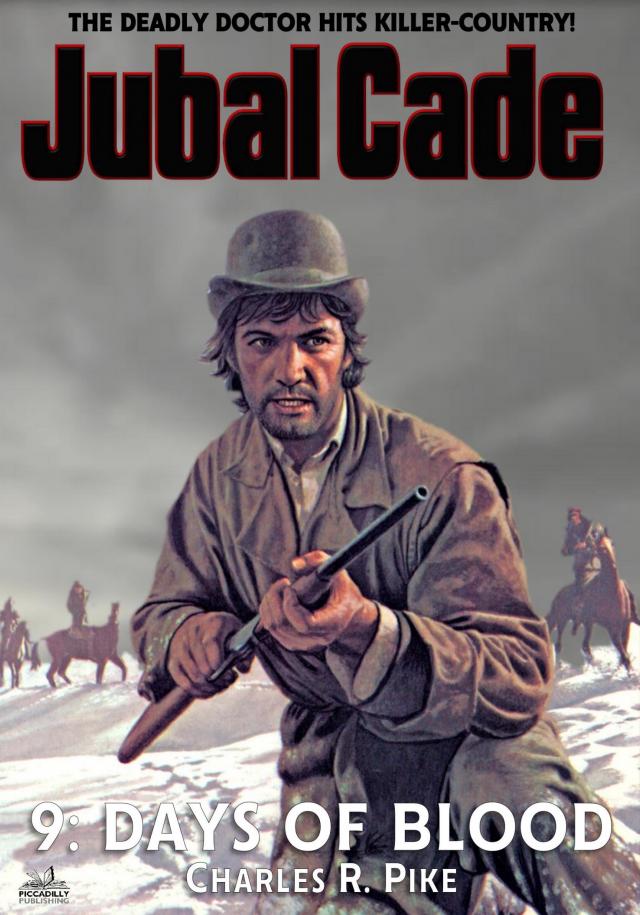
Heading east for Missouri on the Union Pacific railroad, Jubal Cade hits the peaceful little mountain community of Jamestown just after the Coley boys. And when the gunsmoke has cleared, there’s not much left except a ruined train and thirty or more butchered bodies, turning the drifting winter snow crimson with their life-blood. Reason enough for the quick-drawing medic to forget his private vendetta for a while. Reason for Cade to ride south towards the brutal badlands on a trail of violence he knows will lead him straight to a bloody duel with death...
JUBAL CADE 9: DAYS OF BLOOD
By Charles R. Pike
First published by Mayflower Books in 1977
Copyright © Charles R. Pike 1977, 2024
This electronic edition published January 2024
Names, characters and incidents in this book are fictional, and any resemblance to actual events, locales, organizations, or persons living or dead is purely coincidental.
You may not copy, store, distribute, transmit, reproduce or otherwise make available this publication (or any part of it) in any form, or by means (electronic, digital, optical, photocopying, recording or otherwise), without the prior written permission of the publisher. Any person who does any unauthorized act in relation to this publication may be liable to criminal prosecution and civil claims for damages.
This is a Piccadilly Publishing Book / Text © Piccadilly Publishing
Series Editor: Mike Stotter
Published by Arrangement with the Author’s Agent.
Cover Illustration: Richard Clifton-Dey
Read more at Piccadilly Publishing
Chapter One
JAMESTOWN NEVER WAS much of a place, just a straggle of timber-built shacks running alongside the Union Pacific Railroad where it curves around the southwestern tip of the Bitterroot Range. A long-haired mountain man called Laurence had founded the town before most of its inhabitants could remember as a trading post with the Indians who trapped the mountains for beaver, wolf and otter pelts. Laurence was long gone to an unmarked grave and for no particular reason the town had grown. Its focal point remained the sturdy-looking trading post, dealing in furs still, but also selling mining equipment, traps, guns, food and whiskey. Next in importance to the hundred-odd citizens was the Union Pacific office, a single-story building of overlapping, tar-coated planks that boasted a booking office and a telegraph machine. An eating house made most of its money from the infrequent train passengers stopping over long enough to grab a meal; a stable managed, somehow, to keep going and a ragged assortment of single roomed stores and chunky cabins comprised the remainder of the nowhere town.
Deluded by wild dreams of future prosperity, the people of Jamestown had elected themselves a sheriff, a storekeeper called Bill Tilley, whose chief duty was to lock up the odd drunk and supervise trade with the Nez Perce bringing pelts into the store. It was a pretty quiet existence, and Tilley regarded the badge pinned to his calico shirt as decoration rather than symbol of office.
Until the Coley gang hit Jamestown.
They rode in out of a gusting norther that pushed snow like pricking darts before its blast, seven men huddled into mackinaws and buffalo coats, mittened hands never straying far from the cloth-wrapped rifles sheathed alongside their saddles. Jamestown was shuttered down against the wind when they arrived, so no one saw them coming. They headed for the stable, riding in through the unlatched door, and shot the stable hand down as he walked towards them. The shots were drowned out by the howling wind, and the snow kept the one street empty, so they stabled their horses, leaving one man to guard them, as they pushed through the norther. One by one, they picked off the cabins and stores, leaving silent, smoking stoves the only sentinels for the dead.
The trading post held the bulk of Jamestown’s population, mostly men sitting drinking and playing cards, with a few weatherbeaten wives checking over the latest shipment of gingham and bonnets.
Joel Coley ended the inspection and the card games with both barrels of the sawed-off Meteor he carried on a leather strap hung around his neck. The 10-gauge buckshot spread through the store like hell’s hailstones, bloodying the bolts of cloth and splattering the cards. Three women and one man were killed outright, four more men wounded, and the six remaining women reduced to screaming panic. Behind Joel, his brothers, Will, Jesse and Frank, levered Winchesters to spread fire through the room. Tramp Hemingway and Bob Carver backed them with .44 caliber Henry rifles, pumping the magazines empty as they raked the store with bullets.
It was all finished within moments, the placid security of the warm, sheltered room reduced to a reeking cloud of cordite, tainted with the pungent odor of blood sizzling on the potbellied stoves. Twenty-two people lay dead as Joel laughed, helping himself to whiskey from the vacated bar. The others systematically stripped the bodies of valuables, hauling the corpses off to one side of the smoke-filled room.
Bill Tilley heard the sound of gunfire over the shrieking of the norther and pinned his tarnished star on the faded front of his woolen shirt. Reluctantly, he got up from the table, murmuring a vague reassurance to his pinch-faced wife, and pulled on a heavy, wolf-skin coat. He buckled his gun belt around the waist, checking the cartridges in the single-action Smith & Wesson before shoving the revolver into the holster and pulling a beaver hat low over his forehead. Then, cursing whichever drunken trapper was shooting up the place, he shuffled out into the snow.
The wind hit his face like a whip, clouding his eyes with icy particles that made him blink, watering his vision so that he found the trading post mostly by instinct. He paused outside the closed doors, cursing his negligence in forgetting to bring gloves as he drew the Smith & Wesson and pushed through the doors.
Frank Coley saw the doors open and smiled, lifting his Winchester. He watched Tilley come in, shivering as he peered vaguely round the room. Then he squeezed the trigger.
The first bullet punched out the center of Tilley’s badge, breaking two ribs as it smashed into his left lung. He coughed blood and dropped his gun, staggering back as the second shot ploughed into his chest. The third opened up his stomach and hurled him backwards through the doors. Tilley pumped blood over the snow as he sprawled full-length across the rail tracks running down the center of Jamestown’s only street. He felt the snow crystals frosting over his eyes, the knife-edged air cutting his throat, and died wishing he’d never accepted the job.
Inside the store, Joel Coley lifted a shot glass in toast to his brother, grinning like a lobo wolf.
‘C’mon.’ He downed the home-brewed whiskey in one swallow. ‘Let’s get it done.’
Without waiting to see if the others followed, he pushed outside, tying a bright red scarf around his ears. Out in the open, the wind had increased, piling drifts of snow against walls and sidewalks, pure white mostly, but tinged dark blood brown where it shrouded Tilley’s body. They ignored the deceased lawman as they dragged a wagon from a side alley, tipping it over on its side, straddling the rail tracks. Tables, planking, anything even halfway solid was added to the pile until, finally, Joel was satisfied. He turned his back to the wind, opening his mackinaw to study a heavy gold watch, then motioned for the others to follow him back into the store.
‘Should be here within the hour, less’n the snow holds her up.’ He held his hands close to a stove, warming them.
Clouds of vapor rose from Will’s bearskin as he turned to his brother.
‘You’re pure certain she’ll be on the train?’
‘Gotta be,’ grunted Joel, ‘Jesse checked her out, didn’t he?’
‘Shore did,’ called Jesse from around the neck of a whiskey bottle. ‘Comin’ in from Portland, ain’t she?’
‘Better be,’ Frank rasped. ‘It’s one hell of a long way to ride fer nuthin’ if she ain’t.’
‘Suppose she is snow-bound,’ Carver grumbled, ‘what do we do then? We can’t stay here forever.’
‘Why the hell not?’ Joel smiled. ‘Who’s gonna stop us?’
‘Joel’s right.’ Hemingway spoke for the first time. ‘Ain’t anyone left around, is there?’
Bill Tilley’s wife corrected him by appearing suddenly in the doorway. Hunched under a man’s coat, she clutched a snow-rimmed shawl around her shrewish face, sniffing loudly as she entered the trading post. Irritably, she peered round, watery blue eyes scanning the six men at the bar. She missed the bodies piled against the far wall, her gaze settling on Joel, studying his dirty mackinaw with undisguised contempt.
‘You’re the trappers, I suppose.’ Disdain hung like icicles from her words. ‘Bill shut you down, did he?’
‘Ma’am?’ Jesse Coley smiled, touching a hand to the brim of his hat in mock courtesy.
‘Bill Tilley,’ she said curtly. ‘The sheriff of this God-forsaken place. He came round here to quiet you down. Where is he?’
‘Ah,’ Jesse beamed, crossing the plank floor to place a genteel hand on Mrs. Tilley’s elbow. ‘I do believe he’s outside, ma’am.’
The woman let him steer her back to the door, simpering at the unexpected attention. Jesse smiled down at her, exposing a neat row of dazzling teeth as he affected his most charmingly boyish look.
‘Why thank you.’ Mrs. Tilley stepped through the door he opened for her. ‘If only everyone was polite as you.’
‘It’s nothing, ma’am.’ Jesse led her to the edge of the snow-covered boardwalk. ‘Pure pleasure for me.’
He smiled again, pointing across the street to the humped pile sprawled over the tracks.
‘I do believe he’s there, ma’am.’
‘Where?’ Mrs. Tilley shaded her eyes against the driving snow as she studied the street. ‘I don’t see him.’
‘Right there, ma’am.’
Jesse indicated the hump, gently propelling the unaware widow towards the corpse of her husband. She followed the swing of his arm, saw blood-stained wolfskin protruding from under the snow, and began to scream.
‘Guess you’d be kinda lonely on yore own, ma’am,’ Jesse murmured, cocking a Peacemaker. ‘Better for married folks to stick together.’
Mrs. Tilley turned, wondering what on earth the boy was talking about, and saw the gun. She was filling her lungs in preparation for a real scream when the .45 slug shut her mouth forever. It blew away her lower jaw, exiting through the back of her neck so that she fell backwards over the body of her husband in a welter of flouncing petticoats and red flannel underwear.
Jesse chuckled, watching the woman try to suck air through the blood clogging her throat, and triggered the Colt a second time. The bullet hit Emma Tilley clean between her spare breasts, killing her instantly so that she snapped back to embrace her husband closer than she’d held him in the last seven years of their marriage. She sprawled over him, snow rapidly cloaking her body in a white mantle so thick that it succeeded in covering the spreading red stain that united husband and wife in their last resting place.
After that, Jamestown settled down to its former quiet, a miserable little hamlet stuck out in the middle of nowhere, wreathed in snow like a child’s forgotten toy, left to rot through the long winter until the spring melting exposed it again.
Forty miles back, on a narrow strip of snowed-in rock edging the Bitterroots where they flanked the Snake River, a train was pushing through the mounting snow. The string of carriages and box cars were banked by locomotives fore and aft, tall-stacked workhorses of the northern railroads, near bursting their boilers as they fought their way through the blizzard.
Huddled tight around a pot-bellied stove in one of the middle cars, Jubal Cade was winning a poker session from a mixed bunch of travelers. Faced with the prospect of a second night in a freezing carriage, several groups of passengers had opted to sit it out by the stoves, forgetting the cold in contemplation of the cards. Jubal was happy enough with the arrangement—his berth was cold as anyone’s, and he enjoyed poker under almost any circumstances—especially when he was winning; like now. He set down a full house and scooped in the pot, showing his broken front teeth in a boyish grin that belied the cool brain resting under his fresh-cropped black hair.
He had been on the train for three days now, heading east and south from the site of the renegade ambush of President Grant.1
Now he was tired, anxious to reach his destination in St. Louis, and happy to break the monotony of the long journey with a poker session. So far it had been boring: an endless haul through the high reaches of the Cascade Mountains, following through along the flank of the Columbia River into the Bitterroots with snow coming up stronger every day until he couldn’t see out of the dirty windows. The negro conductor had promised a stopover in Jamestown, and even though Jubal didn’t know the place, he was looking forward to stretching his legs some place other than the observation platform sited to the rear of each carriage. He pocketed his winnings, smiling as his opponents promised revenge later in the day, and walked down the car to the rear door.
Outside, the world was white and clean and lonely, the stark blankness of the snow broken only by the pines and occasional outcroppings of rock sticking up through the whiteness like wounds. Jubal drank in the cold mountain air, glad of its freshness after the stale, smoke-ridden atmosphere of the train, savoring it like a good wine, enjoying the clean feeling in his lungs. He stayed there until his fingers grew numb, then turned back inside, heading for his private compartment.
Within the confines of the oaken-paneled cabin, he stripped off, sluicing his muscular body in the water left out by the black carboy. He shaved carefully, balancing his feet against the rocking of the train as it crawled dramatically up the gradient, rounding a sweeping bend that flanked an outcrop of rock before dropping onto the downgrade from the edge of the Bitterroot Range into Jamestown.
He wiped lather from his face and smoothed down his dark hair, checked the newly pressed creases in his grey pants, and, shivering, pulled on a fresh white shirt. He knotted a thick, black string tie around his collar and shrugged a vest around his shoulders. With a grey jacket cut by an English tailor, and the matching derby set firmly on his head, he presented the appearance of a successful traveling man, maybe even a politician. Idly, he wondered how many of the passengers he had met would guess that he was a trained doctor, or a wanted man in two states.2 It didn’t make too much difference: wanted men disappeared easily into the vast hinterland of western America, and few people looked for an outlaw in a grey suit and derby hat. So Jubal Cade walked casually, swaying against the rocking of the train, towards the restaurant car.
Several poker friends smiled as he passed, lifting hands in easy greeting to a fellow card player. Jubal smiled back, heading for his place, doffing his hat as he sat down to join the woman seated across the table.
She was the kind of woman it’s hard to set an age to, though, given a guess, Jubal would have picked something around thirty. Her hair was a dark auburn, falling in fascinating, but unfashionable, waves over her blue-velvet-clad shoulders. She smiled as she saw him, flashing perfect white teeth in a wide, sensuous mouth, belying the reserve of her dark grey eyes. Jubal smiled back, slipping into the bench across from her.
‘No change, ma’am,’ he murmured, looking at the menu card.
Her laughter was deep and rich, matching the deep swell of her bosom, accentuated by the blue dress, filled with genuine humor and what seemed like a real regard for her fellow passengers.
‘Where I come from, Dr. Cade,’ she said, still laughing, ‘dinner consists of beef plain, beef as you like it, and more beef. Beans—if you’re lucky—come extra.’
‘Yeah,’ Jubal grinned, ‘I spent some time in Texas.’3
‘Really?’ The woman’s interest seemed more than that of a casual traveling companion. ‘Are you familiar with the country?’
‘Kind of.’ Jubal remained cautious, wary of committing himself too far. ‘I know some people down that way.’
‘Interesting,’ said the red-haired woman. ‘Do you know the Cantrells?’
‘No, ma’am,’ murmured Jubal, shaking his head, ‘can’t say that I do.’
‘We’re some of the biggest landowners in the state,’ she said proudly, then blushed. ‘I’m sorry, that’s Texan boasting, please forgive me.’
‘Of course.’ Jubal wondered why people with money needed to talk about it so much.
‘I’m sorry.’ She looked genuinely regretful as she watched him over the table. ‘But sometimes I need to talk. It’s difficult when you don’t know anyone.’
‘So talk to me,’ grinned Jubal, ‘I’m willing to listen.’
‘Thank you; you’re very kind.’ She looked embarrassed as she said it, taking refuge behind the menu card.
A steward arrived to alleviate her blushes with a polite enquiry as to their dinner.
‘You got any beef?’ Jubal asked blandly. ‘Miss Cantrell’s partial to beef.’
The woman giggled as the steward recited a list of steaks, grills, sirloins and ribs; all of them beef. She chose the ribs, and Jubal joined her, asking for a bottle of decent red wine, a rare luxury in a country where meals were usually accompanied by coffee or whiskey. He had made a decision, though, when he caught the intercontinental train: he was going to enjoy himself on the journey after months in the saddle, living mostly on dried beef, bacon and plain water. He could exist quite happily on such a diet, but when the opportunity afforded decent fare, he enjoyed indulging himself.
He made polite conversation with the Cantrell woman as the train headed gingerly down the steep gradient, the engineers letting her roll on her own weight, their hands never far from the brake levers. It was warm in the dining car, heavy drapes covering the frosted windows to hold in the heat thrown from the two big stoves set in the aisle between the tables.


