

The Tail of the Arabian, Knight, page 1


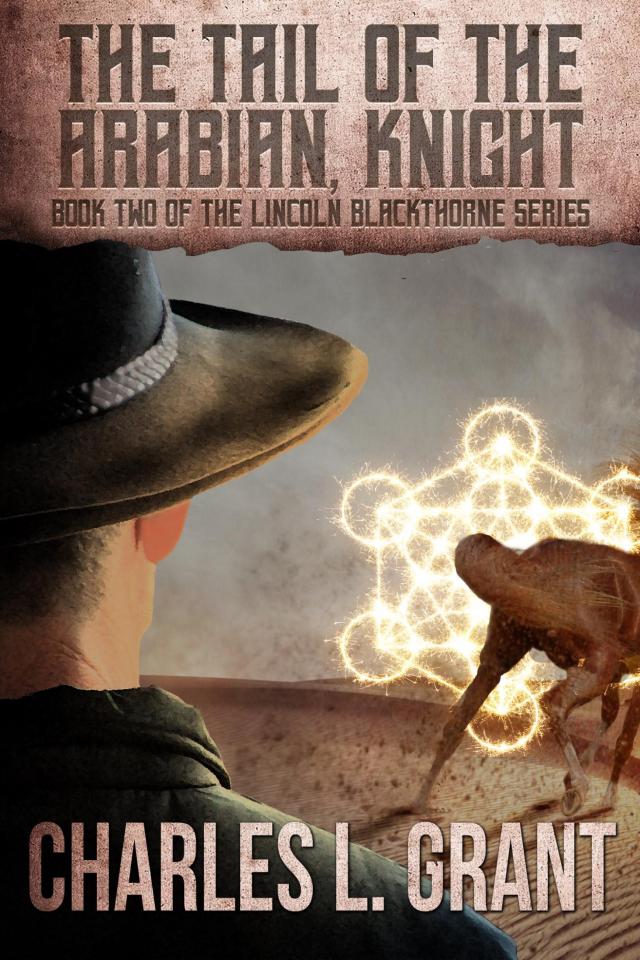
THE TAIL OF THE ARABIAN, KNIGHT
Book Two of the Lincoln Blackthorne Series
By Charles L. Grant (writing as Geoffrey Marsh)
A Gordian Knot Production
Gordian Knot is an imprint of Crossroad Press
Digital Edition published by Crossroad Press
Smashwords edition published at Smashwords by Crossroad Press
Crossroad Press Digital Edition 2019
Original publication by Doubleday—1986
LICENSE NOTES
This eBook is licensed for your personal enjoyment only. This eBook may not be re-sold or given away to other people. If you would like to share this book with another person, please purchase an additional copy for each person you share it with. If you’re reading this book and did not purchase it, or it was not purchased for your use only, then you should return to the vendor of your choice and purchase your own copy. Thank you for respecting the hard work of this author.
Meet the Author
Photo by Jeff Schalles
Charles L. Grant taught English and history at the high school level before becoming a full-time writer in the ’70s. He served for many years as an officer in the Horror Writers Association and in Science Fiction Writers of America.
He was known for his “quiet horror” and for editing the award-winning Shadows anthologies. He received the British Fantasy Society’s Special Award in 1987 for life achievement; in 2000, he was the recipient of the Lifetime Achievement Award from HWA. Other awards include two Nebula Awards and three World Fantasy Awards for writing and editing.
Charlie died from a lengthy illness on September 15, 2006, just three days after his birthday. He lived in Newton, NJ, and was married to writer/editor Kathryn Ptacek for nearly twenty-five years.
Book List
Horror
Novels
Black Oak: Genesis
Black Oak: The Hush of Dark Wings
Black Oak: Winter Knight
Black Oak: Hunting Ground
Black Oak: When the Cold Wind Blows
Fire Mask
For Fear of the Night
In A Dark Dream
Jackals
Millennium Quartet #1: Symphony
Millennium Quartet #2: In the Mood
Millennium Quartet #3: Chariot
Millennium Quartet #4: Riders in the Sky
Night Songs
Raven
Something Stirs
Stunts
The Bloodwind
The Curse
The Grave
The Hour of the Oxrun Dead
The Last Call of Mourning
The Nestling
The Pet
The Sound Of Midnight
The Tea Party
The Universe of Horror Trilogy
The Soft Whisper of the Dead
The Dark Cry of the Moon
The Long Night of the Grave
Collections
Dialing the Wind
Nightmare Seasons
The Black Carousel
The Orchard
Science Fiction
A Quiet Night of Fear
Ascension
Legion
Ravens of the Moon
The Shadow of Alpha
As “Geoffrey Marsh”
The Fangs of the Hooded Demon
The King of Satan’s Eyes
The Patch of the Odin Soldier
The Tail of the Arabian, Knight
As “Lionel Fenn”
The Quest for the White Duck Trilogy
Blood River Down
Web of Defeat
Agnes Day
The Kent Montana Series
The Really Ugly Thing From Mars
The Reasonably Invisible Man
The Once and Future Thing
The Mark of the Moderately Vicious Vampire
668, the Neighbor of the Beast
The Diego Series
Once Upon a Time in the East
By The Time I Get To Nashville
Time, the Semi-Final Frontier
The Seven Spears of the W’dch’ck
As “Simon Lake”
The Midnight Place Series
Daughter of Darkness
Death Cycle
He Told Me To
Something’s Watching
As “Felicia Andrews”
Moonwitch
Mountainwitch
Riverrun
Riverwitch
Seacliffe
Silver Huntress
The Velvet Hart
As “Deborah Lewis”
Eve of the Hound
Kirkwood Fires
The Wind at Winter’s End
Voices Out of Time
DISCOVER CROSSROAD PRESS
Visit the Crossroad site for information about all available products and authors
Check out our blog
Subscribe to our Newsletter for information about new releases, promotions, and to receive a free eBook
Find and follow us on Facebook
We hope you enjoy this eBook and will seek out other books published by Crossroad Press. We strive to make our eBooks as free of errors as possible, but on occasion some make it into the final product. If you spot any problems, please contact us at crossroad@crossroadpress.com and notify us of what you found. We’ll make the necessary corrections and republish the book. We’ll also ensure you get the updated version of the eBook.
If you have a moment, the author would appreciate you taking the time to leave a review for this book at the retailer’s site where you purchased it.
Thank you for your assistance and your support of the authors published by Crossroad Press.
This is for Charles and Kathryn
Who showed me that a man need never retire.
Table of Contents
ONE
TWO
THREE
FOUR
FIVE
SIX
SEVEN
EIGHT
NINE
TEN
ELEVEN
TWELVE
THIRTEEN
FOURTEEN
FIFTEEN
SIXTEEN
SEVENTEEN
EIGHTEEN
NINETEEN
TWENTY
TWENTY-ONE
TWENTY-TWO
TWENTY-THREE
TWENTY-FOUR
ONE
The Hillendale Country Morgan Horse Farm never once, in its eighty-three years, raised, sold, or bred a Morgan horse, even in spirit; it was, however, in the country.
More specifically, it was three miles outside the small hillside community of Inverness, in rural northwestern New Jersey, where the land is seldom flat for more than half a mile at a stretch, and the highways, such as they are, are seldom very straight. They generally follow the convoluted contours of the low, wooded hills, and are not much more than blacktopped cowpaths or resurrected coach roads; to ride one at speed is foolhardy at best, stomach-lurching at worst, and to take any one stretch of Jay Hollow Lane at any speed at all will blur the site of Hillendale into invisibility.
The farm itself lies to the right of the lane—forty verdant and rolling acres that begin below the level of the verge, sweep along a flat for two hundred yards, and climb a slope whose crest is thick with a march of white birch, pine, and blue spruce. Brown-and-grey boulders fringed with flowering weeds dot the landscape, a large pond replete with ducks breaks the green, and all of it is fenced in, as much to keep unwanted visitors out as to keep the horses from wandering onto the tarmac.
The 150-year-old farmhouse is two stories high not counting the attic, white clapboard with a peaked roof broken by four chimneys; the windows are high and narrow, and the shutters are green and laddered. The fine condition of the building is evidence of prosperity, but its back is set firmly to the lane to discourage the casual passerby from stopping for a look around.
Hillendale is not known for its hospitality.
And the first visitor in over a month was Lincoln Bartholomew Blackthorne.
It was June at Hillendale, an early afternoon when the jays scolded halfheartedly from their vantage points in the trees, the robins had given up their worm hunt for the day and were searching for suitable dust pools to take a bath in, and the green-capped ducks in the pond were diving for pearls while dragonflies dove for the peaks of their tails. In the various pastures scattered about the farm, horses grazed, or romped, or took care of the game but unsteady foals stumbling along behind. Far beyond the freshly painted red barn a silent tractor sat in the middle of a field of alfalfa, bundles of hay scattered about it, a trio of crows sitting on the steering wheel.
Not a single car had gone by in more than three hours.
None were expected to pass for at least another three.
“Now this,” said Macon Crowley with a satisfied sigh, “is the life.”
The farmhouse’s deep front porch faced the pine-topped hill, and Macon was sitting on the right-hand side of a hanging, slatted porch swing facing the front yard—an expanse of vigorous rich green no wider than the house itself and bordered by two rows of fat-boled ancient oaks which transformed the lawn into an Emersonian cathedral’s aisle leading to a large white-fenced paddock quite obviously intended for very special use of quite special stock.
“Ah, wilderness! Ah, Rousseau, you old dog! The fresh air, the smell of new-mown hay, the birds singing their lovely hearts out…” He shook his head in supreme contentment and brushed a lazy hand down the front of his blue plaid, mother-of-pearl-buttoned cowboy shirt. Around his slightly paunched waist was a silver-and-turquoise concha belt, on his feet a pair of hand-tooled brown boots whose toes came to a rather nasty point, and the jeans he wore were nearly as white as his trimmed white beard. The only thing missing was a ten-gallon hat. “I tell you, it smells exactly like paradise.”
“I’ll tell you what it smells like,” Old Alice said. “It smells like horse.” She was sitting with him on the swing, on the edge of the seat so her Greek leather sandals could touch the grey floorboards.
“It’s supposed to,” he told her tolerantly. “It’s a horse farm.”
Old Alice adjusted her sombrero with the plastic grapes on the brim and snorted. “Stupid name. A farm is where you plant things, watch them grow, pluck ’em out and eat ’em. I never saw anybody plant a horse except when he was dead. They do not plant horses, do they, Palmer?”
Palmer Crowley lounged in a bentwood rocker on the other side of the steps. His eyes were closed, his double chins gleamed and quivered, his red face shone like a freshly polished ruby. He grunted.
“Told you,” said Alice.
“Farren Upshire,” declared Macon, “can call it a dairy for all I care. It’s still beautiful.”
“It still smells like horse.”
In the paddock were three energetic and stunning mares—two blacks and a grey. They were not Morgans by any stretch of a blind man’s imagination; they were purebred Arabians, and their combined value on a bad day at the market easily exceeded one million dollars.
Macon sighed resignation at Alice’s unromantic obstinacy and glanced wistfully over his shoulder. There were three tall windows evenly spaced behind the swing, their white-tufted curtains pulled back, their new white shades raised all the way up. Their screens did not permit a view of the large parlor inside, but he could hear two voices in earnest conversation, low and unintelligible.
“Stop spying,” Old Alice said, punching his leg just shy of causing a cramp.
He watched disdainfully as she lit a long violet cigarette with an engraved gold lighter, and blew a series of smokerings that would have gotten her top pay in any European circus. “You fail miserably and without redemption to grasp the romance of the place,” he said at last.
“Get stuffed.”
“What?”
“Stuffed. Roy Rogers got his horse stuffed, you know. Put him in a museum, I think. Or up in his bedroom. Something like that.”
“A splendid animal. Trigger was his name.”
“His dog, too.”
“A noble beast. Bullet, I believe. A most remarkable German Shepherd.”
“Probably Dale Evans when she goes.”
“The family that stays together—”
She hit him with a grape.
They swung in companionable silence for several minutes while the horses grazed and Palmer snored and the chains that held them up nearly creaked them to sleep.
Finally, Old Alice groaned with not a little boredom and slid off the benchseat, steadied herself, stretched, and walked stiffly to the railing. There she took a deep breath, coughed, lifted the sombrero’s floppy brim, and sniffed. “Hey,” she said softly, rubbing one hand over her bony hip. A crouch, another sniff. “Hey,” she said again.
Macon watched as the grey mare nervously paced the length of the paddock’s back fence, tossing her head, snorting now and then before breaking into a short run. Alice crouched lower to see under the eaves to the crest of the hill. Then she sat down, and Macon took her place.
“Better tell Blackie,” she said, lighting another cigarette with the butt of the first.
“A squirrel, most likely.”
“You ever see a squirrel that looked like Gene Autry?”
“Could be just a rider. There are lots of other farms around here, y’know. He could be just passing by, minding his own business, saw us and wanted to take a picture for his scrapbook.”
“Been there a while, right, Palmer? And he doesn’t have a stupid camera.”
Palmer snored and nodded.
Macon looked around, at the screen door half again as wide as normal. “He doesn’t like to be disturbed when he’s doing a fitting,” he said.
“He measured a circus tent last week. Farren won’t know the difference.”
Macon hesitated, then strode to the door and knocked on the frame. Waited, and knocked again.
Inside, the voices stopped.
“Well?” said Old Alice as he took his place beside her.
Macon sighed. “Here we go again, I think.”
Old Alice grinned. “Good! I hate it when Blackie hasn’t got anything to do.”
A minute passed, then two, and just as Macon was about to rise and summon Lincoln again, the oversized screen door creaked open, the floorboards shuddered, and Palmer shifted uneasily in his rocking chair.
“What is it, folks?” Farren Upshire asked quietly, squinting at the bright afternoon light. He was just under six feet tall and just over 350 pounds, most of which was gathered solidly around his waist and bulging his trousers to an inordinate degree, thus requiring two stout canes to maintain his balance. His hair was thin and black, his face more folds than creases, and when he spoke so much of him moved that some in his acquaintance have never seen his mouth. He was wearing a pair of trunk-hugging red plaid trousers held up by a pair of red-and-blue suspenders; the waistband almost made it, the rest of the material didn’t. His chest was bare, and so thick with black hair that many people believed he always wore a sweater.
Though he was obviously annoyed at being disturbed, the cane in his left hand thumped the floor like a happy dog’s tail as he smiled broadly at Old Alice, giving her a wink only a blind woman would take for something amiss with his eye.
Upshire loved only his horses, but lust was a vice he was determined to taste at least once before dying.
“What?” he asked again, face creased into a puzzled frown.
“Need to talk to Blackie,” Old Alice said, turning away from his appraisal of her figure with an insulted shrug. Alice had her quirks, but blubber wasn’t one of them.
“We’re mighty busy in there,” he explained in his best love-struck voice. “Lincoln—you know he don’t like being tagged Blackie—he ain’t quite finished with me yet. Sharkskin’s a chore when it comes to a good fit, all them wrinkles and things. A fine tailor that boy is, but he don’t know everything yet about sewing and patching. His mind wanders from time to time, if you know what I mean.”
Macon wiped a hand over his face.
Alice pulled down the sidebrim of her sombrero.
Upshire ignored what he thought might have been giggles and lumbered to the top step to peer down the stretch of lawn to his favorite horses.
“Lovely,” he said with a distinct catch in his voice. “I could just look at them lovely critters for hours. Such lines—so delicate, so perfect. Do you folks know,” he said, glancing over his shoulder to be sure they were listening, “that Arabians are the friendliest horses in the world? It’s in their nature, that’s what it is. Their nature. They’d do anything for their master, long as he treats ’em right.” He sighed, and sniffed. “Run their little equine hearts out if they was asked. Yessir. Mighty fine creatures. Mighty fine.”
The door opened again, Lincoln stepped out, slender and of medium height, with thick brown hair drooped slightly over his forehead. There was exasperation in his expression, and a cloth ruler draped over one shoulder. He did not squint at the light, and his dark eyes took in Upshire’s naked back before turning to Macon.
“What,” he said, barely containing his impatience.
“Echo,” said Old Alice, and lit another cigarette.
“Company on the hill,” Macon told him as he turned to head back inside; the old man jutted his beard like a pointer, moving away from Alice now that Upshire’s attention was diverted. “Don’t think it’s a bird-watcher.”
Lincoln stopped.
“Cowboy,” said Old Alice.
Lincoln turned.
“On a palomino,” said Macon.
“You’re kidding.”
“White hat, white shirt, white pants, white boots,” Alice explained as Lincoln moved behind Palmer and bent down to look up the slope. “If he’s dead, he’s a damned pretty ghost.”
“And I was going to Maine,” he muttered in disgust. “My bag is already packed. Tomorrow at dawn I was going to lock up the shop, bury the key, and drive up there for a well-deserved vacation.”


