Boomer, page 1


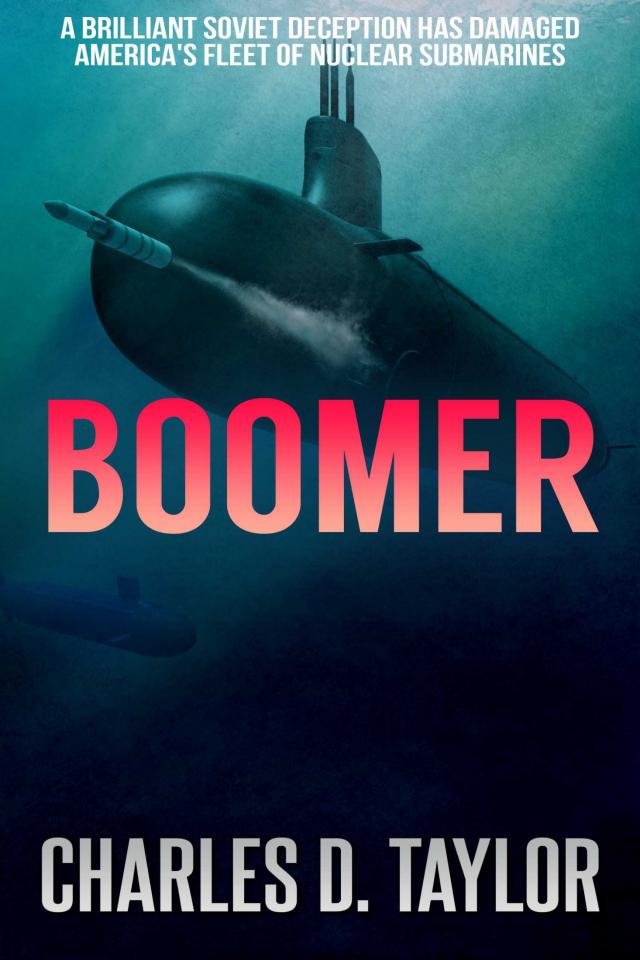
BOOMER
By Charles D. Taylor
A Gordian Knot Production
Gordian Knot is an imprint of Crossroad Press
Digital Edition published by Crossroad Press
Smashwords edition published at Smashwords by Crossroad Press
Crossroad Press digital edition 2023
Copyright © 1990 Charles D. Taylor
LICENSE NOTES
This eBook is licensed for your personal enjoyment only. This eBook may not be re-sold or given away to other people. If you would like to share this book with another person, please purchase an additional copy for each person you share it with. If you’re reading this book and did not purchase it, or it was not purchased for your use only, then you should return to the vendor of your choice and purchase your own copy. Thank you for respecting the hard work of this author.
Meet the Author
Charles Taylor is the bestselling author of thirteen naval action/adventure novels, primarily featuring the nuclear submarine service and the U.S. Navy SEALS. After serving as a Naval Reserve destroyer officer in the Atlantic and Caribbean, he followed a career in both educational and literary publishing. He currently divides his time between summers in Wyoming and winters on the Caribbean island of St. Croix.
Bibliography
Boomer
Choke Point
Counterstrike
Deep Sting
First Salvo
Shadow Wars
Shadows of Vengeance
Show of Force
Sightings
Silent Hunter
Summit
The Twilight Patriots (previously published as The Sunset Patriots)
War Ship
DISCOVER CROSSROAD PRESS
Visit the Crossroad Press website for information about all available products and its authors
Check out our blog
For information about new releases, promotions, and to receive a free eBook, subscribe to our Newsletter at the bottom of any page on our website
Find and follow us on Facebook and Twitter
We hope you enjoy this eBook and will seek out other books published by Crossroad Press. We strive to make our eBooks as free of errors as possible, but on occasion some make it into the final product. If you spot any problems, please contact us at crossroad@crossroadpress.com and notify us of what you found. We’ll make the necessary corrections and republish the book. We’ll also ensure you get the updated version of the eBook.
If you have a moment, the author would appreciate you taking the time to leave a review for this book at the retailer’s site where you purchased it.
Thank you for your assistance and your support of the authors published by Crossroad Press.
This book is dedicated to my mother, Ruth H. Taylor, whose support remains unending and the memory of my father, who said he was so proud that his son was the first author in the family.
“A strategic balance acceptable to the United States must be consistent with our national security objectives and supportive of America’s basic defense strategy—deterrence of aggression. Above all, it must provide a stable deterrent by ensuring there are no circumstances under which the Soviet leadership might believe it could execute a successful first strike against the United States … deterrence can only be assured by convincing the Soviet leadership that the probable costs of their aggression will exceed any possible gains.”
—from Soviet Military Power: An Assessment of the Threat, written and produced by the Department of Defense, 1988
“In the future, the U.S. SSN, designed for such long-range hunting, will find itself in a melee at close range, much like a knife fight in a dark alley.”
—from Melee Warfare by Lt. Daniel F. Nylen, USN, Proceedings of the U.S. Naval Institute, October 1987, pp. 57-64
“There is a great danger that you will solve political problems with military actions.”
—Robert S. McNamara, former Secretary of Defense—personal comment on the 1962 Cuban crisis on Public TV
Acknowledgments
In addition to discussing this book with a number of people, both military and civilian, I have read many books and military and professional journals. In attempting to translate numerous pages of my notes, I may inadvertently have used someone’s words or phrases in dialogue or in simplifying technical sections. I would like to both thank the authors for the impression they made on me and apologize if I have altered their original intent.
For those interested in naval affairs, I can highly recommend the Proceedings of the United States Naval Institute, an organization I have been a proud member of for more than twenty years; their naval publishing program is without peer. The finest book available on the U.S. submarine force is Silent Chase published by Thomasson-Grant, Inc., with photos and tent by Steve and Yogi Kaufman, the latter a retired vice admiral.
I would like to thank Dan Mundy and Bill Stritzler for their suggestions, Lieutenant Commander Jack Ward, USN, for coordinating one of my visits to New London, Bill McDonald for his never-ending interest in my books, Dominick Abel for managing the difficult role of agent and friend, Paul McCarthy for showing me how an editor’s talents can make all the difference in the world, and my wife, Georgie, for her critical help as she survived yet another manuscript—and me. And special thanks to Nelson DeMille for allowing me to borrow a superb idea from his book, The Charm School, After I had completed the manuscript and turned Wayne Newell loose on the world, Nelson was kind enough to allow me even greater justification for such a heinous character, whom you will appreciate even more after reading Mr. DeMille’s fascinating story.
Table of Contents
* * *
Prologue
Chapter One
Chapter Two
Chapter Three
Chapter Four
Chapter Five
Chapter Six
Chapter Seven
Chapter Eight
Chapter Nine
Chapter Ten
Chapter Eleven
Chapter Twelve
Chapter Thirteen
Chapter Fourteen
Chapter Fifteen
Chapter Sixteen
Chapter Seventeen
Epilogue
Author’s Note
Prologue
Discovery
NEVADA NOW TWENTY-FOUR HOURS OVERDUE REPORTING
Impossible!
The odds of such … why, not even the Fates could be tempted in this manner!
Vice Admiral Mark Bennett stared blankly at the sheet of paper in his hand, no longer seeing the words. Instead, an image of Nevada—a blur at first, then a razor-sharp replica—swam before his eyes. He’d been aboard when she went on her initial sea trials. A fine submarine … a superb crew….
There was no reason to reread the message—he’d memorized those seven words instantly. Bennett was the single addressee—Deputy Chief of Naval Operations (DCNO), Undersea Warfare.
The originator, Rear Admiral Neil Arrow, was Commander Submarine Force, Pacific (COMSUBPAC). They were the closest of friends, classmates twenty-five years before at nuclear-power school, then six additional months at the same reactor. Arrow had sent the message under a security classification that he’d used only twice in his life, and both times to Bennett. For the second time that week Mark Bennett had been required to remove another onetime code from his safe, and once again he broke the message himself: NEVADA NOW TWENTY-FOUR HOURS OVERDUE REPORTING.
These six words might not have been nearly so ominous if a similar report hadn’t been received a little more than three days before, with equally frightening impact: ALASKA NOW TWENTY-FOUR HOURS OVERDUE REPORTING. And every four hours after that, following the rigid requirements defined for reporting such incidents, Arrow continued to confirm the fact that Alaska, a Trident ballistic-missile-firing submarine, was missing. Bennett had, of course, reported the situation to each individual in the chain of command with a critical need to know, ending with the President of the United States—eight men, no more. It was a relatively new procedure, secure, safe, and intended to reassure senior officers. But the loss of 192 strategic warheads, which each Trident carried, was hardly reassuring.
Two boomers, two nuclear-powered ballistic-missile submarines (SSBNs), vital links in the strategic triad defending the United States, had now failed to respond to a critical one-time safety report from their stations at the scheduled time—Alaska for almost sixty-five hours now. It had been an experiment, designed to evaluate the security of a new communications system. Under normal conditions there was no such thing as an SSBN violating security to send a message, not even a one-time-burst transmission. It simply wasn’t necessary, not when stealth meant everything. Once an SSBN departed homeport and evaded her Soviet tails, she remained mute until returning home. She had to be in her assigned station because she hadn’t said she wasn’t. That’s the way the system functioned. It was that simple.
Initially, Alaska’s failure was considered an equipment casualty. Communications gear had gone down at critical times in the past and it would again. This new system was untested under mission conditions, and the state of the world was deemed copacetic enough to run this single, critical test. So Arrow had instituted the standard procedures to reestablish contact with Alaska with a short, extra-low-frequency (ELF) query. Nothing. No response. Both admirals concurred there could be any number of causes—that there was no reason to be concerned—but this second message….
Admiral Bennett’s hand began to shake, but so slightly that he failed to not
Bennett placed the message on his desk and smoothed it with his hands before depressing the button to the outer office. “Florence, would you please call Admiral Larsen’s office for me. Tell him I’ll be there in three minutes.” He would need the first two minutes in the head to compose himself before walking into Larsen’s office. Raymond Larsen may have been another close friend, but he was also Chief of Naval Operations and never overlooked a human weakness—especially from someone who might one day sit in his chair.
When he stepped from the private bathroom at the rear of his office, the red light was blinking on the interoffice communicator. “Yes, Florence.”
“Admiral Larsen has Secretary Kerner and two senators in his office now. He asked that you come by about noon.”
Bennett moved into the outer office and tapped his secretary on the shoulder. “Call back and tell him to throw out the senators. The Secretary can stay.” The Secretary of the Navy was part of the chain. “Tell him it’ll still be three minutes because I’m going to bring Admiral Newman with me.” Robbie Newman was Director, Naval Nuclear Propulsion, one of seven full admirals in the Navy at the time. Bennett was out the door before Florence had gotten the CNO’s office back on the line. Newman, who’d come from his Crystal City office, would be waiting outside Larsen’s office.
The Chief of Naval Operations’ office became deathly quiet after Mark Bennett explained as succinctly as possible that Nevada had now joined Alaska among the missing. Neither the Secretary of the Navy nor two of the Navy’s most senior admirals could find the correct words. They stared at each other, eyes shifting from one individual back to another as if one of them would suddenly come up with an answer. It was a quirk of fate—if they hadn’t agreed to this experiment, just once.…
“One … possibly,” the CNO finally murmured. “But two … highly unlikely.”
“Two … almost impossible,” the Navy Secretary concurred.
Silence once again dominated the room.
Then the Secretary spoke up again. “How many boomers do we have on patrol in the Pacific right now?”
“Including Alaska and Nevada, there are four,” Bennett responded. “We have two in transit right now, four alongside the pier.”
“I’d better inform Harry Carpenter now,” the CNO decided. “He’s going to fight me on this one.” Carpenter was the President’s Chief of Staff.
“The hell with him,” the Secretary interrupted. He knew much more about the workings of the White House than he did about the Navy. “This is for the President directly. I don’t want us wasting a second with Carpenter’s bullshit … just in case….”
Long-range strategic bombers and intercontinental ballistic missiles, the other two elements of the country’s triad, were more fragile. They could be shot down, destroyed in their silos, possibly sabotaged, but the SSBNs were supposed to be invincible, impregnable to Soviet intelligence efforts. They were the single element of the triad that kept the balance, and they carried almost half of the U.S. strategic weapons. One missing boomer was critical to United States security. But two of them gone left a gaping hole in American strategy—especially if they had been sunk—for the country was essentially on its hands and knees, at the mercy of its enemies.
How many more?
And how…?
Chapter One
Looking Back: How the Impossible Took Place
The American 688-class attack submarine (SSN) is slightly longer than a football field but only thirty-six feet wide, a sleek, silent hunter. Since she is nuclear powered and designed exclusively to deliver torpedoes and surface-hugging missiles, creature comforts are respectable but secondary, unlike the immense SSBNs more than twice her size. The wardroom of this smaller submarine is the size of a dining room in a comfortable suburban home, perfect for a party of perhaps eight to ten people, a little tight for more. It is the place the captain meets with his officers.
With the exception of those on watch, all of the officers of USS Pasadena were now assembled in the wardroom at the captain’s request. As a result, the most junior officers were unable to be seated, and leaned, arms folded politely, against the bulkhead.
Wayne Newell sat in his normal place at the head of the table as Pasadena’s commanding officer. This was his second tour on a boat of this class, and he exuded confidence in every aspect of his job as a result. Since he had already put in his necessary time on a ballistic-missile submarine, he assumed squadron command might come with his imminent promotion to captain.
Newell looked Navy. Even in the working khaki uniform worn at sea, he was immaculate. His shirt was starched and pressed knife sharp, like a Marine’s, his commander’s silver leaves and submariner’s dolphins reflected the overhead light brilliantly, and three rows of service ribbons accounted for his successful career. His brown hair, cut once a week, was never ruffled. With his hands folded on the green-felt table cover, his blue eyes fell on each of his officers as he spoke. “Navy regs don’t require a speech at a time like this.” A slight, comforting smile displaying even white teeth appeared—a casting director’s dream come true. “I’m sure the rumor has already hit every compartment, and the answer is—no, we’re not involved in a nuclear war, at least none that I’m aware of.” More smile to put his officers at ease. “But, yes, there appears to be a definite possibility.”
This was one of a number of such wardroom gatherings over the past week. Newell, aware that it was vital to keep every member of Pasadena’s crew well informed, had insisted that the contents of each critical message be known to his men. From that initial warning—this is not a drill, repeat, this is not a drill—every man had known that international problems were escalating. They had also learned that Pasadena might serve a critical role in the coming days. Pride, instilled by their captain, had a great deal to do with their performance since that first moment. They were ready … committed … completely under his control.…
“We are approaching our assigned station, which is a point approximately fifteen hundred miles south of Adak and three thousand miles east of the main Japanese island.” It was something they already knew, but Newell was repeating exactly where they had been ordered so no man could possibly doubt anything during this patrol, literally a voyage into the unknown. “We will shortly stream our antenna for one hour in anticipation of our next set of orders. From what little we have been able to gather, diplomacy is still in effect—Washington and Moscow are apparently talking … common sense, I hope,” The captain smiled again and glanced around a table of comfortable officers. He sensed that they knew they were well led.
“Captain?” The engineer officer raised his hand.
“Don’t tell me we’re running out of gas, Kirk.” Newell chuckled. It was a joke that had continued between the captain and Kirk Wolters for the better part of a year.
“Not yet, sir … filled up at the last pit stop.” Wolters had learned to enjoy the banter. His sense of humor had been almost nonexistent until Wayne Newell learned that his engineer needed to be drawn out. Kirk was the most serious of the officers, and his lack of imagination would eventually hurt his career pattern. But now Wolters, thanks to his captain, was even willing to have a few beers ashore with the other officers, something he’d been hesitant about previously. “It’s just … well, how do we know this isn’t an elaborate scheme to test our readiness?” He was as loyal as an officer could be, dedicated totally now to serving Wayne Newell.
“At this point, it would be one hell of a dirty trick, something I’d take right to CNO if it turned out that way. That’s why I’ve had the XO right at my side since about thirty seconds after that first message was broken.” He nodded at Dick Makin, his executive officer. “He agrees with me that they might have yanked our chains for forty-eight, maybe even seventy-two hours, but no longer than that.”