Shadow Wars, page 1


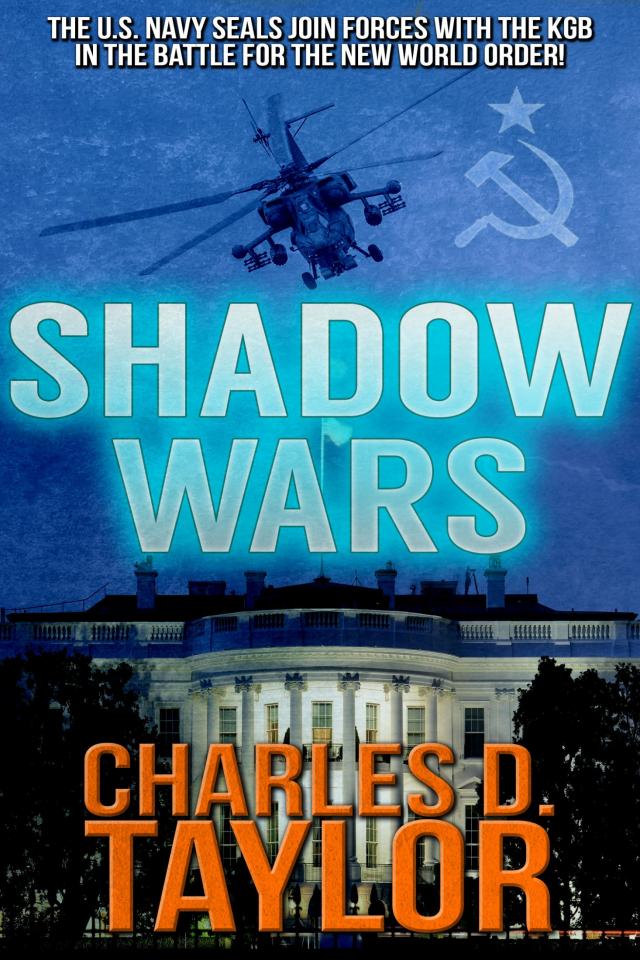
SHADOW WARS
By Charles D. Taylor
A Gordian Knot Military Thriller
Gordian Knot is an imprint of Crossroad Press
Digital Edition published by Crossroad Press
Smashwords edition published at Smashwords by Crossroad Press
Digital Edition Copyright © 2015 Charles D. Taylor
Partial cover image courtesy of Nick Savchenko
LICENSE NOTES
This eBook is licensed for your personal enjoyment only. This eBook may not be re-sold or given away to other people. If you would like to share this book with another person, please purchase an additional copy for each person you share it with. If you’re reading this book and did not purchase it, or it was not purchased for your use only, then you should return to the vendor of your choice and purchase your own copy. Thank you for respecting the hard work of this author.
Meet the Author
Charles Taylor is the bestselling author of thirteen naval action/adventure novels, primarily featuring the nuclear submarine service and the U.S. Navy SEALS. After serving as a Naval Reserve destroyer officer in the Atlantic and Caribbean, he followed a career in both educational and literary publishing. He currently divides his time between summers in Wyoming and winters on the Caribbean island of St. Croix.
Book List
Boomer
Choke Point
Counterstrike
Deep Sting
First Salvo
Shadow Wars
Shadows of Vengeance
Show of Force
Sightings
Silent Hunter
Summit
The Twilight Patriots (formerly published as The Sunset Patriots)
War Ship
DISCOVER CROSSROAD PRESS
Visit us online
Check out our blog and
Subscribe to our Newsletter for the latest Crossroad Press News
Find and follow us on Facebook
Join our group at Goodreads
We hope you enjoy this eBook and will seek out other books published by Crossroad Press. We strive to make our eBooks as free of errors as possible, but on occasion some make it into the final product. If you spot any problems, please contact us at publisher”crossroadpress.com and notify us of what you found. We’ll make the necessary corrections and republish the book. We’ll also ensure you get the updated version of the eBook.
If you’d like to be notified of new Crossroad Press titles when they are published, please send an email to publisher”crossroadpress.com and ask to be added to our mailing list.
If you have a moment, the author would appreciate you taking the time to leave a review for this book at whatever retailer’s site you purchased it from.
Thank you for your assistance and your support of the authors published by Crossroad Press.
This book is dedicated to the memory of Dick Makin and Peter Simonds, dear friends when we were together here. Both loved the prospect of becoming fictional heroes to sail with my imagination beneath Pacific waters in Boomer. Their ventures in both worlds were well done and they are missed.
Acknowledgments
It would take pages to thank the numerous individuals who made the research for this book possible since they are: historians, economists, political scientists, specialists in terrorism/counter-terrorism/covert operations, journalists, and so many other subspecies of talent. They are the authors of numerous articles and books on the above subjects. Special note should be made to Steven Emerson and his superb article on the Stasi which is quoted on the following page.
Paul McCarthy, once again the SEAL of editors, contributed superb ideas and editorial skills to help me see through the “shadows.” Dominick Abel’s calm advice means a great deal each time those “shadows” seem to grow longer. Dr. Carmine Gorga was patient in his valiant efforts to explain the hazards of instantly converting a socialist system to a market economy; economic inconsistencies in this story are my own. Dan Mundy and LCDR Jake Jaquith, USN (who eases into the role of David Chance each time) continue to offer solid help with the manuscript. Norm MacVicar lent his computer genius to author and publisher with just nanoseconds to go. And though I once thought I might finally get by without a captain and his lady after thirty years, Bill and Anne McDonald continue to welcome me at their door with friendship and advice.
My wife, Georgie, remains my most critical reader and that is one of the many reasons for loving her.
Author’s Note
While the fearsome KGB has been renamed the Agency for Federal Security, the organization’s goals have not altered radically. The reform director appointed in the euphoria of change in 1991 lasted only four months. It is the author’s decision to continue to utilize the more familiar acronym—KGB.
“… the world order is changing and many of the changes we see today may continue independent of actions by the United States or Soviet Union.”
—Admiral Carlisle A. H. Trost, USN (Ret.),
U.S. Chief of Naval Operations, 1987-1990,
from his address to 1,150 officers,
instructors, and General Staff at Grechko
Naval Academy in Leningrad
“… East Germany’s Ministry for State Security—the Staatssicherheit—[also known as] the Stasi [was] perhaps the most sophisticated and far-reaching espionage organization ever created…. The Stasi officers form a strong, cohesive subculture; they are proud of their organization and traumatized at losing their privileged status. East German authorities fear that a demogogue could rally Stasi officers and stage an insurrection, using weapons from secret caches and bunkers.”
—Steven Emerson,
“Where Have All The Spies Gone?”,
New York Times Magazine,
12 August 1990
SHADOW WARS
Prologue
“The Disaffeeted … is composed of an infinitude of elements; but we design especially to speak of those persons who, by the fall of former governments, have been injured either in their fortunes or affections. They never take a part in the insurrection as mere common soldiers. [These men] practised in the routine of political life, are too skillful to leave any traces of their maneuvers. Everything of this kind reaches its destination among them only from the third or fourth person. Thus far it [the police] has been unable to follow this train of bribes and intrigues into its obscure shades. These men, who are the very leprosy of the body politic, are uncontestably the most dangerous of all others to every government.”
—History of Secret Societies
written in 1864 by Lucien de la Hodde,
the chief French police spy of the 1830s and 1840s
Snow, fresh from the heavens, beautiful in the late afternoon half-light. White. Clean. Pure. Fresh … concealing.
Soot, soot from old factories, soot from low-banked basement furnaces … brown, black, clinging. It was ugly stuff, unclean, violating the purity of the falling snow—until it was concealed.
You’re lonely, feeling sorry for yourself, Ryng thought, alone in a strange, foreign city and feeling sorry for yourself because once a beautiful woman you don’t deserve to know made you feel more special than anyone since … He kicked angrily at a chunk of dirty ice, ashamed of himself for dredging up that image from so long ago and halfway round the world.
“Memories of good women and old wars die hard for graying warriors, Bernie.” That’s what Pratt had said so many years before, and repeated more times than Ryng could remember. Pratt, that lovely son of a bitch—he was dead, too.
Are you lonely, old man? Or are you angry with yourself because you can’t help falling in love with a girl who could be the daughter you both never had a chance to …
Now, strolling down a snow-covered sidewalk in the ancient city of Prague toward the only apartment the embassy had been able to obtain on such short notice, he forced the image of the woman he’d loved more than twenty years before from his mind. He let the blonde return, beautiful, vibrant, young … young enough to be your daughter for God’s sake! Not so many years ago she was so young he would have been sent to jail for doing what he wanted to do with her now. What does Katherine—Kat she’d insisted because her stuffed-shirt father always used her full name—what does she see in a man my age?
The crunching of a profusion of winter boots over old ice and new snow combined with the rumble of passing vehicles to blot out individual sounds he would normally have noticed. He never heard the big, black car downshift as it slowed behind him, never had the opportunity to note the tinted windows, never looked up as it slid to a stop at the corner ahead. All he could see was Kat, blonde and blue eyed, vivacious, and so crazy that she’d fallen in love with someone like him.
Citizens of this eastern European city might have studied the vehicle more closely but for the diplomatic license plates. Those were a given on a car that size. No matter the government in power, communist then or democratic now, that mode of travel and the accompanying anonymity still seemed to the average citizen a right of the current bureaucracy. Security, even in their new world of openness, required it. Old habits were hard to break. Change came slowly. Even the fresh snow lost its luster of purity in hours.
The passenger in the front seat of the vehicle had raised a hand to indicate the driver should slow as they approached the broad-shouldered individual striding through the snow. “Yes … yes, that’s him,” he said as much to himself as the other two. “I’d remember him a hundred years from now. Stop down the street, by the corner.” Maybe a little older, he though
It would have been impossible for anyone who’d ever encountered that broad-shouldered man, Bernie Ryng, to forget him. In an earlier age, he would have been a gladiator, a janissary, a Cossack, a musketeer, a dragoon, a cavalryman—the quintessential warrior. He was a Navy SEAL, revered by his own kind, feared and hated by his enemy, considered a necessary evil by the civilians who depended on men like him. He was also an old SEAL, a man who’d operated on every continent in both official and covert operations for almost twenty-five years. Now his knees were scarred by surgery, his joints and muscles ached after an hour’s swim or a ten-mile run, and there was a new generation who thought his reactions had grown too slow. Old fart—that’s what they were thinking but they wouldn’t have said it to his face, or to anyone who’d ever worked with him.
So what do they do with an old SEAL? When the black-shoe Navy in the Pentagon determined that his age precluded success in future operations that were designed for younger men, they decided to retire him. But friends, good friends who understood that tiny special warfare brotherhood, and a few knowledgeable officials on Capitol Hill knew he was too good to dump on the civilian world. Assigning him to embassy duty in Eastern Europe as a military attaché was a means of keeping him around until they needed his talents again.
When the big, black car rolled to a stop, the passenger in the front seat spoke to the two in back without turning his head. His voice was neutral, a monotone—“Remember, above all else you must remain at arm’s length when you speak to him. He can still take you both. Be polite. Be firm. Call him ‘Captain Ryng’ so he has no doubt you aren’t making a mistake. He will know you’re operating under orders but you mustn’t mention my name. Make clear immediately that your orders are not to harm him … that a past acquaintance must speak with him under the most secure terms … that he will be returned to this exact location in no more than two hours.” It would be senseless to mention his name. After their previous encounters, Ryng’s response would be pure hatred—a mutual feeling.
Ryng froze before the first one had completed a sentence. His civilian clothes, the bulky winter overcoat, that sensation of being out of uniform—it was all so foreign, and so difficult to react when you sensed danger. He turned slightly to study the speaker, a burly individual clumsily attempting to complete his memorized sentences in heavily accented English. But, like the other, he was definitely capable of handling himself. Neither face was familiar. But they were professionals, certainly well trained to use their physical presence when necessary—lousy language ability, yet comfortable in stopping him, definite in their mission whatever that was.
“Why are you approaching me in this manner?” Ryng asked calmly.
The first speaker looked to the other for help. The second man never shifted his weight, which broadcast an increasingly nervous, aggressive attitude. “No harm to you intended, Captain Ryng,” he stated. “That we are ordered. Your return to here will be …” but he stumbled searching for the proper words.
“Guaranteed,” Ryng finished for him. “I know that. Your friend here managed to say the same thing. Who’s so interested in talking with me?”
“Please, Captain, harm is not …”
Their hands remained at their sides. “Are you armed?”
“No guns,” the first one insisted emphatically. “But we can …” and he made a fist and lifted it up for Ryng’s inspection.
Ryng looked up and down the street. “Would you harm me in front of all these people?” he asked, indicating passersby.
“Times have changed, Captain Ryng,” answered the second in more passable English. “But it is still hard for these people to realize they might actually come to a fellow citizen’s aid without ending up in prison themselves. We could easily convince them that you were a dangerous criminal resisting arrest.”
“Time, sir,” said the first, glancing at his watch. “It is …”
“Fleeting,” Ryng offered. They were correct. There was little point in resisting at this stage. There was something about their approach that signified he would be safe taking the gamble. “Where are we going?”
“Just ahead, that car—the black one.”
Stepping out swiftly toward the vehicle, Ryng forced the two men to catch up with him. Reaching the car, he bent down to peer inside. There was only his reflection in the opaque windows.
The back door was pulled open. “Please, Captain Ryng, if you will join us.”
Ryng eased into the back seat, sinking into plush velveteen cushions worn smooth by years of bureaucratic rumps. The interior smelled of old, polished wood and stale tobacco smoke. The two others slid in on either side of him as the car pulled away from the curb. There was an awkward silence as the three of them stared expectantly at the mute, unmoving passenger in the front.
“Captain Ryng,” the man began after they’d settled into traffic, “I thank you for allowing us to speak briefly together. If you will trust me for two hours, you have my personal assurance that you will be returned unharmed regardless of your reaction to me or our discussion.” He did not turn as he spoke in near perfect English, expressionless but polite. “We are proceeding to a place where we can talk privately, just by ourselves. I must ask you to allow my men to blindfold you now as a security measure. It’s certainly an imposition but also as much protection for you as it is for the location of my office in the event you want nothing to do with me.”
Ryng retained a vision of razor-cut blond hair neatly trimmed across a thick neck as the densely woven black cloth was placed over his eyes and knotted tightly across the back of his head. The car twisted and turned through the streets until there wasn’t a chance of remembering where they would eventually stop.
When they came to a halt, there was the sound of a garage door closing behind them. The front door of the car opened and shut indicating the stranger had gone on ahead by foot. After a suitable delay, Ryng was assisted from the back seat. With one of the men on either arm, he followed detailed instructions that guided his steps through a door from the garage up a short stairway, then into an obviously ancient and very noisy elevator. When it came to a stop, he was led down a short hallway and passed through a door that closed behind him with the soft thud of an insulated, soundproof frame.
“You may leave us now,” the calm voice of the stranger ordered in the same monotone. “I am more than capable of handling Captain Ryng.”
The door shut softly behind him.
“I would remove your blindfold myself, but I hesitate to give any SEAL, especially you, the opportunity for an aggressive reaction. The knot is a simple one. Please undo it yourself.”
Ryng’s breath was expelled with a hiss and the blindfold slipped from his hand as he stared into the icy blue eyes of the man standing behind an old, heavy wooden desk. “Voronov … still alive … !”
“Very much alive. And in perfect health, believe me. If we couldn’t kill each other, Captain Ryng, there’s no man that can.” He indicated a chair to Ryng’s right. “Please, sit before your emotions get the better of you. You’re as subtle as a puppy staring at me like that.”
Ryng reached out with a hand and felt for the chair without taking his eyes from the Russian’s, but he didn’t sit.
His eyes remained locked on the other’s. That countenance was unforgettable—broad face, high cheekbones, Scandinavian features with a hint of Tatar from centuries past around the slightly slanted, glacial blue eyes. They were contemporaries and the blond hair might have been a little thinner now but it was still cut short. His lips, thin and expressionless, were now slightly parted over even white teeth in what might have been a mirthless smile. Though he wore civilian clothes, they might as well have been a uniform. The dark suit was obviously custom-made and fit him like a glove. There were razor-sharp creases in both the starched white shirt and the trousers. But no matter how regal Voronov might have been, there was no hiding that aura of brutal hardness that was his trademark.