

Gunslinger 01, page 1
part #1 of Gunslinger Series


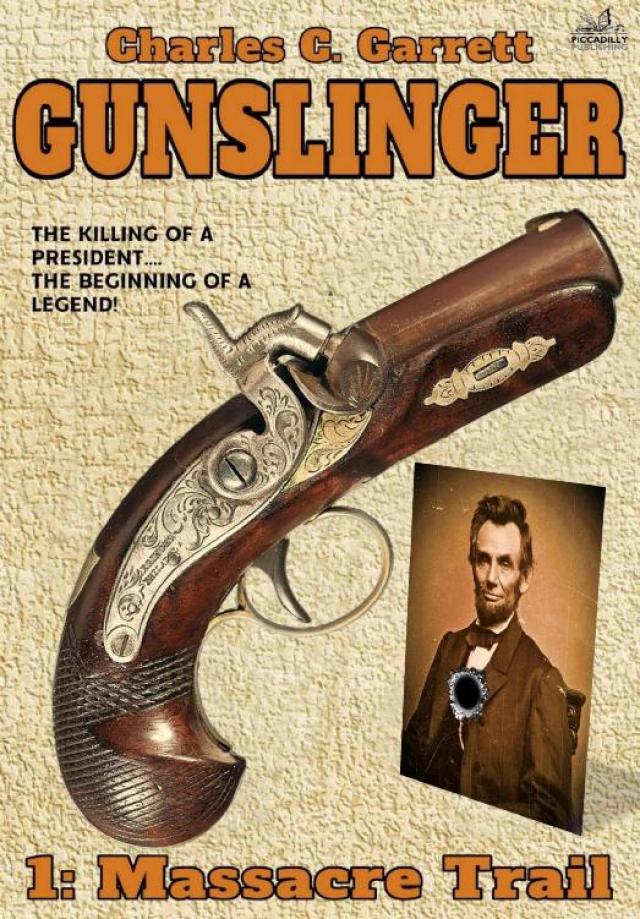
The Home of
Great Western Fiction!
GUNS ARE RYKER’S BUSINESS. SO IS KILLING...
John Ryker was a gunsmith. One of the best at a time when speed and skill with a shooting iron were as vital to survival as food in your belly.
Then one day Ryker sold a man a gun—a Deringer—that later killed a President. That incident set Ryker on a vengeance trail of blood and conflict that would test his gun-skill to its farthest limits. And so the gunsmith became a killer – one whose professional mastery of the West’s armory of death-dealing firepower made him the deadliest around …
GUNSLINGER 1: MASSACRE TRAIL
By Charles C. Garrett
Copyright © Charles C. Garrett 1977, 2022
This electronic edition published July 2022
Names, characters and incidents in this book are fictional, and any resemblance to actual events, locales, organizations, or persons living or dead is purely coincidental.
You may not copy, store, distribute, transmit, reproduce or otherwise make available this publication (or any part of it) in any form, or by means (electronic, digital, optical, photocopying, recording or otherwise), without the prior written permission of the publisher. Any person who does any unauthorized act in relation to this publication may be liable to criminal prosecution and civil claims for damages.
This is a Piccadilly Publishing Book / Text © Piccadilly Publishing
Series Editor: Mike Stotter
Visit www.piccadillypublishing.org to read more about our books
This is for the man from the North Country –
Colin Backhouse, the artist,
with genuine thanks and admiration
Table of Contents
Author’s Note
Publisher’s Note
Chapter One
Chapter Two
Chapter Three
Chapter Four
Chapter Five
Chapter Six
Chapter Seven
Chapter Eight
Chapter Nine
Chapter Ten
Chapter Eleven
Chapter Twelve
Chapter Thirteen
Chapter Fourteen
ABOUT THE AUTHOR
Coming Soon in the Gunslinger series
Weaponary Used In The Massacre Trail
Author’s Note
Some readers might be confused by finding that the name of the small pistols that are at the center of this book are spelt in two different ways, ‘Deringer’ and ‘derringer’. The initial design came from Henry Deringer, but was extensively pirated.
‘Henry Deringer never produced any pocket pistols other than those with percussion cap ignition, but the name derringer was applied not only to the many imitations of his basic, but unpatented design, but also to the numerous cartridge pocket pistols which followed.’
Geoffrey Boothroyd, The Handgun.
Published by Cassells in Great Britain 1970.
Apart from the above mentioned excellent work, which I believe is now sadly out of print, I have had access to many other fine works of reference. The main ones of these are:
Pageant Of The Gun by Harold L. Peterson. Published in 1966 by Doubleday, New York.
Guns & Ammo Guide To Guns Of The Gunfighters. A marvelous magazine, published in 1975 by the Petersen Publishing Go. of Los Angeles.
Guns by Dudley Pope, published by Spring Books in London, 1969, but originally published by Weidenfeld & Nicolson in London in 1965.
The Gunfighters, published by Time-Life Books in New York, 1974.
Famous Guns From The Smithsonian Collection by Hank Wieand Bowman, published in 1967 by the Arco Publishing Company of New York.
The Penguin Book Of The American Civil War by Bruce Catton, published in London by Penguin Books in 1966.
Firearms Curiosa by Lewis Winant, published in a limited edition in England in 1956 by Arco Publishers Limited.
All of these books were of special assistance to me in my research for the ‘Gunslinger’ series and I am most grateful to their respective writers and publishers.
Charles C. Garrett
Phoenix, Arizona. 1977
Publisher’s Note
JOHN WILKES BOOTH assassinated President Abraham Lincoln at 10:15 PM on Friday, April 14, 1865, at Ford’s Theatre in Washington, D.C., using a .44-caliber, single-shot, percussion-cap, Henry Deringer (only one “r” in the middle) pistol from Philadelphia, Pennsylvania, with a two-and-a-half-inch, rifled barrel.
Since this book’s original publication in 1977, new information has come to light, which was been corroborated by the FBI laboratory in 2004. The gun was placed on display at the Ford’s Theatre National Historic Site in 1940. It went missing in 1997—132 years after Lincoln’s death—and the authenticity of the pistol on display was called into question when the estate of a member of a Northeastern U.S. burglary ring was settled. Members of the ring had allegedly stolen the original Booth pistol in the 1960s—when security at the theater was less vigilant than it is today—and replaced it with a replica.
To determine beyond a reasonable doubt whether the Deringer pistol displayed at Ford’s Theatre was the same pistol pictured in pre-1960s historical photographs of the gun.
After a National Park Police captain hand-carried the firearm from Ford’s Theatre the half-block to FBI Headquarters—where the lab was then located—the lab’s Firearms-Toolmarks Unit conducted a series of physical analyses of the pistol, comparing it to other pistols of similar style and caliber. Because its age and historical value precluded test-firing it, a dental material was used to make a cast of the inside of the barrel and other internal parts. Meanwhile, the lab’s Special Photographic Unit superimposed images of the Deringer on historical photographs.
Physical examination revealed a number of imperfections to the display pistol that were unique to the firearm. The most significant was a major crack in the fore stock of the gun, which bore evidence of previous repair. The cast of the barrel revealed a counterclockwise rifling (or left twist), which was unusual for that make of gun.
Photographic superimpositions using the Deringer pistol and images from the 1930s demonstrated a close correspondence between them, with unique characteristics such as the crack in the stock, swirl patterns in the grain of the stock, and pit marks on the barrel visible in both.
These and other comparisons led the lab to conclude that the Deringer pistol displayed at Ford’s Theatre is the real thing, which you can still see there today.
With this information in mind, the publishers have taken the decision to amend the erroneous original text, but this does not detract from the storytelling.
Mike Stotter – Series Editor
Chapter One
THE HAMMER OF the Deringer eased back with a barely audible click. The hand that held it was smudged with black greasepaint across the outside of the index finger. The knuckles whitened against the dark walnut butt of the little pistol, but the hand was rock-steady.
The man looked both ways along the shadowy corridor, his eyes blazing like embers in the deep caverns of his pale face. The organization was perfect. The sentry had unaccountably left his post, despite its overwhelming importance at such a time.
There was the baize-lined door to the left, with the small hole that had been drilled in it the day before, tiny and inconspicuous in the dim light. He pressed his ear to it, straining to hear what was happening beyond. Sweat beaded his forehead and he raised a black sleeve to wipe it off. The movement nearly dislodged one of the revolvers from his belt. He grabbed at it with his left hand, barely checking it from falling to the floor of the corridor.
The gun that had slipped was a .36 caliber Colt. The Navy model of 1851. The other revolver was also a Colt. The 1860 Army model, the heavier .44 caliber. Jostling them in the waistband of the black trousers was a heavy-bladed fighting knife, English-made, with a sharp point and a grip made from a deer’s horn. It was stamped with the name of the cutler—W. F. Jackson of Sheffield—and inscribed ‘Rio Grande Camp Knife’.
It was a heavy armament, but he faced a heavy task.
‘It’s a lovely gun, sir.’
‘Damned fine price you’re charging me for it, as well, Mr. ... I didn’t catch the name?’
‘My name’s Ryker. John Ryker.’
They shook hands across the counter of the small store, with its walls lined with guns of all shapes and sizes.
‘Pleased to make your acquaintance, Mr. Ryker. But I must say that it’s a pretty thing. And John will appreciate it. He’s an actor. Loves something unusual for a present. This pistol will delight him, Mr. Ryker.’
The man behind the counter was tall, topping his customer by several inches. Smartly dressed for a store-keeper in the small township of Settlement, on the Rio Verde in the Arizona Territory. Black frock-coat and trousers, more like a successful attorney. Brocade waistcoat with silk embroidery. Black tie. Neat and elegant despite the temperature, which was up over the hundred.
But the main thing that the customer had noticed was the hat. Black, like everything about Ryker, and flat. The only gleam of ornament about the man was in his hat, set at the center in the front. A silver dollar, with a bullet-hole plugged clean through the middle.
‘Can’t help askin’ you about your hat, Mr. Ryker. Fine thing for a man selling guns to have that coin there. Mind if I ask you if you did it yourself?’
‘Sharps rifle at a hundred paces.’
The man whistled. ‘That must have been some shot.’
‘That’s the beauty of the long Sharps. I always say that if I can see it, then I can hit it.’
‘I guess you have to say that, you selling them.’
It was a light comment, but Ryker leaned across the counter, eyes half-closed, lips curling back from his teeth in anger.
‘You come in here, you got a right to tell me what you want and how much you want to pay. That’s all you get as a right. Words like that need paying for, mister.’
‘I … I didn’t
Ryker leaned back, rocking on the heels of his highly-polished boots. ‘Maybe you did and maybe you didn’t. You think that I’m talkin’ trash about what I can do with my Sharps, then you walk out back. Walk clear up to that nearest spur of the hogback ridge. That’s a full eight hundred paces.’
‘Now wait on, Mr. Ryker.’ The man was backing away, rubbing his hands together like an absconding banker. He felt suddenly cold, despite the stifling heat. He’d taken the gunsmith for an over-dressed store-keeper, and he was learning different. The eyes were light brown. A warm and friendly color. Right now they looked as cold as Sierra melt-water.
‘You walk those eight hundred paces, and you call out you think I can’t shoot at that range.’
‘I really didn’t mean—’
‘And I’ll put a fifty caliber bullet clean through your teeth.’
The customer stopped abruptly, his back jarred by the handle of the door. He stared across the space at Ryker, relieved to see the lines of the face soften and a smile break through.
‘But I guess you don’t want to talk on about what I can do with a rifle, do you?’
‘Sure don’t, sir.’
‘So, you want to buy this little Deringer for your actor friend, John. Let me tell you all about a Deringer, just so as you know what you’re buying him.’
The man in the corridor swallowed hard, feeling for a moment that he might throw up from nerves. Tasting the acrid sweetness of the brandy he had drunk to try and steady himself, he held out his hand, smiling his satisfaction as he saw that the barrel of the small pistol didn’t waver.
The glue on his false beard itched, and he considered ripping it from his face before proceeding. But the importance of disguise checked him. The beard, combined with the touches in black grease-paint to eyes and moustache, might save his life.
A ripple of laughter reached him from the room beyond the door. He’d seen the play himself, enjoying Laura Keene in the leading role. An actress he had met but never worked with. He’d watched for the timing of scenes, surreptitiously making notes and using the silver pocket watch to ensure that he knew when his moment would be.
His target had arrived late, after the play had begun, causing a great hold-up. Ford’s Theatre was full for the Good Friday performance, with the cream of Washington society. He knew the theatre well. It held just less than seventeen hundred paying patrons.
That arrival had been at eight o’clock, while he had still been outside the theatre making arrangements for a man to hold his hired horse. But the faint strains of ‘Hail To The Chief’ had reached him in the street.
With his free hand he checked to ensure that he still held the shaped hunk of wood that he would use to jam the door shut behind him once he was in.
Again he pressed his ear to the hole, checking from the faint noises that the moment was nearer. Another glance up and down the corridor, but there was still no sign of the bodyguard: John Parker was still busy finding himself a quiet drink. Through the hole he could dimly make out the shape of the four people in the box, silhouetted against the yellow light from the stage.
On the right sat a young couple, in the seats that General Ulysses Grant and his wife would otherwise have occupied, had they not taken a last-minute decision to go to New Jersey for a family visit with their children. The couple were Clara Harris and her young beau, Major Henry Rathbone. She was the daughter of the prominent New York Senator, Ira Harris.
By straining his head further to the right, the man in the corridor could see the other two shapes in the box. Holding hands he saw, despite rumors that their marriage wasn’t everything that a good marriage should be. The woman to the right, and then the tall, stooped figure sitting in a rocking-chair to help his back ailment.
It was a couple of minutes before ten-fifteen.
He had a momentary fear the Deringer might fail him.
‘One thing about one of these Deringers is that they’ll never let you down. You take care of your gun and, like a good wife, it’ll take care of you.’
‘You carry guns yourself, Mr. Ryker?’
‘Indeed. Navy Colt. Pair of small pistols. Not the real Deringers, but a couple of weapons that are not yet available to the public. I obtained them through a friend and through my own trade with guns. I think it will be at least a year before they are on sale.’
‘Are they those derringers I heard about? Spell the name with two “r”s instead of one?’
‘Yes. Remington’ll be making them. Called “over and under” guns. Forty-one caliber. Two barrels. One over the other.’
‘I’d consider it an honor to see those, Mr. Ryker, if you have no objection.’
‘I do.’
After his previous experience, the customer had no wish to push his luck with the short-tempered gunsmith, so he just stood and waited, hoping for an explanation.
It came. ‘In my profession, sir, even in a small community like Settlement, there are those who like guns. And who would dearly enjoy the opportunity to relieve me of all of my stock in trade without paying me in silver coin. So I keep the placement of my own weapons a matter between me and my conscience.’ He allowed a moment to pass, and eased the slight tension with a smile and a tip of the hat. ‘Now, I must show you the features of this Deringer for your friend. What does he want it for?’
His customer smiled in a strange, secretive way, and seemed as if he was going to say something. Then checked himself and rubbed at an imaginary speck of dust on his sleeve.
‘Guess just to look after himself in these troubled times, Mr. Ryker. You have not fought in the conflict?’
For the first time, the store-keeper looked ill at ease ‘I . .. That is my father .. . well ... it was my wish to enlist but I was failed on medical grounds.’
‘Might I ask you, sir, on which side you would have been fighting?’
Ryker’s eyes narrowed again. ‘My politics, sir, are also something that I prefer to keep to myself.’
‘But your accent, Mr. Ryker. I am sure I detect the tones of the great State of Virginia?’
‘My parents lived for some time in Richmond.’
‘Then it might not be too sanguine of me to anticipate that your allegiance is to the Confederate States of America?’
‘I have never been a believer in backing a losing cause, and for me, that cause has been lost for many months.’
‘But I must protest that—’
‘You can protest all you wish, but I shall be surprised to see the fighting go on for more than another month or two. It cannot.’
‘You see it ending by Easter?’
‘At the latest. But I have to repeat that I am in the business of selling guns and not chewing over the conflicts of other men. The Deringer.’
‘Yes, Mr. Ryker. You were about to tell me of the Deringer.’
On the stage at Ford’s Theatre, Washington, Mrs. Mount-Chessington was still busily engaged in the affair of trying to marry her daughter to the rich American, Asa Trenchard. And had just discovered that he was not wealthy at all. It was the central high-spot of ‘Our American Cousin’, and those in the audience who had seen the play before sat forward on the edges of their seats in smiling anticipation.
In the dark corridor, the man with the Deringer also tensed himself ready for action. Ready to strike a desperate blow for the Confederacy that he had never seen fit to support as a soldier.
As an actor he’d enjoyed the play and had bought a copy of it. Simply from what he could hear through his spy-hole it was possible to know what was happening. Almost simultaneously with the actress delivering the lines on the stage, his lips moved in the blackness.


