Ellery Queen’s Mystery Magazine. Vol. 102, No. 4 & 5. Whole No. 618 & 619, October 1993, page 1
part #618 of Ellery Queen's Mystery Magazine Series


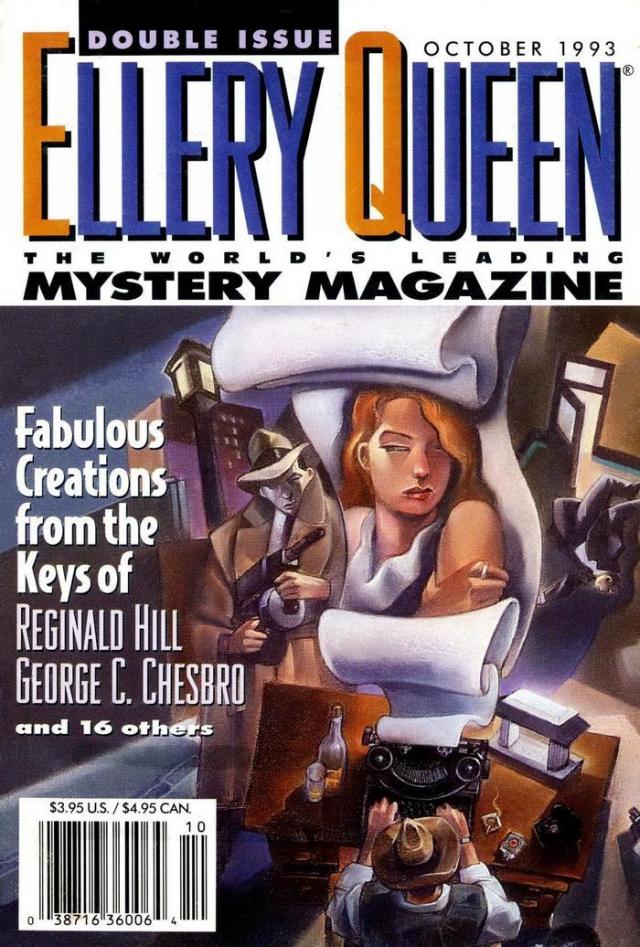
Ellery Queen’s Mystery Magazine. Vol. 102, No. 4 & 5. Whole No. 618 & 619, October 1993
Castle Dangerous
Never Knew He Had It in Him
DetectiverseTaxes
Haunts
Spy at Sea
The Jury Box
Groundhog
A Script for the President
The Haunted Dolls’ House
Masks
Trial by Fire
Muzza
Anomalies
Soul Sculpture
All in the Eyes
DetectiverseMother Goose Nursery Crimes III
No Connection
DetectiverseWeird Willie
Looking on the Bright Side
The Real West
Layover
One Small Step
1.
2.
3.
4.
5.
6.
7.
8.
* * *
Ellery Queen’s Mystery Magazine. Vol. 102, No. 4 & 5. Whole No. 618 & 619, October 1993
Castle Dangerous
by Ian Rankin
© 1993 by Ian Rankin
Good news for fans of Ian Rankin’s Inspector John Rebus: the latest Rebus novel, Strip Jack, will soon be available in the U.S. from St. Martin’s Press. Here’s an outing for Rebus that the author says “takes a slightly tongue-in-cheek look at the relationship between American tourists and their British hosts...”
❖
Sir Walter Scott was dead.
He’d been found at the top of his namesake’s monument in Princes Street Gardens, dead of a heart attack and with a new and powerful pair of binoculars hanging around his slender, mottled neck.
Sir Walter had been one of Edinburgh’s most revered QCs until his retirement a year ago. Detective Inspector John Rebus, climbing the hundreds (surely it must be hundreds) of spiralling steps up to the top of the Scott Monument, paused for a moment to recall one or two of his run-ins with Sir Walter, both in and out of the courtrooms on the Royal Mile. He had been a formidable character, shrewd, devious, and subtle. Law to him had been a challenge rather than an obligation. To John Rebus, it was just a day’s work.
Rebus ached as he reached the last incline. The steps here were narrower than ever, the spiral tighter. Room for one person only, really. At the height of its summer popularity, with a throng of tourists squeezing through it like toothpaste from a tube, Rebus reckoned the Scott Monument might be very scary indeed.
He breathed hard and loud bursting through the small doorway at the top, and stood there for a moment, catching his breath. The panorama before him was, quite simply, the best view in Edinburgh. The castle close behind him, the New Town spread out in front of him, sloping down towards the Firth of Forth, with Fife, Rebus’s birthplace, visible in the distance. Calton Hill... Leith... Arthur’s Seat... and round to the castle again. It was breathtaking, or would have been had the breath not already been taken from him by the climb.
The parapet upon which he stood was incredibly narrow; again, there was hardly room enough to squeeze past someone. How crowded did it get in the summer? Dangerously crowded? It seemed dangerously crowded just now, with only four people up here. He looked over the edge upon the sheer drop to the gardens below, where a massing of tourists, growing restless at being barred from the monument, stared up at him. Rebus shivered.
Not that it was cold. It was early June. Spring was finally late-blooming into summer, but that cold wind never left the city, that wind which never seemed to be warmed by the sun. It bit into Rebus now, reminding him that he lived in a northern climate. He looked down and saw Sir Walter’s slumped body, reminding him why he was here.
“I thought we were going to have another corpse on our hands there for a minute.” The speaker was Detective Sergeant Brian Holmes. He had been in conversation with the police doctor, who himself was crouching over the corpse.
“Just getting my breath back,” Rebus explained.
“You should take up squash.”
“It’s squashed enough up here.” The wind was nipping Rebus’s ears. He began to wish he hadn’t had that haircut at the weekend. “What have we got?”
“Heart attack. The doctor reckons he was due for one anyway. A climb like that in an excited state. One of the witnesses says he just doubled over. Didn’t cry out, didn’t seem in pain...”
“Old mortality, eh?” Rebus looked wistfully at the corpse. “But why do you say he was excited?”
Holmes grinned. “Think I’d bring you up here for the good of your health? Here.” He handed a polythene bag to Rebus. Inside the bag was a badly typed note. “It was found in the binocular case.”
Rebus read the note through its clear polythene window: GO TO TOP OF SCOTT MONUMENT. TUESDAY MIDDAY. I’LL BE THERE. LOOK FOR THE GUN.
“The gun?” Rebus asked, frowning.
There was a sudden explosion. Rebus started, but Holmes just looked at his watch, then corrected its hands. One o’clock. The noise had come from the blank charge fired every day from the castle walls at precisely one o’clock.
“The gun,” Rebus repeated, except now it was a statement. Sir Walter’s binoculars were lying beside him. Rebus lifted them — “He wouldn’t mind, would he?” — and fixed them on the castle. Tourists could be seen walking around. Some peered over the walls. A few fixed their own binoculars on Rebus. One, an elderly Asian, grinned and waved. Rebus lowered the binoculars. He examined them. “These look brand new.”
“Bought for the purpose, I’d say, sir.”
“But what exactly was the purpose, Brian? What was he supposed to be looking at?” Rebus waited for an answer. None was forthcoming. “Whatever it was,” Rebus went on, “it as good as killed him. I suggest we take a look for oursfelves.”
“Where, sir?”
Rebus nodded towards the castle. “Over there, Brian. Come on.”
“Er, Inspector...?” Rebus looked towards the doctor, who was upright now, but pointing downwards with one finger. “How are we going to get him down?”
Rebus stared at Sir Walter. Yes, he could see the problem. It would be hard graft taking him all the way back down the spiral stairs. What’s more, damage to the body would be unavoidable. He supposed they could always use a winch and lower him straight to the ground... Well, it was a job for ambulancemen or undertakers, not the police. Rebus patted the doctor’s shoulder.
“You’re in charge, Doc,” he said, exiting through the door before the doctor could summon up a protest. Holmes shrugged apologetically, smiled, and followed Rebus into the dark. The doctor looked at the body, then over the edge, then back to the body again. He reached into his pocket for a mint, popped it into his mouth, and began to crunch on it. Then he, too, made for the door.
Splendour was falling on the castle walls. Wrong poet, Rebus mused, but right image. He tried to recall if he’d ever read any Scott, but drew a blank. He thought he might have picked up Waverley once. As a colleague at the time had said, “Imagine calling a book after the station.” Rebus hadn’t bothered to explain; and hadn’t read the book either, or if he had it had left no impression...
He stood now on the ramparts, looking across to the Gothic exaggeration of the Scott Monument. A cannon was almost immediately behind him. Anyone wanting to be seen from the top of the monument would probably have been standing right on this spot. People did not linger here though. They might wander along the walls, take a few photographs, or pose for a few, but they would not stand in the one spot for longer than a minute or two.
Which meant, of course, that if someone had been standing here longer, they would be conspicuous. The problem was twofold: first, conspicuous to whom? Everyone else would be in motion, would not notice that someone was lingering. Second, all the potential witnesses would by now have gone their separate ways, in tour buses or on foot, down the Royal Mile or onto Princes Street, along George the Fourth Bridge to look at Greyfriars Bobby... The people milling around just now represented a fresh intake, new water flowing down the same old stream.
Someone wanted to be seen by Sir Walter, and Sir Walter wanted to see him — hence the binoculars. No conversation was needed, just the sighting. Why? Rebus couldn’t think of a single reason. He turned away from the wall and saw Holmes approaching. Meeting his eyes, Holmes shrugged his shoulders.
“I’ve talked to the guards on the gate. They don’t remember seeing anyone suspicious. As one of them said, ‘All these bloody tourists look the same to me.’ ”
Rebus smiled at this, but then someone was tugging at his sleeve, a small handbagged woman with sunglasses and thick lipstick.
“Sorry, could I ask you to move over a bit?” Her accent was American, her voice a nasal sing-song. “Lawrence wants a picture of me with that gorgeous skyline behind me.”
Rebus smiled at her, even made a slight bow, and moved a couple of yards out of the way, Holmes following suit.
“Thanks!” Lawrence called from behind his camera, freeing a hand so that he could wave it towards them. Rebus noticed that the man wore a yellow sticker on his chest. He looked back to the woman, now posing like the film star she so clearly wasn’t, and saw that she too had a badge, her name — Diana — felt-tipped beneath some package company’s logo.
“I wonder...” Rebus said quietly.
“Sir?”
“Maybe you were asking the wrong question at the gate, Brian. Yes, the right idea but the wrong question. Come on, let’s go back and ask again. We’ll see how eagle-eyed our friends really are.”
They passed the photographer — his badge called him Larry rather than Lawrence — just as the shutter clicked.
“Great,” he said to nobody in particular. “Just one more, sweetheart.” As he wound the film, Rebus paused and stood beside him, then made a square from the thumb and forefinger of both hands and peered through it towards the woman Diana, as though assessing the composition of the picture. Larry caught the gesture.
“You a professional?” he asked, his tone just short of awe.
“Only in a manner of speaking, Larry,” said Rebus, turning away again. Holmes was left standing there, staring at the photographer. He wondered whether to shrug and smile again, as he had done with the doctor. What the hell. He shrugged. He smiled. And he followed Rebus towards the gate.
Rebus went alone to the home of Sir Walter Scott, just off the Corstorphione Road near the zoo. As he stepped out of his car, he could have sworn he detected a faint wafting of animal dung. There was another car in the driveway, one which, with a sinking heart, he recognised. As he walked up to the front door of the house, he saw that the curtains were closed in the upstairs windows, while downstairs, painted wooden shutters had been pulled across to block out the daylight.
The door was opened by Superintendent “Farmer” Watson.
“I thought that was your car, sir,” Rebus said as Watson ushered him into the hall. When he spoke, the superintendent’s voice was a whispered growl.
“He’s still up there, you know.”
“Who?”
“Sir Walter, of course!” Flecks of saliva burst from the corners of Watson’s mouth. Rebus thought it judicious to show not even the mildest amusement.
“I left the doctor in charge.”
“Dr. Jameson couldn’t organise a brewery visit. What the hell did you think you were doing?”
“I had... have an investigation on my hands, sir. I thought I could be more usefully employed than playing undertaker.”
“He’s stiff now, you know,” Watson said, his anger having diminished. He didn’t exactly know why it was that he could never stay angry with Rebus; there was something about the man. “They don’t think they can get him down the stairs. They’ve tried twice, but he got stuck both times.”
Rebus pursed his lips, the only way he could prevent them spreading into a wide grin. Watson saw this and saw, too, that the situation was not without a trace of humour.
“Is that why you’re here, sir? Placating the widow?”
“No, I’m here on a personal level. Sir Walter and Lady Scott were friends of mine. That is, Sir Walter was, and Lady Scott still is.”
Rebus nodded slowly. Christ, he was thinking, the poor bugger’s only been dead a couple of hours and here’s old Farmer Watson already trying to... But no, surely not. Watson was many things, but not callous, not like that. Rebus rebuked himself silently, and in so doing missed most of what Watson was saying.
“—in here.”
And a door from the hallway was being opened. Rebus was being shown into a spacious living room — or were they called drawing rooms in houses like this? Walking across to where Lady Scott sat by the fireside was like walking across a dance hall.
“This is Inspector Rebus,” Watson was saying. “One of my men.”
Lady Scott looked up from her handkerchief. “How do you do?” She offered him a delicate hand, which he lightly touched with his own, in place of his usual firm handshake. Lady Scott was in her mid fifties, a well-preserved monument of neat lines and precise movements. Rebus had seen her accompanying her husband to various functions in the city, had come across her photograph in the paper when he had received his knighthood. He saw, too, from the corner of his eye, the way Watson looked at her, a mixture of pity and something more than pity, as though he wanted at the same time to pat her hand and hug her to him.
Who would want Sir Walter dead? That was, in a sense, what he had come here to ask. Still, the question itself was valid. Rebus could think of adversaries — those Scott had crossed in his professional life, those he had helped put behind bars, those, perhaps, who resented everything from his title to the bright blue socks that had become something of a trademark after he admitted on a radio show that he wore no other colour on his feet...
“Lady Scott, I’m sorry to intrude on you at a time like this. I know it’s difficult, but there are a couple of questions...”
“Please, ask your questions.” She gestured for him to sit on the sofa — the sofa on which Farmer Watson had already made himself comfortable. Rebus sat down awkwardly. This whole business was awkward. He knew the chess player’s motto: if in doubt, play a pawn. Or as the Scots themselves would say, ca’ canny. But that had never been his style, and he couldn’t change now. As ever, he decided to sacrifice his queen.
“We found a note in Sir Walter’s binocular case.”
“He didn’t own a pair of binoculars.” Her voice was firm.
“He probably bought them this morning. Did he say where he was going?”
“No, just out. I was upstairs. He called that he was ‘popping out for an hour or two,’ and that was all.”
“What note?” This from Watson. What note indeed. Rebus wondered why Lady Scott hadn’t asked the same thing.
“A typed note, telling Sir Walter to be at the top of the Scott Monument at midday.” Rebus paused, his attention wholly on Sir Walter’s widow. “There have been others, haven’t there? Other notes?”
She nodded slowly. “Yes. I found them by accident. I wasn’t prying, I’m not like that. I was in Walter’s office — he always called it that, his ‘office,’ never his study — looking for something, an old newspaper I think. Yes, there was an article I wanted to reread, and I’d searched high and low for the blessed paper. I was looking in Walter’s office, and I found some... letters.” She wrinkled her nose. “He’d kept them quiet from me. Well, I suppose he had his reasons. I never said anything to him about finding them.” She smiled ruefully. “I used to think sometimes that the unsaid was what kept our marriage alive. That may seem cruel. Now he’s gone, I wish we’d told one another more...”
She dabbed at a liquid eye with the corner of her handkerchief, wrapped as it was around one finger, her free hand twisting and twisting the comers. To Rebus, it looked as if she were using it as a tourniquet.
“Do you know where these other notes are?” he asked.
“I don’t know. Walter may have moved them.”
“Shall we see?”
The office was untidy in the best legal tradition: any available flat surface, including the carpet, seemed to be fair game for stacks of brown folders tied with ribbon, huge bulging manilla envelopes, magazines and newspapers, books and learned journals. Two walls consisted entirely of bookcases, from floor to near the ornate but flaking ceiling. One bookcase, glass-fronted, contained what Rebus reckoned must be the collected works of the other Sir Walter Scott. The glass doors looked as though they hadn’t been opened in a decade; the books themselves might never have been read. Still, it was a nice touch — to have one’s study so thoroughly infiltrated by one’s namesake.
“Ah, they’re still here.” Lady Scott had slid a concertina-style folder out from beneath a pile of similar such files. “Shall we take them back through to the morning room?” She looked around her. “I don’t like it in here... not now.”
Her Edinburgh accent, with its drawn vowels, had turned “morning” into “mourning.” Either that, thought Rebus, or she’d said “mourning room” in the first place. He would have liked to have stayed a little longer in Sir Walter’s office, but was compelled to follow. Back in her chair, Lady Scott untied the ribbon around the file and let it fall open. The file itself was made up of a dozen or more compartments, but only one seemed to contain any paperwork. She pulled out the letters and handed them to Watson, who glanced through them wordlessly before handing them to Rebus.