

So Happy for You, page 1


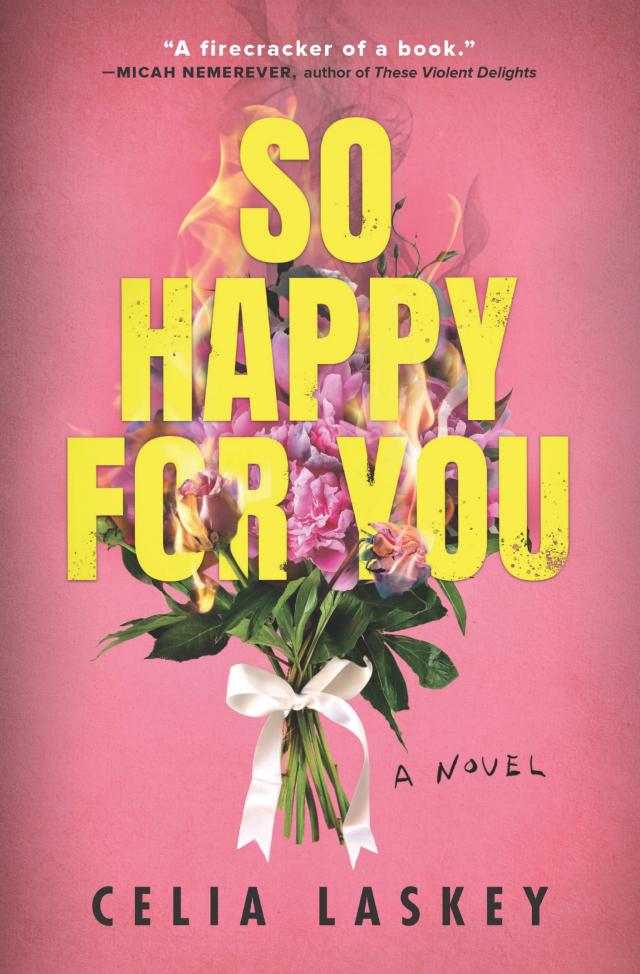
“Magnificent. Celia Laskey has masterfully crafted the tense, messy, big-hearted, and deeply original queer love story we didn’t know we’ve been waiting for, as much full of human characters as incisive social commentary.”
—Peter Kispert, author of I Know You Know Who I Am
“Celia Laskey’s sly thriller completely transfixed me from beginning to end. Tart and playful, this tale of a wedding weekend gone fatally wrong is part psychological game, part societal inquest, and part best friend break-up from hell.”
—Amy Jo Burns, author of Shiner
“So Happy for You is the sort of devilishly clever summer read I crave. Like the worst wedding in history, I watched it unfold with my hands over my eyes and a laugh in my throat, eager to see it fly off the rails.”
—John Fram, author of The Bright Lands
“Laskey is a magician, combining the important social commentary this genre needs with a knock-out page-turning narrative that will leave you guessing to the last page.”
—Chelsea Bieker, author of Godshot and Heartbroke
“So Happy for You skewers the wedding industrial complex with uproarious bitterness and gleeful fury, and a spiraling absurdism that will leave you wondering whether it’s all that absurd after all. If you’ve ever gritted your teeth through a nightmare wedding, this one’s for you.”
—Micah Nemerever, author of These Violent Delights
Celia Laskey is the author of Under the Rainbow, a finalist for the 2020 Center for Fiction First Novel Prize. Her other work has appeared in Guernica, the Minnesota Review, Day One, and elsewhere. She has an MFA from the University of New Mexico and currently lives in Los Angeles with her wife and their dog, Whiskey.
www.CeliaLaskey.com
Twitter: @celia_laskey
Instragram: @celia.laskey
So Happy for You
A Novel
Celia Laskey
To anyone who’s ever been a bridesmaid
Contents
Part I
Chapter 1
Chapter 2
Chapter 3
Chapter 4
Chapter 5
Chapter 6
Chapter 7
Chapter 8
Chapter 9
Chapter 10
Chapter 11
Chapter 12
Part II
Chapter 13
Chapter 14
Chapter 15
Chapter 16
Chapter 17
Chapter 18
Chapter 19
Chapter 20
Chapter 21
Chapter 22
Chapter 23
Chapter 24
Chapter 25
Chapter 26
Chapter 27
Chapter 28
Acknowledgments
Part I
1
If you want to know the story of how my best friend and I ended up trying to kill each other, I should probably start with the night she asked me to be her maid of honor. Before that I guess I should clarify that at that point in our lives, we were more like best-ish friends. We had been actual best friends in high school, but as we got older and I became more and more of a “rabid feminist” and Ellie became more and more focused on meeting a man to marry and have kids with, we kind of started to resent each other. But neither of us could seem to let the friendship go.
Anyway, it was a number of years ago now, when we were both thirty-three. Ellie had asked me to meet her at this new bar in Brooklyn Heights called The Uncurious Cat or The Skinny Pig or some other super-clever name that consisted of an animal preceded by an oxymoronic adjective. Picture any bar in any affluent Brooklyn neighborhood and you’ve got it: gleaming white subway tiles on the wall behind the bar, a chandelier made of dozens of Edison bulbs, an accent wall covered in a vintage flamingo print, tea lights flickering on the tables, oversize ice cubes in drinks, and men in checkered oxford shirts sitting across from red-lipsticked women, their hair in donut-shaped buns.
I watched from outside, shivering in the spring jacket I had prematurely donned that morning—it was early May and it had just unexpectedly snowed again—as all the couples flirtatiously smiled and eagerly nodded and placed their hands on each other’s knees. One couple was already vigorously making out in the corner. I probably rolled my eyes and thought something like: God, straight people, we get it: the world is yours. Because I was gay and frequented dive bars instead of swanky ones, I thought I was better than them. At that time in my life, I thought I was better than most people.
When a woman sitting next to the window went to the bathroom, the man sitting across from her took out his phone and started scrolling through Spouse Spotter, the most popular dating app those days. It was known for giving each member a “marriageability rating,” abbreviated to MR, on a scale of zero to one hundred. A man’s MR was determined by his age, height, looks, wealth, IQ, emotional intelligence, sexual capacity (don’t ask me how they determined this), and willingness to make a long-term commitment. Women were rated by their age, looks, height, bra cup size, weight, academic degrees, personality, and family background. Women who hadn’t married by twenty-seven were labeled “leftovers,” and women who were still single at thirty-five were “rotten.” These labels appeared right next to their profile picture. Men who hadn’t married by a certain age weren’t called anything at all.
An app like this sounds a little fucked up to us now, but you remember how things were then, right? After the divorce rate soared to 76 percent and the marriage rate dwindled to 21 percent, fewer people were buying houses and having kids, which meant suburbs became ghost towns and cities became wildly overcrowded, which meant rent prices and STI rates skyrocketed, which meant the economy and the health of the nation were at risk, which meant the government finally decided they had to take action, even though Americans were happier than ever according to the World Happiness Report. Happiness was not good for capitalism or the patriarchy or white supremacy, i.e., business as usual.
So the government gave a ridiculous amount of money to The National Organization for Marriage, making it the most powerful lobbying group in Washington. They also tripled tax breaks for married couples, gave out loans for weddings and homes at bargain-basement rates, and severely restricted access to abortion and egg freezing. Every month, in every capital city in the US, there was a government-sponsored blind date event. Rom-coms dominated the box office, and family sitcoms were all you could find on TV. Women nearing the age of twenty-seven were targeted with daily countdown ads that displayed the number of days until they became “leftovers,” and women nearing thirty-five got countdown ads until they were “rotten.” Thanks to the government’s efforts, it was clear that people (not only the straights but your basic gays, too) were suddenly desperate to get married in a way they hadn’t been since the ’50s—maybe even more so. Thus why the Uncurious Cat was crowded with young people hoping to spot their spouse.
Ellie had asked me to meet her at the bar because she had “big news,” and I could only assume it meant that she had finally gotten her boyfriend Kaivan to propose (even though they had been together for less than a year) or that they had broken up. I was hoping for the latter. To everyone but Ellie, I called Kaivan “the enema,” an even worse form of douchebag. His parents were hippies, the kind who tended to appropriate from other cultures to show how “open” they were, and they named him Kaivan, a Persian name, even though they were white and pronounced it just like Kevin. Because of his name, his dark hair, and his tan skin, people sometimes assumed he was Middle Eastern, and when he thought it worked to his advantage, he didn’t correct them. He worked in the start-up space and created an app for cheaters called DownLow that would hide secret text messages and calls—he claimed he would never use the app himself; he was just “filling a gap in the market.” He rarely came out because Ellie claimed he always had some networking event, and the rare times he did show up, he’d blab on about his countless “projects,” dropping names of tech people no one knew. Once, when Ellie was falling-over drunk, she told me he never went down on her because he “hated getting his face wet.” The next time I saw him, I asked him if he took showers or liked to go swimming, and he just looked at me blankly. Despite all of these aforementioned flaws, Kaivan seemingly wanted to get married and start a family just as badly as Ellie did, and in this way, they were a good match.
Deciding I couldn’t delay it any longer, I took a deep breath and pulled open the heavy door to the bar, scanning the faces until I saw Ellie’s Polish features: round cheeks and round blue eyes, hair so blond it was almost white, and nearly translucent skin to match. She was wearing a billowy white silk blouse and a delicate gold necklace. She looked up and waved, and as she lowered her hand, I saw it: a huge square of diamond hanging off her ring finger, reflecting the tea light on the table. My chest constricted like someone was tightening a screw, and I realized just how much I had been hoping for a breakup. Not because I wanted Ellie to be unhappy, but the opposite. I wanted Ellie to find a guy who wasn’t an enema; a guy who wouldn’t force me to lie to her about being happy for her engagement. After ordering an old fashioned and a water, I forced a smile and walked toward Ellie, steeling myself for the coming conversation.
“I guess congratulations are in order,” I yelled over the din of the bar as I gestured to her hand, then gave her a hug. “A
“Mostly relieved,” Ellie said, pulling out of the hug and sitting down. “I know you think it’s ridiculous, but the last few years I’ve had this frantic feeling, like a buzzing that keeps getting louder and louder until you can’t hear anything above it, and it’s finally quieted down. The day I get married, it’ll be gone for good.” She leaned back in her chair, lolling her head and letting her arms hang at her sides, then released a long sigh. She did look more relaxed than I had seen her in ages.
I laughed, then shook my head. “That is ridiculous, Ellie.” At that point I had been with my partner Aimee for nine years, and we both agreed we wanted nothing to do with marriage, a patriarchal institution that started as a way to reinforce the idea of women as property and had excluded queer people until only recently. When everyone was campaigning for gay marriage, I would have rather campaigned to abolish marriage entirely—now that’s equality. Once, earlier in our relationship, Aimee had suggested we could just go to city hall with a few friends, so we’d be married but without the big, silly wedding. Wasn’t that kind of subversive in its own way? she had said. When I pressed her about why she wanted to be married, she couldn’t articulate it. She said it was just the way she felt; that it would be a nice way to celebrate our love for each other. I asked if she was dying to save some money on our health insurance and taxes, or if she liked the idea of the government having a vested interest in our relationship. It was strange to me that people correlated marriage with romance, when a state-sanctioned partnership seemed like the least romantic kind. People who didn’t get married but stayed together simply because they wanted to always seemed so much happier. After we talked about it a few times, Aimee came around and admitted the reason she had wanted to get married must have had to do with societal pressure, and now that she saw marriage for what it was, she was happy to simply be my partner for love’s sake, not the government’s.
“You know it’s different for women who want kids,” said Ellie. “We’re on a timeline, whether we like it or not. I was only two years away from being rotten.” She saw me open my mouth and added on, “And don’t start a fight with me about adoption.” She pointed her finger in my face. “We’re here to celebrate my engagement.”
I held up my hands in surrender, then forced myself to ask for the proposal story.
“He did it while we were in Montauk last weekend.” Ellie smiled like she was trying to crack nuts with her cheek muscles as she fingered the ring’s band with her thumb. “He had the chef at the restaurant hide the ring inside this scallop, and at first I was like, ‘what the fuck is in this scallop? I’m going to rip this restaurant a new asshole on Yelp.’ Then I realized it was a ring and I just started screaming.”
The diamond was so big it leaned against her pinky, like it was tired from hauling its weight around. Kaivan’s app must have been doing well. “That ring fit inside a scallop?”
“It was a pretty gigantic scallop.”
“Wow. What a proposal.” It always seemed like the more flimsy the relationship, the more elaborate the proposal—I was surprised Kaivan didn’t get a flash mob to do a choreographed dance to “Marry You” by Bruno Mars.
“And you know how Kaivan and I have been talking about moving to LA?”
“You mean the place New Yorkers go when they’ve given up? Yeah, you’ve mentioned it. Remind me why?”
Ellie rolled her eyes. “Well, you know my mom lives there now since it’s where her whole side of the family is from. When Kaivan and I have kids, it’ll be great to have her around to help out. Plus, I’m tired of winter, and the rat race, and the literal rats, and running to catch a train that never shows up, and living in apartment buildings with other people above and below and on either side of me. It makes me claustrophobic. I want a house with a yard and a pool and a Prius and a dog.”
“I want two kids,” said the woman sitting next to us to the man across the table. “And a gross household income of at least two hundred thousand.” It’s wild to remember that this was the way people talked to each other on early dates then, like it was a numbers-based negotiation instead of two unique people getting to know each other.
The man nodded, typing a note into his phone. “I always liked the idea of three kids, but I can meet you at two,” he said. “As long as we raise them Jewish.”
“You were never really cut out for New York anyway,” I said to Ellie. We had both lived in Brooklyn for ten years at that point. Ellie had moved right after me, when I wouldn’t stop talking about how amazing it was—how you could get a slice of pizza at 3 a.m., and the subway could take you literally anywhere, and there were bodegas on every corner for anytime you had a craving, and there was always something to do, like a robot-themed roof party in Bushwick or a new exhibit at the MoMA featuring miniature models of imagined cities or photos of some faraway place like Kazakhstan. Granted, as I edged into my thirties the days of roof parties were long gone and getting to the MoMA over the weekend when none of the trains were running was a complete ordeal, but I had never thought of leaving. Ellie had been thinking of leaving ever since she arrived—she was always complaining about the inconvenience and the noise and the crowds.
Ellie widened her eyes and made an incredulous face. “I wasn’t cut out for it? God! You’re so mean.”
I was pretty mean, back then. It was a way to feel briefly powerful in a world where I felt powerless, but of course, I wasn’t fully aware of this. I just knew it felt good. The thrill some people got from shopping or exercise or driving fast, I got from being mean. “It’s not an insult,” I said. “Different strokes for different folks.”
Ellie blew air between her lips. “Sure. Says the person who can’t stand when anyone does anything differently from her.”
A waitress came by and took our order for two more drinks. “So when would you move?” I asked.
“Soon, I think. Now that we’re engaged it doesn’t feel so crazy to move across the country together. Our lease is almost up and I don’t want to spend another winter here. I don’t want to get married here, either. Your options are either a tiny restaurant in the city for a million dollars or a dilapidated barn upstate. Now we can do it somewhere beautiful near the ocean, like Malibu. My mom will probably force me to have it at this country club place our family owns. It’s kind of a dump but it has a gorgeous view of the Pacific.”
A man in a checkered oxford appeared beside our table. He had a face like he had drunk a glass of milk every day of his life. “Hi. I was just wondering—” he started.
Here we go, I thought. I had been cursed with a cherubic, open face that tricked strangers into thinking I was an affable person, and men especially got the wrong idea because I didn’t immediately read as gay: I had shoulder-length red hair that I would have cut short in the Universal Lesbian Cut if it wasn’t for my round face and undefined jawline—in pictures, I always zeroed in on the excess skin right below my chin, like a tiny pouch, even though I was a thin person. Otherwise, I had evenly proportioned features that I thought were boring but that most people would categorize as generically attractive. Usually I wore a little bit of makeup, to even my blotchy skin tone and define my almost nonexistent eyebrows, and even though my style wasn’t overly feminine, it wasn’t unfeminine. If certain lesbians could be classified as high femme or butch, I was somewhere in the middle—mid-femme? I loved prints, mainly floral and animal and fruit. That night I was wearing a black sweater with little pink T-rexes on it. No one in the bar knew to look for my short, unpainted nails or knew that underneath my sweater were hairy armpits that hadn’t been shaved in years, especially not the man hovering beside our table.
“No,” I said, looking up at him and shaking my head.
He scrunched his eyes. “What do you mean, no?”
“No to whatever you’re going to say.”
He huffed out some air, something between a laugh and a perturbed sigh. “But you don’t know what I was going to say.”
“Yes, I do,” I said. “Please spare us and just leave us alone.”





