

The Last Zephyr, page 1


Advanced Praise for The Last Zephyr
“A thrilling ride that kept me up late reading. As a fan of all things related to railroads, this book met my need for trains, adventure, and the strength of human character all in one place.”
—Michelle Kempema, executive director Colorado Model Railroad Museum
“What a story! The Last Zephyr is full of richly detailed descriptions of passenger trains, volcanic eruptions, disasters, and leadership in a crisis, all in an emotional adventure tale full of vivid characters and dramatic situations. I couldn’t put it down and was very sorry when the book came to an end.”
—Walter Alvarez, best-selling author of T. Rex and the Crater of Doom
“Embark on a wondrous journey within – the only bittersweet element is that every turn of the page brings you closer to bidding farewell to this splendid tale. You’ll never look at Moffat Tunnel the same way again.”
—B. Travis & Kate Wright, Rollins Pass and Moffat Tunnel Historians
“This book has it all: a dynamic storyline, relatable characters, and of course, trains! It’s a perfect read for anyone who loves riding the rails and adventuring. I just couldn’t put it down. Along with CB’s insightful quotes, everyone is sure to gain something out of this book.”
—Bryson Sleppy, Trains.com/Model, Railroader Magazine
THE LAST ZEPHYR
Copyright© 2023 by C.B. Blackforest
All rights reserved.
Scanning, uploading, and distribution of this book without permission is theft of the author’s intellectual property. For more information or permission to use material from this book, contact Alder Press.
ISBNs: 978-0-9725955-1-3 (pbk); 978-0-9725955-2-0 (ebook)
Library of Congress Control Number: 2023911155
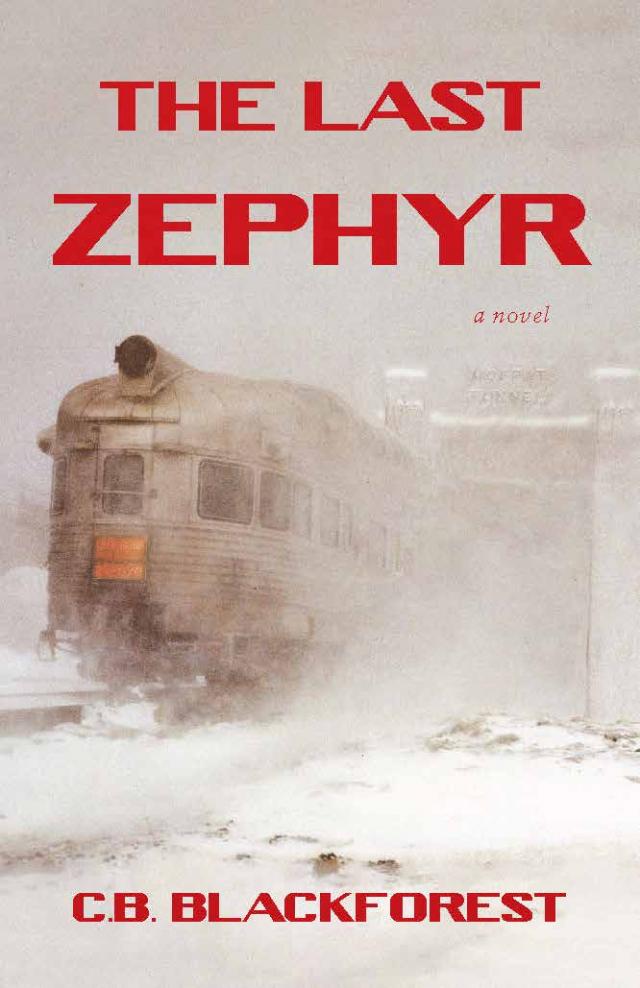
Cover photograph by Mel Patrick
Back cover photograph by Derek Brown
Book cover and interior design by Mike Corrao, Mayfly Design (mayflydesign.com)
Map Illustration: Matt Kania
Editor: Marly Cornell
Alder Press
alder-press.com
P.O. Box 7401
Golden, Colorado
80403
This is a work of fiction. Names, characters, places, companies, organizations, and incidents are the product of the author’s imagination or used fictitiously. Any resemblance to actual events, locales, organizations, or persons, living or dead, is coincidental, historical, or geographic fact.
Alder Press donates a portion of the proceeds from this book to the Colorado Railroad Museum for the preservation, restoration, and presentation of Zephyr related artifacts.
Dedicated to cousin Matthew, his parents, and all the rest of the clan. Family makes all the difference!
Contents
Advanced Praise for The Last Zephyr
Preface
Chapter 1: Yellowstone
Chapter 2: Train Days
Chapter 3: Crew Briefing
Chapter 4: Scanning
Chapter 5: Rails that Climb
Chapter 6: Bad Behavior
Chapter 7: The Moffat Tunnel
Chapter 8: Earthquake!
Chapter 9: Chaos
Chapter 10: Run!
Chapter 11: Safe Inside
Chapter 12: Leadership
Chapter 13: Geology and Mathematics
Chapter 14: Seven Days
Chapter 15: Teamwork
Chapter 16: Darkness
Chapter 17: Alone Together
Chapter 18: Love
Chapter 19: The Wedding
Chapter 20: We Are Alive!
Chapter 21: Let ’er Roll!
Chapter 22: WYE
Chapter 23: Goodbye to the Sky
Chapter 24: The Scream
Chapter 25: Voicemail and Texts
Chapter 26: On the Move
Chapter 27: The Survivalist
Chapter 28: Zephyring
Chapter 29: They Did Their Job to the End
Chapter 30: End of the World
Chapter 31: Rockslide
Chapter 32: The Fireman
Chapter 33: Highway 93
Chapter 34: Barbara Gulch
Chapter 35: Cold War Horse
Chapter 36: Nobody?
Chapter 37: Resources
Chapter 38: Time Pressure
Chapter 39: Southbound
Chapter 40: Victor’s Victory
Chapter 41: Pins and Knuckles
Chapter 42: Sergeant Major Justus Anton
Epilogue
Glossary of Terms
Acknowledgments
About the Author
Preface
This story has its origins millions of years ago, when the complex geologic structure far below Yellowstone National Park and the Rocky Mountains was created. But I will forgo all the prelude and get right to the train ride that, in many ways, came to symbolize humanity’s eternal will to survive. What happened is part of the history of the most pivotal moment in the entire twenty-first century.
As often happens in monumental times, seeds of love are sown when life itself seems to hang in the balance. Such was the case for many who rode the Zephyr, including my parents.
The best place for me to start our story is thirty years ago, as the world neared the end of the turbulent 2020s. A disturbing late-night conference call came from the man who later became my geology professor and mentor during my college years.
Chapter 1
Yellowstone
“Civilization exists by geologic consent, subject to change without notice.”
—Will Durant
Sunday, 10:00 p.m.
“People are going to die! We have to get the word out and evacuate everyone—NOW!” Dr. Michael Sayers couldn’t have been more forceful.
Sara Blackburn, the head of Homeland Security, was annoyed. “What do you want us to do, tell everyone west of the Mississippi that they have to go live somewhere else for who knows how long? Come on, Dr. Sayers, be realistic!” she said.
It had taken weeks for Sayers to get the attention of the highest level of the US government. Now the video conference with Blackburn was only happening because of the shocking news that many parts of Yellowstone National Park had risen ten inches in just twenty-four hours. Not only that, surprising signs of renewed volcanic activity were reported at Dotsero near Glenwood Springs and in Hot Sulphur Springs. Worst of all, a super volcano complex even larger than Yellowstone and thought to be long extinct, appeared to be roaring back to life. The La Garita Caldera located in Southwest Colorado was suddenly causing well water to boil and spewing powerful sulfur smells. Swarms of small earthquakes were recorded from Montana to New Mexico. Sayers put forth his most compelling arguments and evidence. It wasn’t enough.
The scientist was defeated. Blackburn, realizing the conviction of the man she just dressed down, and the implications of doing nothing, asked about the probability of the eruption happening within the next week. Sayers couldn’t know for certain, but he guessed 70 percent.
That wasn’t high enough to convince Blackburn to take the draconian measures Sayers advocated. Instead she agreed to temporarily close the National Park and send out an advisory for people living within a hundred miles of the predicted epicenter.
After the call, Sayers’s boss was livid. “Mike, are you trying to get this office defunded? You just asked a member of the President’s cabinet to tell half the country to run hundreds of miles away from home. Damn, man, did you think she would say, ‘Yes, let’s do that right away!’?!”
Sayers sat quietly, head down, as his boss continued the angry rant laced with sarcastic bite. “Listen close, Mike, I should fire you right now. I would, if you weren’t the most-talented geologist on the team. So here is what’s going to happen. You’ll be in Grand Junction on Tuesday for the Bureau of Land Management meeting. You deliver your presentation in person, and don’t say a word about Yellowstone. Let me make this very real. If you are not there, or if you try to use that event to stir up panic, your job, your pension, and your reputation will be gone. Is that clear?”
“Yep, it’s clear,” Sayers said humbly.
His wife heard the whole thing from the other room. After the call, she came into the study. “What do we do now, Mike?” she asked.
He looked at her in a way that broke her heart. After taking a moment to gather his thoughts, his countenance changed from that of a crushed man, to someone who was determined to save at least his own family. He told his wife to immediately pack up the kids in the car and race south as fast as she could. He would still attend his Tuesday meeting, then fly to Brownsville, Texas, to meet them. “With luck,” he said, “the calderas will give us enough time.”
Chapter 2
Train Days
“Everyone secretly loves trains. Rail fans have the courage to publicly admit they do.”
—CB
Denver had the most beautiful passenger train station and platforms in America. Sweeping white arches of steel were draped with overlapping gleaming white canopies covering the platform area. At first glance, the station was inspiring, simultaneously modern and dramatic while still being in tune with its historic architecture. The famous neon “Travel by Train” sign, which advertised rail journeys for mo
Denver Union Station (DUS) was always busy after the half-billion- dollar renovation was completed in 2014. Train Days, the most important event on the rail fan calendar, made it even more crowded. The big draw to Train Days was the UPR BIG BOY.
Heat emanated from the massive steam engine’s boiler. The crowd of train fans could feel the energy. Steam wafted from underneath the black maze of pipes, rods, and tanks. The smell of burning oil in the firebox hung in the air. That greatest vestige of the steam era sat on DUS Track 5 with a string of bright-yellow streamliner passenger cars with gleaming silver bogies stretching clear to the bumper behind it.
Just one track away, and only seven years younger than the much larger Train Days attraction, sat another relic of railroading lore. Patiently waiting near the end of Track 4 was a 1949 Budd built stainless steel round-ended dome/observation/sleeper train car. In the eyes of many rail fans, that shining beauty was perhaps the best example of the finest, most elegant form of mass human conveyance ever invented. Freshly delivered from a year of painstaking restoration at shops in Strasburg, Colorado, the car was finally qualified by regulators. It was ready to carry passengers on the high iron of Class 1 rail. The car was none other than the “Silver Sky.”
Ben Batton, of the Colorado Railroad Museum, had coordinated the team of people and organizations that got the car to that point. The tall and neatly groomed man stood on the platform, looking at the fruit of his efforts with great satisfaction. He had spent years of his life, mostly volunteer time, working on the project. It all came to a pinnacle today.
The project began a decade prior at conductor Nicholas Jay’s house. Nick had called Ben to talk about what he had found in a derelict state in a tiny train yard in the upper Midwest. As they sat on his patio overlooking the Big Ten Curves of the Moffat subdivision, enjoying chips and fruit smoothies Nick’s daughter Juliette made, Nick told Ben the great news: He found the most famous train car ever to serve the public in America–the Silver Sky.
Chapter 3
Crew Briefing
“Railroaders are masters of monotonous adventure.”
—CB
Four familiar faces sat around the Denver crew room table on the first Monday morning in September, Labor Day. They were one level below the main floor of the Great Hall at Denver’s historic Union Station. Between them, they had over 120 years of seniority and railroad experience. They were the crew of the number-one job in Denver—the regular assignment that the highest seniority members of each craft usually bid for. They were the operating crew of the Zephyr through the Rockies.
Conductor Nick was at the head of the table. He looked dignified with his “salt and pepper” hair and crisp uniform. With only months left before retirement at the age of sixty, he was determined to finish his career with the same energy and enthusiasm he had started with as a brakeman thirty years prior. For Nick, a lifelong train fan, conducting the Zephyr wasn’t just a job; it was “livin’ the dream!” He showed up early, as he always did, to get train orders from the dispatcher printed and placed at each seat for the crew. The crew log was open to the correct page so each worker could sign in.
The oldest of the group was a crotchety but lovable engineer named Larry Cohen. In spite of his rough exterior, Larry had a heart of gold. He was sitting where he always sat for the morning crew briefing—at the opposite end of the table from his conductor. Larry had over thirty-eight years “in the seat,” a term for a locomotive engineer operating a railroad engine. He looked young for his age and kept himself in top physical condition. He was one of those guys who could retire at any time with full benefits, but kept working because it was better for his family situation. Even so, everyone knew he would retire soon. Knowing he was a “short timer” gave him a bit more freedom than the others on the crew to speak his mind. Over the last few years, Larry’s rants about sports, politics, religion, or anything else under the sun had become legendary. He was best known for spilling his guts while riding in the van to the train station from the hotel in Grand Junction. Among the Denver-based crews, Larry’s diatribes had become known as “The Morning Grind with Larry Cohen.”
The second engineer was Christina Emmerson. She was quiet, self-confident, and one of the growing number of female locomotive engineers in the system. She didn’t speak out much, but that did not mean she was disengaged. She was just more contemplative before speaking than most. Christina was a great colleague. Everyone trusted her professionalism and skills without question.
Nick’s assistant conductor had been with him for several years. Her name tag read “Renate Sebastian,” but everyone just called her René. She excelled at organization and neatness. Usually, she beat Nick to the station and had the paperwork all laid out. But that day the crowds on her commuter RTD train were so big, she had to wait for the next departure. Still she was twenty minutes early for her sign-up time. But she was annoyed. She was out of her routine because of the Train Days crowds.
René joined the railroad after a successful career in the hotel industry. Even though she and her husband were on solid financial footing, she wasn’t ready to leave the workforce. She chose passenger railroading as her second career for the same reason lots of people are drawn to the trains—the unexplainable mystique of the rails. Although René was nearly as old as Nick, she was twenty years behind him in seniority. That made Nick the conductor in charge. The two worked well together as a team, as seasoned railroaders usually do.
All four were more than just colleagues, they were best friends. They spent more time with each other than with their own families. Nick and Larry were almost like brothers after decades of safely running trains together.
It was 7:05 a.m. Still fifteen minutes until going on duty. Everyone thought Nick would be glowing and raving about the Silver Sky. They had heard him talk with great passion about the project that had finally come to fruition.
To their surprise, the first topic Nick brought up had nothing to do with trains at all. Instead he expressed concern about the news he heard on the radio while driving to work. He asked if the other members of the crew had heard it. They all had some idea of what was happening.
Larry spoke up. “Yeah, so the Parks Service is evacuating Yellowstone because of heaving ground?”
“That is what I heard,” Nick said. “It’s unusual that the ground all over the park would have places that swell up like that; I think they said almost a foot. It has happened before, but not more than just an isolated pocket and a few inches here or there.”
René chimed in, “I suppose there will be something happening soon. It will be interesting to see how many people in Cody or Jackson Hole try to quickly sell their houses this week,” she said, as they all grimaced mildly.
Nick got the joke and chuckled, but he was alarmed. “This really could end up being serious, guys. We could be in for something cataclysmic,” he said. “Who knows? It could end up being anything from a small puff of steam blowing off, to an absolutely devastating eruption that wipes out all of Yellowstone Park and most of the western part of the US, or anything in between.”
“All that may be true, but they would tell us if they really thought it was that bad. They can predict things like that nowadays,” Larry said.
Nick disagreed. “I don’t think we are that good at predicting geological events yet.”
Nick looked at Christina and could tell she was worried. He tried to back off his scary doomsday talk. He suggested that the rise in ground level probably wasn’t that big a deal. He said the evacuation of people was just a precaution. “In all probability, a bunch of water seeped in under the earth’s crust, got hot, and steamed up. Real soon that steam will find a way to the surface and the ground will resettle. Kind of like a blister, once it pops, everything will be fine. It could end up being a really awesome show—way bigger than Old Faithful, but not deadly, if people keep their distance. That is why they are ordering the evacuation.”
“That’s right,” Larry said. “Speaking of steam, did you guys see the BIG BOY out there? What an amazing piece of machinery. Did you feel the heat coming off that boiler? I don’t know how those guys ran them things day after day for twelve hours at a time in the summer. I’d melt and die.”





