

Stephen Colbert, page 1


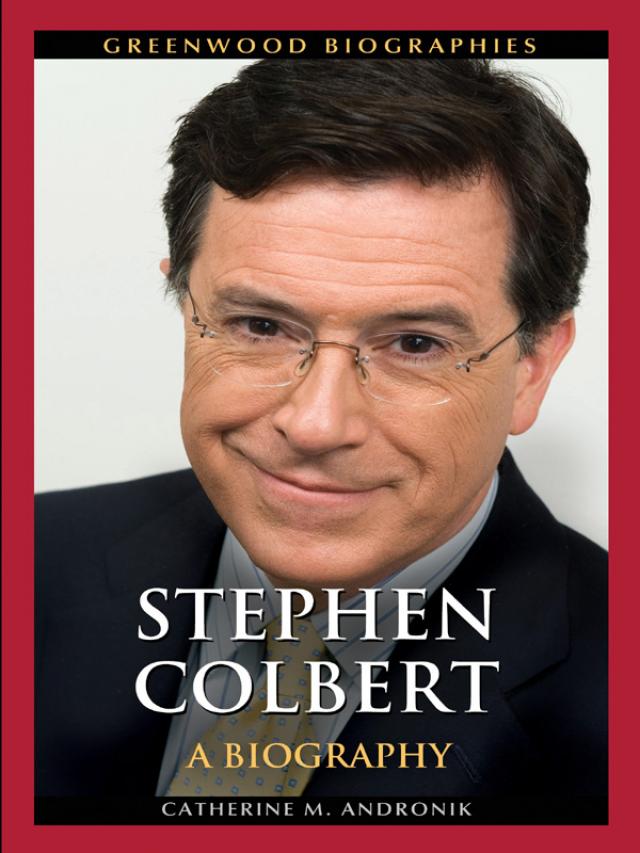
STEPHEN COLBERT
A Biography
Catherine M. Andronik
Copyright 2012 by ABC-CLIO, LLC.
All rights reserved. No part of this publication may be reproduced, stored in a retrieval system, or transmitted, in any form or by any means, electronic, mechanical, photocopying, recording, or otherwise, except for the inclusion of brief quotations in a review, without prior permission in writing from the publisher.
Library of Congress Cataloging-in-Publication Data
Andronik, Catherine M.
Stephen Colbert : a biography / Catherine M. Andronik.
p. cm. (Greenwood biographies)
Includes bibliographical references and index.
ISBN 978-0-313-38628-2 (hardcopy : alk. paper) ISBN 978-0-313-38629-9 (ebook) 1., Colbert, Stephen, 1964 2., Television personalities United States Biography. 3., Comedians United States Biography. I., Title.
PN2287.C5695A58 2012
792.702 8092 dc23
[B] 2011053334
ISBN: 978-0-313-38628-2
EISBN: 978-0-313-38629-9
16 15 14 13 12 1 2 3 4 5
This book is also available on the World Wide Web as an eBook.
Visit www.abc-clio.com for details.
Greenwood
An Imprint of ABC-CLIO, LLC
ABC-CLIO, LLC
130 Cremona Drive, P.O. Box 1911
Santa Barbara, California 93116-1911
This book is printed on acid-free paper &
Manufactured in the United States of America
Recent Titles in Greenwood Biographies
Diego Rivera: A Biography
Manuel Aguilar-Moreno and Erika Cabrera
Ronald Reagan: A Biography
J. David Woodard
Pancho Villa: A Biography
Alejandro Quintana
Michelle Obama: A Biography
Alma Halbert Bond
Lady Gaga: A Biography
Paula Johanson
Bono: A Biography
David Kootnikoff
Henry Louis Gates, Jr.: A Biography
Meg Greene
Robert E. Lee: A Biography
Brian C. Melton
Ulysses S. Grant: A Biography
Robert B. Broadwater
Thurgood Marshall: A Biography
Glenn L. Starks and F. Erik Brooks
Katy Perry: A Biography
Kimberly Dillon Summers
Sonia Sotomayor: A Biography
Meg Greene
CONTENTS
Series Foreword
Introduction
Timeline: Events in the Life of Stephen Colbert
Chapter 1 Studio Audience
Chapter 2 Baby of the Family
Chapter 3 North to Chicago
Chapter 4 Days and Nights at the Improv
Chapter 5 The Daily Show
Chapter 6 A Show of His Own
Chapter 7 The Bump
Chapter 8 The Infamous White House Correspondents' Dinner
Chapter 9 Hat in the Ring
Chapter 10 Taking the Show on the Road
Chapter 11 Spinoffs
Chapter 12 Restoring Sanity (and/or Fear)
Chapter 13 Colbert v. Congress
Chapter 14 Hey, He Can Act!
Chapter 15 Who's the Man?
Bibliography
Index
SERIES FOREWORD
In response to school and library needs, ABC-CLIO publishes this distinguished series of full-length biographies specifically for student use. Prepared by field experts and professionals, these engaging biographies are tailored for students who need challenging yet accessible biographies. Ideal for school assignments and student research, the length, format, and subject areas are designed to meet educators' requirements and students' interests.
ABC-CLIO offers an extensive selection of biographies spanning all curriculum-related subject areas including social studies, the sciences, literature and the arts, history and politics, and popular culture, covering public figures and famous personalities from all time periods and backgrounds, both historic and contemporary, who have made an impact on American and/or world culture. The subjects of these biographies were chosen based on comprehensive feedback from librarians and educators. Consideration was given to both curriculum relevance and inherent interest. Readers will find a wide array of subject choices from fascinating entertainers like Miley Cyrus and Lady Gaga to inspiring leaders like John F. Kennedy and Nelson Mandela, from the greatest athletes of our time like Michael Jordan and Lance Armstrong to the most amazing success stories of our day like J. K. Rowling and Oprah.
While the emphasis is on fact, not glorification, the books are meant to be fun to read. Each volume provides in-depth information about the subject's life from birth through childhood, the teen years, and adulthood. A thorough account relates family background and education, traces personal and professional influences, and explores struggles, accomplishments, and contributions. A timeline highlights the most significant life events against an historical perspective. Bibliographies supplement the reference value of each volume.
INTRODUCTION
Stephen Tyrone Colbert is an American comedian and actor who has built a following around the character he created a character who is also named Stephen Colbert. Since 2005, he has hosted an Emmy-winning television show, The Colbert Report, on the cable channel Comedy Central. Colbert's character is a satirical version of conservative political pundits like Bill O'Reilly. Colbert the real person claims two honorary doctorates and Jordanian knighthood, and he sometimes does add the titles Dr. and Dr., Sir to his name, though usually as a joke.
Colbert was born on May 13, 1964, the 11th and last child in his family. He grew up in Charleston, South Carolina. When he was 10 years old, his father and two brothers were killed in a plane crash as they were traveling to Connecticut to drop off the boys at boarding school. As all the other siblings were older, Stephen lived alone with his mother until he went away to college. Although the Colbert family is Catholic, Stephen attended Porter-Gaud School, a private Episcopal high school in Charleston. While in his teens, he became interested in drama and theater. For two years he attended Sydney-Hampden College in Virginia, an all-male institution, where he studied philosophy. Unhappy there, he transferred to Northwestern University in Evanston, Illinois, as a communications/theater major. Though his intent was to become a serious dramatic actor, friends drew him into Chicago's rich world of improvisational theater. After graduation from Northwestern in 1986, he joined Second City, the premier American training ground for improvisational comedians. With Second City, he was in a traveling company with the late Chris Farley (of Saturday Night Live), Amy Sedaris, and Paul Dinello and served as understudy for future coworker Steve Carell.
Colbert found kindred spirits in Sedaris and Dinello. The three moved to New York, where they wrote and acted in several short-lived series for Comedy Central. Exit 57 looked at the weird and wacky lives of a group of young people. Strangers with Candy, their most successful endeavor, was about a problem teen who returns to high school decades later to get her diploma and is now a problem adult; it spawned a movie of the same title. If one watches the credits for Strangers with Candy, one might notice a certain Evelyn McGee aka Mrs. Stephen Colbert. McGee was also a Charleston native; the two met in 1990, married, and have raised a family of three very non-show-business children. Colbert was also involved in writing for the short-lived The Dana Carvey Show.
Among Comedy Central's programs in the late 1990s was The Daily Show, hosted at first by Craig Kilborn. The program was a send-up of real newscasts, complete with a team of correspondents. For a short time in the Kilborn years, those correspondents included Colbert. He also tried his hand at real news for ABC's Good Morning, America, where he covered humorous human interest stories. Only one of his pieces actually aired.
In 1999, Craig Kilborn left The Daily Show and was replaced by Jon Stewart, an actor and stand-up comedian who had previously hosted a talk show on MTV. Reluctantly, Colbert accepted an offer to rejoin the cast of The Daily Show. With the smart, biting wit of Stewart at the helm, the show skyrocketed to success. Colbert began developing his character, a “poorly informed, high-status idiot,” as a foil to Stewart. As many of The Daily Show's other correspondents Steve Carell, Ed Helms, Rob Corddry left the show for other movie or television projects, Comedy Central looked for a way to keep Colbert in its stable. What developed was a Daily Show spinoff, The Colbert Report.
The Colbert Report parodies the shows of such pundits as Bill O'Reilly and Rush Limbaugh. Colbert proclaims his conservative version of the truth loudly and bombastically and refuses to be swayed from his beliefs by mere facts. His guests on the show have run the gamut from politicians to scientists to rock bands, from the sublime to the ridiculous. None are spared from Colbert's sharp tongue. The show engendered a fan following, known as Colbert Nation, which wields considerable clout in the real world.
The real Stephen Colbert should not be mistaken for the character of the same name; while there is some overlap between the two, they are not the same. Both are proud, vocal Catholics; the real Stephen Colbert actually teaches Sunday school without his trademark irony. Whereas the character is staunchly Republican, the real Stephen Colbert holds a more Democratic views. And sometimes it is difficult to say whether an accomplishment belongs to the man or the character. Queen Noor of Jordan, for instance, knighted Stephen on one episode of his show but, since he was in character, is he
TIMELINE: EVENTS IN THE LIFE OF STEPHEN COLBERT
May 13, 1964 Stephen Tyrone Colbert is born.
September 11, 1974 Stephen's father, Dr. James Colbert, and brothers, Paul and Peter, are killed in a plane crash.
1986 Graduates from Northwestern University.
Early 1990s Joins Second City.
1995 1996 With Amy Sedaris and Paul Dinello, creates Exit 57 for Comedy Central.
1997 Joins cast of The Daily Show with Craig Kilborn.
1997 Correspondent for Good Morning, America.
1998 2000 With Amy Sedaris and Paul Dinello, creates Strangers with Candy for Comedy Central.
1999 Rejoins cast of The Daily Show with Jon Stewart.
2000 Presidential election coverage for The Daily Show.
2003 Publication of Wigfield.
2004 Presidential election coverage for The Daily Show.
October 17, 2005 Launch of The Colbert Report on Comedy Central.
April 29, 2006 Comedy guest at White House Correspondents' Dinner.
2007 Publication of I Am America (And So Can You!).
October 16, 2007 Declares presidential candidacy in South Carolina.
November 5, 2007 Drops presidential bid.
November 5, 2007 Writers Guild of America strike begins.
February 12, 2008 Writers Guild of America strike ends.
November 23, 2008 A Colbert Christmas airs.
June 8 11, 2009 Operation Iraqi Stephen airs.
September 24, 2010 Testifies before Congress on immigration.
October 30, 2010 Rally to Restore Sanity and/or Fear, Washington, D.C.
April 7 9, 2011 Sondheim's Company with New York Philharmonic.
June 30, 2011 SuperPac approved.
Chapter 1
STUDIO AUDIENCE
The line snakes up and down a covered alleyway on 54th Street in Manhattan, between 10th and 11th Avenues. It is about 5:30 p.m.; some of these people have already been here for quite a while. There are about as many men as women; most appear to be in their mid-20s, though quite a few others could be called mature adults. Their goal: entrance into the building that abuts the alley, the building with a red, white, and blue marqueed awning designating the studio where The Colbert Report is taped at about 7:30, Monday through Thursday evenings, 161 days a year, in front of a studio audience. About 120 of these people will be the lucky ones who reach that goal. Most clutch email printouts confirming that they requested tickets online. Others are hoping that it is a slow day for confirmed ticketholders and they will gain entrance as stand-bys. On the alley wall, a sketch of Stephen Colbert, eyebrow cocked, asks the waiting throngs to please refrain from defacing the building with graffiti. The wall is, as requested, graffiti-free.
Before long, staffers with clipboards and stacks of blue laminated tickets bearing Colbert's cartoon likeness and a number make their way through the line, checking names against the email records. “Are you ready to laugh tonight?” they ask energetically. There are also tickets on red or white paper, which designate preferred seating. Among those tapped for these front-row seats are members of the armed services and extreme early birds. Patience and determination pay off.
The line gradually shuffles forward, and finally, with enough people to fill each and every seat in the studio, that evening's audience is assembled to mill about in a chairless waiting room. Tickets to the taping are limited, but free; those left out in the alley will probably try another day and arrive earlier.
Inside the tiny waiting room, a large-screen television on one wall streams the DVD The Best of the Colbert Report, featuring clips from some of Colbert's shows from 2005 to 2007. Meanwhile, another staffer explains the studio protocol: turn off your cell phones, no cameras or other recording devices, no food or drink during the taping.
Finally, the studio doors open and the audience files in to take its seats. It is semicircular amphitheater-style seating, a good view from everywhere, not a bad spot in the house. Monitors are set up so the audience can see what viewers at home will see, such as the graphics frequently used in The Colbert Report sketches. The live set which Colbert and his staff refer to as the “Eagle's Nest”1 seems smaller than it looks on television, but everything is there: the omnipresent blazing red, white, and blue graphics; the wraparound desk with its comfy-looking, ergonomic office chair; the bookshelves crammed with items memorializing the host and his accomplishments from a model racing yacht to a Rock 'em-Sock 'em Robot game; the round polished wood table in front of a cozy electric fireplace where Colbert interviews each evening's special guests. The trademark capital C is everywhere. Colbert has said that the design of the Eagle's Nest recalls, in a weird way, Leonardo da Vinci's painting The Last Supper. He actually instructed his set designer to study the painting. “All the architecture of that room points at Jesus's head, the entire room is a halo, and he doesn't have a halo. On the set, I'd like the lines of the set to converge on my head. And so if you look at the design, it all does, it all points at my head. And even radial lines on the floor, and on my podium, and watermarks in the images behind me, and all the vertices, are right behind my head. So there's a sort of sun-god burst quality about the set around me.”2 The meticulous design of the set also has to do with Colbert's vision of his character as not a newscaster, but as news himself. “I said [to the designer], I am the news. I translate nothing. I am not a medium. I am not a member of the media, because I'm not a vessel. I am it.'”3
The theme music for The Colbert Report was just as carefully planned as the layout of the studio. Titled “Baby Muggles,” it's by the 1970s rock band Cheap Trick, best known for hits like “The Flame” and “Surrender.”4 When the band was composing it, Colbert suggested it take Aaron Copland's “Fanfare for the Common Man” as inspiration for grandeur. “If you can put majesty on top, with something that rocks for 15 seconds, and with a discernible melody, that'd be great.”5
But we haven't gotten to “Baby Muggles” yet. Instead, music with a strong dance beat blasts from studio's speakers, adding to the feeling that you've just crashed a very cool party.
The stage manager comes out to explain the audience's crucial role in the evening's show. Colbert, he explains, was trained in improvisational comedy. An enthusiastic, laughing, engaged audience encourages improvisational or stand-up comedians to ad-lib, to deviate a bit from the prepared script; a good audience really can make the show funnier. He demonstrates the signal for a strong audience response, which could include standing, cheering, clapping, woo-hooing, chanting. This behavior is appropriate for the beginning of the show and returns from commercial breaks. It is, however, not appropriate during Colbert's commentary, when anything from chuckles to hearty laughs are all that are required. And, the stage manager assures us, this is Stephen Colbert. Laughing will not be a chore; it should come quite easily.
Production-wise, about 90 people make each night's The Colbert Report happen. Some the audience gets to see the crew making its way around the stage, checking lights, cameras, microphones, and monitors. Others work behind the scenes. For instance, Colbert does not write his scripts alone; he collaborates with a team of a dozen talented writers. At a little past 7:00 p.m., a staffer enters from the wings with sheaves of paper in his hands. Carefully, neatly, he places one stack on the C-shaped desk at center stage. “Okay, we've got a script,” he can be heard to say quietly.6 The behind-the-scenes work is done for the day. Besides Colbert's script on the desk, a copy is also transcribed into a teleprompter so Colbert can read it while apparently looking at the camera.
Soon after, a stand-up comedian enters to warm up the audience. He singles out one or two people and asks questions, then bases his act on their responses. It gets people laughing freely, primed for more. At last, he introduces the star of the show, and Colbert himself skips onstage from behind his desk.
For just these few minutes before the actual show, the studio audience is allowed to see the real Colbert, the man, not the character he has created. He calls this his opportunity to humanize himself. People in the audience volunteer questions, and, out of character, Colbert answers them. That evening, subjects range from the college commencement addresses he gave recently, to his favorite Harry Potter character, Professor Lupin. (“I love those books. But poor Tonks,” Colbert adds.) There is also an unexpectedly, somewhat embarrassingly funny exchange based on the phrase “Who's the Man?” A reference to the flub reappears as an ad-lib a few minutes later in the show itself. With a professional's full control of his audience, Colbert suddenly calls an end to the question-and-answer session no one clamors for just one more comment. He takes a seat at his desk for a quick makeup touch-up. A spritz of hairspray on his signature brunette forelock gets the audience cheering. Afterward he playfully shoots a few rubber bands into the audience, looks about for something else to throw, and, finally, with a wicked grin, produces an equally wicked-looking knife from under the desk. There are no takers. Then he disappears backstage once again.7


