

Sister Secrets, page 1


Like a pane of aqua glass spread before you.
One big breath in.
‘Take your marks.’
My front leg is shaking.
And then it begins.
Nothing left to do but fight.
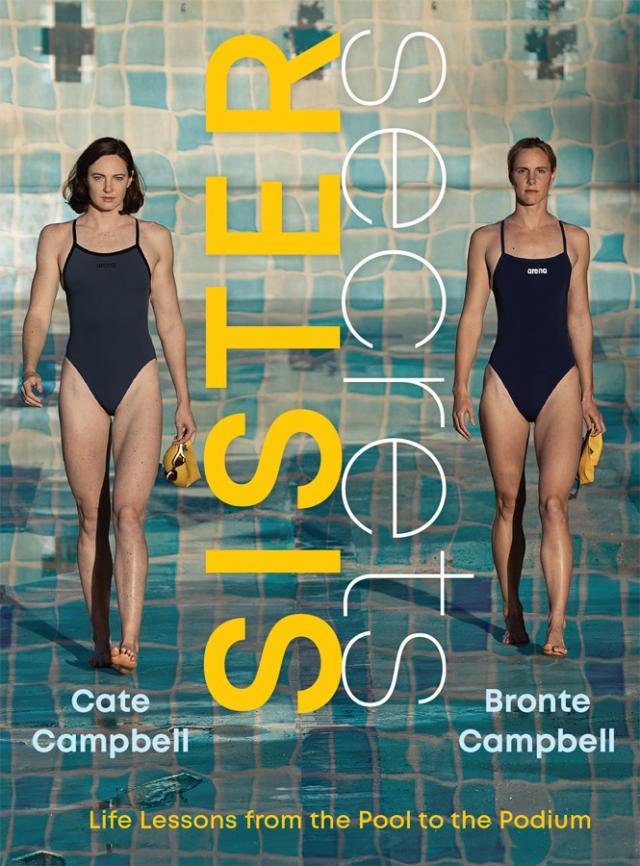
Cate and Bronte Campbell stand among the true greats of Australian swimming. In their own words, Sister Secrets follows all the highs and lows of their journey – their ambitions, successes, disappointments and losses, their long road to Tokyo and the triumph they found there. And along the way, they reveal their secrets to motivation, mental toughness and finding balance in and beyond the world of elite-level swimming.
An amazing account of how two sisters gained the
courage to take on the world – and each other.
Photo credits
Phil Hillyard Pic 1, Pic 2, Pic 3, Pic 4, Pic 5, Pic 6, Pic 7, Pic 8, Pic 9; Pentaphoto_Alessandro Trovati Pic 10, Pic 11, Pic 12, Pic 13, Pic 14, Pic 15, Pic 16, Pic 17, Pic 18; Delly Carr Pic 19, Pic 20; DPPI Media / Alamy Stock Photo Pic 21, Pic 22; BJ Warnick / Newscom / Alamy Stock Photo Pic 23, Pic 24; ITAR-TASS News Agency / Alamy Stock Photo Pic 25, Pic 26; LMspencer / Shutterstock Pic 27; Martin Rickett / PA Images / Alamy Stock Photo Pic 28; Orange Pics BV / Alamy Stock Photo Pic 29; rathshiki / Shutterstock Pic 30; S.Pytel / Shutterstock Pic 31; Aflo Co. Ltd. / Alamy Stock Photo Pic 32; katacarix / Shutterstock.com Pic 33; Adam Davy / PA Images / Alamy Stock Photo Pic 34; all other images courtesy of Cate and Bronte Campbell/Campbell family.
First published by Allen & Unwin in 2021
Copyright © Cate Campbell and Bronte Campbell, 2021
All rights reserved. No part of this book may be reproduced or transmitted in any form or by any means, electronic or mechanical, including photocopying, recording or by any information storage and retrieval system, without prior permission in writing from the publisher. The Australian Copyright Act 1968 (the Act) allows a maximum of one chapter or ten per cent of this book, whichever is the greater, to be photocopied by any educational institution for its educational purposes provided that the educational institution (or body that administers it) has given a remuneration notice to the Copyright Agency (Australia) under the Act.
Allen & Unwin
83 Alexander Street
Crows Nest NSW 2065
Australia
Phone: (61 2) 8425 0100
Email: info@allenandunwin.com
Web: www.allenandunwin.com
ISBN 9781760525910
EISBN 9781761063305 eBook
For teaching resources, explore www.allenandunwin.com/resources/for-teachers
Cover & text design by Sandra Nobes
Cover photo by Ryan Pierse / Getty Images
Set in 11 pt Sofia Pro by Sandra Nobes
For the believers and doubters,
the fallers and the get-back-uppers
For the tears and the joy,
the heartbreak and the glimpses of sun
For anyone who ever had a dream
Beginnings
Big Dreams
Belief and Beyond
Olympics
Winning
Losing
Of Mind and Body
COVID-19
Tokyo 2020
Ten Things They Don’t Tell You
CATE
Our childhoods were shaped by water. Like water slowly wears away rock, moulding and contorting it, so it ran through our lives, carving out a slow, seemingly inevitable path, a funnel for our hopes, passions and energies. It was the beginning of a journey that would lead us from a tiny African country called Malawi all the way to the top of an Olympic podium.
GROWING UP IN AFRICA
The eldest two of five children, Bronte and I grew up in an African country called Malawi. Our dad, Eric, and mum, Jenny, were born and raised in South Africa. After marrying, they travelled the world for a year, living and working in America and England. Upon returning to South Africa, they weren’t quite ready to settle back into normal life again – so on a whim, Dad took a three-year contract in Malawi. Little did they know that three years would turn into ten, during which they would become a family of seven.
Flanked by Mozambique, Tanzania and Zambia, Malawi is a tiny country in south-east Africa – so small, it could fit into Queensland over fifteen times. Despite Malawi being a landlocked country, over a third of its surface area is taken up by Lake Malawi. While our dad, an accountant by profession but an avid sailor, was off racing catamarans, we spent most weekends splashing in the lake’s shallows, always on the lookout for the crocodiles and hippopotamuses known to inhabit the area.
Our days were filled with school lessons – we were home-schooled – interspersed with hours of play. We had a small menagerie of animals that roamed our garden – rabbits, chickens, turkeys, guineafowl, guinea pigs, cats, dogs and, at one point, a pig. Every day was an adventure, whether it was finding all the places the chickens had laid their eggs, rescuing the guineafowl when they got stuck on the roof, or dressing up our patient, long-suffering labrador, Lexi. As children, we got to experience the wild, innocent, ignorant freedom that comes from living in a place like Africa without noticing any of its drawbacks. For our parents, it was a regular occurrence to be unable to find fresh milk, or to discover the flour had weevils in it; as an adult, I imagine this would have been frustrating, but as children we happily went without milk or ate muffins with weevils in them. The frequent power outages, far from being a nuisance, were an opportunity to build indoor forts and light them up with candles and torches.
But beyond the inconveniences that were part of life for our family, Malawi had much larger problems – poverty, inequality and corruption were widespread and systemic. As a child, I accepted the way things were. Now, viewing my childhood memories through an adult lens, I am acutely aware of my privilege in having been able to enjoy the wonders of the country while being protected from its greater challenges.
THE FIRST SPLASH
Swimming runs in the family. Our grandmother on our mum’s side was a swimming teacher and Mum herself was a national-level synchronised swimmer for South Africa. However, as this was during Apartheid, and South Africa was banned from international sporting competitions, Mum was never able to compete at an Olympics or Commonwealth Games.
I have no recollection of learning to swim. We never had formal swimming lessons or instruction – Mum taught us in the backyard pool before we could even walk. While a love of water was evident in both Bronte and me, I needed more time before I was comfortable in it. I hated putting my face under the water and insisted on swimming with floaties on – even though the floaties were completely deflated and more of a hindrance than a help. Bronte, on the other hand, fearless and daring, would happily leap into the water, come spluttering to the surface and, much to my consternation, try to wrestle the useless floaties off my arms.
BRONTE
SINK OR SWIM
My memories of swimming in Africa are tied up with my mother and grandmother. Mum taught synchronised swimming (now called artistic swimming) at the local high school; she would cart us along with the proviso that we not get in the way. That meant playing quietly on the side or joining in with the big kids and trying to keep up. Needless to say, neither Cate nor I could sit still on the side – I don’t know many kids who could on a hot subtropical day.
So we jumped in and, at five and seven years old, were expected to hold our own. I can’t say we were very good; at my first competition I got three out of ten for my routine and finished fourth out of four people – and one of the judges was my own mother! But I did learn how to work to keep up, and try harder than anyone else in the group, even if it only meant breaking even. It’s a habit I’ve carried through my whole swimming career.
My grandmother, who used to teach local kids in her backyard pool, also showed me a way into swimming. I still have certificates from making it through her squads. In the very beginning, swimming for me was all about family and learning and fun. Working hard, yes. Concentrating, yes. But never winning. It wasn’t until a few years later that I started to see it as something different entirely.
CATE
ACROSS THE SEAS
In 2001, our parents decided to move to Australia, just before the birth of our youngest sister. I was nine and Bronte was seven. The thing that struck me most about Australia was how clean it was. None of the roads had potholes, there was no rubbish on the pavements, and every set of traffic lights worked! I remember thinking (and still do when I come back to Australia after travelling) that we had landed in paradise.
Our introduction to club swimming came when we arrived in Brisbane. The house we were renting was a ten-minute walk from a local swimming pool, and we immediately signed up as a way to make friends and connect with Australian culture.
Little did we know how this seemingly insignificant choice of swim club would change the course of our lives. It was there that we met our coach of twenty years, Simon Cusack, without whom both our lives would be very different.
Origin story
My origin story is more hero worship than superhero. I clearly remember watching the Australian swimmers at the 2000 Olympics: Grant Hackett winning the 1500m by over two lengths, Susie O’Neill and Ian Thorpe, the relay boys and Leisel Jones. By this point we knew we were about to move to Australia and I watched these goliaths who represented my new home in fascination.
From that moment I was hooked. Every seven-year-old has a dream of what they want to be when they grow up: an actor, an astronaut, a firefighter – all the cool and impossible jobs we’re too scared to strive for once we’re grown. All I wanted was to be an Olympic swimmer.
BRONTE
EARLY RISER
The house we first rented in the inner west of Brisbane was a ten-minute walk to the pool. A small, six-lane, 25m pool where I would end up training for twelve years and qualifying for my first Olympics.
Four mornings a week would find me bouncing out of bed at 6am and walking down to the pool. My session didn’t start until 7am, but I was convinced that if I got there early and watched the ‘big kids’ train, I would be a better swimmer. I was a total pain at training; my perfectionist nature not only required that I do the session faultlessly but that everyone else should too. If I lapped someone, I’d make sure they did the extra laps. No slacking off! My poor squad, they just wanted to do their session and make it to school. But I knew I was training for the Olympics.
Cate, on the other hand, was less enthusiastic. She was the person who got lapped, walked on the bottom of the pool, turned around at the flags and generally just wanted it to be over so she could go home.
NEMESIS!
That all changed when we went to our first swimming carnival. I came first in my 25m backstroke, freestyle and butterfly and second in my 25m breaststroke, which earned me Age Champion. Cate came third in her 25m backstroke, which she was quite happy with. That is, she was happy until I started parading around at home with my medals clanking and bringing my trophy to the dinner table. Seven-year-old Bronte was a bit of a show-off. After about a week of this, Cate snapped: she stole all my hard-earned paraphernalia and hid it under her bed. This induced tears from me, a search by Mum and the subsequent discovery of my treasures.
Mum sat us both down and said to Cate, ‘Bronte worked hard for those. I’ve seen you at training and you don’t work hard. That’s fine, you don’t have to. But if you want what Bronte has, then you’re going to have to work for it.’
And in that moment, when Cate looked at what I had and decided she wanted it for herself, my greatest nemesis was born. The Joker to my Batman (because I’m writing this I get to be Batman). Who knows, but had I been more humble as a seven-year-old, I might not have created the monster of a swimmer that is my older sister. The monster of a swimmer who I’ve spent the rest of my career chasing, touching the wall second behind and training against every single day.
Mum also had a chat with me that day about being a little more humble in victory, which was a valuable lesson. No one wins forever (except Winx), and it’s important to me to earn the respect of my competitors through both my victories and defeats.
Living on a dream
For the next eight years, until Cate got her driver’s licence, my mother sacrificed her sleep to drive us to 5am training. I’m sure sometimes it felt like she was sacrificing her sanity too, as we spent most of the drive discussing all the things we were going to do ‘after we’d been to the Olympics’. Things like buying a yacht for Dad, having a private plane, travelling to Paris. Credit to Mum, she never once told us we couldn’t do it. She never said, ‘that’s going to be incredibly hard’ or ‘not that many people make it’ or ‘Olympians are not millionaires even if you do’. She let us spend a bit of time in fantasyland. Reality would catch up with us at some point. Until then we lived on dreams.
SETBACKS
While Cate blazed onto the Dolphins Swim Team at fifteen, it took me a little longer to hit my straps. When I was fifteen I got glandular fever and post-viral fatigue. I stopped making junior teams and couldn’t train properly. At one point I was sleeping for twelve hours a night, falling asleep in classes during the day then going to training and performing terribly. My times were slower, my competitors getting faster and, forget about an Olympic dream, I was struggling to make national age finals.
It was the closest I’ve been to giving up. There didn’t seem to be a way out. The harder I pushed, the worse I got. If it wasn’t for my clear-headed parents and coach I wouldn’t still be swimming. They made me take a break. If you’re beating your head against a wall and the wall isn’t moving, all you’re doing is giving yourself a headache. I had two months off, and in that time I began to doubt whether I’d ever get back to where I had been.
SISTERS BUT NOT THE SAME
By this age Cate was an Olympian. I was very far away from that. It looked like Cate was going to be the swimmer of the family and I was going to be the alternate little red engine who tried but couldn’t make it to the top of the hill. But my coach took me aside. He told me that everyone has a different path. That I wasn’t the same as Cate, nor would our careers look the same. That he still believed I could be an Olympic swimmer, but I’d have to do it in my own way and my own time. That was hugely influential for me. Sometimes all you need is for someone to see you as you are, without comparing you to anyone else, and then say they believe in you anyway.
It took another two years of recovery and training, but at seventeen I made my first Olympic team.
BRONTE
BELIEF VERSUS ACTION
I’ve never spent too much time worrying about belief. I remember a radio interview where the reporter really wanted me to say that I could beat Cate. He came back to it again and again, eventually asking, ‘If you don’t believe you can beat her, how can you ever do it?’ To me that seemed completely irrelevant. Believing was not the problem; it didn’t matter how much believing I did, it wouldn’t make me fitter, stronger or faster.
Training would do that, and I was training every day. It’s always been in the doing that I find my strength. In giving my all in every session, in paying attention to the tiny details and then using that as fuel on race day. Going into a race I can back myself 100 per cent knowing the workload I have behind me.
The onus many people place on belief is problematic as it leaves no room for doubt. I have experienced doubt at different stages of my career. The idea that without belief there is no success is not only false, but it also leads to the erroneous conclusion that doubts will inevitably lead to failure. I’ve found the opposite to be true: that doubts can actually fuel success (I explore this more in the chapter, ‘Losing’).
MOTIVATION
I feel the same way about motivation. I was pretty motivated (perhaps too motivated!) as a kid, but in adulthood I struggle as much as anyone with motivation. If I only went to the pool when I felt motivated to train, I would make it there twice a week. Maybe.
For me, motivation is not a feeling, it’s an action. And it only takes a second. When the alarm goes off at 5.20am, I don’t feel motivated to get out of bed, I just get out of bed. It only takes a second to roll over and put my feet on the floor and then I’m up. It’s the same at training. I made a commitment to swimming a long time ago. Once that decision was made, it was an all or nothing approach. There are days when I get to training and I’m tired and sore and don’t want to be there. But I am – I’ve already committed. For the next two and a half hours I have to be at the pool, no matter what.
The only question is, will I make it count? If I have to be there anyway, I’m going to make sure this session is making me better in some way. It doesn’t have to be huge, but on those mornings when I’m not feeling it, I always pick one small thing that I need to improve. Whether it’s attacking every turn, focusing on my breath timing, or concentrating on keeping my core engaged. That way, even if I’m unable to hit my times, I can look back at the session and see that I still achieved something. It’s a cycle of satisfaction fuelling motivation and it’s very powerful.
CATE
TRAIN HARD, FEEL GOOD
After that little sit-down with Mum, and motivated by the not-so-humble seven-year-old Bronte, I started to apply myself in training. I quickly discovered that the more I trained, the better I performed, and the better I performed, the more I enjoyed myself – therefore, the more I trained. It was a pretty easy, self-fulfilling cycle to fall into. This continued relatively uninterrupted for the next few years.


