

Saints of Feather and Fang, page 1


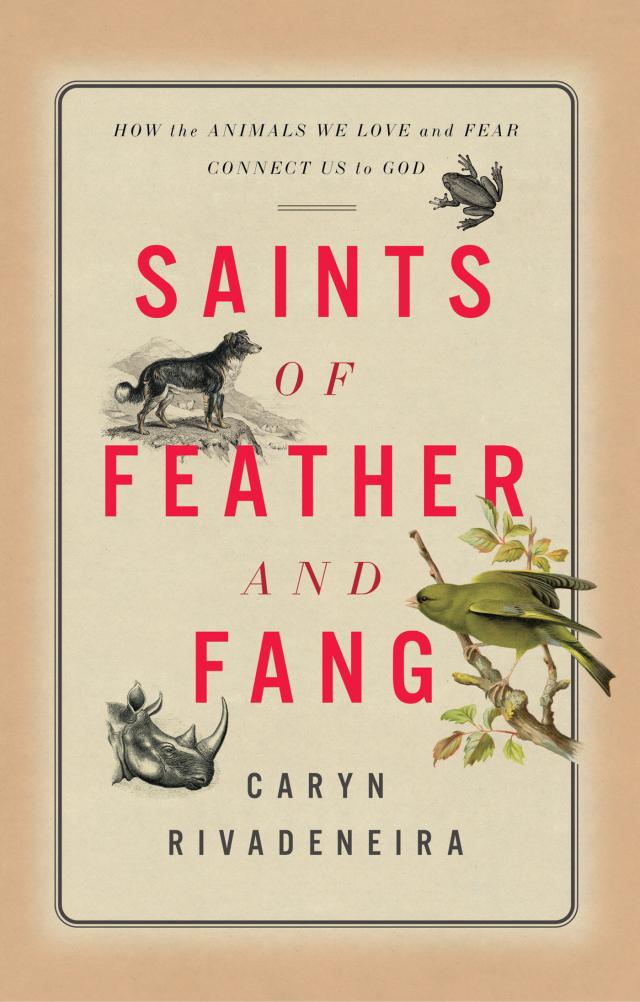
Praise for Saints of Feather and Fang: How the Animals We Love and Fear Connect Us to God
“Caryn Rivadeneira finds holiness in wild and domesticated creatures. There are cuddly pets here, but there are coyotes, hedgehogs, and snakes as well. This is an honest God-experience. We feel stroked or companioned at times, but frightened and mystified just as often.”
—Jon M. Sweeney, author of Feed the Wolf and The Complete Francis of Assisi
“For curious animal lovers who cherish God, talented author Caryn Rivadeneira has compiled a beautifully inspiring look at how creatures of the animal kingdom serve as spiritual guides for the growth of human souls. Surprising and original, it is a glorious reflection on humanity’s connection to the joy and power of the Lord’s ‘feather and fang’ fellowship.”
—Patricia Raybon, award-winning author of My First White Friend: Confessions on Race, Love, and Forgiveness and I Told the Mountain to Move: Learning to Pray So Things Change
“From comparing God’s love to that of a ‘mama eagle,’ to likening pit bulls to the good Samaritan and exploring the ‘anywhen’ of liminal places, Saints of Feather and Fang is full of surprises. Author, animal lover, and seminarian Caryn Rivadeneira is fierce, funny, and fresh in these pages as she examines what animals can teach us about our Creator.”
—Jennifer Grant, author of Dimming the Day and other books
“Animals have always been my teachers, my mentors, my inspiration. In them, I see the face of the Creator. Caryn Rivadeneira’s sometimes sweet, sometimes funny, always touching stories remind us that each of God’s creatures is sacred and holy, with lessons to teach us all about God’s love.”
—Sy Montgomery, author of The Soul of an Octopus and How to Be a Good Creature
“The psalmist tells us that the heavens declare the glory of God, but what does that really mean? From pit bulls and snakes to hedgehogs and sheepdogs, this book will inspire the reader to imagine and explore what creation might be proclaiming about God.”
—April Fiet, author of The Sacred Pulse: Holy Rhythms for Overwhelmed Souls
“Caryn Rivadeneira’s sparkling mosaic of stories, science, and Scripture about animals will have you seeing God in the octopi, donkeys, and crows. Warmly, and with wit, she reveals One Great Love streaming through everything that breathes, redeeming us all, together.”
—Gayle Boss, author of All Creation Waits: The Advent Mystery of New Beginnings and Wild Hope: Stories for Lent from the Vanishing
“Caryn Rivadeneira writes that animals help us to understand and see God’s greatness and goodness better; this book did just that for me. Saints of Feather and Fang is a book to be savored.”
—Suzy Flory, New York Times bestselling author or coauthor of sixteen books
Saints of Feather and Fang
Saints of Feather and Fang
How the Animals We Love and Fear Connect Us to God
Caryn Rivadeneira
Broadleaf Books
Minneapolis
SAINTS OF FEATHER AND FANG
How the Animals We Love and Fear Connect Us to God
Copyright © 2022 Caryn Rivadeneira. Printed by Broadleaf Books, an imprint of 1517 Media. All rights reserved. Except for brief quotations in critical articles or reviews, no part of this book may be reproduced in any manner without prior written permission from the publisher. Email copyright@1517.media or write to Permissions, Broadleaf Books, PO Box 1209, Minneapolis, MN 55440-1209.
All Scripture quotations, unless otherwise indicated, are from the New Revised Standard Version Bible, copyright © 1989 National Council of the Churches of Christ in the United States of America. Used by permission. All rights reserved worldwide.
Scripture quotations marked (NIV) are taken from the Holy Bible, New International Version®, NIV®. Copyright © 1973, 1978, 1984, 2011 by Biblica, Inc.™ Used by permission of Zondervan. All rights reserved worldwide. www.zondervan.com The “NIV” and “New International Version” are trademarks registered in the United States Patent and Trademark Office by Biblica, Inc.™
Cover images: Frog-Kruszklb/istock.com
Dog-THEPALMER/istock.com
Bird & rhinoceros-duncan1890/istock.com
Cover design: Gearbox
Print ISBN: 978-1-5064-7208-9
eBook ISBN: 978-1-5064-7209-6
While the author and 1517 Media have confirmed that all references to website addresses (URLs) were accurate at the time of writing, URLs may have expired or changed since the manuscript was prepared.
To Henrik, Greta, and Fredrik
Contents
Introduction
1 Love When God Stirs the Nest
2 Rescue The Lord Is My Sheepdog
3 Vices and Virtues How Pit Bulls Choose to Love
4 Delight Building Hedgehog Highways
5 Adaptability Coyotes on the Rebound
6 Gut Instinct To Put Your Snout to the Sky
7 Fear How to Pet a Snake
8 Creative Abundance Why the Octopus Changes Color
9 Curiosity What Kills the Cat Makes Us Love It
10 Liminal Places Where the Crows Lead
11 Redemption Consider the Donkeys
Appendix Further Thoughts on Animals in the Bible
Acknowledgments
Notes
Introduction
All creatures of our God and King
Lift up your voice with us and sing.
—Saint Francis of Assisi
I have always loved animals. Family lore tells of me reaching for our giant husky-shepherd mix the moment I came home from the hospital, refusing to speak to grown-ups but happily running to greet every strange dog I encountered, and hiding from the costumed characters at Disney World, instead following tiny chipmunks into the bushes.
When my own memories kick in, the story doesn’t change. I rejected baby dolls and Barbies, preferring the company of the piles of stuffed animals that overwhelmed my bedroom. My most perused book was National Geographic Book of Mammals. I’d spread the volumes open and study the pictures and information, returning again and again to the spread on bats, hoping to squelch my fear. (It worked! More on this later.)
The stories demonstrating my deep love of animals are endless. A million spring to mind. But since this is a book about animals and God, it’s important that I mention this: though I have been a Christian nearly my whole life, I have not always loved Jesus.
You heard that right.
I was baptized as an infant in a Lutheran congregation and taken to church most Sundays of my youth. I had a mystical experience with God at age seven that led me to believe in God’s actual realness and presence. All this time, I would have said I loved Jesus. But I never really did. Here’s how I know.
My grandmother died when I was seventeen. She was a devout Christian woman, although she didn’t go to church. Not in the years I knew her, at least. TV preachers were her thing. I still have notebooks filled with notes and questions she’d jot down as she watched church from the comfort of her chair.
My grandma had some weird beliefs. In fact, I believe the best Christians do. But one that I never questioned was her stance that if dogs weren’t in heaven, she didn’t want to go there either.
This made complete and total sense to me—until, that is, my late twenties, when I mentioned this bit of theology to a Christian acquaintance. She laughed and then said, “Good thing we’ll be so happy to see Jesus, we won’t even care if our dogs aren’t there!”
Total gut punch.
It was the worst thing I’d ever heard.
But that was when I realized I didn’t love Jesus. I believed in Jesus (in a wrestling, antagonistic sort of way). I followed Jesus (in a middle-class American sort of way). And I proclaimed Jesus (in my reserved way).
But I didn’t love him. Because I could not for one second fathom being happier to see Jesus than I would’ve been to see Sven or Faith or Gus.
It wasn’t even close.
But it wasn’t just the idea of not being happy to see my dogs that threw me. When I gave heaven or a new earth any thought, I never cared about mansions or streets of gold. Yes, I wanted reunions with loved ones and conversations with Cleopatra (I believe in a big God). For sure, I wanted relationships with no suffering.
But mostly, I wanted the lion lying down with the yearling. I wanted the child playing with the cobra. I wanted the garden of Eden where I could scratch the cheeks of a mama grizzly and nuzzle a moose.
That was heaven.
But still, I felt bad when I realized I didn’t love Jesus as I thought I did or should have. So I did what any good Christian would have done: I took it to Jesus himself. I asked for forgiveness. I asked for help. I said, “If I don’t love you as I should, help me.”
Of course, there was no immediate change. No thunderbolt. No new heart.
But when, ten or so years later, I walked into the kitchen to find our one-hundred-pound Rottweiler dead on the kitchen floor, I dropped to the ground to touch Bob’s huge snout, to confirm the lack of breath. I had often wondered if he would die with his beloved tennis ball in his mouth. He didn’t. But in my despair, a sudden and overwhelming sense of calm came over me. An image flashed through my mind—a picture of Jesus throwing a tennis ball to our sweet dog in heaven.
And I loved Jesus for it.
***
God has always used weird things to shape my theology. Often, it’s been through suffering. Other times, it’s through the music of the Indi
At least, when I’m paying attention.
I’ve written books about suffering. I’ve already overshared personal stories about my family (and my children are old enough now to be fully off-limits—although perhaps they should have always been). My thoughts about the Indigo Girls and hymn writers remain too unformed to write about yet. But being in the mood to explore more about how God uses weird things to reveal Godself, I’m inclined to let the animals do some talking, to explore and listen to the ways all creatures proclaim the glories and wonders of our Creator.
Of course, my desire is in good company. From the psalmists to Saint Francis to British veterinarian and author James Herriot, animal-loving humans have long appreciated and written about what animals “say” about God. When we pay attention, we see that animals can teach, show, and model aspects of our Creator we might otherwise miss. I have to believe this is the way God intended it.
After all, God may have made humans in God’s image and given humans some kind of “dominion” over animals, but throughout Scripture, writers look to the animal kingdom for metaphors for God. (Of course, what this dominion was meant to look like is hotly contested. But no matter our interpretation, we’ve clearly messed up caring for the earth in more ways than we can count.) Jesus, who was the Lion of Judah and Lamb of God, made it clear that servants—suffering ones, even—make wonderful teachers. In the Bible, the promises of rescue, redemption, and rebirth apply to all creation. Not just us humans. And so, although only humans go to church and write creeds, though only we attend seminaries and get baptized, all creatures share the ability to recognize and praise our Creator. Psalm 148:7–14 offers a beautiful picture of this:
Praise the Lord from the earth,
you sea monsters and all deeps,
fire and hail, snow and frost,
stormy wind fulfilling his command!
Mountains and all hills,
fruit trees and all cedars!
Wild animals and all cattle,
creeping things and flying birds!
Kings of the earth and all peoples,
princes and all rulers of the earth!
Young men and women alike,
old and young together!
Let them praise the name of the Lord,
for his name alone is exalted;
his glory is above earth and heaven.
Sea monsters. Creeping things. Wild animals. Flying birds. Amazing! All creatures can praise God and thus know something about God’s good heart.
We can learn these things if we pay attention. When I finally started listening to what animals had to say about things like love—what love looks and feels like—I discovered I may have loved Jesus all along.
Which is why and how this book came to be. While many people view animal stories as mere “feel-good” or “human interest” pieces that exist to warm our hearts and cheer our days, the human experience with the animals we love and fear runs much deeper. I suspect we all understand this—and not just us pet lovers. I mean, we go to zoos and aquariums; we take trips into nature and get excited about spotting wild creatures for good reason: animals are good for our souls because they move our souls and reveal our Creator.
That is why this book is titled—somewhat cheekily—Saints of Feather and Fang. Of course, animals are not actual saints (well, with the exception of Saint Guinefort, a snake-killing, child-saving French chien whose grave was the site of many a miracle). But the saints do tell us something about God. And they point us to God. As someone who has loved and lived with animals my whole life, been involved with animal rescue, and written children’s books about emotional support dogs who work miracles on the regular (Helper Hounds!) and adventurous penguins who teach about conservation (Edward & Annie!), I have seen that animals mirror the saints in many ways.
We’re going to look at the ways animals teach us about love; about God’s rescue plans; about vices and virtues; about delight, adaptability, and the importance of instinct; about fear, creativity, and abundance; about those liminal spaces between earth and heaven; and about redemption. To make this journey, we need to open our minds, our hearts, our senses. We might need to think differently about the typical ways we encounter God—or view animals. But animals are one of God’s great gifts. All nature speaks and points to our Creator if we are willing to notice. We can learn so much about this life and our God if we pay some attention to these amazing saints of feather and fang.
1
Love
When God Stirs the Nest
After suffering a second stroke, my friend’s mother was largely unable to communicate with her family. Words came out hard and slow if at all. Day after day, my friend Meg would sit next to her mother’s hospital bed, reading her mother’s favorite books and speaking words of love and comfort. Meg would ask questions, desperate to hear one word. To no avail.
That is, until one afternoon Meg’s mother cried as she gasped out one word to her daughter. “Bill,” she said. “Bill . . .”
“Bill?” Meg asked. “Mom, who is Bill?”
There was no answer, of course. But again and again, her mom moaned, “Bill . . .” as the tears flowed.
In her distress, Meg’s mind raced to what could be causing her mother to cry like this. A long-lost love? Or a long-lost child? Was her mother trying to tell her about a baby she’d given up? Is that what Meg would learn?
She texted her dad and her siblings: “Mom is crying about a ‘Bill.’ Anyone have any clues?”
No one did.
Meg’s mind continued to reel—until a nurse walked in. Meg’s mom looked at the nurse and moaned, “Bill . . .”
“Oh don’t worry,” the nurse said. “Bill will be here again next week. Tuesday, I think.”
Meg was stunned. In all her wonderings, never once had she imagined Bill had made his way to her mother’s hospital room.
“Who’s Bill?” Meg asked the nurse, nervous to hear the answer.
“Bill the therapy pony,” the nurse said. “All the patients love him.”
“I laughed for ten minutes straight,” Meg told me later. Never once since her strokes had her mother cried about her children or grandchildren. She hadn’t cried over visits from friends or siblings. Her mom didn’t even really like animals, and yet Bill the therapy pony managed to elicit tears. “I couldn’t believe it!” Meg said.
I could. In fact, the story didn’t surprise me at all.
Of course Bill the therapy pony would cause that reaction. And not just because miniature horses (not really ponies) are ridiculously cute. In addition to helping people like Meg’s mom recover motor and speech skills, therapy animals like Bill, through both training and instinct, offer essential human needs in times of suffering. Bill brought comfort, joy, and smiles. But ultimately, Bill brought love. Without judgment. Without worry lines. Without breaking down in sobs of grief. These things are all but impossible for concerned children, grandchildren, siblings, and friends to do for a loved one in that moment. Bill the therapy pony’s face never betrayed him. His whinny never came out higher-pitched than intended. Bill could simply be calm, joyful, and present for Meg’s mom during a troubling time.
In many ways, Bill was the loving presence of God. And who wouldn’t cry about that?
***
Whether animals show or feel love has been a subject of debate for probably as long as humans have loved animals. Though certainly humans (and the earliest humans) first admired or even loved animals long before dogs became our friends, our earliest evidence of humanity’s love for animals—outside of our bellies—goes back at least fifteen thousand years. While human appreciation and love for animals from afar (or as dinner) probably goes back millions of years, it was around 13,000 BCE that, researchers estimate, our nomadic ancestors wandered into wolf territory, and a few friendly wolves decided to wander into theirs—perhaps lured by the smell of sizzling meat or simply company. And according to writer Jeffrey Kluger, when we fell for these friendly wolves, we fell fast.


