

Kesrick, page 1


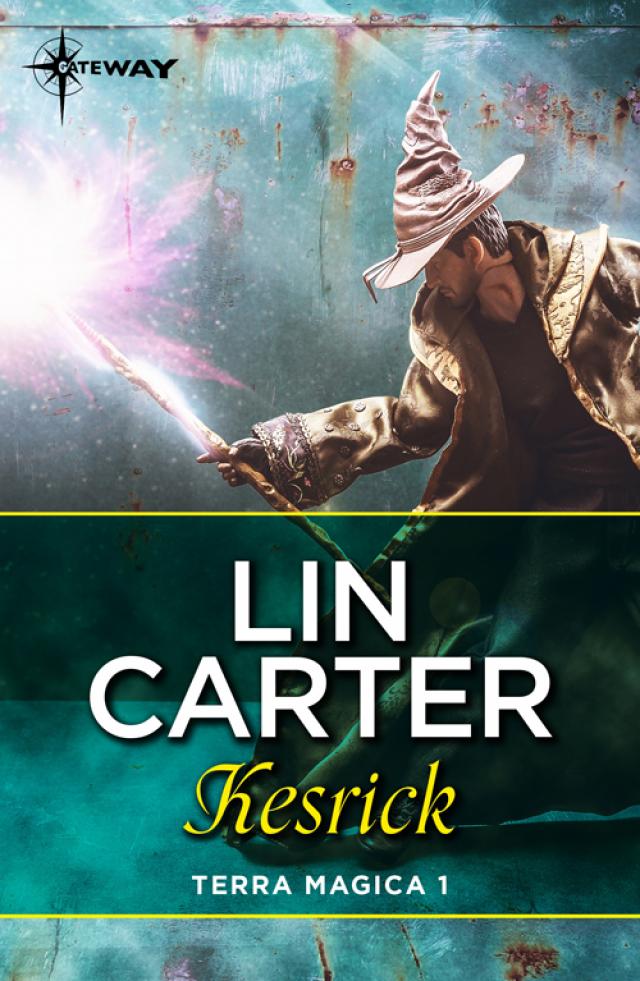
Kesrick
Lin Carter
www.sfgateway.com
Enter the SF Gateway …
In the last years of the twentieth century (as Wells might have put it), Gollancz, Britain’s oldest and most distinguished science fiction imprint, created the SF and Fantasy Masterworks series. Dedicated to re-publishing the English language’s finest works of SF and Fantasy, most of which were languishing out of print at the time, they were – and remain – landmark lists, consummately fulfilling the original mission statement:
‘SF MASTERWORKS is a library of the greatest SF ever written, chosen with the help of today’s leading SF writers and editors. These books show that genuinely innovative SF is as exciting today as when it was first written.’
Now, as we move inexorably into the twenty-first century, we are delighted to be widening our remit even more. The realities of commercial publishing are such that vast troves of classic SF & Fantasy are almost certainly destined never again to see print. Until very recently, this meant that anyone interested in reading any of these books would have been confined to scouring second-hand bookshops. The advent of digital publishing has changed that paradigm for ever.
The technology now exists to enable us to make available, for the first time, the entire backlists of an incredibly wide range of classic and modern SF and fantasy authors. Our plan is, at its simplest, to use this technology to build on the success of the SF and Fantasy Masterworks series and to go even further.
Welcome to the new home of Science Fiction & Fantasy. Welcome to the most comprehensive electronic library of classic SFF titles ever assembled.
Welcome to the SF Gateway.
Contents
Title Page
Gateway Introduction
Contents
The Cast of Characters
Book One: The Knight of Dragonrouge
I: At the World’s Edge
II: In the Dubious Woods
III: The Monster-Guarded Gate
IV: Conversations at Table
V: The Magic Horse
Book Two: The Princess of Scythia
VI: A Damsel in Distress
VII: The Monster from the Sea
VIII: Disenchanting Gaglioffo
IX: The Enchanted Palace
X: The Garden of Jewels
Book Three: The Two Talismans
XI: The Genie Appears
XII: The Treachery of Gaglioffo
XIII: Wed and Widowed
XIV: The Wandering Garden
XV: A Knight of Tartary
Book Four: The Fairy and the Witch
XVI: The Fairy of the Fountain
XVII: The Witch’s Hut
XVIII: Concerning Mother Gothel
XIX: At The Jolly Flagon
XX: The Wandering Garden, Again
Book Five: The Undoing of Zazamanc
XXI: The Subterranean Palace
XXII: Azraq, Again
XXIII: Gaglioffo Repents
XXIV: Walking Cadavers
XXV: The Magic Pommel-Stone
Website
Also by Lin Carter
The Notes to Kesrick
A Word of Appreciation
Dedication
About the Author
Copyright
THE CAST OF CHARACTERS
KESRICK, knight of Dragonrouge and our Hero.
PTERON, a friendly sorcerer.
ARIMASPIA, princess of Scythia and our heroine.
GAGLIOFFO, a treacherous Paynim.
AZRAQ, a dangerous Efreet.
ZAZAMANC, an Egyptian wizard and our Villain.
OCTAMASADAS, Arimaspia’s wicked step-father.
PIROUETTA, Fairy of the Fountain, Kesrick’s Godmother.
MANDRICARDO, a noble knight of Tartary.
MOTHER GOTHEL, a Wicked Witch.
CALLIPYGIA, an Amazon.
Plus:
The Dragon, the Melusine, the Hippogriff, the Rosmarin, the Magic Horse, the Pastinaca, and the celebrated Phoenix.
THE SCENE: Terra Magica, a parallel world whose history has become the source and substance of our myths and epics and legends and fairy-tales.
THE TIME is the twilight of the Golden Age.
… Giants and the genii,
Multiplex of wing and eye,
Whose strong obedience broke the sky
When Solomon was King.
—Matthew Arnold
BOOK ONE
_______________________
The Knight of Dragonrouge
I
AT THE WORLD’S EDGE
It had been centuries since last a sound other than the mournful wind had disturbed the stillness that reigned here at the Edge, and at the distant clatter of hooves the Dragon awoke from his slumbers and lay listening.
Hooves meant a horse, and a horse suggested the presence of a rider, and that meant—Man.
Man, to members of the dragonish breed such as Dzoraug, meant Food. He opened his left eye, flooding the cavern with crimson light. The gods, who had stationed him here in the Beginning so that he might guard forever the bridge that spanned the starry abyss between this world and the next, had of course seen to it that he should never suffer the pangs of hunger. Just above the mouth of his cave they had planted a curious Dedaim tree, whose undying boughs bore ever a grisly fruit of human heads. To a Dragon there is no tastier a tidbit than Head, hence Dzoraug never went hungry. But the monotony of this diet had, over the ages, somewhat palled on him. He dreamed betimes, and in his dragonish dreams there appeared succulent visions of Arm, or Leg, or even Foot.
Hence that clatter of hooves drawing nearer along the World’s Edge, just above his cave, was not a matter of disinterest to Dzoraug. Anything that might alleviate the sameness of his dinner menu aroused his interest; and thus it was that he opened his other eye and peered out of the mouth of his lair and up the steep and narrow path that wound from his doorstep to the brink of the world above.
The unlidding of that second enormous eye increased the sulfurous crimson luminance within the cavern. The light glimmered on heavy rings of gold and on old coins cut with the cartouches of pharaohs forgot ere Nineveh arose, and the names of dynasties extinct save in story. It flashed from heaped and mounded gems in all their scattered thousands—diamonds and rubies and topazes, pearls and amethysts, emeralds and opals, sapphires and garnets, and on many another gem unknown even to the students of minerals. For the floor of his cavern was carpeted with treasure: gems and crowns and ingots beyond the numbering, and the great Dragon lay sleepily coiled upon this wealth like a mother bird upon her eggs, for a Dragon sleeps not well upon cold stone.
There came to him no further noise of hooves, and Dzoraug wondered if perchance the rider had passed him by, riding north to the Empire of Prester John, or southward, it might be, to Far Cathay, the dominions of the Grand Cham. But he shrewdly guessed that, even now, the rider had dismounted and was looping the reins of his steed about the gnarled and hairy roots of the Dedaim tree, where it leaned over the Edge of the World, and that shortly he would come inching his way down that perilous path that led to his door.
So he waited, did Dzoraug, patiently and also with curiosity. For it had been long and longer still since last there came hither a visitor to his lonely lair at the very limit and margin of Terra Magica (a world which lies as close to our own as do two pages in a book, and of whose histories and geographies our poets and dreamers, tellers-of-tales sometimes glimpse in their deepest dreams).
That last misfortunate visitor had been a Hero … what was his name, now? Not Siegfried, surely; something with a “t” in it, thought the Dragon. He could not remember; it had been so very long ago. But the skull and one of the gnawed thigh bones lay in the corner under a heap of coronets.
Great winds howl about the World’s Edge, and unless you are very careful they will pluck you from your footing and whirl you shrieking into space, and you will fall and fall and fall forever, for to this abyss there is no bottom, no bottom at all. It is something to think about.
And Kesrick thought very much about it as he climbed, very carefully, down the narrow and steep and perilous stair the gods had cut from the solid rock of the World’s Edge, and which led down from the hairy, repulsive roots of that loathsome Dedaim tree to the broad stone doorstep before the mouth of the dragon’s lair.
The winds hooted about him, plucking playfully at his locks and tugging at his cloak, which flapped behind him like the wings of some immense bat. It was strange to think that these very winds had arisen first on some far world—Altair, perhaps, or Betelgeuse—but so it was. They had a bitter taste to them, these star-borne winds, the metallic stench of ozone from far nebulae, the sting of phosphorous, perhaps from falling stars, the bitter whiff of thunderbolts.
From here he could see that awesome arch that was the Bridge Between the Worlds, a mighty curve of buttressed stone that soared from the Dragon’s front stoop to dwindle from sight among the stars. On that vast road travel the spirits of kings and saints and heroes, en route to the next life.
But the cold winds made his eyes water and the vista of that endless stony arch made him dizzy. He leaned against the world’s side and rubbed his eyes, looking down.
Below him, the blue sky purpled into darkness.
Far below him jeweled fires glimmered—stars unknown and as yet unnamed by men.
Beneath his heels there blazed the Southern Cross.
Then a reddish glare fell upon him from the Dragon’s staring eyes, and he had come to the bottom of the stair. Here the gods had th
He looked at the Dragon, which all the while regarded him sleepily with two half-lidded eyes like the mouths of furnaces.
The head of Dzoraug was so huge that it completely filled the mouth of his cavernous lair so that he could not come forth therefrom. And the mouth of the cave was itself so vast that you could have built a cathedral therein without scraping a single carven saint or spire against the roof.
Green and mossy with age was that enormous head, grown about with lichens like an ancient boulder, and worn and weathered so that its scales were dull and indistinct.
“Greetings, Man,” said Dzoraug in a slow, deep voice that was rusty from disuse. “Are you a hero?”
That question made Kesrick laugh, and his laughter made him forget his fear. “As for that, Great-grandfather,” he replied courteously, “we shall have to wait until the end of my adventures to see.”
“I mean, are you here on the purpose of heroes? Which is often to slay us of the dragonish race,” said Dzoraug.
Kesrick shook his head, red locks tousling. “Nay, Great-grandfather, and when and if I launch upon a monster-slaying career, I venture to say I shall begin with someone more than a bit smaller than yourself.”
The Dragon smiled a little at this reply, but suspicion still lurked with him. “Mayhap,” he rumbled, “yet I sense about you the tang of magic steel, and is that not a—sword—that hangs at your side, poorly concealed under your cloak?”
Kesrick admitted that this was so. “And it is on the matter of swords that I am come hither, for I would beg the answer of a question from you, who are reputed to be the wisest of all created things, as you are rumored to be the oldest.”
“Pray step a little closer,” suggested the Dragon slyly, “so that we can converse more easily and without raising our voices.”
Kesrick grinned and shook his head. “I can hear you quite clearly from here,” he said. “And it is never wise to come too close to the jaws of Dragons, even one so polite and hospitable as yourself.”
Dzoraug grumbled and shifted his tremendous weight a little. The young knight was well out of reach even of his tongue, which was longer than you would have thought, and was also the means by which he occasionally obtained a meal of Hero.
“Now what would I be knowing of swords?” he inquired a bit peevishly. “They are the ancient bane of my race, and I curse the day the first of them was forged! Chrysaor was its abominable name; Mulciber made it for Jupiter to use in his wars against the Titans…. Or was it forged by Hephaestus, for Odin to use against the Frost Giants? I forget much of those days, for my memory is not what it once was….”
The youth felt a touch of awe before such antiquity. “And are you truly old enough to remember the gods, Great-grandfather?”
Dzoraug blinked sleepily. “Young sir, I remember the gods that were before the gods, and the gods that reigned before them. The dynasties of heaven are as numberless as are the dynasties of earth: it is just that they last a bit longer. They all are vanquished by Time in the end, you know, for Time vanquishes all things that ever were, or are, or will be; saving only myself, of course, for the gods that made me saw to it that there should ever be a truce between myself and Time.”
Kesrick’s green eyes twinkled thoughtfully. He wondered how he could twist the path of their conversation around to the matter on which he had come hither.
“I have heard wise men say that the Dragon Dzoraug knows everything that there is to know,” he said cleverly; “that you crouch here at the World’s Edge and dream the slow ages by, and that all knowledge comes your way in the end, when it has been by all the rest of the world forgot.”
“I was here at the Beginning and I will be here still, until the End,” the Dragon murmured sleepily. His heavy lids were drooping now, closing over the blaze of his mighty eyes like the iron doors of a smithy. He had slept too long to remain awake for long; he was in the habit of sleep.
“I remember the first tree, you know; and the first cloud, for that matter. I am the Oldest Thing there is, for I was the first thing created after the world itself. Ah, and the First Star … Oh, but it was very fair! … the pattern and prototype of all the stars there are…. You do not see stars like that one any more these days.”
And Dzoraug fell into a dreamy and contemplative silence—perhaps thinking of that First Star and its supernal and perfect purity and brilliance, as it looked that first of all evenings, when he saw it bloom like a white rose of flame against the virginal skies.
“Yes, I hear much of the world and how it goes, even here where men come not often now,” he rumbled drowsily. “The old gods come this way, you know, the tired gods, the half-forgotten gods, on their way to that unthinkable and remote bourn where gods go when men have ceased to worship them, and they begin to fade away….”
“I search for the stolen pommel stone of the sword Dastagerd,” the knight said softly. “Perchance you remember it from of old. It is the Sword of Undoings: the Dwarves made it for Dietrich and he slew many monsters with it, before deciding that he liked Nagelring better. The Emperor Huon gave it to Sir Guyon when he knighted him, and Guyon was the ancestor of my house, for I am Sir Kesrick of Dragonrouge.”
“… Dragonrouge?” mumbled the old Worm, more than half asleep.
“Aye. The hall of my fathers rises in a far land to the west, The Kingdom of the Franks. The Red Dragon is my blazonry, and we have been friends, thy brood and my kind, for very long. I thought perchance, when it was stolen away, that it had drifted here to the World’s Edge to mingle with your hoard. Oh, tell me, Great-grandfather, if you will and if you can, where might I search for the lost pommel-stone; or, if you in all your wisdom know not, from whom I should inquire of it?”
The great glaring eyes were almost lidded by now, only narrow crescents of scarlet fire showed in the gloom of the cave’s mouth.
“There is a sorcerer who dwells in a stone house on the shores of the Isle of Taprobane which lies across the narrow straits from the Kingdom of the Gangarids in Hindoostan,” the Dragon mumbled sleepily.
Kesrick listened attentively, and when at last the tale was told, he thanked the Dragon politely and turned and made his slow and careful way back up that steep and perilous stair to where his steed was tethered to the hairy, repulsive roots of the Dedaim tree.
The red luminance had vanished now, and gloom reigned within the vast and treasure-littered cavern. The sleepy eyes had closed and the First of All Dragons slept with his huge snout thrust out over the brink of the bottomless abyss. And it may well be, for aught I know, that as he slept, Dzoraug dreamed, perchance of the world the way it looked on that first morning, green and dewy, fresh and fair.
And that is how it begins.
II
IN THE DUBIOUS WOODS
Through the dark forest Kesrick came riding. The journey from the World’s Edge had been long and arduous and his curious steed had grown aweary, as had the young knight.
Weary though he was, he did not pause to rest nor did he care to linger long within the dark aisles of this wood, for this was called the Dubious Wood, and it has never enjoyed the most wholesome of reputations. The silence which reigned about him as he rode was ominous, and the gloom oppressive, for the boughs of the gnarled and ancient trees which grew thickly were yet more thickly intertwined above his head, closing out the sunlight of late afternoon.
Kesrick liked it little; however the way led through the dark, still forest, and the way must be traversed. But this unbroken silence was odd and curious, for in more reputable woods than this there are always tiny creatures scuttling and scurrying through the bushes and the dry leaves, and the chirruping of birds upon the boughs above. In the experience of Kesrick, and in the histories he had read in his youth, forests only fall silent when something large and dangerous and hungry is aprowl.
He rather hoped the histories he had read had been in error on this point, at least.


