

The Changing of Keys, page 2
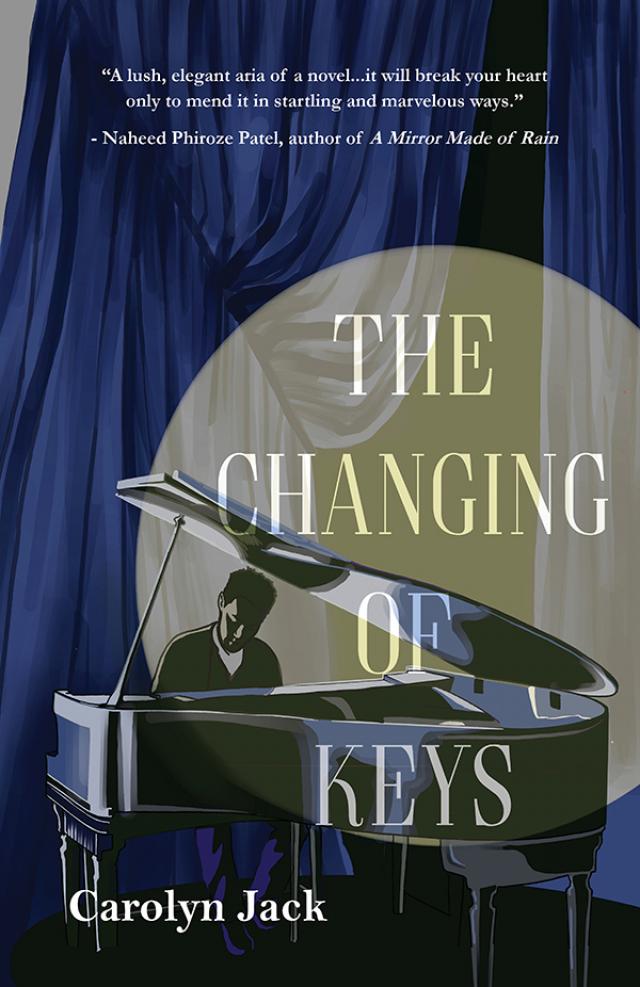


She made her announcement right after my third-year recital, when we were back at the house with Brownlea and a crowd of other boys and parents, drinking lemonade. It had been rather a grand day, as these things go. The hall at school had been packed: men in pale jackets, women in their silks and linens and hats, hushing the squirming, noisy, younger brothers and sisters—all of them sweating like cane cutters in the April heat, even though the drier winter was only just turning back into the swamp of sultry air that, by late May, would have everything on the island coated in tacky moisture. The hall, with its fissured plaster and dark, scarred wooden seats, usually looked somber in spite of the light that came through its arched windows, but the mums had all donated bouquets from their gardens and so the place looked positively festive. There was even a bunch of oleander sprays from Mother, in a vase beside the piano.
Five of us performed: two singers, a violin player, a cellist, and myself. Mother had seen to it that Brownlea put me last on the bill. The others weren’t much to speak of—oh, the violinist did all right and the tenor was passable, I guess, even though he flatted out most of the low notes in the Schumann. I didn’t bother to listen much. I remember sitting in the room backstage, playing my piece over and over on the tabletop and wiping the sweat off my face with brown paper towels. I was performing the Beethoven Appassionata, and my fingers constantly repeated the relentless, tricky arpeggios of the last movement. I had good pianist’s hands—large, even then, with long, slender fingers. Rather like Mother’s, but ringless. I never could bear the feeling of anything on my hands.
She came backstage a few minutes before I was to play, appearing at the door like my own personal Roman legionnaire, marching imperviously across the room full of boys and teachers to ask, in her very haute voix while she straightened my tie and collar, if I had pared my fingernails so they wouldn’t click on the keys.
She, whose radar could pick up the slightest tremor of human movement, appeared not to notice the convulsions of snickers this produced. I flung her hands off and walked out to the corridor, where the next-to-last recitalist was just coming off the stage, followed by an entourage of parents and aunties and toadies. I remember his name: Colin Atcheson. One of those graceful, good-looking, all-round boys—his family let him play football as well as violin, despite the danger to his precious hands, and he did both pretty well. And here he was, surrounded by mates and his healthy father and his soft-spoken mother, calling “Good luck, then,” to me as I walked past and I wanted to impale him on his own rosewood bow. I muttered “Piss off!” under my breath as I climbed the stage stairs.
Brownlea was waiting at the door and he immediately looked alarmed at my expression. “Here now, what’s wrong? Can’t you tell me? Well, you can’t go out there with that ferocious look on your face, you’ll frighten the tots.”
A man of humor as pallid as his personality.
“Come on now, manage it a bit. Use it for the music, you know? Give Ludwig a good, controlled kick. I emphasize controlled.”
I looked at the floor.
“Oh, come—no sulks. You’re good at this. Go show them.”
He tried to pat my shoulder. I jerked away from him and threw open the stage door, hurrying to the piano bench. I barely bowed to the collection of mediocrity watching me and seated myself at once, almost simultaneously crashing out the first chords as if the keys were the triggers of so many guns.
I played with vicious precision for the next twenty-five minutes.
When it was over, I just sat there until some of the crowd ventured a timid handclap or two, and then I was on my feet and the audience was, too, looking a little windblown and stunned, as if I had diverted a hurricane through their tea party, but applauding madly as I took my bows. I finally went off and Brownlea thumped me on the back, saying “Marvelous!” over and over and even Colin Atcheson came down the corridor and whispered “Bloody great job” in my ear and I could tell he meant it.
Mother said, “Shall we go?”
How Mother. But at the house, she picked up her glass of lemonade and tapped on it with a spoon and I scarcely dared to breathe for hope and disbelief that she might compliment me at last.
“I welcome you all to my house,” she announced. Her voice had never sounded so toneless. “Especially the boys who performed today.”
Polite applause.
“I can think of no better occasion to tell you all that I have decided to send my son to the States at the end of the term. He will be studying piano in Chicago with my husband’s friend and colleague, Gunter Hellman, and beginning what I am confident will be an unsurpassed professional career.”
I think there was a gasp. I think it might have been my own. I don’t really remember. I know that she sat down without looking at me and that people crowded round to shake my hand and offer ever more puzzled congratulations as they saw my face. I suppose I said thank you.
Brownlea finally got close enough to take my elbow and pull me into the kitchen. He scraped his hair away from his glasses with an oddly helpless gesture and stared at me.
“I begged your mother to tell you sooner, to talk it over with you, but she wouldn’t and she made me promise not to, either. She said she wanted it to be a surprise, but I was afraid it would be a bad one and I can see that I was right.”
I didn’t say anything.
“I know you’re shocked now, but after you’ve had a chance to think about it, if you really don’t want to go, perhaps I could talk her out of it.”
A gate seemed to fall open inside my head.
“Don’t you speak to her! Don’t you ever speak to her at all! Why would I want her to talk it over with you?”
My voice cracked, making me even more furious.
“What have you got to say about it, anyway? It’s up to me, isn’t it? To decide my own future? I should think! I’ll be the one who says if I go or not, but I’ll tell you something, if Mother thinks I should go, then perhaps I should, because she’s a lot smarter than you, a lot smarter, and so am I!”
Brownlea took a deep breath.
“I didn’t say you shouldn’t go, only that if you didn’t want to, I would try to reason with her. Of course, it’s not my decision.”
“You’re completely right, it isn’t! It’s none of your business and my mother is none of your business! And she never will be!”
Drops of pure hate ran down my cheeks. Brownlea’s face contracted with an anger I had never seen in him before.
“Here now, that’s quite enough of that. In fact, I’ve had quite enough of your wretched temper altogether and you’d better belt up right now. I’m trying to help you, you know? I’ve always tried to help you because I think you’re very talented and very lonely and you need someone to stand by you, but all you’ve ever done is jeer at me like a nasty little sod. You keep that up and all your fears are going to come true—no one at all will care what the blazes happens to you. So go to the States or don’t go to the States—it’s all one to me—but at least think rationally about it before you decide. And talk to your mother yourself.”
He slammed out the back kitchen door. Through the window, I could see him striding up the street like a frumpy, middle-aged Horatius heading for the bridge.
Talk to Mother.
I don’t believe I had ever talked to Mother, just shouted and listened and watched. It was all she had ever seemed to allow.
In order to be talked to, would she not have had to hear what I was saying? And I do not refer to her Camille-like cochleae.
I dried my face with my sleeve and got some ice water from the refrigerator. No one else had come into the kitchen and it occurred to me that they all—well, Mother excepted—must have been able to hear the quarrel and were either afraid to enter or had fled the house entirely. I hoped they had. I didn’t want to see any of their alarmed, stupid pudding-faces ever again. Let them all run away from this house, this appalling, silent house that I, too, must leave, evidently. Well, the sooner the better.
I suddenly wanted to go after Brownlea. I still don’t know why. Not to apologize, certainly, and not to ask his opinion. What would he know about plotting international success? And I didn’t want him ever again to mention my mother. But I wanted to walk with him.
There was still no sound from any other part of the house. I quietly stepped out the back door and went round to the road. In an instant, my white dress shirt began to cling to me and my skin to sting from the violent sunlight and the fine mist of sweat it produced all over me. I had forgotten a hat.
I slowly passed up the line of bungalows that led toward town, feeling separated from myself and curiously objective. Would I miss these houses, after living here nearly all my life? This was all the home I’d got, after all—I barely remembered the mother country we’d come from. Sand and heat and salt and rank vegetation were what I knew, sticky piano keys and the slight carbon smell of the heater inside the piano case that was supposed to keep down the damp. Mold that grew on shoes and belts in their closets. Coarse weeds that grew overnight through the pavement and insects that fell out of books when you opened them. A crawling, seething, primordial world whose prim, manmade structures secretly rotted under nature’s relentless attack.
I knew no temperate places. Even as I put one foot in front of the other, stirring up the bleached earth, the sun crushed and disoriented me; all color, sensation, thought became both painfully heightened and enervating. The sight of thick, fleshy leaves on a vine irritated me beyond endurance. The smell of the sludgy ponds that simmered everywhere on the island offended me to the point of madness with their bacterial stink. And the ocean—I could no longer look at it, nor wished to.
No, I would miss nothing. I would go to a bitter place and thrive.
I had reached the center of town. It was the hottest part of the day and few people except the bazaar merchants and some tourists were about. The cobbled street appeared to undulate with the slow-rolling waves of steamy air. The usual cacophony from the wharf echoed off the stucco walls of shops—conch vendors, their small boats piled high with huge, spiral shells, shouting at each other as they vied for position near the market stalls, the pilots of pleasure craft calling out for people to board their catamarans and glass-bottomed boats, the shrill laughter of the locals who hawked pineapples and bits of coral and whatnot to the hungry and the souvenir hunters. There weren’t many travelers on the island this time of year. Most came in the winter, when the weather was relatively cool and dry. By mid-spring, the heat could slay anyone idiotic enough to spend all day shopping, climbing the falls, or sunning on the beach. And yet some still came after Easter, intent on tans and loading up a year’s supply of duty-free rum and Royal Doulton.
But ours was not the main island, where the casinos and nightclubs kept the night air throbbing with hideous noise until dawn. Ours was dull—picturesque and terribly authentic, if decaying colonial buildings and a dirt-poor indigenous population were the authentic you wanted. It was popular with the artistic crowd, hence the ready availability of good teachers for the school. You could spot them instantly—they tended to go native a lot, or what they thought was native, wearing bright cotton clothes and straw hats and abandoning their shaving habits. The women, too. Many were seasonal folk who returned home in the summer and, to them, their time here was simply a biggish holiday.
Not so for the year-round residents, the Anglo ones. Our little society rigidly preserved the standards of the old life back home, as terrified of contracting island ease and indolence as if those were blood diseases. Arrayed in the armor of leather armchairs and church services and, apparently, underwear that pinched, my group vowed stern, silent oaths of social rectitude and cultural purity, to embalm the dowdy, reserved, middle-class existence it had known since the war and to cling to it as if to a holy era that must be honored unceasingly by repetition. Time seemed to have stopped for our parents twenty-five years ago and on another continent. They wore cardigan sweaters and listened to the old songs on the radio in the evening, complaining when their deliveries of digestive biscuits and knickers from Marks & Spencer didn’t come through on time and threatening to write letters to the royal governor.
Mother belonged to all that. Yet she remained apart from it, as well, and not only because she was isolated by her inability to hear. A ferocious otherness possessed her, a sense of mission that surrounded and separated her like an electrical field from the ordinary folk in our community. She wandered into the grocer’s and the wool shop like the others, nodded and smiled at her neighbors in church of a Sunday, was as thoroughly English as they.
But theirs was the England of eel pie, while hers was the England of Excalibur.
I turned into a small lane off the Queen’s Way, at the far end of the marketplace. It connected the more elegant main street with the wharf side along the curve of the Bay Road. In it, a row of shabby wooden cottages sat close to the stone curb, with bits of overgrown garden behind, crammed with metal bins and broken pots, hurricane shutters askew at the windows. For a block, the world on the cottage side of the street from earth to sky was solid brown and green and gray, like a section of strangely configured jungle, with vines made of clotheslines connecting one tree house to the next.
Across the lane, as if across the border of a tropical Oz, lay the rear grounds of the bay-front hotels, their thick pink- and yellow-painted walls and expanses of stone terrace barely visible through the fiery cumulus of poinciana, bougainvillea and oleander, the rainbow striations of hibiscus and allamanda, the dark spires of banana and royal palm trees.
Divided by their no-man’s-land of pavement, these worlds opposed each other like reality and subconscious. I wondered if Brownlea sat on his landlady’s porch in the evening, staring out from the framework of peeling clapboards that would blinker his peripheral vision, and yearn for the color and mysterious privilege of the life on the other side of the street.
He was just turning into the garden of the block’s largest and most dilapidated dwelling, walking less fiercely now, with more than the usual slump to his shoulders.
“Mr. Brownlea.”
He didn’t turn. I jogged a few steps. My clothes were sodden with sweat.
“Mr. Brownlea!”
He stopped then and looked at me without replying, simply waiting for me to catch up.
“You didn’t…you never told me whether you thought I’d managed that bit in the last movement all right.”
A spark of something—amusement?—flicked across his spectacled gaze and burned out.
“That was a long walk in the sun to ask a question I think you already know the answer to.” He raised an eyebrow. “If you walk back now, you’ll get sunstroke, judging from the color of your face. You look like a geranium. Come inside and have some water.”
I had never been in his rooms, had never desired to see them. The thought of entering them now was still far from enticing, but I nodded and followed him up the creaking stair.
The walls were covered in grimy paper printed with cuckoo clocks, the expanses broken here and there by framed photographs of long-ago people whose images were too dim to make out in the half-light. At the top of the stairs, a short corridor ended in a flimsy wooden door that Brownlea opened, gesturing me inside.
The place was, in most ways, quite what I had expected—a threadbare settee, a narrow bed in an alcove by the window, a small table near a gas ring and kettle, dusty stacks of sheet music—but not entirely. On nearly every surface—every bookshelf, on the windowsill, the chest of drawers, even on top of the tiny refrigerator—were rows of brightly colored toy cars, miniature racing and sports cars.
I picked up a red one and looked at Brownlea.
“Model cars.”
“Yes, I was absolutely mad for them as a boy and have collected them ever since. My mother made me take every last one with me when I moved out of her house. Said she couldn’t bear to have them underfoot, like a lot of enameled mice. That’s a ’59 Corvette you’ve got there.”
I spun the little wheels with my finger and replaced the car in its spot.
“I didn’t know you liked cars.”
Brownlea’s glance was dry.
“There are rather a lot of things you don’t know about me. You’re welcome to look at those, if you like. I’ll get us some ice water.”
I went round the room examining the flashiest and the most curious of them while Brownlea removed his jacket and filled two glasses from a bottle in the fridge. He handed me one and sat on the single wooden chair near the table.
“One of the things you don’t know about me that I’m sure will amuse you is that, when I was growing up, I wanted more than anything to be a race-car driver. I imagined myself going to America and driving the most exotic formula cars and breaking land-speed records and all sorts of rubbish. Of course, I didn’t think it was rubbish then. And I still like the cars.”
I sat on the arm of the settee. “Why didn’t you try?”
He paused for a moment and seemed to decide that I was not being scornful, but truly wanted to know. He nodded once or twice.
“I did. For a while. I actually did learn to drive and used to lurk about a small racecourse not far from where we lived. There were some great chaps there, they all treated me well. They’d even let me get behind the wheel once in a while to drive the cars off the track and into the shed. Very slowly.”
He laughed.
“But my mum and dad wanted me to go to university. They never had and I was the great hope of the family, you see”—again that quick and quickly gone spark of humor—“and I couldn’t disappoint them. And by the time I went down after all that music study, racing cars seemed a bit outlandish, even to me. But I still enjoy following the sport. Ever been to a race?”





