

Distilling Lies, page 1


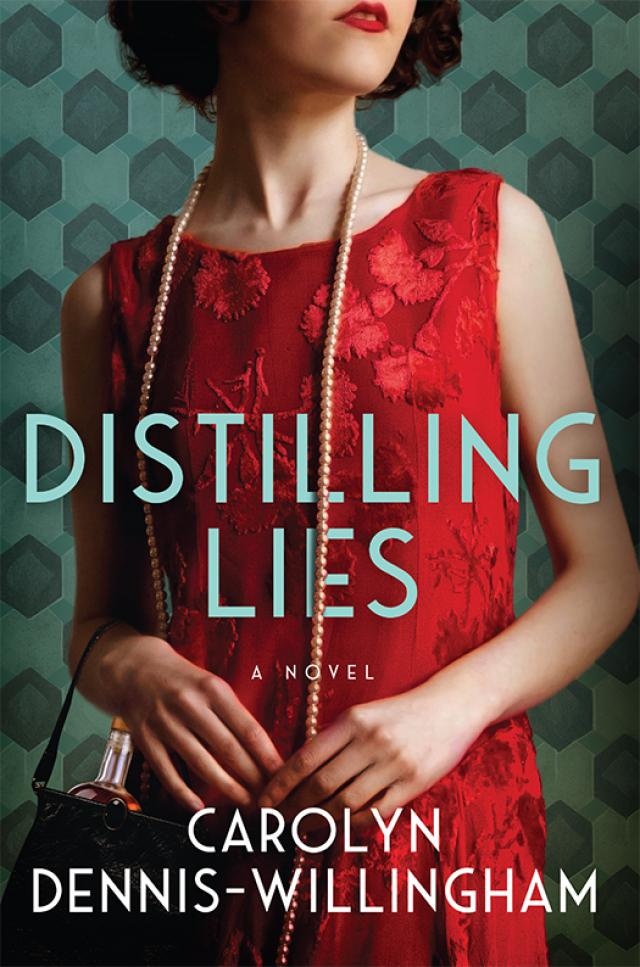
This book is a work of fiction. Names, characters, businesses, organizations, places, events, and incidents are either a product of the author’s imagination or are used fictitiously. Any resemblance to actual persons, living or dead, events, or locales is entirely coincidental.
Published by River Grove Books
Austin, TX
www.rivergrovebooks.com
Copyright © 2023 Carolyn Dennis-Willingham
All rights reserved.
Thank you for purchasing an authorized edition of this book and for complying with copyright law. No part of this book may be reproduced, stored in a retrieval system, or transmitted by any means, electronic, mechanical, photocopying, recording, or otherwise, without written permission from the copyright holder.
Distributed by River Grove Books
For ordering information or special discounts for bulk purchases, please contact Greenleaf Book Group at PO Box 91869, Austin, TX 78709, 512.891.6100.
Design and composition by Greenleaf Book Group
Cover design by Greenleaf Book Group and Damon Freeman
Cover image used under licence from Laura Ranftler / Arcangel
Publisher’s Cataloging-in-Publication data is available.
Print ISBN: 978-1-63299-667-1
eBook ISBN: 978-1-63299-668-8
First Edition
To the women who roared in the 1920s and to the women who, 100 years later, are doing it again.
And in memory of Buffy, my childhood dog, who taught me about the three-legged variety.
And Cole, my four-legged best friend, who showed me how to persevere against the odds until time reminded him it was okay to rest.
I can’t go back to yesterday because I was a different person then.
—Alice, in Lewis Carroll’s Alice’s Adventures in Wonderland
EMMA JUNE
10 WEEKS AFTER THE CARNIVAL
Daddy stood next to Miss Helen and strained to smile. This day, like so many others recently, wouldn’t be easy for him. But it was his idea, not mine.
Choppers barked, then whined. I turned away from the window and distracted him with a quick belly rub so he wouldn’t notice me tossing my cloche hat into the suitcase. He knew I was leaving. Perhaps he thought of me as one more missing part.
I would get on that train if, for no other reason, than to pacify Daddy. Eighteen years old and I had never traveled without a parent.
If I was being honest, part of me wanted to see for myself if the hubbub I’d read about in magazine articles was true. The endless dances, the sporting events, the student agitation to stop Prohibition. All those books to devour.
But my heart would remain here in Holly Gap, waiting.
I lay back on my bed and closed my eyes. I needed a moment.
In my daydream, I pictured Mama barging through the front door yelling, “Doll baby!” I would inhale her lavender scent as she squeezed me and said, “Stop apologizing, baby. You have absolutely nothing to be sorry for.”
If only.
Nothing stayed the same. Life fluctuated like the flow of the Brazos River depending on the rainfall, or like the direction the steam drifted from Miss Helen’s distillery depending on the wind.
Before the spring carnival the worst thing that had happened to my family was the amputation of Choppers’s leg five years before. After that, drastic change returned to the easy kind. Like cutting my hair into a fashionable bob and wearing shorter dresses. Or Miss Helen coming up with another name for her moonshine and having to glue new labels on all the Mason jars.
Anticipated changes, like spring turning into summer, were as commonplace as a morning yawn. So when the 1928 March page was forever ripped off our Coca-Cola wall calendar, the rhythm of the upcoming months was supposed to be familiar. I thought I knew what to expect and ignorantly planned accordingly.
I pictured Betty, Mama’s best friend, showing me how to bloom wild and carefree like the Texas bluebonnets and Indian blankets. And, like the wildflowers, Betty would provide our Cross Timbers and prairie land with much-needed color. She would continue to add pizzazz to our small town and laugh at the rolling eyes of gossipers.
I remained blind, ignorantly thinking catastrophe could never find my small town, or me, for that matter. I believed Mama would drive us to Mineral Wells to see picture shows, and Charlene and me to church picnics. While among the not-so-holy-rollers, we would place bets on which Methodist would be the first to get ossified on Miss Helen’s moonshine. Then we’d up the ante and guess which upstanding churchgoer would be first to holler at Sheriff Gunny Gibbons to “keep up the good work”—which really meant “thanks for ignoring Prohibition.”
Summer would turn into a heat that bore into our Texas bones like a drill pumping for oil. Except for keeping an eye out for rattlers, the heat wouldn’t stop us. The Brazos River was at the ready for splashing and squealing with my girlfriends long enough to bring our dreams of being citified, and our boy talk, to a brief halt. And on those warm summer evenings, the fireflies would almost provide us enough light for reading. These were my expectations of coming days when a calamity meant the latest Sears and Roebuck catalog was overdue on its delivery.
I counted on the everyday rhythm of these sounds that were so deeply rooted in my marrow they had synced with my heartbeat. Miss Helen’s moonshine distillery thumping and hissing next door. Her son, Scooter, calling out to me, “It’s gonna grow, Emma June,” after he buried one of her kitchen utensils or some other whatnot in their yard. Jazz music radiating from our Victor Victrola when Mama played her favorite records. The steady ticking of our grandfather clock. Cricket music soothing me to sleep. And before the first rooster crowed, the hazy rumbling away of Ol’ Bess, Daddy’s work truck, as he left each morning for the dairy.
But as I wore naïveté like the latest fashion, all normalcy came to a grinding halt. My fear became so loud I could scarcely hear the familiar, comforting sounds of a cricket’s chirp or the rustling of oak leaves when the wind blew. Because the snakes didn’t wait for summer to coil at our feet. They came on carnival night, flicked their lying tongues, and took Mama with them.
And then I met Frank.
FRANK
TWO WEEKS BEFORE CARNIVAL NIGHT
Frank held on to the little strut he had left and headed for his flophouse. Another long day at the shipyard loading and unloading crates left him bone-weary and stinking of everything from bananas to fish.
But the music would revive him. Always did. Jazz and blues. Who needed anything more at twenty-one years old?
He had just enough time to make it back to his dump, rinse away his stench, and put on his glad rags and finer flat cap. He’d stick his blues harp in his pocket then stroll to the Upper French Quarter to hit a few clubs.
Although the days kept their order—crates, music, booze, and bed—sometimes the in-between differed. Last week the new employee at the shipyard had tried to steal his work order. The scuffle started with yelling and Frank getting punched in the face. It ended with Frank dislocating the sap’s shoulder.
The night before, he’d gotten drunk enough to work up the courage to pull out his harmonica at the Dog House and strutted his pride when invited on stage to play with the band. It made for a perfect ending on a day that started like all the others.
Ready for a quick change, he turned down the alley toward his pitiful abode. He spotted Irene standing by his door. Another in-between surprise.
Last year when she visited, dressed to the nines, munitions heavily applied to her face, she had actually swung the pearls around her neck in a cheesy greeting.
This time was different. Her usual perfectly toned skin looked pasty as old newspaper and the bags under her eyes seemed to carry a load of trouble. No cloche hat covered her dark, disheveled hair. And from the looks of the large stain, her plain dress had finished off most of her coffee or Coca-Cola.
“Ma? What are you doing here?”
“Frank. Thank God.”
“For what?” He pushed past and opened his door.
“I need your help.”
“Landlord kick you out for having too many martini parties?”
“Can I please come in?”
Frank walked in ahead of his mother. If she wanted to sit, she’d have to shove his music books off his one chair. The bed was off-limits. The scraps of paper weren’t haphazardly strewn across the mattress like she probably thought. The notes and lyrics to his original songs needed to stay in order.
Irene remained in the doorway, a forlorn look on her face as if she’d been the one left behind. It wasn’t true. Soon after his father lammed off, his mother had left Frank with Aunt Patsy and hit the road before his second birthday. But passing him off to her sister turned out to be a good thing. Aunt Patsy wrote the book on good mothering. Irene was clueless.
Ma hadn’t completely disappeared. Once or twice a year she’d peel herself away from the glitz of New York City and pop in for visits. The last time was nine months ago when she came to Aunt Patsy’s funeral. Unlike Pete Sanders, his deadbeat father, Irene visited on occasion. Maybe he should be grateful for those morsels of attention.
“What do you want?” he asked.
“Like I said. I need your help.”
Frank turned his back, changed into a new shirt, and slicked back his hair.
“It’s important, Frank. I wouldn’t ask if it wasn’t.” She swayed on her feet. Not from booze this time. Her head seemed clear enough.
He moved the books and pointed to the chair. “To do what?”
“To come with me. We’ll catch the train back to the Mineral Wells station. Drive the rest of the way to Holly Gap.”
“Where the hell is Holly Gap?”
“A small town in north Texas where I’ve been living for six months. And don’t look so disgusted.”
“Are you nuts?” No way he was going to Texas. Ever since Aunt Patsy died, he’d become used to not counting on anyone. And no one counting on him. It freed him up to focus on music.
“Only for a short time. I’m being blackmailed, Frank.”
It didn’t surprise him. To Irene Sanders, a clean life meant her martini glass was smudge-free. “Your last letter said you were scraping pennies at some diner,” Frank said.
“The blackmail is why I’m broke. The man knows me from a long time ago and remembers … something about me. I’ve been paying him to keep a secret so … so a good friend won’t think less of me.” She stared down at her scuffed low-heeled pumps. The Irene he knew was never ashamed of her actions. “Now the money’s run out.”
He knew better than to lend her dough. He’d done that once, and it set him back six months. “What did you do a long time ago? Rob a bank or something?”
Irene ignored his cheeky comment. “Bernice and I are friends. I don’t want to let her down.”
Frank felt the heat in his face. He was the one she’d left high and dry. “Whatever it is, just tell her,” he said, his jaw clenching. “I don’t have dough to give you.”
“I don’t need money. I want you to keep an eye on my blackmailer. Cover my back. In two weeks. Bernice and I are taking her daughter and friend to the Mineral Wells carnival. I’ll tell her then.”
Frank shook his head. “You want me to be your muscle.” At five feet eleven, he was barely a brute. But he did have a fine right hook.
She lit a cigarette with a shaky hand. “I need to tell her, Frank. I need to right a wrong.”
One wrong? Irene Sanders clearly couldn’t count.
She looked down, then rubbed a shoulder with her free hand. “Bernice doesn’t know I’m Irene Sanders. In Holly Gap, I go by Betty Bedford. It’s … complicated.”
It sounded to Frank like his mother had to cover her tracks. Not hard to believe, since complicated seemed to be her middle name. “And what exactly is in this for me?”
“For you? If all goes according to plan, Frank, your life will change for the better, like it’s meant to be.”
Now she was talking. To Irene Sanders, or whatever she called herself, better meant money. With enough dough Frank could open his own club in New Orleans, dress in fine suits, move out of the dump he lived in.
Leaving with his mother, the woman he barely knew, was a crap-shoot. But then everything in life was a gamble.
Like Aunt Patsy used to tell him, the biggest risk was not to take one.
Next stop, Hicksville, Texas.
CHAPTER 1
EMMA JUNE
Spring carnival night started with sweet anticipation.
I planned on starring in my own picture show. Opening scene: Wade sitting next to me on a well-chosen bench, the carnival lights catching the shine of silk on my legs as I slide my dress up to a knee.
Mama’s best friend had told me time and again that nobody would follow along to our parade if we didn’t strut with pomp and circumstance. Except Betty didn’t just strut her parade. She shimmied. When she swanked her style down Main Street, puffing a cigarette from its holder and taking snorts from her fancy flask, I could almost hear a jazz band strike up and march behind her. It’s one of the reasons I liked her. And another reason Daddy didn’t.
I slipped on my galoshes but kept the buckles stylishly unfastened.
“And if you don’t win, it means those judges are a bunch of lily-livered saps.” Daddy’s voice traveled from the kitchen to my bedroom.
“Oh, Theo, now you’re just thinking one-sided,” Mama said.
“Problem is, I can’t decide which side I like better,” Daddy chuckled.
Our house was sturdier than most in Holly Gap, but the thin walls meant secret-telling was outdoor business. When Charlene came over, we spent a lot of time sitting under the post oaks at the twenty-five-yard line between my house and the Munsons’.
“You watch out for our girl,” Daddy continued. “No telling what kind of riffraff will be there.”
“Okay, gloomy Gus. I’ll make sure everything is peachy.”
“You know what I mean, Bernice.”
More finger waves would have looked better, but there was no time to gel and set my hair again. I shook the bottle of nail tint but, for the same reason, changed my mind about a third coat.
I slid the stockings up to my thighs, rolled down the tops, and gave thanks to the Sears and Roebuck Gods for the timely delivery.
A quick knock and Mama entered my bedroom holding a rose-colored dropped-waist dress and matching headband. “I don’t know what you planned on wearing, Emma June. But you can have this. I’m too fat to wear it anyway.”
Mama was beautiful and miles from being fat. Her burgundy hair, smooth skin, and high cheekbones made her look barely over thirty instead of thirty-eight. From a distance, Mama and Betty looked like they could have been sisters. Although Betty had brown hair, they both had stunning big eyes and hourglass figures.
“And, doll baby,” she whispered. “Wear pink lipstick, not red. Your father’s too young to have a heart attack.” She tossed me a wink and closed the door behind her.
Daddy thought all young women who wore bright red lipstick would end up in the back seat of a roofed motorcar followed by a polliwog growing in their bellies.
While the world rotated toward change, Daddy wouldn’t budge. He thought the loosening of morals would be the downfall of humanity and worried the invention of new machines would take jobs away from workers. The telephone, he said, was the lazy man’s way of checking on neighbors—which was why we didn’t have one. Yet he had no problem walking the fifty yards to use the Munsons’ candlestick telly.
I pushed the side lever upward on the tube and pressed color to my lips. Overshooting the critical bow shape, I wiped the corner of my mouth and started over.
Betty applied her cosmetics with perfection. Coal smudged eyelids, lipstick never missing its mark. And her clothes. The fit of her flapper dresses could knock the sour out of a lemon.
The main reason I liked Betty had to do with the light that turned on inside Mama. The moment Mama met Betty, she tugged off her corset skin, breathed easier, and had more fun. Daddy had smiled at her new zeal for life until he learned her enthusiasm came from a “questionable source.”
Choppers whined, his pitiful Labrador eyes melding into his German shepherd face.
“I know,” I told him. “It’s only a carnival. But if I want something good to happen, I have to dress the part.” Another quote from Betty’s book of wisdom.
I slipped Mama’s chiffon dress over my chemise. The shoulders drooped because dressmakers thought all girls had bubs bigger than teacups. Not that it mattered. Dresses were supposed to make us look pancake-chested.
My rhinestone dangles, the final touch. I twisted the back of the earrings, screwing them tightly in place.
“She’s not going to be there, is she?” Daddy’s voice.
“Honey, I do wish you would stop this old-fashioned nonsense.”
“It isn’t nonsense, Bernice. That woman moved here and brought those big city morals along with her. You’ve changed, you know, in the six months you’ve known her.”
“I drank before, Theo. Hard not to when you live next door to a lady-legger.”
“Never will understand Helen making moonshine under the same roof she raises young Scooter. And Leonard goes along with it.”
As if Leonard had a choice. The string Miss Helen tied around her husband had little to no stretch.
“Theo, we’re emancipated women now. We can vote, smoke, dance, even drink if we want to.”
“Betty gave you a flask, for Christ’s sake. What kind of person gives a flask to a respectable wife with a young daughter?”
A fun one, I thought.


