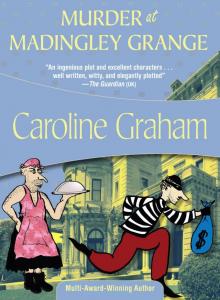
Murder at Maddingley Grange, page 17


She was feeling especially deprived at the moment for her usual bridge group, a cowed compliant bunch, had failed to meet the previous Thursday due to the fact that Davina Bingley’s mother had thoughtlessly died. Miss Bingley, Mrs. Saville’s regular partner, had rung up timorously with the news at five-thirty, “Far too late,” as Mrs. Saville had crisply informed her, “to find a substitute.” The rest of the group had been glad of a breather, for Mrs. Saville was an alarming opponent. Nerveless, forceful and almost invincible. On the rare occasions when she was defeated, her rival had hardly drawn a victorious breath before being pounded by waves of silent fury as cards for a return bout were hurled down.
Now she folded her copy of the Telegraph (all the posh papers had been delivered in time for breakfast), drained her coffee and prepared to move. Not that she wasn’t perfectly comfortable in her present position but she had no intention of being forced into conversation with her companion. Mrs. Saville felt she had imbibed enough homely maxims of unlettered wisdom already. But then something happened to put any idea of a move right out of her mind. She heard a sound. A contracted whirring. Brief and ending with a tight snap; then a heavyish tap. All this immediately repeated. Mrs. Saville did not need to turn her head. To an exalté of the tables the sound of a deck being split, shuffled and reassembled is unmistakable.
What dreadful luck! How absolutely and utterly galling that of all the visitors to Madingley Grange the one person with whom any sort of social discourse was absolutely out of the question should be another gamester. Violet, or even at a pinch the unspeakable Fred, might just have been permitted to wear the mantle of opponent. After all, once the game had commenced, the sheer amount of energy and attention needed would help to water down the more obnoxious aspects of their personalities. But this foul old gypsy…Mrs. Saville clenched her fists in sheer frustration. And the old woman was keen, too. She also needed to play, otherwise why travel with a pack?
Here Mrs. Saville made her first mistake. The word need implying as it did a certain vulnerability in the player, a dependence upon the game, was quite inappropriate when applied to Mrs. Gibbs. Cards were not for her the means of passing a pleasant hour or weapons with which to best a quailing adversary. Rather were they the tangible manifestation of life’s dark undertow. She did not play cards but regarded them as the divine instrument of sibylline revelation. Momentarily their display would halt the celestial flux of rushing meteors and shifting incandescent stars and act on these marvels like isinglass in a pan of soup, clarifying and making bright, exposing to the eye of the seer runic patterns of dynamic precision and power. True, on occasion Mrs. Gibbs gambled, but she did so supremely, like an Olympian, with a stylish impassivity that bordered on disdain.
Mrs. Saville knew nothing of theurgy and was irritated to find her attention being tugged sideways, again and again, to encompass the humped form of the old lady. Mrs. Gibbs had hitched her chair closer to the table. She placed her right arm across the front of her body, the hand, slightly arched, resting on the metal rim. Then swiftly she flung her hand across the table, describing a semicircle. There was a multicolored blur as the cards fluttered and fell, immaculately edge to edge. Then the old lady covered the final card with her left hand, reversed the procedure, and the cards, turning on their backs, were with thrilling, almost magical speed and precision once more in the palm of her hand.
Mrs. Saville, her mouth dry, stared. The old lady then took ten cards and set them out, face upward, in the form of a five-pointed star. She leaned over them, her face ferocious and enclosed, her lips pushed forward judiciously. She was mumbling. The same syllables over and over again. It sounded to Mrs. Saville like “nearly nearly nearly.” Then Mrs. Gibbs made another catchall movement and the cards were gone. An involuntary “Oh!” escaped Mrs. Saville. Immediately she turned her head away.
Several minutes passed; then, as the old lady showed no signs of having even heard, let alone being about to respond to, Mrs. Saville’s exclamation, she sneaked another look. It appeared that Mrs. Gibbs was about to start a run of patience. Cards were laid down, each appearing to flower suddenly at the tips of her fingers when required. Mrs. Saville, gazing at the silent figure in the vile cardigan, had never seen anything like it. Suddenly, although her glance had not once lifted from the table, Mrs. Gibbs said: “You’ll know me next time, missus.”
Mortified to find herself in the discomfiting position of voyeur, Mrs. Saville made an embarrassed gobbly clucking sound.
This attracted the attention of one of the doves, which flew up and tried to sit on her lap. There was a brief tussle during which she attempted to remove the bird and think of an appropriate reply. To apologize was naturally out of the question. On the other hand something must be said, if only to make it plain that she was not the sort of person to be left with the penultimate word.
Her mind formed various rejoinders, all quite quashing. She selected the most pointed and was consequently horrified when her lips parted and the words “Perhaps you might care to play” emerged. She leaned back, palpitating in her wicker chair, regarding the old woman with trepidation and dismay. How had this rash utterance come about? Surely not because of some obscure and sinister influence? No. That was nonsense. She was simply the victim of nothing more alarming than her own overwhelming compulsion to play a game, any game, of cards.
As Mrs. Saville mulled over her strange predicament, her attention was caught by the extraordinarily long lobes of Mrs. Gibbs’s ears. Wrinkled leathery flaps pierced by black pearls, they really looked quite mummified. At home Mrs. Saville had a book on famous murder trials which had left her with the definite impression that long earlobes were a sure sign of the killer temperament. Any move therefore that might put her in a confrontational position vis-à-vis the old lady was to be resisted at all costs. She picked up her chair and closed the gap between them.
“No one seemed very interested in bridge last night, did they?” No reply. “Hard to settle down, perhaps, after Mrs. Gregory’s little drama.” Ditto. “Of course, there are games that only two can play. If you’d care…?”
“Games.” Mrs. Gibbs hawked and spat the word like a gob of phlegm.
Mrs. Saville had offended. Obviously, all that necromantic feinting and carrying on was meant to impress. And playing cards quite beneath Mrs. Gibbs’s dignity.
“Just to pass the time till lunch.” Mrs. Saville’s voice, attempting airiness, failed miserably. “D’you play gin?” A violent head shake. “I’ll teach you.” She reached out for the cards. The old lady barked “Oy!” and gathered up the pack. A scroop of silk, the reticule gaped and the cards vanished.
“No matter. I have some.” Mrs. Saville opened her handbag. “You must teach me that trick. Where you made them open out and jump back so quickly.” That would put them in their place at the bridge club. Especially Major Withers.
Mrs. Gibbs shrugged. Her dark eyes glimmered with a complicated mixture of emotions. Irony, malice, amusement, anger. But she spoke softly. “I don’t do tricks.”
“I didn’t mean to be patronizing,” said Mrs. Saville, as near to making amends as she had been in her entire life. She waited a moment, then, as no revelations seemed to be forthcoming, continued. “Right. Gin is it?” She dealt two hands of ten cards. “Now this is a very easy game. As the nondealer you take what we call the ‘up’ card. You see…?” A smile of encouragement. “Oh. I will then…”
“Load of rubbidge.”
“At least try,” coaxed Mrs. Saville, anguished at seeing the chance of her first game in three days slipping away. “Next step—I’ll explain about the deadwood—”
“Deadwood,” snorted the old lady. “Some folks got that between the ears.”
“Aces are low,” persisted Mrs. Saville, biting back her natural response and willing her body to remain seated. She continued her explanations and the ladies played four games, Mrs. Gibbs, in casually audacious style, winning three.
“That was rather naughty,” said Mrs. Saville, fizzing with exhilaration. “Pretending you hadn’t played before.”
“I ain’t played it afore. And I ain’t playing it again neither.”
“Very well.” Although the old lady was obviously lying, Mrs. Saville had no intention of being forced into a quarrelsome position. She could see the thread of Mrs. Gibbs’s attention was a grudging and slender one, ready to snap at the slightest hint of adverse criticism. “Perhaps there is something you would like to play?”
“Blackjack.”
“I’m not sure…?” Mrs. Saville tailed off, hoping she was not about to be exposed to the lurid history of some swarthy ancestor.
“Vanty Oon.”
“Ah, yes—I’ve played Vingt-et-Un. But it is usual,” she continued with a nice hesitancy (after all, the old lady looked as if she didn’t have two pennies to rub together) “to play for a modest stake. Nothing too high of course. At home we usually—”
“Yeh,” said Mrs. Gibbs. “I’ll hack that.” And reopened her bag.
Mrs. Saville brought out a soft chamois drawstring purse full of fifty-pence pieces, without which she never traveled, and put it on the table. Mrs. Gibbs produced a thick roll of grubby notes held together by an elastic band. The outside note was a twenty pounder, and when she removed the band and bent the wad backward to make it lie flat, it became plain that the rest were as well.
Mrs. Saville’s heart stopped, gathered speed and thundered on. How common, she thought, feeling quite dizzy at the sight of such purse-proud insolence. How incredibly vulgar. Confident though she was of her ability to trounce all corners, Mrs. Saville had no intention of contending with such lubricious display. She said nothing but tugged open her leather sac and tipped out a little heap of coins. She was stacking them in a tidy pile when, fatefully, she glanced up and caught Mrs. Gibbs’s eye. What cold contempt. What sovereign disdain. And more, and worse. For surely there lurked also in that glance a trace of disappointment. As if she, Laetitia Saville, had been tried against who knew what arcane, piquantly crackpot ideal and been found wanting. How dare she? An old gypsy woman. How dare she? Pallid with anger Mrs. Saville removed the coins and put a checkbook in their place.
“Woss that?”
“It is a checkbook,” said Mrs. Saville, speaking very distinctly and thinking to forge ahead in the “who’s looking down on whom” stakes. She then brought out her Mappin and Webb gold propelling pencil with the jeweled initials. The old lady picked it up, held it to her ear and rolled it between her fingers as if it were a cigar. She nudged the checkbook with it.
“Lay paper.”
“I bank,” said Mrs. Saville icily, “at Coutts. They are the nonpareils of the financial fraternity. Their checks are honored throughout the world by all right-thinking people.”
Mrs. Gibbs laughed then, a corvine squawk. “Crazy as coots,” she cried, livery wattles flapping. “Caw, caw, caw.”
“And I am not so familiar with vingt-et-un that I am prepared to play for stakes like that.” She pointed at the greasy wad of notes.
“And I ain’t playing that daft gin.”
“We could have a nice game of casino.” Seeing that the cawing and wattle-shaking were about to start again, she added quickly: “What do you suggest then?”
“Poker.”
“Poker?”
“You can tickle that, can’cha?”
“Naturally.” Mrs. Saville sounded defensive. It was true she had played the game in her time and with considerable success, having by nature the precise expression—impassivity lightly laced with disbelief—that the successful poker face must necessarily command. But although she found the suggestion exciting (already her palms felt slightly damp) she had far rather Mrs. Gibbs had chosen a more salubrious option. Poker to Mrs. Saville’s mind had a definitely sleazy image, conjuring up a ring of stout perspiring men, shirt sleeves high and gartered, wreathed in smoke and surrounded by beer bottles. A nice game of casino would be much more to the mark. She said so.
“Draw poker. Joker’s wild.”
“I don’t care to be railroaded, Mrs. Gibbs.”
The old lady picked up the cards, halved and quartered them and then, with a crisp snap and flutter, made the pack whole and pushed it back. “Cut. Aces high.”
Mrs. Saville took the pack and pointedly shuffled once more. Although she had seen no evidence of chicanery, she found the very speed at which Mrs. Gibbs moved highly suspect. She shuffled again, tapped the cards neatly into shape and placed the pack in the center of the table. The old lady curled her lip back, exposing a yellow snaggletooth, and nodded a directive.
Mrs. Saville cut. The king of hearts! Advantage Laetitia, she thought triumphantly. Mrs. Gibbs reached out and turned over the top card. It was the ace of spades. There was a long silence while Mrs. Saville took in this flukey quirk of fate. Because, of course, that’s all it was. These things happened sometimes. Foolish to regard them as omens. And after all, she was not committed to any definite number of games. She could stop playing anytime she chose. It was not likely that the old lady, who had been dragooned into participation, would object.
“Very well, Mrs. Gibbs,” she said, making her second mistake. “Draw poker, Joker’s wild, it is.”
Chapter Sixteen
Derek produced his pencil torch and shone it into the cavity. The door opened on to a cemented area about five feet square from which steps went steeply down. The wall, originally whitewashed, was now gray with cobwebs. Derek hesitated. Didn’t some spiders bite? He cleared his throat warningly before stepping into the passage.
No sooner was he there than a further and much more alarming supposition came to mind. This was the getaway route. Chummy’s retreat. What if he had not got clear of the house last night? What if he planned to make a further robbery attempt? What if he was still in there?
Derek stepped back again. Naturally he must explore this new discovery. He had no intention of being cheated of the boost to his pride the telling of such an exploration would bring. But it was the height of folly to do so unprotected. Holmes armed himself as a matter of course when embarking on a hazardous mission (“the Eley’s Number Two I think Watson!”) and was an excellent shot, as the state of Mrs. Hudson’s walls could testify. Even the faithful doctor had been known to carry an old army revolver. Derek looked around for a weapon.
The fireplace first. A pretty affair of primrose and leaf-green William de Morgan tiles with a tiny little basket of a grate filled with dried flowers. But no poker. He scouted farther afield. The heaviest item that was anything like portable was the old lady’s hairbrush. Derek seized it and, facing the bathroom mirror, narrowed his eyes and made a couple of savage swings and chops. Not good enough, especially as he could not count on the element of surprise. It was his opponent, already in situ, who would have that advantage. Derek put the brush down and returned to the bedroom.
And then he remembered. “Fool that I am!” he cried aloud, pulling from his pocket Gilly’s gun. Here was protection indeed. His imagination waxed fat, exchanging his previous modest fantasy for one vastly more grandiose. Far from just announcing his discovery of the secret passage, Derek now saw himself emerging at the other end, chivvying before him a cringing hoodlum. That would show them all, and no mistake.
Derek moved boldly forward, the gun warm and heavy in his hand. He pictured the miscreant cowering, hands aloft, on seeing his approach. “See this, you villain!” he would cry, waving the pistol. “This is a Major Fontaine Thirty-four. Short range, detachable box and radial lever. One blast from this and you won’t know what hit you.”
Fortunately there was a wooden handle on the inside of the door so that Derek was able to close it behind him. He did not wish to leave it ajar, possibly alerting Mrs. Gibbs should she return. This was his tunnel and he would spring it on the startled and admiring assembly when he was good and ready.
Once the door was closed darkness was complete. Derek directed the thin beam of his torch to the edge of the first step and began, very carefully, to descend. High above his head were the beginnings of the final roof-support beams. He thought he heard a bit of scuffling up there and pointed his torch, hoping it wasn’t bats. Bats bit you. And drove you mad if they got in your hair. He couldn’t actually see any but that might be because his light wasn’t too strong.
Derek stood very still and listened, gammony ears alert. He had definitely not imagined the scuffling but now it seemed to be coming from a much lower level and some distance ahead. He redirected his torch. Rats. More biters. But at least they would not (unless he had chanced on an astonishing new strain of Rattus decumanus) be flying into his hair.
Derek kept a firm grip on his gun and crept on, hugging the dusty wall for there was no handrail on his right-hand side. Just a sheer drop into darkness. The air was cold and clammy and malodorous. Derek wrinkled his nostrils. Most unpleasant. Musty, like mildewed paper or rotting fabric. Perhaps—for it seemed to be taking him forever to get anywhere—the steps went down not just to the ground floor but beyond. Right under the house to the cellar. Maybe that’s where the smell was coming from. They probably stored unwanted furniture and other rubbish down there. Or—Derek suddenly stood quite still—it might be a crypt! He wished now he’d paid attention when Simon was talking last night about the layout of the Grange. Did the late Victorians have marble-effigy tombs beneath their manor houses? Perhaps this was where Mrs. Gibbs’s ghost hung out. Consoling himself with the thought that, if this proved to be the case, at least it would be way beyond the stage where biting strangers might appeal, Derek, the huge hump of his shadow behind him, began once more to descend.
But then something awful happened. A horrible clinging moist thing stretched suddenly across his face. Derek cried out and, flinging his arm up to brush it away, dropped his torch. It rolled and clattered to the bottom of the steps, where it lay, glowing up at him out of the humble dark, like a tiny Cyclops. Pulling off the threads of cobweb, Derek gave himself a moment to recuperate then, feeling the way with his now trembling left hand, rapidly covered the remainder of the steps.