

The Tally Stick, page 1


-
A compulsive and chilling novel about subjugation, survival, and the meaning of family
Up on the highway, the only evidence that the Chamberlains had ever been there was two smeared tire tracks in the mud leading into an almost undamaged screen of bushes and trees. No other cars passed that way until after dawn. By that time the tracks had been washed away by the heavy rain. After being in New Zealand for only five days, the English Chamberlain family had vanished into thin air. The date was 4 April 1978. In 2010 the remains of the eldest Chamberlain child are discovered in a remote part of the West Coast, showing he lived for four years after the family disappeared. Found alongside him are his father’s watch and what turns out to be a tally stick, a piece of scored wood marking items of debt. How had he survived and then died? Where is the rest of the family? And what is the meaning of the tally stick?
-
Praise for The Tally Stick
“There’s a steady relentlessness to the action in the bent fairy tale of Carl Nixon’s fourth novel. Nixon sketches in aspects of his characters’ lives deftly.”
Newsroom
“The writing in The Tally Stick is evocative, you can smell the native bush, see the birds, feel the soggy forest floor. There is much that the reader must fill in for themselves. It is a read full of conflict, violence, and dread, but there is also beauty and kindness, and the switching back and forth gives it an inevitability that puts the characters in the frame of a morality play.”
ALYSON BAKER, Nelson Public Libraries
“Carl Nixon is one of my favorite New Zealand writers. I love his stuff. This latest novel is very cinematic. I would place it firmly amongst what’s called a literature of unease. Very ominous, very foreboding, it’s all about the atmosphere. The writing is very powerful.”
Radio New Zealand
“I like that the novel tests this Eurocentric notion of ‘the wild,’ and that it clearly looks to other dominant forms of narrative, not least the ambivalence of New Zealand Gothic. But it challenges our expectations of genre, and in doing so engages with thorny questions about the nature of our relationships with one another.”
The Spinoff
“The Tally Stick is an efficient, gripping story, a Kiwi Gothic thriller that is confidently and economically told.It is probably Nixon’s strongest novel.”
PHILIP MATTHEWS, Academy of New Zealand Literature
“The Tally Stick unravels a yarn of acceptance, denial, love and resentment. There are many subtle investigations into why people behave as they do, and how simple but necessary choices affect everything. Every event and every conversation is essential to the plot with the things left unsaid and unexplained as the most powerful moments that will leave the reader thinking about the moral rights and wrongs of this story for some time to come. This is the best kind of novel: complex, contemplative, upsetting, written with an ease and flow that makes it a compelling read.”
LOUISE WARD, Wardini Books
“The Tally Stick is a novel of character and edge-of-the-seat suspense, with the landscape and weather of the West Coast of New Zealand given a prominent role.”
Weekend Herald
•
Praise for The Virgin and the Whale
“He’s a contender, Carl Nixon. He’s an acclaimed playwright, has won significant awards for his short stories and he’s come close with his novels, too. This book offers us fragmentary insights into the way our national memory constructs our national identity. With all that self-consciousness going on, The Virgin and the Whale is an ambitious project. But Nixon is no mere fashion victim. This is an intelligently constructed novel and, best of all, a beautifully told story.”
NZ Herald
“This novel is wonderfully accomplished, beautifully told and a delight to engage with.”
NZ Listener
“This story is about battles of wills and ideologies as well as the healing power of love. Yet Nixon’s novel is also, and equally, about the healing properties of storytelling itself. Above all, those who can listen to a story and hear the surface and subtexts are upheld over those whose minds are not open to the riches and alternative ways of thinking that stories can bring. Nixon brings home to us why literature is highly placed among the humanities.”
Otago Daily Times
“It is a story which is powerful, yet gentle. It is evocative and poignant. But most of all it is beautifully written and clever and kept me hooked to the last.”
Timaru Herald
“I was literally hooked from the first eight words—just wonderful, storytelling at its most sublime. I’m going to do the unheard of for me and turn around and read it again.”
Afternoons on Radio New Zealand
“Places Nixon firmly as one of our leading writers—complex narrative, beautiful prose and compelling characters make this book absolutely sing.”
Radio New Zealand
“All lovers of Christchurch should read this book. It is as gripping and well written as Carl Nixon’s first two novels.”
The Press (New Zealand)
•
Praise for Rocking Horse Road
“Intensely atmospheric, it strongly evokes 1980s New Zealand—dairies, summer, the beach, teenage boredom and sexual yearning—Rocking Horse Road is also a powerful exploration of maleness, and of grief and the impossibility of articulating grief.”
The Dominion Post
“The whodunit is just a small part of what makes this book such a joy to read.”
Australian Women’s Weekly
“This is a book of illusions, one of those works crafted by a magician, skilled at subtly directing your attention away from the real story until it’s too late and you’re suddenly given a whole new picture of all that has gone before. Told in a laconic, almost languid way, never missing a beat, nor the opportunity to quietly set you up for what’s coming, the book is gripping and forthright. Though it started as a short story, it never feels forced or stretched. It is detailed and full and written with such attention and verve that it feels that it is the right length.”
The Press (New Zealand)
“Carl Nixon has skillfully recreated provincial 1980s New Zealand—I hope Nixon writes many more novels.”
Herald on Sunday
“I enjoyed Carl Nixon’s short stories, so dived into this novel eagerly, and it didn’t let me down—Nixon’s writing conjures vivid pictures of that place and period, allowing the reader to step back into a familiar New Zealand of 27 years ago. While the timing of the story is a growing and turning point for the boys involved, it is also a similar point for the country as a whole. More than that, as the boys grow into men their fixation on the murder remains. To me the book also hints at a subconscious longing in us all for a time when things seemed simpler and more cohesive.”
Waikato Times
“Nixon captures well the calculus of suspicion in this type of murder—its circling and descent: the way its mass builds around a man before, with cruel fickleness, it moves on to menace someone else. This, and the parallel he offers between the boys’ trapping and killing of a dog and their revenge on a young ‘Don’t Stand So Close To Me’ teacher, show Nixon to be a writer of talent.”
Sunday Star Times
“Nixon’s teenage voice never loses character, and he has perfectly realized the burning emotion and slightly befuddled sense of discovery of the teenage boys—it would be a crime if it doesn’t make it on to the reading lists for senior English classes throughout the country.”
Nelson Mail
“Nixon writes beautifully. He gets the style and timbre of the teenagers just right. He uses their language. Something easy is ‘a piece of piss,’ a lazy-training member of the 1st XV ‘needs a fire lit under his arse.’ Is there anyone who’s played rugby at any level in New Zealand who hasn’t heard that expression? What a pleasure then to read Rocking Horse Road. Carl Nixon has fulfilled the promise he showed with last year’s stories, Fish ‘n’ Chip Shop Song. He is a major talent and this is a very good book. You should read it.”
North & South Magazine
“Both chronicle and investigation, sociological fiction and morality tale, Rocking Horse Road is a beautiful impressionist novel.”
Telemara Magazine
“Carl Nixon tells this story, and that is what is outstanding about it, from a we-perspective: the crime and the efforts to solve it are reported from the boys’ perspective—later: the men’s—furthermore, the country and its people are characterized, families and relationships are dissected, so that, at the end, a panorama of New Zealand’s society over the last two decades evolves. The result: a very distinct and exceptional crime novel, which is brilliantly constructed and passionately narrated.”
Funkhaus Europa
“Nixon interprets the classic coming-of-age motif in a stunning manner.”
Die Welt
“Carl Nixon wrote a clever, multilayered and extremely thrilling novel, in which we get to know a lot about New Zealand along the way. He does not establish a causally determined connection between the individual crime and the authoritarian conditions during the 1981 Springbok rugby tour but mirrors the one in the other. In a knowledgeable and subtle fashion, he tells us about a few teenagers, in whom a sense of justice and a restrained sensuality are mixed together into a highly explosive brew. And he provides us with an eventful imag
Die Presse
-
CARL NIXON was born in Christchurch in 1967 and is one of New Zealand’s leading authors. He has written several novels, a collection of short stories, and numerous theatrical scripts. His books have regularly appeared on New Zealand’s bestselling fiction lists and have been listed for international awards, including the Commonwealth Writers’ Prize, Best First Book (South East Asia and Australasia region), and the Dublin International IMPAC Awards. He has adapted for the stage Lloyd Jones’s novel The Book of Fame and J. M. Coetzee’s Disgrace. In 2018 Nixon was awarded the Katherine Mansfield Menton Fellowship in France, where he worked on The Tally Stick.
-
AUTHOR
“New Zealand was the last country in the world to have people come to it. The Maori came to New Zealand maybe only eight hundred years ago, and the other explorers from Europe after that; I’m really interested in that process where people come to New Zealand, historically, and then become changed by the land, by the place. So, I was really interested in the idea of two or three kids from England—upper-class, wealthy kids—finding themselves in this harsh landscape and then being transformed by the conditions they find themselves in. It seemed to me to mirror New Zealand’s history.”
PUBLISHER
“While reading this gripping novel one can almost smell New Zealand’s dense rainforest, where the children in this story end up after the crash of their parents’ car. Carl Nixon describes experiences that touch upon our deepest fears: being left at the mercy of a cruel nature and—maybe even worse—of untrustworthy people. Carl Nixon knows how to write a suspenseful and filmic story. Read and shiver!”
-
CARL NIXON
The
TALLY STICK
WORLD EDITIONS
New York, London, Amsterdam
-
Published in the USA in 2022 by World Editions LLC, New York
Published in the UK in 2022 by World Editions Ltd., London
World Editions
New York / London / Amsterdam
Copyright © Carl Nixon, 2020
By agreement with Pontas Literary & Film Agency.
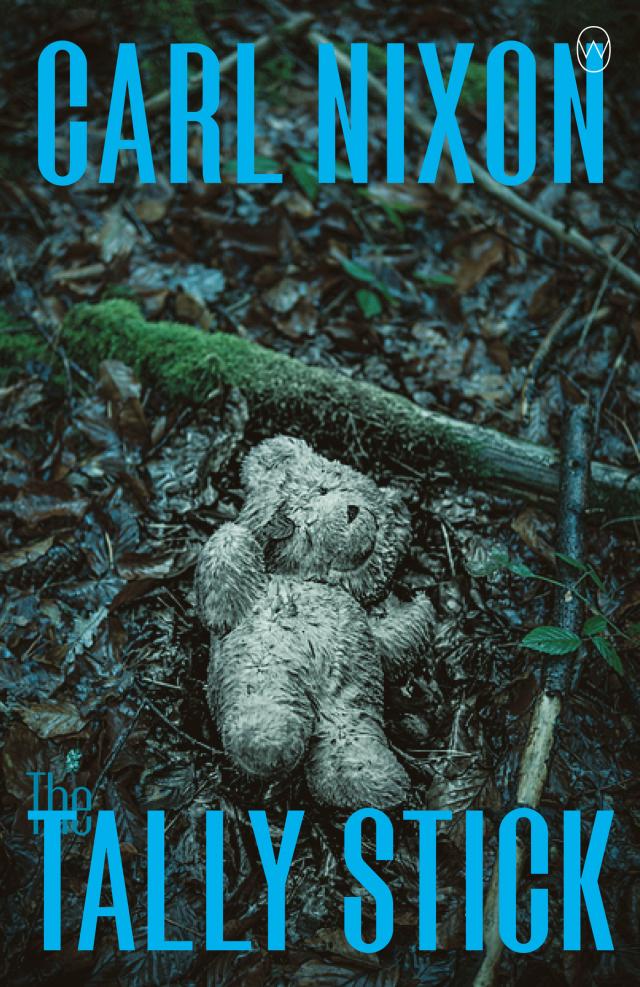
Cover image © plainpicture/cgimanufaktur
Author portrait © Stephanie Nixon
This book is a work of fiction. Any resemblance to actual persons, living or dead, or actual events is purely coincidental. The opinions expressed therein are those of the characters and should not be confused with those of the author.
Library of Congress Cataloging in Publication Data is available
ISBN Trade paperback 978-1-64286-098-6
ISBN E-book 978-1-64286-095-5
First published by Penguin Random House New Zealand, 2020
All rights reserved. No part of this publication may be reproduced, stored in or introduced into a retrieval system, or transmitted, in any form, or by any means (electronic, mechanical, photocopying, recording or otherwise) without the prior written permission of the publisher.
Twitter: @WorldEdBooks
Facebook: @WorldEditionsInternationalPublishing
Instagram: @WorldEdBooks
Youtube: World Editions
www.worldeditions.org
Book Club Discussion Guides are available on our website.
-
For Rebecca, Alice and Fenton.
-
TALLY STICK historical a piece of wood scored across with notches for the items of an account and then split into halves, each party keeping one.
FAMILY a set of parents and children, or of relations, living together or not.
-
THE CAR CONTAINING the four sleeping children left the earth. From the top of the wooded bluff, where the rain-slick road had curved so treacherously, down to the swollen river at the base of the cliff, was easily sixty feet. There was no moon that night, only low, leaden cloud clogging the sky. As if suspended, the car hung in the air for a fraction—of a fraction—of a moment. Very soon the children would begin to fall. Towards the tops of the trees. Towards the headlong water rushing between the boulders. Into the future.
The only person awake was the driver, the children’s father, John Chamberlain. His long, narrow face was visible in the dashboard light. He was staring forward at the headlights as they shone east over the seemingly endless forest; fat, diamond drops of rain slanting through the beams. His expression was, more than anything—even more than fearful—disbelieving. Both hands still grasped the wheel as if he remained in control. Perhaps he believed there might, even then, be a manoeuvre he could perform, a secret lever known only to a few he could search for, yank; something—anything—he could do that might save his family. Behind him, one of the children groaned and shifted in their sleep.
“Julia.” John’s voice was a dry whisper.
The children’s mother was next to him, her chin tucked bird-like into her shoulder, head resting on a cardigan pressed against the door. Earlier, she had unbuckled her seat belt—it had been uncomfortable—now it coiled loosely across her shoulder and down into the shallow pool of her lap. She was dreaming about horses. Three brindled mares were wheeling in formation in a dry, barren field. White dust rose around them, swirling higher and higher. Faster and faster the horses ran, as if trying to escape the dust they were throwing into the air. In Julia’s dream, the horses’ hooves were impossibly loud.
John wished there were time to apologise to his wife. He wanted to say sorry for many things: the long hours he’d been keeping at work; that petty argument about the wallpaper; the woman in Tottenham Julia still knew nothing about. Mostly he was sorry for bringing the children to this country. Julia hadn’t wanted to leave London. He’d pressured her: that was the right word to use, pressured—he could admit it now. He’d insisted that this job was a stepping stone. A place to land lightly before moving on. He’d promised her a future with postings to the New York office, perhaps even Paris. They would hire a nanny once they had settled into the new house in Wellington. A picturesque little city. “It’s only two years at the bottom of the world,” he’d said. “Think of New Zealand as an adventure.” In the end Julia had come around to his way of thinking. She was a good wife. A fine mother.
Hours earlier, the family had stopped at a small village to eat a dinner of steak and chips. Julia talked about getting a room for the night. Perhaps they could walk up the valley the next morning with the other tourists to see the face of the glacier? Excited by the idea, the children looked up from their meals.
“It’s just a wall of dirty ice,” he told them, pushing aside the plate with his thumb, his food half-eaten. “There’ll be nothing to see. Besides, I’m sure this rain isn’t going to stop, not before morning. We should push on.”
John had been told this part of the country was a natural wonder, a remnant of prehistory, but all they’d experienced in the three days they’d been travelling was relentless rain and grey coastline, mountains hidden behind cloud, and undercooked chips. If they’d bought a ticket, he would have asked for his money back.
It had been dark when they left the restaurant. As they made the bowing dash to the car, the neon vacancy sign outside a motel was smudged to the point of illegibility by the downpour. He’d never seen anything like it. Drops as big as marbles. Monsoon rain.
He had driven down the coast, heading for the only pass through the Alps this far south. Even on full, the wipers fought to clear the water from the windscreen. The three eldest children had cocooned themselves in the back seat with pillows, sleeping bags and a woollen blanket. Lulled by the vibration of the engine and the timpani of rain on the roof, they’d quickly fallen asleep. The baby, Emma, had taken longer to settle. She was lying at his wife’s feet in a portable bed, a sort of fashionable, hippy papoose that zipped up to her chin. It had been given to them by Julia’s sister, Suzanne, as a going-away present. At the time John had believed the bed to be a waste of precious space, but it had proved surprisingly useful. Emma’s grizzling had dissolved into soft snuffling and then silence.


