

Traitor Maguire, page 1


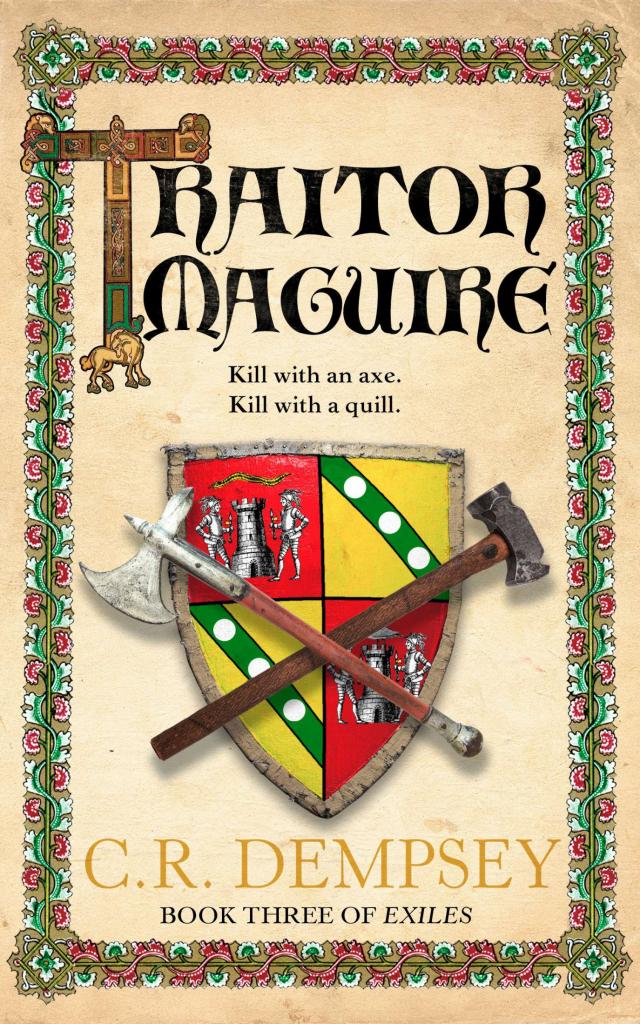
Traitor Maguire
C R Dempsey
CRMPD Media Limited
Copyright © 2022 by C R Dempsey
All rights reserved. No part of this publication may be reproduced, stored or transmitted in any form or by any means, electronic, mechanical, photocopying, recording, scanning, or otherwise without written permission from the publisher. It is illegal to copy this book, post it to a website, or distribute it by any other means without permission.
This novel is entirely a work of fiction. The names, characters and incidents portrayed in it are the work of the author's imagination. Any resemblance to actual persons, living or dead, events or localities is entirely coincidental.
C R Dempsey asserts the moral right to be identified as the author of this work.
For Mena and Maya
Contents
1. How does the wind embrace?
2. How the dawn glistens
3. Dark clouds surround the castle
4. The company of strangers
5. Opening arguments
6. Diplomatic relations
7. New man of the house
8. Anointing the enemy
9. The visitor
10. Second chances
11. Enlightenment
12. Arguments met
13. Friends look after friends
14. Love letters
15. Indebted
16. An alliance sealed
17. Resentment in love
18. Return of the master
19. The dirt of the road
20. Keep it in the family
21. An unexpected reunion
22. Reality intervenes
23. Spanish sun
24. The grey man returns
25. A tug on the heart strings
26. Creating the dragon
27. Taking sides
28. The decision
29. Donnacha’s curse
30. Tribulations
31. The trial opens
32. Interlude
33. The hue and cry for traitor Maguire
34. The reckoning
35. The verdict
Also By
About Author
Acknowledgments
Chapter one
How does the wind embrace?
Cormac O ’Cassidy looked at his chapped hands and the small torrents of blood pooling in the ridges of his knuckles. How could he have fallen so? A malignant curse must have possessed him. Was it sin that lodged itself as a black tumour upon his soul? Had God heard he toyed with the heretic religion from across the water? He looked to the sky for answers and all he got were drops of rain in his eyes. Neither God nor man nor beast had sympathy for him, a victim of the cruel torments of Eunan Maguire. Melancholy possessed his very bones.
″I am but a destitute man, shorn of the trappings of wealth and both the burden and pleasures of family and responsibility. They cut respect and love for the world from me and tossed them to the wayside alongside my honour and dignity. How does the wind embrace these cursed bones?”
The wind embraced the trees, from root to branch, its cold torrents climbed and shook the bare limbs and bowed them into submission until they would spring back and bend in the other direction when another gust would subdue them again. The wind embraced the land, from soil to sky, chilling plants and animals alike and forcing those who could to seek shelter. The wind embraced the water, moulding its still form, as it huddled for respite at the bottom of gorges of mud, the residue of the frozen footprints of weary travellers. The wind embraced the road, it chilled the mud and froze the stone, driving back anyone foolhardy enough to travel it. The wind embraced Cormac O’Cassidy. It blew through his thin layers of clothing, now reduced to rags, but he did not care. The wind embraced his bald head, freezing his brain and howling in his ears, but still it could make his life no worse than the misfortune he had fallen into. So he trudged on. One foot went before the other, forming those gorges of frozen mud. A weary traveller, lost but not directionless. He bowed his head into the wind, and each hair contemplated greying or deserting. The wind whistled in the trees, the spindly bare branches bowed into the path and grasped at the air, testing the resolve of the man to continue his journey. Their leaves had long since abandoned them in the fairer climes of autumn, and they embraced the wind as skeleton bones, trying to grasp onto life once more.
He tore at his clothes, undeserving of even their meagre protection. Should the cold take him and cast him in a ditch to become at one with the bog, he would surely end up in hell, a suitable punishment for the destruction of his family under his watch. Cormac cursed himself for not taking care of Eunan Maguire when they had the chance and he cursed his dead son for projecting his failure upon his family and ensuring their downfall during his brief, miserable existence. He staggered forward each foot without a destination, but the memory of his daughter drove him on. He could save her. If he made it to Dublin, he could save her.
The road became full of creatures fleeing war and the famine in the north. They dragged their possessions behind them, and Cormac felt the pang of jealousy for whatever had cast them into such a maelstrom, they had the time to gather necessities for the journey. Cormac joined in behind them and they formed a slow train, plodding towards the Pale. The Pale had a large English garrison that would surely never fall to the rebellion in the north, and even if it did, Dublin port could bring you anywhere in the world you wished.
As they got nearer to Dublin, the ranks of the rabble swelled. The people’s supplies ran out. His starving companions saw his tattered rags were once fine clothes and concluded he was hiding something from them and pulled at his sleeves, begging for food or drinkable water. They were a tiller’s hands, the skilled hands of a seamstress, the coarse hands of a cow herder or a tanner or a blacksmith. All of those hands would have once poured money into the pocket of the O’Cassidy Maguire but famine and coign and livery of the hired Galloglass living off their lands, compounded by the destructiveness of the war, had driven them from their once plentiful lands and emptied their bellies of food and their minds of hope. But Cormac beat their hands away, for he had nothing to give. They had cast him out of his mansion with only the clothes on his back and the wits and brains in his head. He pulled out the bottom of his pockets to show he shared their emptiness, but the people scoffed and scornfully said he was playing a trick. Cormac sensed danger and told them his men were just beyond the hill and they could either back away and gain the benefit of their protection or persist and feel the wrath of their swords. In the rabble’s moment of hesitation, he made his way to the front of the column and declared he knew the way to Dublin and his previous dealings with the O’Reillys meant he could get them through their lands unmolested. The rabble followed him, for no one else had lofted themselves up into such a position and any promise of safe passage would have landed sweetly on the ears of such a melancholy mob. He lifted his arm and pointed towards the dark clouds to the east and the crowd would have eagerly followed him had his words not been snatched away by the wind. He bowed his head and pulled his clothes tight and set off into the wind.
Bogs were as treacle, streams became meandering rivers, rocks grew into mountains, children were baggage and the baggage weighed like rocks of burden as they hauled themselves over the bogs of Breifne. But each of them held some beacon of hope in their hearts to drive them forward, even if for Cormac, it was the burning ember of the hope for revenge.
They reached the muddy path to Dublin. Its distinctiveness from what they had travelled on before was that it was muddier, the road most well-trodden down by the English army. Some from the crowd pointed forth and hailed the masts of the port of Dublin, but Cormac’s judgement was not so clouded. He only saw the rainbow of swirling clouds of grey fighting for the privilege to pelt them with rain. He did not tell them that a lifetime poring over ledgers had filled his pockets but reduced his long sight to a blur. His precious glasses, imported at great expense, he presumed had perished along with the rest of his valuables when they set his house on fire. The column gained more stragglers as it weaved its way through lands devoid of hope and its ranks swelled. They attracted attention from the locals, who would brave the weather and stand by their houses and stores, pitchforks at the ready to protect their skinny pigs and bony hens. They sent their sons to warn the local chieftains of the trail of destruction coming their way. The men of the local clans took to their horses and shadowed the column to escort it off their lands. Cormac felt life become more precarious. A spark in his soul ignited. He wished to live, if only to free his daughter and gain his revenge.
The next day jubilation seized the masses at the front, but Cormac, for all his endeavours, could only see clouds. But rumours spread quickly, and the crowd continued with renewed vigour. However, they soon found their path blocked.
″Turn around and go back to where you came from!” shouted a grizzled English sergeant who commanded a bristle of musket barrels.
The English soldiers had positioned themselves in front of a bridge, a fragile piece of masonry held up more by moss than mortar. Its last action was likely to be to bear the weight of this wretched horde. There was no way across the river than via this well-defended bridge. The column broke into huddled groups to discuss their limited options. After a few moments of mass inaction, Cormac made his way to the front for his former cowardice had deserted him. He felt his destiny lay ahead and as long as the musket ball did its damage with haste, it would be a blessed relief. He stood an execution’s distance in front
″You would run out of bullets before we would run out of men. Step aside! Let this gorge not be the burial ground for all of us!”
The clarity and forcefulness of his call surprised even him.
The sergeant looked behind him and over the bridge. He ordered his men to step aside, but it was not Cormac’s demand he obeyed.
Across the bridge rode a one-armed man, but his lack of an arm did not diminish his authority. The soldiers parted and reassembled their ranks on both sides of the road with a precision that gave a motivational combination of fear and respect. The captain’s face was a sheet of granite, and a lack of bullets would not be an obstacle should he have to clear the road. In his wake marched another twenty men with another rider at the rear. It was clear he was not here to negotiate. He rode up to Cormac and pulled his horse to a halt. He spoke both to Cormac and over his head to the rabble behind.
″Clear the way now or face the lead of the Crown. My name is Williamson and I am on a mission from Her Majesty. If successful, it could lead to land for you to settle. But if you persist on this march to Dublin, let you account to God for any fallen souls this day, not I!”
Cormac looked up at Captain Williamson and saw a resolve that could not be reasoned with. He had cast off his normal cowardice, which acted as a restraint on reckless actions that could have a consequence of physical pain, but he considered he should have died under the old oak tree alongside his son. He let his mouth wander where it may.
″Curse you and your wretched whores from the Pale who serve the Crown. Curse Eunan Maguire and Seamus MacSheehy and may my brother Donnacha wreak my revenge upon them. Go on! Do your damnedest and let’s see who is still standing when the bullets fly!”
Captain Williamson reached for his pistol, cocked it, and aimed at Cormac’s face. Cormac closed his eyes. The expanding wet patch on his breeches gave way to a feeling of inner tranquillity in both soul and bladder. He gulped, for his cowardice had not wandered far. At least if it was to the face, it should be quick and relatively painless.
Captain Williamson lowered his gun, his curiosity piqued.
″Say, you cursed Eunan Maguire and then Seamus MacSheehy. Who are they to you?”
″They are my nemesis, a curse on my soul for all the evil I have done in the world. My daughter was due to be betrothed to the son of Connor Roe. It was to be the making of the O’Cassidys and a victory to all those in Fermanagh who wished to bring this wretched war to an end. Alas, I am to die a pauper on the windswept road to Dublin and my failure will be complete,” and he once more closed his eyes and awaited his bullet.
It did not come, for the captain paused momentarily, bringing the lines around his eyes together.
″You look like a man who likes a bargain. Your life is forfeit, for the bullet from my gun will smash through the front of your head. Take it as a given that I will fire without hesitation. But I can give you the chance of revenge, a chance to get your life back. All you need to do is swear allegiance to the Crown and do what I say until Her Majesty’s order is restored. When the spoils are shared, you can share them with the winners.”
Cormac opened his eyes, for he could not believe his luck.
″My loyalty to the Queen never wavered. I always supported Connor Roe even when I had to do so in secret.” Cormac grabbed Captain William’s boots. “I swear loyalty to the Queen! I swear loyalty to the Queen! But my loyalty never wavered!”
Captain Williamson gave a grim smile.
″Cross the bridge and don’t look back. Take it as your first test of loyalty. Follow my instructions to the letter to prove your trustworthiness. Follow the road over the hill.”
″Thank you, sir! Thank you for your kindness!”
″Be gone with you for I have the Queen’s work to do whilst you will get some rest before the Queen calls on you!”
″Yes, yes! Thank you, sir! I will set off at once!”
Rejuvenated, he ran across the bridge and set off up the gentle slope of the hill on the other side. He was so elated with his reprieve that he barely heard the volley of guns from behind him on the other side of the bridge. He held his nose to the whiff of gun smoke and he did not look back. He was now a Queen’s man from the Pale.
Chapter two
How the dawn glistens
Cormac’s once grand house, whose architecture marked the no-man ’s-land between the English Pale and the Gaelic hinterlands, was now a blot on the landscape, another charred monument to the low-level violence that bubbled under the surface in Fermanagh only to burst through occasionally in great fissures. Where once there was the activity of commerce was now the activity of war, for Seamus and Eunan had converted the surrounds of the house into a great shabby camp for their undisciplined men.
Eunan was nervous for he knew not what it took to be the O’Cassidy Maguire but searched endlessly for clues or advice. He fumbled through the charred remains of the once opulent corridor of the grand entrance to O’Cassidy house, searching for anything of value, be it perhaps a book or an ornament that had survived the flames. The tapestries and furniture had all gone up like a tinderbox as Óisin’s men had bombarded the house with flaming arrows. The blackness of the soot and smoke had damaged the house as completely as the plague would damage any body. Eunan had berated Óisin for such a callous act of vandalism, for what was the point in him being the O’Cassidy Maguire if his men had destroyed everything worth having?
Suddenly, the back of his head throbbed. There was blackness and then stars in his eyes. His new wife had not been afraid of making known her objections, both verbally and through whatever items of value she could lay her hands on to aim at his head. Her objections were plentiful but could be summed up as: why did you destroy my house and lands, why did you kill my only brother, why did you steal my family’s title and why did you force me to marry you? There were not enough potential projectiles in the house with which to express her rage, but she searched and hoarded the most deadly for an opportune time to ambush him. Eunan did not have the verbal dexterity to populate his powers of persuasion to placate his wife, and usually had to rely on her fear of Seamus to get her to stop.
The cause of Eunan’s pain today was a beautiful vase which was filled with an abundance of flowers from the surrounding fields, and purchased by her father on one of his trips to the Pale. The smoke had dulled its beauty and a stray arrow had taken a chip off the rim, the fury upon sight of this multiplied the force with which Caoimhe propelled it towards Eunan’s head. It left a swollen lump and a trickle of blood as it smashed into a thousand pieces, but even that was not enough to express the depths of Caoimhe’s rage. Books, combs and whatever else was in immediate reach clattered against the back of the door that Eunan pulled behind him to make his escape. He fled and descended to the less damaged parts of the house, and sat in the empty kitchen. He dabbed a corner of cloth into a bucket of water and soothed his fresh wound. But the anger and violence combined with Caoimhe’s beauty excited him. She would be a ravishing wife if she could be tamed. The kitchen door scraped as it opened.
“Still mad, is she?” said Seamus.
A chilly breeze snuck in behind him and stole the heat from the room and the daydreams from Eunan’s head.
Beads of sweat rolled down Seamus’s face, defying the cold. His beard appeared whiter, as the season rolled on his cheeks bore a winter rouge, and he had the air of a man for whom things were going his way. Such a jovial entry jarred with Eunan and he threw his hands in the air.
“It’s like you threw me into a bag with a cat and then married us!” said Eunan.
But Seamus was used to Eunan’s negativity and did not let it dent his mood.
“It’s always me, isn’t it? No matter what I do, if anything bad ever happens to you, it’s always me!”
Eunan looked at him incredulously.
“Do you expect me to say anything other than yes?”


