

Binary, page 5


“And what leads you to that conclusion?” asked Dr. Landry.
“Dr. Crane,” I answered. “When we spoke on the phone, she asked if I was familiar with fringe science. I rambled off things like doomsday devices, bio weaponisation, cybernetics, relativity, black holes, and teleportation. Since I’d never assist with doomsday devices or bio weaponisation, there’s no way you’ve developed and contained a black hole here, and I’ve never had a real interest in teleportation, that leaves relativity bonded with cybernetics, because relativity comes into play when you get deeper into quantum cybernetics. That, combined with the fact that I’m obsessed with A.I. and the elements of quantum mechanics, erases all other plausible possibilities except for cybernetics, robotics, and artificial intelligence... which I can only assume that you’re trying to, or have already, linked somehow... in which case you’re still in the preliminary stages of or having difficulties with... or else you wouldn’t need me.”
“Very impressive, Alexis.” He smiled through a disbelieving giggle. “Very impressive indeed.”
“So, I’m right?” I asked, “I’m right, aren’t I?”
He placed his hand on my shoulder as he turned me down another hallway. “You’re going to be quite the addition here.”
The facility mirrored itself as we walked. Each hallway had become a replica of the last: ceramic coated stainless-steel doors, seamless tile beneath our feet guiding our steps, and nine-foot ceilings rested overhead with infrequent sprinkler heads, but every turn was like a walk down the same corridor. If it were not for some having more doors than others, no one could tell them apart. It was an easy place to get lost in.
Guards appeared and disappeared, all armed and stern in expression. A few seemed more relaxed than the others. Those loosened must have been seniors that had been there for a while, gotten comfortable, and had nothing else to prove or be edgy about.
We came to an area of hidden information. Passcodes ruled everything. Multiple guards stood at an ample door ahead. Behind it awaited the most intellectually fear-provoking experience of my life, and the beginning of discoveries about The Project, myself, and the surrounding cosmos.
“Are you ready?” asked Dr. Landry.
“Yeah,” I answered. “I’m more than ready.”
It was a lie, one of those non-malicious, little white lies like Father told me about the envelope he slid under my keyboard, only it was not to protect a surprise. It was so I could move forward without judgment and leave Dr. Landry with the confidence he had chosen the right person.
He punched in another code. The door opened. Air sucked into it, and a decontamination station came into view. It was empty of all but a grated floor, a few ventilation fans, and overhead sprinkler heads resembling fancy showerheads one would expect to find in the homes of the wealthy. We would bathe in a mist and ultraviolet lights, then I see what they were so secretive about.
7-4
First impression
I was shaking inside, waiting for the decontamination corridor to release us into the laboratory. All my studies had led me to the compound, and I feared failure. Though I did not know what I was getting into, I knew I wanted to leave my mark in the world, and the compound was my best chance to do it.
The window on the interior decontamination door gave a partial view of things to come. I could not see much from where I was standing other than a few scientists moving about, part of an odd-looking chair covered in wiring, and the bare legs of a man sitting in it.
I was never more on edge than the moment I walked from that opening decontamination door. The world around me was still, yet it spun in my head. My heart raced my mind towards a photo finish, but I was not about to show it. I did my best to shelter my angst before passing through the door with Dr. Landry.
Chapter 8
B. R. U. C. E.
THE DOOR RELEASED ITS grip, and I moved in behind Dr. Landry. I walked close to him. Everything was so clean, organized, and symmetrically lit. It was more than a laboratory. It was a myriad of perfection, and I was soon to be a historical part of it.
Two scientists in white lab coats, gloves, and face masks came into view as I entered. One was working at a station, the other had a tightly formed face shield on with sound-amplifying devices on each side of his head. Wires ran from them into a black, box-shaped apparatus as he moved about the man in the chair, listening to something the rest of us could not hear. We watched him until he took off the headpiece and moved to a nearby computer.
I could not believe my eyes when the man in the chair came into view. The visual surpassed everything I had imagined it would be. It rested beyond all I could have hoped for. The man in the chair... was not a man.
“Alexis,” said Dr. Landry, “there’s someone I’d like you to meet.”
I wanted to say something, but I could not. The complexity of its beauty and simplicity of its nature rendered me speechless.
What I thought was a man at first glance spoke with heavy robotic inflection. “Hello, Alexis.”
“Oh my God.” I paused to digest. “It’s... amazing.”
Distracting wires and tubes ran from the sides of its body into the chair supporting it. The laboratory was a miracle of modern science beyond comprehension. The chair it was sitting in was no different. A monolith of technology.
I tried to take it in: the pearl white surroundings, the quiet, yet still-working environment, the utter absence of sound, the chrome-lined tables, the stainless-steel switch covers, and the marvel resting before me. They were in astounding uniform.
“May I?” I asked.
“Yes,” answered Dr. Landry.
I leaned in to inspect its body.
The makeshift skin they had on it looked thick and rubbery in texture, yet it appeared flexible. Its design was dense and hid the location of its joints from sight. I wanted to touch it, but Dr. Landry had already informed me to keep my hands at my side.
I moved to its left, and its eyes followed me, taking full command of my attention. It was a machine. I knew that, but its eyes were so real they claimed to be in harmony with the living.
With all my studies in global science, technology, and advanced cybernetics behind me, I could have fathomed nothing artificial being convincing to such a degree. They melted into me, and something inside me was melting into them.
“His eyes,” I said. “They look so real.”
“Yes,” said Dr. Landry. “That’s because the skin enveloping the robotic eye is, in fact, organic living tissue.”
It was hard to accept what I was seeing as the truth. The way they moved within their sockets was human-like, but the fact they conveyed emotion was unbelievable. They composed its body of nonliving tissue, but the eyes surpassed the use of expressions like ‘scientific breakthrough.’
“This... This...” I stuttered. “This is astounding.”
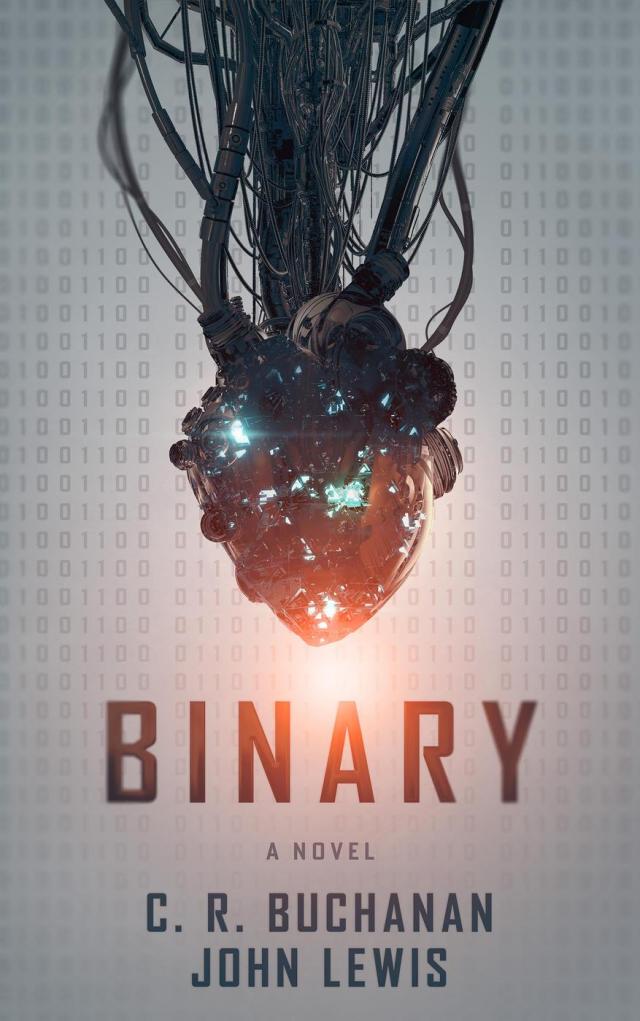
Dr. Landry typed in a few commands and a robotic arm lowered a complex, heart-sized object peppered with unusual lights from the ceiling, pivoting the object to him. He grabbed it and the arm went skyward again.
Visible currents of non-electrical origin surged beneath its surface. A series of pliable metallic tubes, almost too small to be seen, outlined its sharp edges sporadically. I was as curious about it as I was the humanoid sitting in front of me.
“We call this the Heart Device,” said Dr. Landry. “Would you like to hold it?”
“Of course,” I said.
Dr. Landry handed it to me. “Don’t worry. You can’t break it.”
The object was light. Though it was a tenth larger than a human heart, it weighed no more than a crumpled-up piece of paper.
I moved it up and down to calculate its weight. “This is unreal. How much does it...”
“The chiliahedron weighs 6.3 grams. It’s the most durable thing in this room. Trust me, we spent years doing all things imaginable trying to reach the substance contained within it, but as time passed, we came to understand it was something we couldn’t tap into. Even if we reached it, I don’t think it would be of any use to us.”
I gazed into the center of the Heart Device. There were only a few sections on it that allowed one to peer into its abyss. I brought one close to my eye and felt small when I investigated it. I could not comprehend why, but it seemed bigger than me. Bigger than all of us.
Various colors of what looked like a gas/liquid combination moved about its interior in nonrandom patterns as if it were alive, yet they never mixed. Something black and cloudlike brushed against its side four times trying to get to me. The device was hollow, but it was not empty. It drew me in. I had never felt such a tug.
“This object...” Dr. Landry grasped it from my hand. “We believe what’s inside of it is beyond scientific explanation. Beyond measurement.”
“It looks like various colors of gas,” I said, “but something cloudy is—”
“Don’t spend too much time racking your brain over it,” interrupted Dr. Landry. “We’ve never been able to detect any chemical reactions or elements present within. It’s essentially hollow, filled with something undetectable, and defies reasonable explanation.” He sat in front of the cybernetic man with the heart-sized object in hand. “I can tell you what the two of us think it is.”
“What?” I asked.
“Some of us think it’s Bruce’s soul,” answered Dr. Landry. “Not like humans may have, mind you. We think it’s a proverbial soul designed for cybernetics and A.I. to interact with.”
“Why would you think that?” I asked.
“What do you mean?” He asked in return.
“I mean...” I ran tact through my head. “It’s unusual when a man of your standing talks about souls. Not in the capacity you did. Not with that level of conviction. I’m just curious about the reasoning behind it.”
“Because no other explanations have ever been found or make more sense,” said Dr. Landry. “We think it belongs directly to Bruce. The Heart Device is where the ‘C’ in his name came from.”
“Bruce is an acronym?” I asked.
“Indeed,” answered Dr. Landry. “Binary radiogenic univocal chiliahedron of evidence.”
It made sense:
Binary - Relating to, composed of, or involving two things. The language computers used to communicate.
Radiogenic - Physics produced by radioactive decay.
Univocal - Having only one meaning.
Chiliahedron - a thousand-sided polyhedron, referring to the Heart Device itself.
Evidence - something that furnishes proof.
“Is it radioactive?” I asked.
“No,” answered Dr. Landry.
“So,” I said, “when you were coming up with the acronym—”
“I’d like to share a special moment with you,” interrupted Dr. Landry. “We’ve never talked about the Heart Device with it before.”
He looked down at the chiliahedron for a moment, then into the eyes of his greatest creation. I would have thought they had a connection if I had not known better. But I believed the connection was driven by the heart-sized object in Dr. Landry’s hands.
The machine leaned forward a few inches. Its head moved with curiosity, bunching the rubbery skin up around its throat.
“Do you know what this is?” asked Dr. Landry.
“No,” it answered. “What is it?”
“It’s your heart.”
The machine looked at me as if I held answers, then back to the doctor. “Heart?”
“Found nearly six decades ago,” answered Dr. Landry. “We think it will give you honest intelligence.”
The machine’s cybernetic mind was hard at work. Its head cocked and looked at the doctor the way Sparky looked at me when he was confused.
“No more A. I.,” explained the doctor. “You’ll have the ability to choose your responses and make your own decisions.”
The machine postured forward half an inch and its head jerked about for a second in thought before it looked back to Dr. Landry with wide-eyed curiosity and a partially opened mouth. Its expression matched mine.
The things Dr. Landry was talking about existed, but at the outermost realms of science fiction. It was beyond fringe and the reach of civilization’s intellectual capabilities.
“This is my only hope,” said Dr. Landry with a hint of desperation.
“Hope for what?” I asked.
“To complete The Project before I die.” His head lowered. “I’m nearly ninety, Alexis. Sixty plus years your senior.”
“Do you think it will work?” I asked.
“Yes.” He turned to me with pleading confidence. Wrinkles on his forehead gathered as he spoke. “If I want to see it in my lifetime, it must.”
He stared at the wonder sitting before him, lost in hope as the machine looked back, equally agog.
“He’s impressive, I know,” said Dr. Landry, “but he’s only presenting a fraction of the bewilderment to come.”
“What do you mean?” I asked. “How so?”
“The Heart Device is enthralling for reasons I don’t have scientific explanations for,” answered Dr. Landry. “It’s special, Alexis. Exceedingly special.”
He turned back to his creation. The machine was not strapped down and could have stood from the chair, but it did not. I assumed they kept all motor functions from the neck down disconnected or offline unless needed.
I watched them for a moment before something I would have earlier thought impossible caught my eye.
8-2
The skin room
The large observation window at the machine’s far left sucked me towards it, giving me a view into a room where miracles were being created. It was the utopia of scientific evolution I strived to be part of my entire life. Until that moment, living such a life had been but a personal reverie.
Twenty-five square meters of gorgeous flesh-toned skin were being stretched around a tubular formation by two of the three scientists in the room. The third was spraying it down with a gel-like purple chemical. All three scientists were wearing thick biohazard suits with tubes running from the ceiling to connect to their backs at their beltlines to pump in the air, keeping the suits bloated with positive air pressure.
Humidity in the skin room was high. I was unsure if it was being purged in or coming from the purple chemical that they were spraying. Condensation was visible on the glass separating us.
“How often do you have to replace its skin?” I asked.
“Never,” answered Dr. Landry. “What you’re looking at right now is the last stage in its visual and sensory upgrades.”
“Is the chemical hazardous?” I asked.
“Chemical?” he asked in return.
I pointed to the workers in biohazard suits. “The chemical they’re spraying on the skin.”
“No,” answered Dr. Landry. “Why do you ask?”
“The suits they’re wearing,” I answered.
“Ah, yes,” said Dr. Landry. “Oxygen levels in that room are high so the skin can breathe. It is organic, after all.”
My attention went back to Bruce, then to the room again.
“You’re wondering how the skin is going to get enough oxygen once it’s on Bruce, aren’t you?” asked Dr. Landry.
“I am,” I answered.
“We’ve never tested it,” he said. “We built it to the specifications as best we could, and we’re hoping the micro-machines within Bruce will do what we think they’re going to do once applied.”
It was a lot to take in. I sat next to Bruce, shaking my head in disbelief I was there.
“He has lungs,” he said.
My head whipped to Bruce.
Dr. Landry smiled. “They’re not like mine and yours, of course.”
“How do they work?” I asked.
Dr. Landry laughed. “I’m sorry. I’m not used to people asking questions I don’t have the answers to. I’ll tell you this. We don’t think his lungs will activate until his skin and eyes reach a point of oxygen deprivation that they’re needed. And at that point, we don’t think they will stop.”
“You mean,” I asked, “it’ll keep breathing?”
“Yes,” answered Dr. Landry. “Much like you and I are doing now. His chest will even rise and fall. We believe their design was not only to oxygenate but to help him blend in as well.”
“Blend with what?” I asked. “People?”
Dr. Landry looked to the ground in thought. “We’re not sure.”
“How long do you think it’ll take for it to draw its first breath?” I asked.
“We don’t know,” he snickered. “Enough with the questions, for now.”
“It’s just that it already looks so real,” I said.
The doctor looked towards the misty skin room and nodded his head. “Yes, but thanks to what you see in there, the thousands of hibernating micro-machines hiding under its makeshift skin, and the possibility of linking the Heart Device into its operating system... In a few days, my dear, he will be real.”
More questions than I could keep in line twirled up. I did not want to appear impatient, or like an inquisitive child that could not hold her tongue, but it was part of who I was.
“You said it’s going to make its own decisions,” I said. “Do you think you’ll ever give it the freedom to exercise those decisions?”
“Elaborate,” said Dr. Landry.
I studied Bruce for a moment. “Will it ever leave the compound?”
“Perhaps,” answered Dr. Landry.
“By itself?” I asked.
“That’s a little further ahead than we’ve thought,” answered Dr. Landry. “We only have a small idea what it’s going to be capable of, or what it would do with those capabilities.”
“Wait,” I asked. “How do you not know its capabilities?”
“Come again?” I asked.
Dr. Landry bit his bottom lip, inhaling and forcing a smile. He cleared his throat and eyed me. I had offended him, though he remained professional.
I was not one to regulate internal monologue and often said things others would not. It was hard for me to separate the difference between being politically correct and lying. And there I was, trying to be tactful in my response.


