

The Marching Morons, page 1


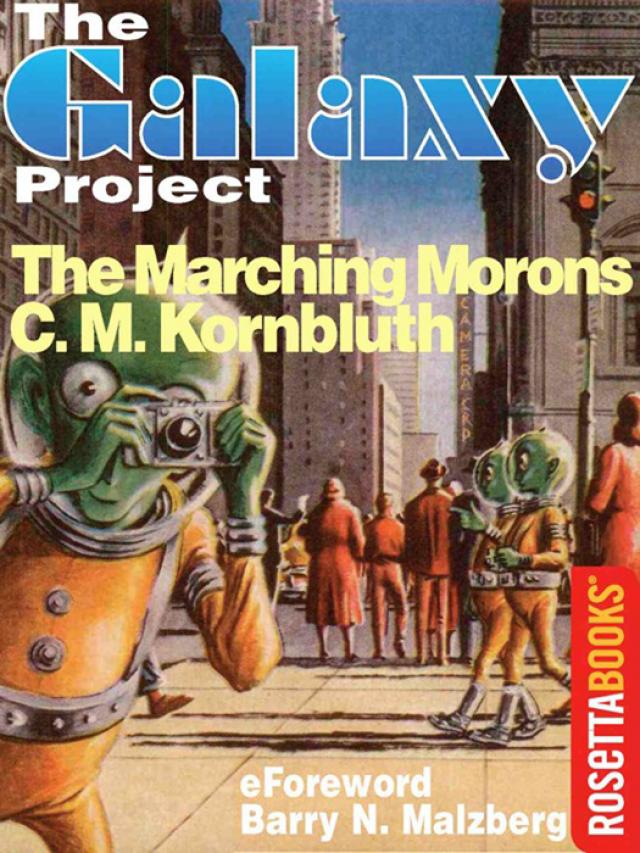
The Marching Morons
The Galaxy Project
C. M. Kornbluth
Series Editor Barry N. Malzberg
Copyright
The Marching Morons
Copyright © 1951 by C. M. Kornbluth, renewed 1979
eForeword
Copyright © 2011 by Barry N. Malzberg
Jacket illustration copyright © 1952 by the Estate of Ed Emshwiller
Cover art to the electronic edition copyright © 2011 by RosettaBooks, LLC
Special materials copyright © 2011 by RosettaBooks, LLC
All rights reserved. No part of this book may be used or reproduced in any manner whatsoever without written permission except in the case of brief quotations embodied in critical articles and reviews.
Electronic edition published 2011 by RosettaBooks LLC, New York.
ISBN e-Pub edition: 9780795321535
Contents
About Galaxy Magazine
About Science Fiction Novelettes and Novellas
About the Author
About the Author of the eForeword
About the Jacket
eForeword
The Marching Morons
ABOUT GALAXY MAGAZINE
The first issue of Galaxy, dated October 1950, already heralded to the highest standards of the field. The authors it published regularly contributed to the leading magazine Astounding, writing a kind of elegant and humanistic science fiction which although not previously unknown had always been anomalous. Its founding editor, H. L. Gold (1914–1996), was a science fiction writer of some prominence whose editorial background had been in pulp magazines and comic books; however, his ambitions were distinctly literary, and he was deliberately searching for an audience much wider and more eclectic than the perceived audience of science fiction. His goal, he stated, was a magazine whose fiction “Would read like the table of contents of a literary magazine or The Saturday Evening Post of the 21st century, dealing with extrapolation as if it were contemporary.” The magazine, although plagued by distribution difficulties and an Italian-based publisher (World Editions), was an immediate artistic success, and when its ownership was transferred with the issue of August 1951 to its printer Robert M. Guinn, it achieved financial stability for the remainder of the decade.
Galaxy published every notable science fiction writer of its first decade and found in many writers who would become central figures: Robert Sheckley, James E. Gunn, Wyman Guin, and F. L. Wallace, among others. Galaxy revivified older writers such as Frederik Pohl and Alfred Bester (whose first novel, The Demolished Man, was commissioned and directed page by page by Gold). John Campbell fought with Astounding and remained an important editor, and The Magazine of Fantasy and Science Fiction (inaugurated a year before Galaxy) held to high standards of literary quality while spreading its contents over two fields, but Galaxy was incontestably the 1950s’ flagship magazine for the acidly satiric, sometimes profoundly comic aspect of its best contributions. Galaxy had a lasting effect not only upon science fiction but upon literature itself. J.G. Ballard stated that he had been deeply affected by Galaxy. Alan Arkin, an actor who became a star after 1960 and won an Oscar in the new millennium, contributed two stories in the mid-fifties.
At this point Gold was succumbing to agoraphobia, physical ills, and overall exhaustion (some of this perhaps attributable to his active service during WWII) against which he had struggled from the outset. (There is creditable evidence that Frederik Pohl was the de facto editor during Gold’s last years.) Gold would return some submissions with notes like: “Garbage,” “Absolute Crap.” Isaac Asimov noted in his memoir “Anthony Boucher wrote rejection slips which read like acceptances. And Horace wrote notes of acceptance which felt like rejections.” Despite this, the magazine retained most of its high standard and also some of its regular contributors (William Tenn, Robert Sheckley, Pohl himself). Others could no longer bear Gold’s imperiousness and abusiveness.
ABOUT SCIENCE FICTION NOVELETTES AND NOVELLAS
In the view of James E. Gunn, science fiction as a genre finds its peak in the novella (17,500–40,000 words) and novelette (7,500–17,500 words). Both forms have the length to develop ideas and characters fully but do not suffer from padding or the hortatory aspect present in most modern science fiction novels. The longer story-form has existed since science fictions inception with the April 1926 issue of Amazing Stories, but Galaxy developed the form to a consistent level of sophistication and efficiency and published more notable stories of sub-novel length than any other magazine during the 50s…and probably in any decade.
The novella and novelette as forms make technical and conceptual demands greater, perhaps even greater than the novel, and Galaxy writers, under founding editor H. L. Gold’s direction, consistently excelled in these lengths. Gold’s most memorable story, “A Matter of Form” (1938) was a long novelette, and he brought practical as well as theoretical lessons to his writers, who he unleashed to develop these ideas. (John Campbell of course, had also done this in the 40s and continued in the 50s to be a directive editor.) It is not inconceivable that many or even most of the contents of the 1950’s Galaxy were based on ideas originated by Gold: golden technology becomes brass and jails its human victims when it runs amok—is certainly one of his most characteristic.
ABOUT THE AUTHOR
Cyril Kornbluth (1923 or 1924–1958) was a fully accomplished science fiction writer by his late teens, selling under many pseudonyms to all of the then extant science fiction magazines except Astounding. His work from its outset was recognized for its proficiency, resonance, and darkness. Born in Brooklyn, he met Fred Pohl (also a Brooklynite) in the mid-thirties, and the two were among the founding members of the Futurian Club from which emerged many of the most important writers of the 50s. Kornbluth collaborated with Pohl on the famous 1952 future advertising satire The Space Merchants and several successor novels. He assumed from the first prominence as one of Galaxy’s most important early contributors. Several of his 1950s short stories (“The Little Black Bag,” “The Marching Morons,” “The Last Man Let In the Bar,” “Shark Ship,” “The Altar At Midnight”) are regarded as among the greatest to emerge from science fiction during that decade. A WWII combat veteran (he carried a machine gun through the Battle of the Bulge), Kornbluth incurred psychic and cardiac damaged, which contributed to his early death. He died on a railroad platform in March 1958 on his way to NYC to begin work as an Assistant Editor of The Magazine of Fantasy and Science Fiction, survived by a wife and two sons. Several novels, including the final, posthumously published Man of Cold Rages, were not science fiction, and at the time of his death he was embarked on a course to take himself out of the field. Nonetheless, he is remembered only for his science fiction, which set a standard for Galaxy and its decade.
ABOUT THE AUTHOR OF THE eFOREWORD
Barry N. Malzberg’s Beyond Apollo was in 1973 the winner of the first John W. Campbell Memorial Award for the best science-fiction novel of the year; he twice won the LOCUS Award for nonfiction books of critical history and commentary on science fiction. Several short works have been final-listed for the Nebula and Hugo and Engines of the Night and Breakfast in the Ruins, the nonfiction works, were on the Hugo final ballot for Best Related Nonfiction as is his collaborative book with Mike Resnick, The Business of Science Fiction.
ABOUT THE JACKET
COVER IMAGE: “The Forty Credit Tour of Earth” by Ed Emshwiller
Ed Emshwiller (1925–1990) was Galaxy’s dominant artist through the 1950s. His quirky images, perspective, and off-center humor provide perhaps the best realization of the magazine’s iconoclastic, satirical vision. Emshwiller was—matched with Kelly Freas—science fiction’s signature artist through the decade and a half initiated by this color illustration. He and Carol Emshwiller, the celebrated science fiction writer, lived in Long Island during the period of his prominence in science fiction. (Nonstop Press published Emshwiller: Infinity X Two: The Art & Life of Ed and Carol Emshwiller, a joint biography and collection of their work in visual and literary medium, in 2007.) In the early 70s, Emshwiller became passionately interested in avant-garde filmmaking, and that passion led him to California, where he spent his last decades deeply involved in the medium of independent film and its community. He abandoned illustration: in Carol’s words “When Ed was through with something he was really through with it.” He died of cancer in 1990. His son, Peter Emshwiller, published a fair amount of science fiction in the 80s and 90s.
eForeword
When this novelette was published in the April 1951 issue, Cyril Kornbluth must have felt that he was on the brink of a great career. His collaborative novel with Judith Merril, Mars Child, would begin running in the magazine the next month, he was already deeply involved in The Space Merchants with Merril’s husband Fred Pohl, and his novelette in the July 1950 Astounding “The Little Black Bag” was already being regarded as a classic. A little down the road were his second collaboration with Judith Merril, Gunner Cade, which would run in Astounding beginning in March 1952 (just before The Space Merchants) and his first book sale, Takeoff, to Doubleday. He was twenty-six years old and had been a professional writer since 1940. Some of the stories that he wrote as a teenager for the secondary magazines (“The Rocket of 1955,” “The Words of Guru”) showed talent so convincing that it was impossible to think of the author as precocious. In the eyes of his friends and colleagues, he was an old genius trapped in the failing body of a sedentary war veteran with a bad heart. Seven years
“The Marching Morons,” a brutal extrapolation of Malthusian theory with more than a pinch of Gresham, is perhaps the ugliest, the most brutal and stripped satirical work that the acerbic Gold ever published in his magazine. It found a split reaction from the outset, and some critics have felt that its portrait of a population overwhelmingly tilted toward the frantically breeding subnormals, and the desperate measures taken by the secret masters of that culture to deal with the idiots is…well, it is too much. It is a novelette that can be taken as a kind of apologia for genocide (some of those who really hate this story suggested that if “Jew” had been substituted for “moron” in the conception, it could have been an apologia written by and for Hitler). Science fiction fans in the main liked it—it did refract how many of them felt about the so-called “mundanes,” the larger society that ignored or despised science fiction—but non-fans and occasional readers were in the main repelled. This is one of those stories which, like Tom Godwin’s 1954 Astounding novelette “The Cold Equations,” retains its ability, half a century after its original appearance, to start an emotional debate. Its true worth—to say nothing of fairness—remains in doubt all of these years later. It certainly has gotten around, though.
Martin H. Greenberg reprinted “The Marching Morons” in the 1951 volume of his long retrospective best-of-the-year anthology series in collaboration with Isaac Asimov. His introduction is refractory of the anguish the story then thirty-five years in the past was still able to cause: “The purpose of these volumes is to reprint the best science fiction of the year, not the most controversial, but there seems no alternative to reprinting this story.” Indeed, no true history of the period or of Galaxy can fairly ignore this troubling work. Kornbluth’s bitterness had been apparent from those earliest stories he had published in Astonishing and elsewhere as a teenager (“The Words of Guru” views humanity as a disease to be expurgated by its omniscient protagonist) and “The Little Black Bag,” a work of self-dealing, corruption, technological misalliance, and destruction, is unyielding in its harshness…but “The Marching Morons” reveals a misanthropy, a level of contempt that Kornbluth had with varying success been able to mask in his earlier work. But here the ambiguity is gone. The preponderance of the population are morons and they deserve to die. They are on a route to end human existence anyway.
The story, as is usually the case with Kornbluth, is also darkly comic in its portrayal of the morons’ culture, and its depiction of the television programs that amuse them as clearly foreshadows our contemporary “reality television” as it reflected the quiz shows of its time. (“Name, honey?” “Uh…uh.” “Folks, she forgot her name! Would you buy it for a quarter?”) Kornbluth contributed a catchphrase (that prospective quarter) to the science fiction lexicon and it has thus far proved immortal. You can still get a laugh saying it on a convention panel. Try it.
This April 1951 issue, only the seventh the magazine had published, depicted a magazine in full stride. Here also is William Tenn’s “Betelgeuse Bridge” (also in this first series). Here is Poul Anderson suddenly fully stylistically developed, and here is Walt Sheldon’s “I The Unspeakable,” a story whose flagrant sentimentality is disguised as brutality (in Sheldon’s culture the word “love” is “the unspeakable”). Gold in his editorial is laying out his plans to take over not only science fiction but the world itself. Boundless optimism unto megalomania carried forward by dystopian contents…that was Gold’s formula, whether he thought of it as such, and he was insistent upon cultivating an audience of non-science fiction writers who he could bring into the category. He wanted to sell science fiction—sophisticated, subtle, bleak science fiction—to an audience that did not like or know the form, and for at least half of his editorial tenure, he gambled his magazine on that paradox.
As with other noble experiments, Galaxy failed while succeeding, succeeded while in descent toward failure. Past the first shocking novelty of its content and slant, Galaxy risked becoming formulaic and predictable, and its audience, having sampled at the fountain, became restless. But the formula worked longer and more successfully than most, and its effects—both literary and social—were absolute.
Kornbluth’s sudden, early death took out a career which was only foreshadowed by what he had already managed. But, if no Mozart, he had a good try at being Kornbluth, and it was never the same after him. Same is true of Galaxy. “The history of our little field is a history of failure,” I wrote in Engines of the Night thirty years ago. Well, yes. And Mozart never completed the K.427 C Minor Mass; Bach left The Art of the Fugue in mid-phrase. Still, Tony Soprano: What you gonna do?
—Barry N. Malzberg
The Marching Morons
Some things had not changed. A potter’s wheel was still a potter’s wheel and clay was still clay. Efim Hawkins had built his shop near Goose Lake, which had a narrow band of good fat clay and a narrow beach of white sand. He fired three bottle-nosed kilns with willow charcoal from the wood lot. The wood lot was also useful for long walks while the kilns were cooling; if he let himself stay within sight of them, he would open them prematurely, impatient to see how some new shape or glaze had come through the fire, and—ping!—the new shape or glaze would be good for nothing but the shard pile back of his slip tanks.
A business conference was in full swing in his shop, a modest cube of brick, tile-roofed, as the Chicago-Los Angeles “rocket” thundered overhead—very noisy, very swept-back, very fiery jets, shaped as sleekly swift-looking as an airborne barracuda.
The buyer from Marshall Fields was turning over a black-glazed one liter carafe, nodding approval with his massive, handsome head. “This is real pretty,” he told Hawkins and his own secretary, Gomez-Laplace. “This has got lots of what ya call real est’etic principles. Yeah, it is real pretty.”
“How much?” the secretary asked the potter.
“Seven-fifty each in dozen lots,” said Hawkins. “I ran up fifteen dozen last month.”
“They are real est’etic,” repeated the buyer from Fields. “I will take them all.”
“I don’t think we can do that, doctor,” said the secretary. “They’d cost us $1,350. That would leave only $532 in our quarter’s budget. And we still have to run down to East Liverpool to pick up some cheap dinner sets.”
“Dinner sets?” asked the buyer, his big face full of wonder.
“Dinner sets. The department’s been out of them for two months now. Mr. Garvy-Seabright got pretty nasty about it yesterday. Remember?”
“Garvy-Seabright, that meat-headed bluenose,” the buyer said contemptuously. “He don’t know nothin’ about est’etics. Why for don’t he lemme run my own department?” His eye fell on a stray copy of Whambozambo Comix and he sat down with it. An occasional deep chuckle or grunt of surprise escaped him as he turned the pages.
Uninterrupted, the potter and the buyer’s secretary quickly closed a deal for two dozen of the liter carafes. “I wish we could take more,” said the secretary, “but you heard what I told him. We’ve had to turn away customers for ordinary dinnerware because he shot the last quarter’s budget on some Mexican piggy banks some equally enthusiastic importer stuck him with. The fifth floor is packed solid with them.”


