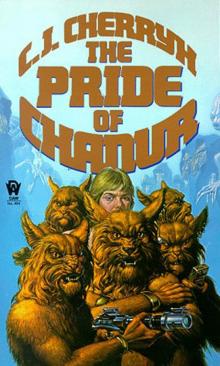
Shon'Jir, page 23
part #2 of Faded Sun Trilogy Series


“An?ehon,” Melein said aloud, and the sound rang like a thunderclap into that long silence.
The machinery blazed to life, activated with a suddenness that made Niun flinch in spite of himself, and he heard the beginnings of an outcry from Duncan, one immediately stifled. The human stood beside him, knelt to set the pan’en down, and rose again, hand on his pistol.
“I am receiving,” said a deep and soulless voice. “Proceed.”
By the name of the city Melein had called it: Niun’s skin prickled, first at the realization that he had seen a symbol and heard it named, a forbidden thing. and then that such a creation had answered them. He saw Melein herself take a step back, her hand at her heart.
“An?ehon,” she addressed the machine, and the very floor seemed to pulse in time with the throb of the lights. It was indeed the city that spoke to them, and it had used the hal’ari, the High Language, that was echoed unchanged throughout all of mri time. “An?ehon, where are your people?”
A brighter flurry of lights ran the boards.
“Unknown,” the machine pronounced at last.
Melein drew a deep breath stood still for several moments in which Niun did not dare to move. “An?ehon,” she said then, “we are your people. We have returned. We are descended from the People of An?ehon and from Zohain and Tho’ei’i?shai and Le’a’haen. Do you know these names?”
There was again a flurry of lights and sounds, extreme agitation in the machine. Niun took a step forward, put a cautioning hand toward Melein, but she stood firmly, disregarding him. Bank after bank in the farthest reaches of the hall flared to life: section after section illumined itself.
“We are present,” said another voice. “I am Zohain.”
“State your name, visitor,” said An?ehon’s deeper voice. “Please state your names. I see one who is not of the People. Please state your authority to invoke us, visitor.”
“I am Melein s’lntel Zain?Abrin, she’pan of the People that went out from Kutath.”
The lights pulsed, in increasing unison. “I am An?ehon. I am at the orders of the she’pan of the People. Zohain and Tho’e’i?shai and Le’a’haen are speaking through me. I perceive others. I perceive one of the not?People.”
“They are here with my permission.”
The lights pulsed, all in unison now. “May An?ehon ask permission to ask?” the machine began, the ritual courtesy of one who would question a she’pan; and the source of it sent cold over Niun’s skin,
“Ask.”
“What is this person of the not?People? Shall we accept it, she’pan?”
“Accept him. He is Duncan?without?a?Mother. He comes from the Dark. This, of the People, is Niun s’lntel Zain?Abrin, kel’anth of my Kel; this other is a shadow?who?sits?at?our?door.”
“Other shadows have entered the city with you.”
“The dusei are likewise shadows in our house.”
“There was a ship which we permitted to land.”
“It brought us.”
“There is a signal which it gives, not in the language of the People.”
“An?ehon, let it continue.”
“She’pan,” it responded.
“There are none of the People in your limits?”
“No.”
“Do any remain, An?ehon?”
“Rephrase.”
“Do any others of the People survive, An?ehon?”
“Yes, she’pan. Many live.”
The answer struck; it went uncomprehended for several heartbeats, for Niun had waited for no. Yes. Yes, many, many, MANY!
“She’pan,” Niun exclaimed, and tears stung his eyes. He stood still, nonetheless, and breathed deeply to drive the weakness from him, felt Duncan’s hand on his shoulder, offering whatever moved the human, and after a moment he was aware of that, too. Gladness, he thought; Duncan was glad for them. He was touched by this, and at the same time annoyed by the human contact.
Human.
Before he had heard An?ehon speak, he had had no resentment for Duncan’s humanity; before he had known that there were others, he had not felt the difference in them so keenly.
Shame touched him, that he should go before others of the People, drawing this with them self?interested shame and dishonorable, and hurtful. Perhaps Duncan even sensed it. Niun lifted his arm, set it likewise on Duncan’s shoulder, pressed with his fingers.
“Sov?kela,” he said in a low voice.
The human did not speak. Perhaps he likewise found nothing to say.
“An?ehon,” Melein addressed the machine, “where are they now?”
A graphic flashed to a central screen: dots flashed.
Ten, twenty sites. The globe shaped, turned in the viewer, and there were others.
“There were no power readings for those sites,” Duncan murmured. Niun tightened his hand, warning him to silence.
Melein turned to them, hands open in dismissal. “Go. Wait below.”
Perhaps it was because of Duncan; more likely it was that here began sen?matters that the Kel had no business to overhear.
The People survived.
Melein would guide them: the thought came suddenly that he would have need of all the skill that his masters had taught him that first in finding the People, it would be necessary to kill: and this was a bitterness more than such killing ever had been.
“Come,” he said to Duncan. He bent to take the pan’en’ into his own arms, trusting their safety now to the city, that obeyed Melein.
“No,” Melein said. “Leave it.”
He did so, brought Duncan out and down again, where they had left their other belongings; and there they prepared to wait.
Night came on them. From sen?tower there was no stir; Niun sat and fretted at Melein’s long silence, and Duncan did not venture conversation with him. Once, restless, he left the human to watch and climbed up to kel?hall: there was only emptiness there, vaster by far than the earth?walled kel?hall he had known. There were pictures, maps, painted there, age?faded, showing a world that had ceased to be, and the sight depressed him.
He left the place, anxious for Duncan, alone in main hall, and started down the winding ramp. A cnittering, mechanical thing darted behind him … he whirled and caught at his pistol, but it was only an automaton, a cleaner such as regul had employed. It answered what kept the place clean, or what did repairs to keep the ancient machinery running.
He shrugged, half a shiver, and descended to Duncan startled the human, who settled back again, distressed and relieved at once.
“I wish the dusei would come back,” Duncan said.
“Yes,” Niun agreed. They were limited without the animals. They dared not leave the outer door unguarded. He looked in that direction, where there was only night, and then began to search through their packs. “I am going to take the she’pan up some food. I do not think we will be moving tonight. And mind, there are some small machines about. I think they are harmless. Do not damage one.”
“It comes to me,” Duncan said softly, “that An?ehon could be dangerous if it chose to be.”
“It comes to me too.”
“It said. that it permitted the ship to land. That means it could have prevented it.”
Niun drew a slow breath and let it go, gathered up the packet of food and a flask, the while Duncan’s words nagged at him. The human had learned well how to keep his thoughts from his face; he could no longer read him with absolute success. The implications disturbed him; it was not the landing of their own ship that Duncan was thinking of.
Others.
The humans that would come.
Such a thought Duncan offered to him.
He rose and went without looking back, climbed the way to sen?hall, thoughts of treachery moiling in him: and not treachery, if Duncan were Melein’s.
What was the man?
He entered cautiously into the outer hall of the Sen, called out aloud, for the door was left open; he could hear the voice of the machine, drowning his words, perhaps.
But Melein came. Her eyes were shadowed and held a dazed look. Her weariness frightened him.
“I have brought you food,” he said.
She gathered the offering into her hands. “Thank you,” she said, and turned away, walked slowly back into that room. He lingered, and saw what he ought not, the pan’en open, and filled with leaves of gold. saw the pulse of lights welcome Melein, mortal flesh conversing with machines that were cities. She stood, and light bathed her white?robed figure until it blazed blue?white like a star. The packet of food tumbled from her loose hand, rolled. The flask slipped from the other and struck the floor without a sound. She did not seem to notice.
“Melein!” he cried, and started forward.
She turned, held out her hands, forbidding, panic on her face. Blue light broke across his vision: he flung himself back, crashed to the floor, half dazed.
Voices echoed, and one was Melein’s. He gathered himself to one knee as she reached him, touched him: he gained his feet, though his heart still hammered from the shock that had passed through him.
“He is well?” asked the voice of An?ehon. “He is well?”
“Yes,” Melein said.
“Come away,” Niun urged her. “Come away; leave this thing, at least until the morning. What is time to this machine? Come away from it, and rest.”
“I shall eat and rest here,” she said. Her hands caressed his arm, withdrew as she stepped back from him, retreating into the room with the machine. “Do not try to come here.”
“I fear this thing.”
“It should be feared,” she lingered to say, and her eyes held ineffable weariness. “We are not alone. We are not alone, Niun. We will find the People. Look at yourself, she’pan’s?kel’en.”
“Where shall we find them, and when, she’pan? Does it know?”
“There have been wars. The seas have dried; the People have diminished and fought among themselves; cities are abandoned for want of water. Only machines remain here: An?ehon says that it teaches the she’panei that come here, to learn of it Go away. I do not know it all. And I must. It learns of me too; it will share the knowledge with all the Cities of the People, and perhaps, with that One it calls the Living City. I do not know, I cannot grasp what the connection is among the cities. But I hold An?ehon. It listens to me. And by it I will hold Kutath.”
“I am,” he said, dazed by the temerity of such a vision, “the she’pan’s Hand.” “Look to Duncan.”
“Yes,” he said; and accepted her gesture of dismissal and left, still feeling in his bones the ache that the machine’s weapon had left; dazed he was still, and much that she had said wandered his mind without a tether to hold it … only that Melein meant to fight, and that therefore she would need him.
A’ani. Challenge. She’panei did not share: the she’pan served by the most skillful kel’en, survived. Melein prepared herself.
He returned in silence to the hall below, curled up in the corner, massaging his aching arms and reckoning in troubled thoughts that there was killing to be done.
“Is she all right?” Duncan intruded into his silence, unwelcome.
“She will not leave. She is talking to it, with them. She speaks of wars, kel Duncan.”
“Is that remarkable for the People?” Niun looked at him, prepared to be angry, and realized that it was a failure of words. “Wars. Mri wars. Wars?with?distance?weapons.” He resorted to the forbidden mu’ara, and Duncan seemed then to understand him, and fell quickly silent
“Would that the dusei would come,” Niun declared suddenly, wrenching his thoughts from such prospects; and in his restlessness he went to the door and ventured to call to them, that lilting call that sometimes, only sometimes, could sum-mon them.
It did not work this time. There was no answer this night, nor the next.
But on the third, while Melein remained shut in sen?tower, and they fretted in their isolation below, there came a familiar breathing and rattle of claws on the steps outside, and that peculiar pressure at the senses that heralded the dusei.
It was the first night that they two dared sleep soundly, warm next their beasts and sure that they would be warned if danger came on them.
It was Melein that came; a clap of her hands startled them and the beasts together, wakened them in dismay that she, though one of them, had found them sleeping.
“Come,” she said; and when they had both gained their feet and stood ready to do her bidding: “The People are near. An?ehon has lit a beacon for them. They are coming.”
Chapter Twenty
THE STORM days past had left banks of sand heaped in the city, high dunes that made unreal shapes in the light that whipped about the square.
Duncan looked back at the source, a beacon from the edun’s crest that flashed powerfully in the still?dark sky, a summons to any that might be within sight of the city.
And the People would come to that summoning.
They took nothing with them: the pan’en, the sled, everything they owned was left in the edun. If they fared well, they would return; if not, they had no further need. There was, he suspected, though Niun had not spoken overmuch of their chances, no question of flight, whatever happened.
The dusei were disturbed, the more so as they neared the city’s limits. Niun scattered them with a sharp command; it was not a situation for dus?feelings. The beasts left them, and vanished quickly into the dark and the ruins.
“Should I not go also?” Duncan asked.
The mri both looked at him. “No,” said Niun. “No,” Me-lein echoed, as if such an offering offended them.
And in the dawning, on the sand ridge facing the city, appeared a line of black.
Kel’ein.
The Face that is Turned Outward.
“Shon’ai,” Niun said softly. Shon’ai sa’jiran, the mot ran. The cast is made: no recalling it. “She’pan, will you wait, or will you come?”
“I will walk with you. lest there be some over?anxious kel’en on the other side. There are still she’panei. We will see if there is still respect for law.”
And in the first light of Na’i’in, the black line advanced, a single column. They walked to meet it, the three of them, and there were no words.
The column stopped, and a pair of kel’ein detached themselves and came forward.
Melein stopped. “Come,” Niun said to Duncan.
They walked without her. “Keep silent,” Niun said, “and keep to my left flank.”
And at speaking?distance, only barely, the strange kel’ein stopped; and hailed them. It was a mu’ara, and not a word of it could Duncan understand, but only she’pan.
“Among the People,” Niun shouted them back, “is the hal’ari forgotten?”
The two strangers came forward still further, and paused: Duncan felt their eyes on him, on what of his face was not veiled. They knew something amiss; he felt it in that too?close scrutiny.
“What do you bring?” the elder asked Niun, and it was the hal’ari. “What is this, kel’en?”
Niun said nothing.
The stranger’s eyes went beyond Niun, distant, and came back again. “Here is Sochil’s land. Whatever you are, advise your she’pan so, and seek her grace to go away. We do not want this meeting.”
“A ship has touched your lands,” Niun said.
There was silence from the other side. They knew, and were perturbed: it did not need dusei to feel that hi the air.
“We are of Melein s’lntel,” said Niun. .
“I am Hlil s’Sochil,” said the younger, slipping hand into ‘belt in a threatening posture. “And you, stranger?”
“I am daithon Niun s’lntel Zain?Abrin, kel’anth of the Kel of Melein.”
Mil at once adopted a quieter posture, made a slight gesture of respect. He and his elder companion were clad in coarse, faded black; but they were adorned with many j’tai, honors that glittered and winked in the cold sun and the weapons they bore were the yin’ein, worn and businesslike.
“I am Merai s’Elil Kov?Nelan,” said the elder. “Daithon and kel’anth of Kel of Edun An?ehon. What shall we say to our she’pan, kel’anth?”
“Say that it is challenge.” 1
There was a moment’s silence. Merai’s eyes went to Duncan, worrying at a presence that did not belong; worrying, Duncan thought, at questions that he would ask if he could. They knew of the ship; and Merai’s amber eyes were filled with apprehension.
But suddenly Merai inclined his head and walked of, he and Hlil together.
“They sense something wrong in me,” Duncan said.
“Their she’pan will come. It is a question for her now. Stand still; fold your hands behind you. Do nothing you are not bidden to do.”
So they stood, with the wind fluttering gently at their robes and blowing a fine sifting off the surface of sand. A tread disturbed the silence after a time; Melein joined them.
“Her name is Sochil,” Niun said without looking about her. “We have advised her kel’anth of your intentions.”
She said nothing, but waited.
And in utter silence the People came, the kel’ein first, ranging themselves in a circle about them, rank upon rank, so that had they intended flight there was no retreat. Duncan stood stone?still as his companions, as did the hostile Kel, and felt the stares that were fixed on him, on them all, for surely there was strangeness even in Niun and Melein, the fineness of then clothing, the zahen’ein that they bore with the yin’ein, the different style of the zaidhe, with its dark plastic visor and careful folding, while their own were mere squares and twists of cloth, and their veils were twisted into the head?cloths, and not fastened to the metal band that theirs had. Hems were ragged, sleeves frayed. Their weapon hilts were in bone and lacquered fiber, while those of Niun were of brass and gold and cho?silk wrappings: Duncan thought even his own finer than those these strangers bore.
A figure of awe among them, Niun: Duncan did not know the name that Niun had called himself daithon was like a word for son, but different; but he reckoned suddenly that the kinsman of a she’pan ranked nigh the she’pan herself.