

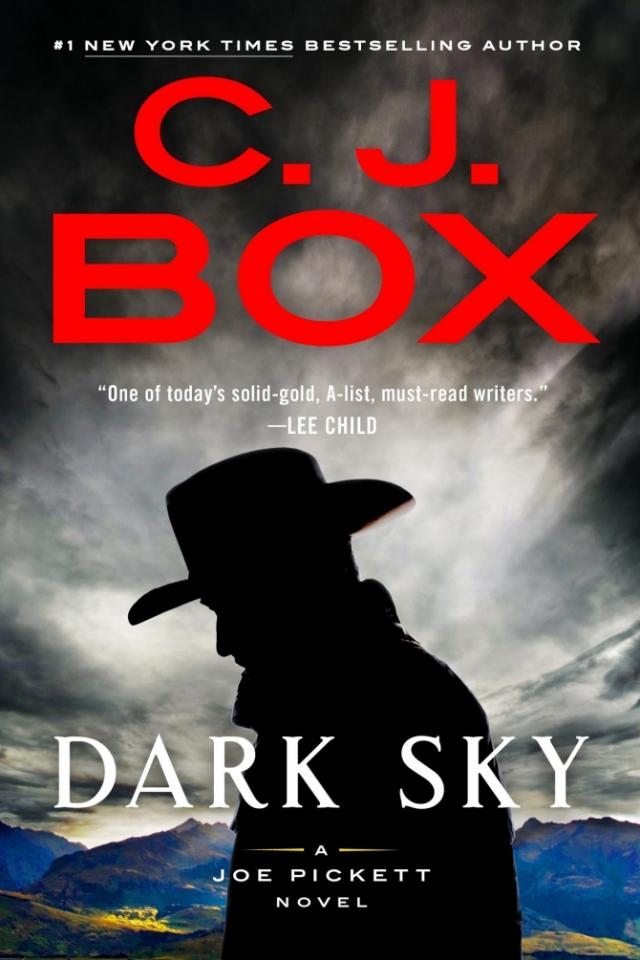
Dark Sky, page 2
part #21 of Joe Pickett Series


“We may need to winnow down some of your stuff if it’s too much.”
“Are you saying we don’t have pack animals?” Price asked with a look of genuine concern. “My understanding is we’d have pack animals to transport everything we need.”
“We’ve got horses and panniers,” Joe said. “They’re waiting for us in the parking lot. But we need to limit the weight on each animal to no more than thirty percent of its body weight. We’ve got five packhorses in addition to the horses we’ll ride.”
Price frowned. “How much does a horse weigh?”
“Depends on the horse.”
Price closed his eyes and took a deep breath, then slowly reopened them. “I was under the assumption all of this was already sorted out in advance.”
Joe said, “I told Tim to limit your baggage to five hundred pounds.”
Price glared at him. “You know, good old Joe, I can do math in my head. In fact, I’m quite good at it. I’m a coder and a programmer and I’ve designed world-class proprietary algorithms. Are you telling me that your packhorses can only handle a hundred pounds each? I find that hard to believe, since most human riders weigh well above that.”
“They do,” Joe said. “But we need to plan for the weight of hauling elk back down the mountain.”
“Oh.”
“We’ll get it figured out,” Joe offered in an attempt to be conciliatory. As he said it, Joannides approached the group.
Price turned to his assistant. “If we need to leave things behind, they’ll be yours.”
“Yes, boss,” he said through gritted teeth as he turned and walked away.
Joe felt embarrassed for the man, which Price seemed to pick up on.
“I hope that’s not the first of many misunderstandings,” Price said. “Sometimes I think Tim tells me what he thinks I want to hear rather than what I need to hear.”
Joe was glad Joannides was out of earshot.
“Since you’ve been communicating with Tim,” Price continued, “it’s important that you know I’m not some kind of prima donna. I take what we’re about to do very seriously and it’s extremely valuable to me. I appreciate you and the wrangler taking your time to do this.”
Joe nodded.
“As I hope Tim conveyed to you, I only want to participate in an authentic, fair-chase hunt. Pretend I’m just a normal person who hires you to guide him.”
Joe started to say that he didn’t usually guide hunters at all, but Price was on a roll.
“I’ve had hundreds of opportunities to just shoot an animal, if that’s what I wanted to do. I’m talking absolute trophies. But that was on land owned by friends and colleagues, or worse, game farms. That is the last thing I want to do.
“I want real,” Price said. “I want the actual experience. Did Tim communicate this to you clearly?”
Joe was torn how to answer without throwing Joannides under the bus.
“I get it,” Joe said.
“Wonderful,” Price said. “Now, do you think you can go get the wrangler and help us unload all of that gear? And be very careful. Some of it is really delicate.”
Joe turned and pushed through the double doors into the terminal. He found Boedecker sitting on a plastic chair reading the Saddlestring Roundup.
The rancher looked up as Joe approached. He said, “Are you sure we can’t get out of this?”
“I’m pretty sure.”
Boedecker put the paper aside and looked around to make sure no one could overhear what he was about to say. His eyes were unblinking.
“You can go,” the man said. “No hard feelings on my part. In fact . . .”
Joe cocked his head as he waited for more.
“I’d really advise you to go home,” Boedecker said finally. “I can do this without you.”
Joe was puzzled. “I signed on for this.”
Before Boedecker could continue, Joannides stuck his head in the door. He was frantic.
“We need to get this show on the road, gentlemen,” he said.
Boedecker gave Joe a long look that Joe supposed was designed to tell him something. Then he stood up and the two of them walked through the tiny terminal toward the waiting plane.
Joe looked up from the tarmac. A procession of dark clouds scudded across the sky from the north. Soon, it looked like, they’d envelop Battle Mountain.
TWO
Two and a half weeks before, Joe had sat in a leather-backed armchair across from Colter Allen, the governor of Wyoming, in the newly refurbished capitol building in Cheyenne. Game and Fish Department director Rick Ewig was with him.
They’d both been summoned to appear before the governor. Joe had left a telephone message on Ewig’s phone asking if the director knew what the meeting was about. Ewig hadn’t called back.
“Why am I here?” Joe asked Allen.
“I’ll explain,” Allen said.
* * *
—
Governor Colter Allen was in the midst of completing his third year in his first term of office. His term had been wracked with problems including a #MeToo scandal, as well as revelations that he’d falsified his résumé and he’d been backed by donors of questionable character, including Joe’s own mother-in-law. Additionally, Governor Allen was thought by general consensus within the state to have fouled up the response to the onset of the coronavirus pandemic by lurching from strict shelter-in-place orders to a full-blown reopening within weeks, then issuing no guidance at all for months while the virus raged.
Joe’s relationship with the Republican governor was nothing like it had been when Spencer Rulon held the office. Although slippery at times, Rulon had enlisted Joe to be his “range rider” and he’d sent him out to different places in the state on special assignments. And when Joe had gotten into trouble, which was often, Rulon had backed him up.
Allen had assumed office with the misconception that Joe would do anything he asked, including gathering dirt on his political opponents and spreading misinformation on his behalf. When Joe had refused, Allen retaliated. If it weren’t for Rulon stepping in as a private-practice attorney and representing him, Joe would have long been out of a job and possibly indicted.
Although there had been rumblings about the possible impeachment of Allen—Wyoming’s first ever—the bills to start the proceedings had been killed in committee by the legislature. According to the Casper Star-Tribune, the house of representatives and senate seemed to have concluded that rather than play hardball with the governor, they’d simply wait him out and elect someone new.
By his very nature, Joe was nonpolitical. He’d done his best over the years to avoid trips to the capital city and especially during the short sessions of the legislature when nothing ever seemed to happen. He had no doubt that he’d taken the right path, especially now when the finances of the state were in a tailspin and all the committee hearings and general sessions seemed filled with anger and acrimony.
Joe thought that Allen had aged in the past three years. The governor’s once-broad shoulders had slumped and his salt-and-pepper mane was thinning and turning snow-white. His movie-star good looks—which he’d once parlayed into a few scenes in a soft-porn pseudo-western feature called Bunk House that no one had known about until his #MeToo scandal broke—were filling out and softening. Jowls like the beard of a tom turkey hung down from his jawline and jiggled when he talked.
“If you’ve been paying any attention,” Allen said to both Joe and Ewig, “you’ll know that we’re facing more budget cuts. No one is safe, including your agency.”
“I’m aware of the situation, Governor,” Ewig said. Unlike Joe, the director was duty-bound to testify during the legislature and defend the department’s budget. Joe didn’t envy him.
Wyoming was unique because its financial health was determined almost solely by the boom-and-bust mineral industries and the taxes they paid on extraction. Citizens paid very little. There was no income tax, and property taxes were some of the lowest in the nation. When coal was booming—as it had been in previous years—the state was flush with cash. That was no longer the case, and lawmakers were trying to figure out how to deal with the downturn.
It wasn’t going well.
The legislature was dominated by Republicans, and there were good ones and bad ones, as well as ideological factions that might as well comprise different parties altogether. Groups of legislators could best be defined, according to some, by how loudly they said no to any new ideas. The mayor of Saddlestring had put it best to Joe—the one thing the Wyoming legislature specialized in was inertia.
“I plan to run again next year and I need a win,” Governor Allen declared to Joe more than to Ewig. “You need to help me get it.”
Joe shifted uncomfortably in his chair.
“Coal’s dying, oil prices are low, no one wants new taxes, and the Cowboy Congress isn’t going to help me at all,” Allen said. “As we’ve seen, they’ll do absolutely nothing to diversify our economy or bring in new revenue. They’ll just sit around blowing hot air while I twist in the wind so they can make the case for a new governor next year. They’ll point at me and say, ‘The state went to shit with him in office.’ That’s their brilliant strategy.”
Ewig took a deep breath and let it out slowly. Joe guessed he’d endured Allen’s rants before. Joe tried to keep his own face blank while he listened. A new governor, he thought, wouldn’t be the worst thing in the world.
“All of our revenue streams are tied to dying concerns,” Allen said. “The legislature prefers to rub its hands and gnash its teeth while watching them die. They’re all hoping against hope for something good to happen, like a war in the Middle East that would raise the price of a barrel of our oil.”
Joe tried not to react to that.
Allen spun in his chair and pointed to a large map of the United States. “Either that,” he said, jabbing his finger at the states of Washington, Oregon, and California, “or we need the West Coast to break off and fall into the ocean and drown all of those lefty politicians who won’t let us export our coal to Asia. The Chi-Coms want to buy our coal. We want to sell it to them, but we need a seaport to do it. The environmental wackos on the West Coast won’t let us. We’re between a rock and a hard place, gentlemen.”
He turned back around. “Have either of you ever heard of Steven Price?”
Both Joe and Ewig shook their heads.
“Have you ever heard of Aloft, Inc.? Or a social media site called ConFab?”
“ConFab sounds familiar,” Joe said. “I think my youngest daughter uses it.”
“Your youngest daughter and tens of millions of other people,” Allen said. “It’s the fastest-growing social media platform in Silicon Valley.”
“It’s a mystery to me,” Ewig confessed. “I don’t even do Facebook.”
“Another reason we’re in trouble,” Allen said with derision. “My state directors are wallowing around in the twentieth century while the rest of the world passes us by.”
It was an unnecessary insult, Joe thought. Rick Ewig was a former game warden and had proved himself to be a very competent director of the agency. Allen’s reputation for disparaging his own people was being demonstrated right before Joe’s eyes.
“Steve Price was a billionaire before he was thirty,” Allen said. “That was before he invented ConFab. Now he’s a multibillionaire—one of the wealthiest men in America. And it’s all happened really fast.”
“Okay,” Joe said. He couldn’t tell where the conversation was leading.
“My people have learned a little about Steve Price,” Allen said. “He’s absolutely brilliant, but he’s a nerd. He’s a unique talent and he’s very quirky, like a lot of those tech moguls. He eats weird, drives weird cars, has weird friends, and he believes in all kinds of new age voodoo crap. But one thing very interesting about Price is that he’s into self-improvement. He’s pledged to himself to try to learn everything he can about everything. He wants to be the wisest human being on earth, and he thinks he can get there by devoting himself to learning new things.
“Every year,” Allen continued, “Price focuses on something he knows absolutely nothing about and he tries to master it before he can move on. One year he spent learning Mandarin Chinese until he could speak it fluently. Another year he decided to seek out and eat every kind of pepper grown anywhere in the world. He doesn’t ever want to die, so he poured millions into research two years ago and learned everything there is to know about extending the aging process. He spent an entire year walking door-to-door in Iowa, talking to farmers so he could get a better understanding of ‘how Middle Americans think,’ as he put it.
“Do you want to know what his newest thing is?” Allen asked.
He answered his own question before either Ewig or Joe could guess.
“Steve Price is spending the year producing all of his own food. He’s got his own garden, his own cows and goats, and even a brewery and distillery. When I say ‘producing,’ I mean he does everything himself. He dug up the dirt, planted seeds, watered and weeded, and harvested his own personal crop. When he wants protein, he kills one of his herd and butchers the meat himself. He’s vowed to consume nothing this year unless he produced it himself.”
“That’s kind of admirable,” Joe said.
“Crazy, is what it is,” Allen said. “But he’s a billionaire, so who can argue? Anyway, to complete his journey, he wants to hunt and kill a big-game animal with his own hands. He wants to process the meat and eat it. He wants to get his hands dirty and really understand the relationship between wild animals and human beings who kill and eat them. So when Price’s people reached out to us about setting up the perfect big-game hunting experience, I came up with a brilliant idea, if I do say so myself. And that, gentlemen, is where you come in.”
Governor Allen pointed directly at Joe. “More specifically, Pickett, that’s where you come in.”
To which Joe responded, “Why me?”
Allen deflected Joe’s question with a wave of his hand and continued on.
“Aloft, Inc. is in the planning stages to build the largest server farm in North America. It’ll cover miles and miles of ground, and the whole thing will be powered by the biggest single renewable energy project—wind, solar, all that crap—in the world. It’s a multibillion-dollar venture.
“What Aloft and Price haven’t determined is where to locate this monstrosity,” Allen said. “Everyone assumes it’ll be Texas, Nevada, California, or Washington State, but the determination hasn’t been made.”
“You’re thinking it should be here,” Ewig said.
That’s what Joe had concluded as well.
“Damn right,” Allen said. “We’ve got the land, we’ve got cool temperatures to keep those servers running, we’ve got cheap labor with all our unemployed energy workers, and we’ve got . . . me! I’ll do just about anything to land that project, with or without our do-nothing Cowboy Congress.”
This would be his big win, Joe thought. This is what Allen thinks might propel him to reelection, despite his unpopularity.
“We need to get this state on Steve Price’s radar,” Allen said. “We need him to love us. Most of all, we need a commitment to get those construction dollars and new jobs before the peasants decide to revolt or the legislature shows me the door.”
Allen said to Joe, “I asked Rick for a recommendation on who should take Price elk hunting. I said I needed someone rock-solid. Despite my well-known feelings about you, he said your name. I know you have a ton of elk in those mountains of yours.”
Joe said, “There are plenty of actual hunting guides I could recommend. Good ones.”
“I thought about that,” Allen said. “Then I dismissed it. I don’t like the idea of some local rube taking him hunting. What if the local says he doesn’t like the Internet? Or what if he says this server project is ridiculous? That could screw up our chances. No, I need someone who works directly for me. Someone who’ll say nice things about me and the state and be totally accommodating.”
“Someone you can fire if it doesn’t work out,” Joe said.
“Exactly. And not only fire, but defund his entire state agency in these dire days of budget cuts.”
Joe glared at Allen.
“Could you live with the knowledge that your actions resulted in the unemployment of hundreds of colleagues?” Allen asked.
Joe felt his face burn.
“There are plenty of yahoos in the legislature who would support cutting entire state agencies,” Allen said. “Especially ones that some people feel have gotten too big for their britches.”
Joe closed his eyes and reopened them. He had a real urge to throw himself across the desk and throttle Colter Allen. Unfortunately, what the governor had said about some lawmakers wanting to defund state government had more than a grain of truth.
“We don’t really have a choice here, Joe,” Ewig said softly. Now Joe knew why the director hadn’t clued him in beforehand.
In the hallway after the meeting, Ewig asked Joe for a moment. They ducked behind a standing mount of a huge grizzly bear, stepping out of view of the receptionist’s desk that led to the governor’s inner office.
“I’m sorry, Joe,” Ewig said. “I’m sorry to put this all on you. It isn’t fair.”
Joe shrugged. His boss was correct.
“Don’t do it for him,” Ewig said. “Don’t do it for me. Do it for all of your colleagues and the state.”
“That’s a lot to ask,” Joe said.
“I know it is. But when the governor asked me for a recommendation for a guide, I couldn’t help but think of you. You’ve got elk experience, and you know how to keep your mouth shut. I needed someone I could trust to do this.”
“Thanks for that,” Joe said, looking away. “But what if the hunt goes pear-shaped? Weather could be a factor, or maybe we just can’t find the elk. Or Price gets a shot and misses. Or worse, he wounds an elk and we spend three days trying to track it? You know how it is in the mountains. Anything can happen.”
“Are you saying we don’t have pack animals?” Price asked with a look of genuine concern. “My understanding is we’d have pack animals to transport everything we need.”
“We’ve got horses and panniers,” Joe said. “They’re waiting for us in the parking lot. But we need to limit the weight on each animal to no more than thirty percent of its body weight. We’ve got five packhorses in addition to the horses we’ll ride.”
Price frowned. “How much does a horse weigh?”
“Depends on the horse.”
Price closed his eyes and took a deep breath, then slowly reopened them. “I was under the assumption all of this was already sorted out in advance.”
Joe said, “I told Tim to limit your baggage to five hundred pounds.”
Price glared at him. “You know, good old Joe, I can do math in my head. In fact, I’m quite good at it. I’m a coder and a programmer and I’ve designed world-class proprietary algorithms. Are you telling me that your packhorses can only handle a hundred pounds each? I find that hard to believe, since most human riders weigh well above that.”
“They do,” Joe said. “But we need to plan for the weight of hauling elk back down the mountain.”
“Oh.”
“We’ll get it figured out,” Joe offered in an attempt to be conciliatory. As he said it, Joannides approached the group.
Price turned to his assistant. “If we need to leave things behind, they’ll be yours.”
“Yes, boss,” he said through gritted teeth as he turned and walked away.
Joe felt embarrassed for the man, which Price seemed to pick up on.
“I hope that’s not the first of many misunderstandings,” Price said. “Sometimes I think Tim tells me what he thinks I want to hear rather than what I need to hear.”
Joe was glad Joannides was out of earshot.
“Since you’ve been communicating with Tim,” Price continued, “it’s important that you know I’m not some kind of prima donna. I take what we’re about to do very seriously and it’s extremely valuable to me. I appreciate you and the wrangler taking your time to do this.”
Joe nodded.
“As I hope Tim conveyed to you, I only want to participate in an authentic, fair-chase hunt. Pretend I’m just a normal person who hires you to guide him.”
Joe started to say that he didn’t usually guide hunters at all, but Price was on a roll.
“I’ve had hundreds of opportunities to just shoot an animal, if that’s what I wanted to do. I’m talking absolute trophies. But that was on land owned by friends and colleagues, or worse, game farms. That is the last thing I want to do.
“I want real,” Price said. “I want the actual experience. Did Tim communicate this to you clearly?”
Joe was torn how to answer without throwing Joannides under the bus.
“I get it,” Joe said.
“Wonderful,” Price said. “Now, do you think you can go get the wrangler and help us unload all of that gear? And be very careful. Some of it is really delicate.”
Joe turned and pushed through the double doors into the terminal. He found Boedecker sitting on a plastic chair reading the Saddlestring Roundup.
The rancher looked up as Joe approached. He said, “Are you sure we can’t get out of this?”
“I’m pretty sure.”
Boedecker put the paper aside and looked around to make sure no one could overhear what he was about to say. His eyes were unblinking.
“You can go,” the man said. “No hard feelings on my part. In fact . . .”
Joe cocked his head as he waited for more.
“I’d really advise you to go home,” Boedecker said finally. “I can do this without you.”
Joe was puzzled. “I signed on for this.”
Before Boedecker could continue, Joannides stuck his head in the door. He was frantic.
“We need to get this show on the road, gentlemen,” he said.
Boedecker gave Joe a long look that Joe supposed was designed to tell him something. Then he stood up and the two of them walked through the tiny terminal toward the waiting plane.
Joe looked up from the tarmac. A procession of dark clouds scudded across the sky from the north. Soon, it looked like, they’d envelop Battle Mountain.
TWO
Two and a half weeks before, Joe had sat in a leather-backed armchair across from Colter Allen, the governor of Wyoming, in the newly refurbished capitol building in Cheyenne. Game and Fish Department director Rick Ewig was with him.
They’d both been summoned to appear before the governor. Joe had left a telephone message on Ewig’s phone asking if the director knew what the meeting was about. Ewig hadn’t called back.
“Why am I here?” Joe asked Allen.
“I’ll explain,” Allen said.
* * *
—
Governor Colter Allen was in the midst of completing his third year in his first term of office. His term had been wracked with problems including a #MeToo scandal, as well as revelations that he’d falsified his résumé and he’d been backed by donors of questionable character, including Joe’s own mother-in-law. Additionally, Governor Allen was thought by general consensus within the state to have fouled up the response to the onset of the coronavirus pandemic by lurching from strict shelter-in-place orders to a full-blown reopening within weeks, then issuing no guidance at all for months while the virus raged.
Joe’s relationship with the Republican governor was nothing like it had been when Spencer Rulon held the office. Although slippery at times, Rulon had enlisted Joe to be his “range rider” and he’d sent him out to different places in the state on special assignments. And when Joe had gotten into trouble, which was often, Rulon had backed him up.
Allen had assumed office with the misconception that Joe would do anything he asked, including gathering dirt on his political opponents and spreading misinformation on his behalf. When Joe had refused, Allen retaliated. If it weren’t for Rulon stepping in as a private-practice attorney and representing him, Joe would have long been out of a job and possibly indicted.
Although there had been rumblings about the possible impeachment of Allen—Wyoming’s first ever—the bills to start the proceedings had been killed in committee by the legislature. According to the Casper Star-Tribune, the house of representatives and senate seemed to have concluded that rather than play hardball with the governor, they’d simply wait him out and elect someone new.
By his very nature, Joe was nonpolitical. He’d done his best over the years to avoid trips to the capital city and especially during the short sessions of the legislature when nothing ever seemed to happen. He had no doubt that he’d taken the right path, especially now when the finances of the state were in a tailspin and all the committee hearings and general sessions seemed filled with anger and acrimony.
Joe thought that Allen had aged in the past three years. The governor’s once-broad shoulders had slumped and his salt-and-pepper mane was thinning and turning snow-white. His movie-star good looks—which he’d once parlayed into a few scenes in a soft-porn pseudo-western feature called Bunk House that no one had known about until his #MeToo scandal broke—were filling out and softening. Jowls like the beard of a tom turkey hung down from his jawline and jiggled when he talked.
“If you’ve been paying any attention,” Allen said to both Joe and Ewig, “you’ll know that we’re facing more budget cuts. No one is safe, including your agency.”
“I’m aware of the situation, Governor,” Ewig said. Unlike Joe, the director was duty-bound to testify during the legislature and defend the department’s budget. Joe didn’t envy him.
Wyoming was unique because its financial health was determined almost solely by the boom-and-bust mineral industries and the taxes they paid on extraction. Citizens paid very little. There was no income tax, and property taxes were some of the lowest in the nation. When coal was booming—as it had been in previous years—the state was flush with cash. That was no longer the case, and lawmakers were trying to figure out how to deal with the downturn.
It wasn’t going well.
The legislature was dominated by Republicans, and there were good ones and bad ones, as well as ideological factions that might as well comprise different parties altogether. Groups of legislators could best be defined, according to some, by how loudly they said no to any new ideas. The mayor of Saddlestring had put it best to Joe—the one thing the Wyoming legislature specialized in was inertia.
“I plan to run again next year and I need a win,” Governor Allen declared to Joe more than to Ewig. “You need to help me get it.”
Joe shifted uncomfortably in his chair.
“Coal’s dying, oil prices are low, no one wants new taxes, and the Cowboy Congress isn’t going to help me at all,” Allen said. “As we’ve seen, they’ll do absolutely nothing to diversify our economy or bring in new revenue. They’ll just sit around blowing hot air while I twist in the wind so they can make the case for a new governor next year. They’ll point at me and say, ‘The state went to shit with him in office.’ That’s their brilliant strategy.”
Ewig took a deep breath and let it out slowly. Joe guessed he’d endured Allen’s rants before. Joe tried to keep his own face blank while he listened. A new governor, he thought, wouldn’t be the worst thing in the world.
“All of our revenue streams are tied to dying concerns,” Allen said. “The legislature prefers to rub its hands and gnash its teeth while watching them die. They’re all hoping against hope for something good to happen, like a war in the Middle East that would raise the price of a barrel of our oil.”
Joe tried not to react to that.
Allen spun in his chair and pointed to a large map of the United States. “Either that,” he said, jabbing his finger at the states of Washington, Oregon, and California, “or we need the West Coast to break off and fall into the ocean and drown all of those lefty politicians who won’t let us export our coal to Asia. The Chi-Coms want to buy our coal. We want to sell it to them, but we need a seaport to do it. The environmental wackos on the West Coast won’t let us. We’re between a rock and a hard place, gentlemen.”
He turned back around. “Have either of you ever heard of Steven Price?”
Both Joe and Ewig shook their heads.
“Have you ever heard of Aloft, Inc.? Or a social media site called ConFab?”
“ConFab sounds familiar,” Joe said. “I think my youngest daughter uses it.”
“Your youngest daughter and tens of millions of other people,” Allen said. “It’s the fastest-growing social media platform in Silicon Valley.”
“It’s a mystery to me,” Ewig confessed. “I don’t even do Facebook.”
“Another reason we’re in trouble,” Allen said with derision. “My state directors are wallowing around in the twentieth century while the rest of the world passes us by.”
It was an unnecessary insult, Joe thought. Rick Ewig was a former game warden and had proved himself to be a very competent director of the agency. Allen’s reputation for disparaging his own people was being demonstrated right before Joe’s eyes.
“Steve Price was a billionaire before he was thirty,” Allen said. “That was before he invented ConFab. Now he’s a multibillionaire—one of the wealthiest men in America. And it’s all happened really fast.”
“Okay,” Joe said. He couldn’t tell where the conversation was leading.
“My people have learned a little about Steve Price,” Allen said. “He’s absolutely brilliant, but he’s a nerd. He’s a unique talent and he’s very quirky, like a lot of those tech moguls. He eats weird, drives weird cars, has weird friends, and he believes in all kinds of new age voodoo crap. But one thing very interesting about Price is that he’s into self-improvement. He’s pledged to himself to try to learn everything he can about everything. He wants to be the wisest human being on earth, and he thinks he can get there by devoting himself to learning new things.
“Every year,” Allen continued, “Price focuses on something he knows absolutely nothing about and he tries to master it before he can move on. One year he spent learning Mandarin Chinese until he could speak it fluently. Another year he decided to seek out and eat every kind of pepper grown anywhere in the world. He doesn’t ever want to die, so he poured millions into research two years ago and learned everything there is to know about extending the aging process. He spent an entire year walking door-to-door in Iowa, talking to farmers so he could get a better understanding of ‘how Middle Americans think,’ as he put it.
“Do you want to know what his newest thing is?” Allen asked.
He answered his own question before either Ewig or Joe could guess.
“Steve Price is spending the year producing all of his own food. He’s got his own garden, his own cows and goats, and even a brewery and distillery. When I say ‘producing,’ I mean he does everything himself. He dug up the dirt, planted seeds, watered and weeded, and harvested his own personal crop. When he wants protein, he kills one of his herd and butchers the meat himself. He’s vowed to consume nothing this year unless he produced it himself.”
“That’s kind of admirable,” Joe said.
“Crazy, is what it is,” Allen said. “But he’s a billionaire, so who can argue? Anyway, to complete his journey, he wants to hunt and kill a big-game animal with his own hands. He wants to process the meat and eat it. He wants to get his hands dirty and really understand the relationship between wild animals and human beings who kill and eat them. So when Price’s people reached out to us about setting up the perfect big-game hunting experience, I came up with a brilliant idea, if I do say so myself. And that, gentlemen, is where you come in.”
Governor Allen pointed directly at Joe. “More specifically, Pickett, that’s where you come in.”
To which Joe responded, “Why me?”
Allen deflected Joe’s question with a wave of his hand and continued on.
“Aloft, Inc. is in the planning stages to build the largest server farm in North America. It’ll cover miles and miles of ground, and the whole thing will be powered by the biggest single renewable energy project—wind, solar, all that crap—in the world. It’s a multibillion-dollar venture.
“What Aloft and Price haven’t determined is where to locate this monstrosity,” Allen said. “Everyone assumes it’ll be Texas, Nevada, California, or Washington State, but the determination hasn’t been made.”
“You’re thinking it should be here,” Ewig said.
That’s what Joe had concluded as well.
“Damn right,” Allen said. “We’ve got the land, we’ve got cool temperatures to keep those servers running, we’ve got cheap labor with all our unemployed energy workers, and we’ve got . . . me! I’ll do just about anything to land that project, with or without our do-nothing Cowboy Congress.”
This would be his big win, Joe thought. This is what Allen thinks might propel him to reelection, despite his unpopularity.
“We need to get this state on Steve Price’s radar,” Allen said. “We need him to love us. Most of all, we need a commitment to get those construction dollars and new jobs before the peasants decide to revolt or the legislature shows me the door.”
Allen said to Joe, “I asked Rick for a recommendation on who should take Price elk hunting. I said I needed someone rock-solid. Despite my well-known feelings about you, he said your name. I know you have a ton of elk in those mountains of yours.”
Joe said, “There are plenty of actual hunting guides I could recommend. Good ones.”
“I thought about that,” Allen said. “Then I dismissed it. I don’t like the idea of some local rube taking him hunting. What if the local says he doesn’t like the Internet? Or what if he says this server project is ridiculous? That could screw up our chances. No, I need someone who works directly for me. Someone who’ll say nice things about me and the state and be totally accommodating.”
“Someone you can fire if it doesn’t work out,” Joe said.
“Exactly. And not only fire, but defund his entire state agency in these dire days of budget cuts.”
Joe glared at Allen.
“Could you live with the knowledge that your actions resulted in the unemployment of hundreds of colleagues?” Allen asked.
Joe felt his face burn.
“There are plenty of yahoos in the legislature who would support cutting entire state agencies,” Allen said. “Especially ones that some people feel have gotten too big for their britches.”
Joe closed his eyes and reopened them. He had a real urge to throw himself across the desk and throttle Colter Allen. Unfortunately, what the governor had said about some lawmakers wanting to defund state government had more than a grain of truth.
“We don’t really have a choice here, Joe,” Ewig said softly. Now Joe knew why the director hadn’t clued him in beforehand.
In the hallway after the meeting, Ewig asked Joe for a moment. They ducked behind a standing mount of a huge grizzly bear, stepping out of view of the receptionist’s desk that led to the governor’s inner office.
“I’m sorry, Joe,” Ewig said. “I’m sorry to put this all on you. It isn’t fair.”
Joe shrugged. His boss was correct.
“Don’t do it for him,” Ewig said. “Don’t do it for me. Do it for all of your colleagues and the state.”
“That’s a lot to ask,” Joe said.
“I know it is. But when the governor asked me for a recommendation for a guide, I couldn’t help but think of you. You’ve got elk experience, and you know how to keep your mouth shut. I needed someone I could trust to do this.”
“Thanks for that,” Joe said, looking away. “But what if the hunt goes pear-shaped? Weather could be a factor, or maybe we just can’t find the elk. Or Price gets a shot and misses. Or worse, he wounds an elk and we spend three days trying to track it? You know how it is in the mountains. Anything can happen.”


