

We Can Be Heroes, page 1


ALSO BY PAUL BURSTON
Fiction
The Closer I Get
The Black Path
The Gay Divorcee
Lovers & Losers
Star People
Shameless
Non-Fiction
Queen’s Country
A Queer Romance
Gutterheart
What Are You Looking At?
Text copyright © 2023 by Paul Burston
All rights reserved.
No part of this book may be reproduced, or stored in a retrieval system, or transmitted in any form or by any means, electronic, mechanical, photocopying, recording, or otherwise, without express written permission of the publisher.
Published by Little A, Seattle
www.apub.com
Amazon, the Amazon logo, and Little A are trademarks of Amazon.com, Inc., or its affiliates.
ISBN-13: 9781662501050
ISBN-10: 1662501056
Cover design by James Jones
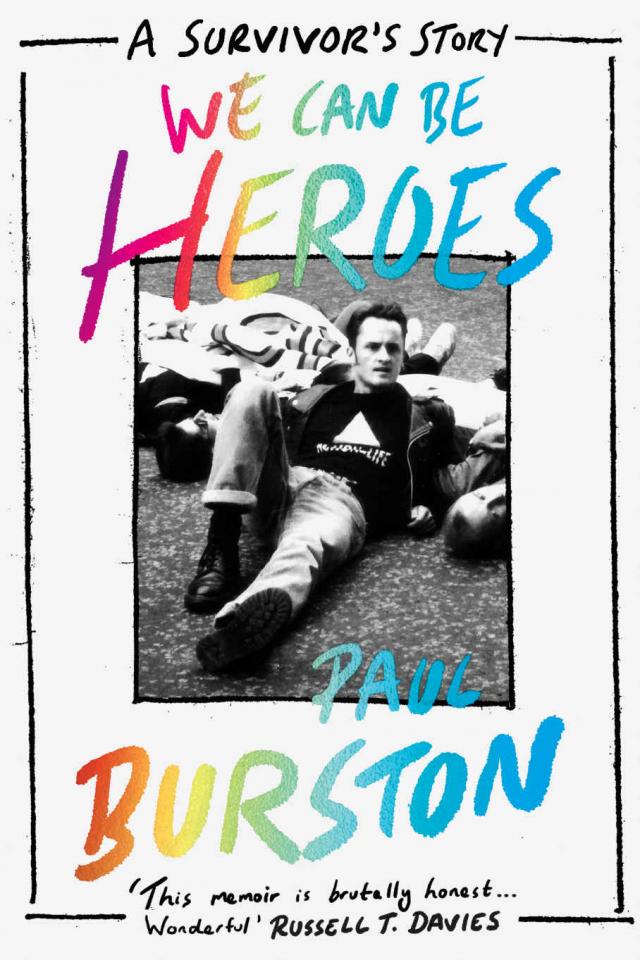
Cover photography and photos on page 151 by Gordon Rainsford
In loving memory of Vaughan Michael Williams, Brian Kennedy, Michael Griffiths, Georg Osterman, Derek Jarman and Spud Jones – not forgetting Robin, Martyn, Colin, Hugo, John and all the others who died far too soon. Rest in power.
And to survivors everywhere. I see you.
CONTENTS
Start Reading
Prologue: Heaven Loves Ya
Chapter 1: Smalltown Boy
Chapter 2: Teenage Wildlife
Chapter 3: Nowhere Fast
Chapter 4: This Charming Man
Chapter 5: Take On Me
Chapter 6: Pride (In The Name Of Love)
Chapter 7: Club Tropicana
Chapter 8: Reasons To Be Fearful
Chapter 9: Sign O’ The Times
Chapter 10: The Only Way Is Up
Chapter 11: Transition, Transmission
Chapter 12: A Family Affair
Chapter 13: We Can Be Heroes
Chapter 14: Love Is The Drug
Chapter 15: Rage Hard
Chapter 16: Deeper And Deeper
Chapter 17: Queer With Attitude
Chapter 18: Union City Blue
Chapter 19: Outside
Chapter 20: Lust For Life
Chapter 21: Queen Bitch
Chapter 22: From New York To LA
Chapter 23: When The Going Gets Tough
Chapter 24: White Lines
Chapter 25: Shameless
Chapter 26: The Drugs Don’t Work
Chapter 27: All The Love
Chapter 28: DJ
Chapter 29: Speak My Language
Chapter 30: Glittering Prize
Chapter 31: I’m Deranged
Chapter 32: Station To Station
Chapter 33: Criminal World
Chapter 34: I Can’t Give Everything Away
Chapter 35: Life’s A Riot
Epilogue: Where Are We Now?
ACKNOWLEDGEMENTS
ABOUT THE AUTHOR
‘Every story needs a hero’ – advice traditionally given to writers
Prologue:
Heaven Loves Ya
The first time I went to Heaven I never made it through the hallowed doors. I stood outside, chain-smoking furiously, furtively watching the men queuing to get in, looking for someone, anyone, who looked vaguely like me.
It was March 1985. I was nineteen years old, new to London, and a stranger to the gay world I’d only ever glimpsed in pop videos or read about in newspapers. I’d never been to a gay club or even a gay bar before. I didn’t have any gay friends. I had no idea there were such things as gay helplines or gay youth groups. So I stood outside Heaven feeling much as I’d felt for most of my young life – isolated and alone.
Years of emotional insecurity, internalised homophobia and sexual repression had brought me to this point. I’d survived a childhood marred by abuse and school bullying. I’d entertained thoughts of suicide and had very nearly drowned. But none of that mattered any more. I’d escaped. I’d left my small town in South Wales and moved to London. Now, finally, I was on the cusp of a new life, a new beginning. A world of possibilities waited for me beyond those doors. All I had to do was step across the threshold.
I couldn’t do it. I was still a teenager, and a tribal one at that. I’d been a Bowie boy, a post-punk, a New Romantic and an almost-goth. What I hadn’t been, at least until now, was an out gay man. I’d come to Heaven looking for my tribe, and so far I was failing miserably. On that night in March 1985, I wore heavy eye make-up and had spiky, backcombed hair. I looked like the love child of Robert Smith of The Cure and Ian McCulloch of Echo & the Bunnymen. Everyone else queuing for the club looked more like members of the Village People – or so it seemed to me at the time. I desperately wanted to belong but these were not my people. I stood there for over an hour before finally admitting defeat, hot-footing it across Hungerford Bridge to Waterloo and catching the last train home.
Fast-forward a few weeks. Here I am again, hovering on the corner of Villiers Street with a cigarette pinched between my fingers, watching the boys go by. I’m about to venture underneath the arches and approach the familiar neon sign marking the entrance to the most famous gay club in Europe, if not the world. It’s another Saturday night – my third in a row. My previous two visits ended before they even began, and I’m determined that this time I won’t bottle it at the last minute. Steeling myself, I stub out my cigarette, join the queue and descend the stairs. As I pay the entrance fee and take my first step into this brave new world, a man swishes past screaming, ‘So many men, so little time!’ – the title of a popular gay dance track at the time. Saturday nights are men-only and there really are so many of them – hundreds of sweaty men, all on the pull. My eyes are drawn to the fan dancers with their bare chests, porn-star moustaches, and bandanas. My nose prickles at the unfamiliar, overwhelming smell of amyl nitrate. This world is like nothing I’ve ever experienced before. It’s exhilarating and intimidating in equal measure. I’m terrified that someone might talk to me – and equally terrified that nobody will.
Standing at the edge of the dance floor with my back pressed firmly against the wall, the teenage taunts echo in my ears: ‘Backs to the wall, boys!’ ‘Burston, you fucking poof!’
This is nothing like the nightclubs I frequented during my misspent youth in South Wales, where DJs talked over Top 40 tunes and my friends and I took our lives in our hands by wearing eyeliner. There are no cheesy DJs here and few hints of androgyny. The Heaven look is hyper-masculine and all-American. Tight white vests cling to gym-honed torsos. Perfect teeth glow under ultraviolet lights. Muscular arms reach towards the ceiling, hit by the laser beams mentioned on ‘Relax’ by Frankie Goes To Hollywood, the video for which was filmed in this very club. High above me is the iron walkway where David Bowie and Catherine Deneuve stalk their prey in the opening scene of Tony Scott’s glossy vampire thriller The Hunger, while below them the goth band Bauhaus perform ‘Bela Lugosi’s Dead’.
There are no goth anthems playing tonight. The music is unfamiliar but undeniably infectious – that genre of American gay disco known as Hi-NRG, which will soon mutate into Eurodisco and influence everyone from New Order and Pet Shop Boys to Stock Aitken Waterman. One of the few tracks I recognise is the current Number One single in the UK, a song that cuts across all sexual boundaries and fills dance floors across the country – ‘You Spin Me Round (Like A Record)’ by Dead Or Alive.
Nobody spins me round. I feel like one of the girls at the school disco, waiting to be asked to dance, waiting to be chosen. But nobody asks me to dance. Nobody chooses me. I stand rooted to the same spot for hours, afraid to make eye contact with anyone, only vacating my space in order to venture to the bar or go to the toilet, where the groans of pleasure from the stalls fuel my already feverish imagination. I leave the club exactly as I arrived – friendless and alone.
But as I wait for the night bus in Trafalgar Square, I feel something I haven’t felt before. It isn’t just pride in myself for having finally conquered my fears and taken the first step on a journey of self-discovery. It’s a sense of belonging. I know I’ll be back – and next time, I won’t just stand on the sidelines. I’ll throw myself right into the thick of things.
Chapter 1:
Smalltown Boy
I was born five weeks premature to a woman who wasn’t ready to be a mother.
I don’t blame her. My parents’ marriage wasn’t a happy one. She was only nineteen when they first met, and training to be a nurse. Even before the wedding, the warning signs were there. My father had been engaged once before. His previous fiancée had broken off the engagement.
Bridgend in South Wales is a small town, so it’s hardly surprising that one night the two young women crossed paths. My father’s ex warned my mother, ‘You don’t know what you’re marrying!’
It didn’t take her long to find out.
There are gaps in my knowledge of my family history. My mother has never been one for dwelling on the past. What were those first few years of marriage like for her? Was there a particular incident that finally tipped her over the edge? I don’t know. But considering the societal pressures of the time, it can’t have been easy for her to do what she did next.
Still relatively newly wed, my mother packed her bags, left the marital home and fled to York, where her father lived when he wasn’t serving at sea with the merchant navy. She began divorce proceedings. Then she discovered she was pregnant. My mother doesn’t talk muc
h about the circumstances surrounding my birth. I do know that she considered having an abortion. This was revealed to me one Christmas when we’d all had too much to drink. I also know that it would have been extremely difficult for her to have had an abortion in 1965. The Abortion Act wasn’t passed until 1967.
In any case, she changed her mind, gave birth to me and found it difficult to bond. These days she would probably be diagnosed as suffering from postnatal depression, though for many years any mention of mental illness was met with a derisory snort. ‘Depressed?’ she’d say, rolling her eyes. ‘I wish I had time to be depressed!’
Joking aside, my mother didn’t have much time for anything, least of all herself. She was a single mother now.
Mum’s father, my grandad, was an infrequent but much-loved presence in my life – and made me dream of a world of possibilities beyond the small town where I grew up. He’d stowed away at the age of sixteen, and was eventually awarded a medal for his military service. When he wasn’t in uniform, he was a snappy dresser, favouring sharp suits, hats and silk ties. Mum often says I remind her of him. He died when I was in my mid-twenties. His funeral was held in Yorkshire, and later we scattered his ashes in the sea at Barry Docks. It was a blustery day, and a sudden gust of wind blew his remains back into the faces of his grieving relatives. Someone joked, ‘We’ve all got a bit of Grandad in us now.’ I like to think I do.
I never met my grandmother. Growing up, whenever I asked about her, I was told she’d died before I was born. The reality is that she walked out on her family when my mother was still a child, though I only discovered this fairly recently. For my mum, the emotional wounds inflicted during childhood were hard to bear and best avoided. This is one of the many lessons I learned from her – and am still unlearning.
I never really stopped to question why I was born in York but raised in South Wales, until I was sixteen and applied for my first passport. There it was, handwritten in black ink on my birth certificate. Place of birth – York. When I asked my mum, she got upset. Any mention of my father was a trigger for her. Over the years, I’ve heard varying accounts of what happened immediately after I was born. In one version of events, she wrote to tell him he had a son. In another, someone tipped him off and he drove to York to bring her home. His name appears on my birth certificate, along with his occupation at the time – a steel mill operator. There’s no mention of my mother’s occupation. Together, they decided to give the marriage another go – ‘for the good of the child’, as people told themselves back then.
But it wasn’t good for the child. It wasn’t good at all. As far as I was concerned, it was the worst decision she could have made.
In 1965, the year I was born, Round The Horne was first broadcast on BBC Radio, and listeners were introduced to Hugh Paddick and Kenneth Williams as Julian and Sandy, a couple of camp characters who spoke in the gay slang known as Polari. Male homosexuality was still illegal, and punishable with a prison sentence. I was approaching my second birthday when the Sexual Offences Act of 1967 partially decriminalised sex between consenting adult males over the age of twenty-one. I was five years old when the Gay Liberation Front was founded in the UK; six when London held its first Gay Pride march and David Bowie first appeared as Ziggy Stardust on Top Of The Pops, dressed in a multicoloured jumpsuit, plastered in make-up and singing ‘Starman’.
I say all this because I knew I was different from a very young age. The other boys did, too. In my first year at junior school, I became attached to a boy called Andrew. Too attached, some people thought. My parents were summoned to the school; a complaint had been made. Nothing was ever explained to me, but suddenly Andrew and I were no longer seated together in class. He avoided me in the playground and started hanging around with other boys.
I started hanging around with girls. They found me amusing, and didn’t mind that I wasn’t good at rugby and didn’t display the macho aggression boys in Bridgend were encouraged to develop from a young age. At junior school I was called a poof and a sissy long before I knew what those words meant – though I knew they weren’t something to aspire to. And it didn’t stop there.
‘Can you beat him up?’ a local lad asked my friend Mark one day when we were playing together by the river.
‘Anyone can beat him up,’ my so-called friend replied.
I remember feeling deeply betrayed by this, but Mark was right. Anyone could beat me up – and frequently did. Whenever someone punched me, I froze. I was the boy who didn’t fight back. Not then. Not like that.
I was bullied a lot at school. But I was just as fearful at home.
‘I’ll say one thing for your father,’ my mother used to tell me. ‘He never came home drunk.’
This may well be true. But it’s hardly a glowing endorsement of his qualities as a father that the only accolade she could think of was his sobriety.
In 1971, Philip Larkin published his famous poem about the ways in which your mum and dad fuck you up. But in my case, my father fucked me up far more. I always knew my mother loved me. My father was ambivalent at best – and he was rarely at his best where I was concerned. There are no photos of me smiling as a small child – no moments of unguarded joy captured for posterity in picture frames or family albums. In each one I look sullen, wary, wounded.
Children are innately egocentric and have a tendency to blame themselves for what goes on around them. Did I do something wrong? Was it something I said? Or was I just not lovable enough? I never understood why my father treated me the way he did. I wasn’t a difficult child. I never caused any trouble. I kept my head down and did well at school.
Sometimes my mother would accuse me of ‘acting up’ – something I always vigorously denied, though in years to come those words would take on a whole new meaning. Looking back, I think I was probably ‘acting out’ – but we didn’t have the vocabulary for this then, at least not in working-class South Wales. Nobody ever questioned why I behaved the way I did – possibly because they didn’t want to know. Some things were better left unsaid.
My mother’s friend and former neighbour ‘Auntie’ Alma remembers me as a tongue-tied, nervous little boy who played with her son Phillip, always said ‘please’ and ‘thank you’, and shook with fear whenever my father came to collect me. Whenever there was trouble at home, it was Alma I ran to for help. There was never any love lost between Alma and my father. I think this is one reason why I’ve always felt so close to her.
My sister Debbie was born when I was two. By the time I was seven, my mother had returned to work part-time as a night nurse at the local hospital. She found her calling on what was then called the prem unit, caring for premature babies. While she worked, my younger sister and I would be left alone in the house with my father. These were the nights I dreaded the most.
I should say now that my sister’s memories of this period are very different to mine. As she once told me, she was the child our parents planned in order to try to save their marriage. I was the child who wasn’t planned and came along when they were on the verge of getting divorced. Our experiences were bound to be different. According to her, he was a stern but ultimately loving father. In my case, he was anything but.
My mother used to tell me, ‘You were a nervous wreck until your father left.’ For years, I wanted him gone from my life so desperately that I regularly wished him dead. But then my father bestowed upon me the one act of kindness he has ever shown me in my entire life. He walked out and moved in with another woman. It wasn’t easy for my poor mum, though I was far too young to appreciate this at the time. All that mattered to me was that he’d gone.
Word soon spread around school that Paul Burston came from a broken home. Nothing could have been further from the truth. The day my father left was the day my home was fixed.
I’ve always loved reading and I’ve always written stories. At junior school I wrote adventure stories about a boy called Jim, heavily influenced by whatever I watched on TV that week – Bonanza, Star Trek, Doctor Who. On more than one occasion, my intrepid hero came face-to-face with a Dalek! It was life, Jim, but not as I knew it. My friend Caroline would illustrate the stories and our proud headmaster would insist that I read them aloud during morning assembly. At break time, boys would corner me in the playground and beat me up for showing off. But they didn’t beat it out of me.


