

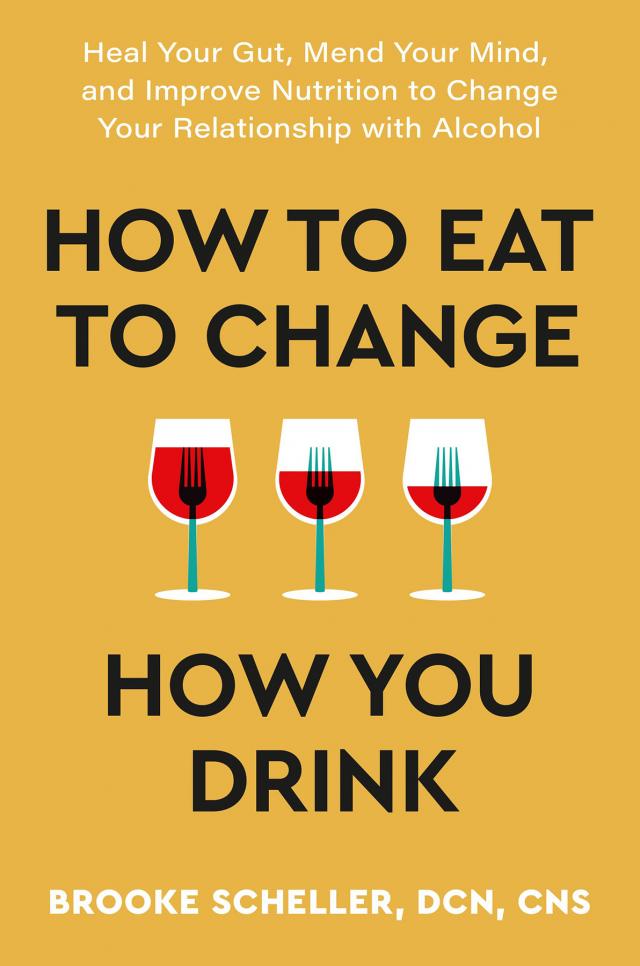
How to Eat to Change How You Drink, page 1


The advice herein is not intended to replace the services of trained health professionals or be a substitute for medical advice. You are advised to consult with your health care professional with regard to matters relating to your health, and in particular regarding matters that may require diagnosis or medical attention.
Copyright © 2023 by Brooke Scheller, DCN, CNS
Cover design and illustration by Jim Datz. Cover copyright © 2023 by Hachette Book Group, Inc.
Hachette Book Group supports the right to free expression and the value of copyright. The purpose of copyright is to encourage writers and artists to produce the creative works that enrich our culture.
The scanning, uploading, and distribution of this book without permission is a theft of the author’s intellectual property. If you would like permission to use material from the book (other than for review purposes), please contact permissions@hbgusa.com. Thank you for your support of the author’s rights.
Balance
Hachette Book Group
1290 Avenue of the Americas
New York, NY 10104
GCP-Balance.com
Twitter.com/GCPBalance
Instagram.com/GCPBalance
First Edition: December 2023
Balance is an imprint of Grand Central Publishing. The Balance name and logo are trademarks of Hachette Book Group, Inc.
The publisher is not responsible for websites (or their content) that are not owned by the publisher.
The Hachette Speakers Bureau provides a wide range of authors for speaking events. To find out more, go to hachettespeakersbureau.com or email HachetteSpeakers@hbgusa.com.
Balance books may be purchased in bulk for business, educational, or promotional use. For information, please contact your local bookseller or the Hachette Book Group Special Markets Department at special.markets@hbgusa.com.
Print book interior design by Amy Quinn.
Library of Congress Cataloging-in-Publication Data
Names: Scheller, Brooke, author.
Title: How to eat to change how you drink : heal your gut, mend your mind, and improve nutrition to change your relationship with alcohol / Brooke Scheller, DCN, CNS.
Description: First edition. | New York : Balance, [2023] | Includes index.
Identifiers: LCCN 2023026360 | ISBN 9781538741061 (hardcover) | ISBN 9781538741085 (ebook)
Subjects: LCSH: Alcoholics—Rehabilitation. | Alcoholism—Psychological aspects. | Nutrition.
Classification: LCC HV5275 .S33 2023 | DDC 362.292/86—dc23/eng/20230705
LC record available at https://lccn.loc.gov/2023026360
ISBNs: 9781538768907 (paperback), 9781538741061 (hardcover), 9781538741085 (ebook)
E3-20231117-JV-NF-ORI
Contents
Cover
Title Page
Copyright
Dedication
Introduction
PART 1: IS IT TIME TO CHANGE YOUR RELATIONSHIP WITH ALCOHOL? 1. To Drink or Not to Drink
2. The Doctor and the Wine Bottle
3. The Three Drinking Archetypes
PART 2: A FUNCTIONAL APPROACH TO SOBRIETY 4. The Relationship Between Alcohol and Nutrition
5. Blood Sugar and the Endocrine System
6. The Gut and the Microbiome
7. The Brain and Neurotransmitters
PART 3: HOW TO EAT TO CHANGE HOW YOU DRINK 8. Starting Where You Are
9. A 4-Week Food and Nutrition Guide to Drink Less
10. Supplements, Herbs, and Other Lifestyle Modifications
11. Building Community
PART 4: RECIPES 12: Healthy Recipes to Support Your Alcohol Reduction Plan
13: Mocktails and Tonics
Conclusion
Resources
Acknowledgments
Discover More
Notes
About the Author
To the little girl who fought the battles so that I could show up for my destiny.
I see you,
I feel you,
I love you.
And to my late grandmother, Mary Regis Allen, who spoke the language of recovery to me, long before I could understand it.
Explore book giveaways, sneak peeks, deals, and more.
Tap here to learn more.
Introduction
IT STARTS WITH A WHISPER.
A gut feeling that says, Maybe I should quit drinking.
Hm, what’s that? you think. You push it down, hoping it’ll quiet down. But it doesn’t.
Over time, the whisper gains volume.
It becomes louder and louder until it eventually becomes a scream.
That’s what it’s like for many of us when it comes to exploring our relationship with alcohol. That’s what it was like for me. I started drinking as a teenager, and it completely absorbed my 20s and early 30s. It seems almost unbelievable to think that I had put my body through so much harm from alcohol use over the course of 20 years, and yet this story is much more common than we think. I used to think I’m still young. But 20 years is a long time to do anything on a regular basis.
When I woke up one morning in June 2021, the internal screams had become so loud that I couldn’t yell over them anymore. I couldn’t cover my ears and I couldn’t run away. I found myself constantly waiting for moments when I could get a small dopamine hit from alcohol, followed by spiraling anxiety and depression from the comedown. I was anxious when I drank and anxious when I didn’t drink. Pretending that everything was fine and that I was in control felt like a full-time job. I was exhausted from keeping up this charade.
Nothing out of the ordinary happened that morning, aside from a comment a loved one made in passing that I had drunk to oblivion all weekend. I didn’t lose my job, didn’t get a DUI, and wasn’t in any real trouble. In fact, I had a great job, graduate degrees, and a safe and comfortable home. I didn’t look like the stereotype of someone whom you’d call an alcoholic, and yet by that point, I was drinking alcohol every single day. I didn’t always drink that much. It slowly increased year over year. So slowly that I hardly noticed when three days per week became four, and then five, until it was a daily ritual.
It took a long time for me to realize that the screams I was hearing were my own. That the anxiety was from the “me” behind the wall of alcohol. She was trying to tell me that there was another way. She was trying to save me from the fate of those who came before me. She was trying to tell me that it was okay to stop running. She was trying to tell me that my path forward was waiting for me just on the other side of this obstacle course.
What begins as a seemingly harmless way to have fun, cut loose, or relax becomes a habit that can sabotage our physical health, mental health, relationships, friendships, career goals, family lives, finances, and so much more. I thought for a long time that I didn’t drink to mask emotions, that I “just liked to drink.” I told myself that I could stop at any time… if I wanted to. But alcohol is a snake oil salesman. It’ll promise you the cure to all that ails you, all while poisoning you and selling your soul to the next barstool. Everywhere we look, alcohol marketing convinces us that we need it for that extra something. I don’t know about you… but I never found it. In fact, I only found myself more and more lost with each drink.
When I finally got my head above water, I realized that I had expertise in the very substance that I was abusing. Alcohol is a macronutrient, and its metabolism has a direct impact on our nutritional status and overall health. As a doctor of clinical nutrition, I realized how much alcohol had affected my own health and the health of those around me. I started to dive deeper into why we drink—the deeper biochemical systems at play that make us want to drink and make it difficult for some of us to stop. While there is so much important work being done on the ways alcohol can affect our mental health, and sober communities are popping up everywhere, we’re rarely talking about what’s going on in our bodies. And so, my work began.
Because I have a family history of addiction and mental health disorders, my interest in nutrition was always in finding other solutions to these ailments beyond medication and traditional therapies. Nutrition can hold the key to so many of the body’s misunderstood health concerns. It became my mission to discover how nutrition plays a role and to educate those with a history of alcohol use on how to use nutrition to change their habits and heal their bodies.
In 2021, I decided to use my experience working as a nutritionist in private practice and in startup organizations to build programs and offerings to help others use nutrition as a catalyst to support new behaviors around alcohol. I created my flagship program, Functional Sobriety, to serve as a guide to educate my clients on how alcohol contributes to their health effects, understand more about their unique needs, and use food and wellness practices to change their lifestyles and cut back or eliminate alcohol entirely.
It has been one of my greatest pleasures to be able to use my two passions to help others. When I see the spark of change in my clients, I know that my experience in sobriety can serve as a guide for others, and I hope it will for you, too. My clients have successfully lost hundreds of pounds, eliminated medications (those for high blood pressure and heartburn, among others), and completely turned around their lives with a new vigor and passion for pursuing their health through alcohol elimination.
My desire is for this information to allow you to feel the inspiration to change your drinking habits sooner than I did—in hopes that you can find relief from
To start, we’ll discuss how alcohol impacts our nutritional pathways, and then you’ll identify your personal drinking archetype. Finding your drinking archetype will help you identify areas of opportunity in part 2, where we will talk about the different body systems that I address in my Functional Sobriety approach. And finally, we will move into the dietary plan and recommendations to help you recover from long-term alcohol use, and how to use food and nutrition to help change your relationship with alcohol. At the end of the book, you’ll find recipes to support your sober or sober-curious journey, and that will provide the proper nutrition to heal your gut, your brain, and your hormones.
I am so grateful to be on this journey with you and cannot wait for you to experience a more peaceful, aligned life, and to become the YOU that you want to be.
Dr. Brooke Scheller
Part 1
IS IT TIME TO CHANGE YOUR RELATIONSHIP WITH ALCOHOL?
CHAPTER 1
To Drink or Not to Drink
Stop leaving and you will arrive.
Stop searching and you will see.
Stop running away and you will be found.
—Lao Tzu
IF YOU’VE PICKED UP THIS BOOK, THERE’S A PRETTY GOOD CHANCE you’re questioning your relationship with alcohol. If you are anything like me, you have probably played a similar kind of tennis match in your head on repeat: you wonder if you have your drinking under control, if it’s time to make a change, or if you might be an alcoholic. You might even have sought out this book hoping to find confirmation that you are not an alcoholic.
There is still a stigma around alcohol and substance use. So many of us are hung up on whether we are an alcoholic or not. And while this is changing in the era of the sober-curious, there is still an aversion to the words sober and alcoholic. That’s why in this book we will avoid using the word alcoholic. Instead, we’re going to examine our drinking behaviors and then explore nutrition and lifestyle changes that affect our habits around alcohol. Rest assured that you do not need to identify yourself as an alcoholic to decide to make a change in your relationship with alcohol.
Another common misconception is that you must have a history of alcoholism in the family in order to develop an unhealthy relationship with alcohol, which simply isn’t true. Why? Because alcohol is addictive. Not just for some, but for anyone who drinks it. Common belief suggests that alcohol and abuse of other substances is entirely the result of genetics—that we need to have a family history or certain genetic predisposition toward addiction. And yes, genes do play a role, but they are not a definitive cause of addiction. Those without a history of alcohol abuse in their family can still develop alcohol use disorders, so genetics doesn’t fully explain this phenomenon. We’ll talk more about some of these genes throughout the course of this book.
We’re beginning to understand how alcohol use affects the brain and body in ways that span far beyond genetics. We’re learning that alcohol rewires the brain in ways that are harmful to everyone who consumes it. This is because alcohol hacks our normal pleasure and reward systems into thinking we need alcohol to survive. And the more we drink it, the more we reinforce this behavior and need it on a consistent basis. You may be in this cycle, but the good news is that you aren’t doomed to repeat it forever.
Becoming sober or making a commitment to change your alcohol intake is not an easy decision. Alcohol tricks us into believing we need it to interact with others and to relieve our stress. Most people don’t just wake up one day and think, I’ll quit drinking today. Instead, we wake up hungover and claim, That’s the last time I’m drinking!—only to find ourselves with a glass in hand by 5 pm. It can take years and years of contemplation before we find ourselves willing to let it go.
But, and this is important, I want you to be aware that there are much deeper systems at play here. It’s not that we are weak-willed or have something innately wrong with us because we use alcohol. Instead, I want you to understand the biochemistry of why we drink—the internal systems and processes happening in our body that play a role in how and why we drink, and why some people seem to be unfazed by alcohol while others will die for it.
Understand that this isn’t just about willpower. It is not just about alcoholism in our genes or our family tree. It’s not just about labeling yourself an alcoholic or not. Here, we will focus on how we can take control of our behaviors around alcohol using nutrition and health practices to nourish our bodies and support the root causes of why we drink, along with healing our bodies from consistent alcohol use. This book will help you better identify how to change your biochemistry through food and other natural means to make it easier to break the alcohol use cycle. But before we get into the nitty-gritty, I want to answer a question I’m sure is on your mind.
I THOUGHT A LITTLE ALCOHOL WAS GOOD FOR ME?
You’ve heard this before. On the news, from your doctor, in the dietary guidelines set by the government, and even from your friends and family. Red wine, or other small amounts of alcohol, can be good in moderation… right?
Research has previously shown that the compounds in red wine, namely the antioxidants, can be good for the heart. These antioxidants are suggested to have cardioprotective effects that can reduce blood pressure, reduce the risk of cardiovascular disease, and are helpful in protecting the body from free radical damage and some cancers.1 But let’s look at these claims more closely.
Much of the early research about this comes from studies that looked into the Mediterranean diet, the eating patterns of those living along the Mediterranean (the southern regions of Italy, Greece, France, as well as some countries on the African continent). In these countries, the locals tend to consume diets that are rich in vegetables, whole grains, fish, healthy sources of fat, and lean protein, as well as low-to-moderate amounts of wine. What’s missing from their diet is the processed, packaged, sugar-laden foods that make up a large percentage of the standard American diet (which also goes by the appropriate acronym SAD). Essentially, those living in the Mediterranean region are more likely to eat whole foods—single-ingredient foods and substantial amounts of fresh produce. In general, a Mediterranean diet has been shown to provide cardiovascular benefits, regardless of wine and alcohol intake. If your diet consists of colorful plates filled with greens, roasted vegetables, whole grains, fish, or chicken roasted in olive oil and herbs, a glass of red wine alongside this doesn’t present much cause for concern. But if your plate consists of fried foods, melty cheese, and frozen foods whose ingredients you cannot pronounce, adding an alcoholic beverage is like pouring gasoline on a fire.
The so-called French paradox is another commonly discussed principle, which is defined by the very low incidence of cardiovascular disease among the French, despite a very high intake of saturated fat, carbs, and alcohol. We picture Parisians enjoying a buttery croissant, a baguette, a cheese plate, or a large carafe of wine. Wouldn’t we suspect that health would deteriorate with this type of diet? Indeed, the French diet features high amounts of “unhealthy foods” and high alcohol intake. It is thought that wine might be the reason why their cardiovascular disease rates are lower.2 Let’s discuss where those suggested benefits may come from.
Are Antioxidants the Antidote?
If you do a search online for “Is red wine good for you?,” you’ll find a series of articles pointing out that red wine is high in antioxidants—like resveratrol—that can help support the gut, the brain, and cardiovascular health. But resveratrol isn’t exclusively found in wine. Grapes, both red and white, along with blueberries, raspberries, cranberries, and even peanuts are also sources of resveratrol (see more in A Note on Antioxidants here).


