

The Undead Truth of Us, page 1


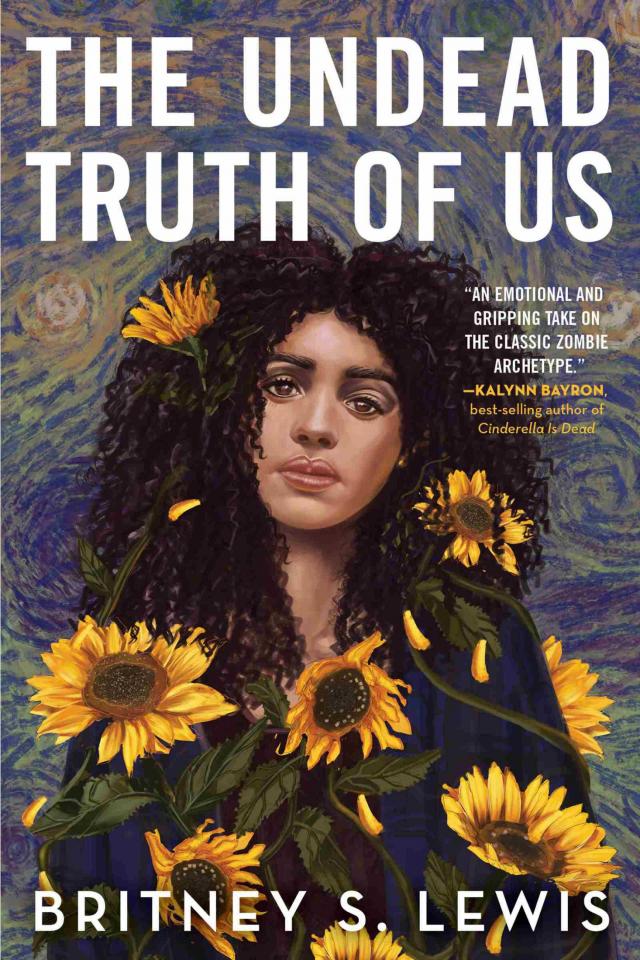
Copyright © 2022 by Britney S. Lewis
All rights reserved. Published by Hyperion, an imprint of Buena Vista Books, Inc. No part of this book may be reproduced or transmitted in any form or by any means, electronic or mechanical, including photocopying, recording, or by any information storage and retrieval system, without written permission from the publisher. For information address Hyperion, 77 West 66th Street, New York, New York 10023.
Designed by Zareen Johnson
Library of Congress Cataloging-in-Publication Data
Names: Lewis, Britney S., author.
Title: The undead truth of us / by Britney S. Lewis.
Description: First edition. • Los Angeles ; New York : Hyperion, 2022. • Audience: Ages 12–18. • Audience: Grades 7–12. • Summary: After her mother’s sudden death, sixteen-year-old dancer Zharie Young begins seeing zombies, and when she meets an undead boy, he helps her understand how love can change someone—for good or for dead.
Identifiers: LCCN 2021025271 (print) • LCCN 2021025272 (ebook) • ISBN 9781368075831 (hardcover) • ISBN 9781368081993 (paperback) • ISBN 9781368075909 (ebk)
Subjects: CYAC: Grief—Fiction. • Zombies—Fiction. • Dating (Social customs)—Fiction. • Dance—Fiction. • African Americans—Fiction. • LCGFT: Novels.
Classification: LCC PZ7.1.L5125 Un 2022 (print) • LCC PZ7.1.L5125 (ebook) • DDC [Fic]—dc23
LC record available at https://lccn.loc.gov/2021025271
LC ebook record available at https://lccn.loc.gov/2021025272
ISBN 978-1-368-07590-9
Visit www.HyperionTeens.com
Contents
Title Page
Copyright
Epigraph
Dedication
Chapter One
Chapter Two
Chapter Three
Chapter Four
Chapter Five
Chapter Six
Chapter Seven
Chapter Eight
Chapter Nine
Chapter Ten
Chapter Eleven
Chapter Twelve
Chapter Thirteen
Chapter Fourteen
Chapter Fifteen
Chapter Sixteen
Chapter Seventeen
Chapter Eighteen
Chapter Nineteen
Chapter Twenty
Chapter Twenty-One
Chapter Twenty-Two
Chapter Twenty-Three
Chapter Twenty-Four
Chapter Twenty-Five
Chapter Twenty-Six
Chapter Twenty-Seven
Chapter Twenty-Eight
Chapter Twenty-Nine
Chapter Thirty
Chapter Thirty-One
Chapter Thirty-Two
Chapter Thirty-Three
Chapter Thirty-Four
Chapter Thirty-Five
Chapter Thirty-Six
Chapter Thirty-Seven
Chapter Thirty-Eight
Chapter Thirty-Nine
Chapter Forty
Chapter Forty-One
Chapter Forty-Two
Chapter Forty-Three
Chapter Forty-Four
Chapter Forty-Five
Chapter Forty-Six
Chapter Forty-Seven
Chapter Forty-Eight
Chapter Forty-Nine
Acknowledgments
About the Author
And what is done in love
is done well.
—Vincent van Gogh
Dear reader, I understand there may be some areas in this book that could be triggering. In the interest of transparency, it’s important that you’re aware of these topics before reading the story.
Content warnings: profanity, blood, gore, body horror, grief, loss of parent, abandonment of parent, death of parent, mentions of anxiety and depression.
TO YOU, READER.
Don’t let the monsters of the universe keep you from living.
Take risks, fall in love, create your own path.
AND TO MY BEAR.
For proving that love can change you in more good ways than bad.
FIVE DAYS. FIVE. That was how long it took for Mama to turn into a zombie.
Day one she was stoic. She refused to move from the couch, even after I turned off the TV in the evening. I still remember how frigid her face looked in the dimness of the flickering candle before I blew it out. The spaces above her cheeks were sunken in, eyes bulged away from her face. A wiggle under there, only slightly, but it did. I saw it move. I saw it twist.
And her brown skin looked frail and thin—any wrong move, and I was afraid it would tear away in small slits, revealing the tissue beneath.
“Mama…” I whispered, creeping closer to her in the darkness. One foot after the other, the floorboards creaking with each step. I wanted to know if she was okay, if she was even awake, but she didn’t say anything. Looked at her again, waited. She released a deep breath, the air cracking on its way out. Sounded like something was in there, inching its way up her trachea.
I left it alone. Kissed her clammy head, pulled a blanket over her, and tucked her in, hoping she’d be fine in the morning.
And she would be fine. She always was.
Day two was strange. It began with her golden-brown eyes. They glazed into a cynical gray like cataracts, and the brightness that used to be in them dissipated like smoke in the wind. When she spoke, her sentences were short and sloth-like—every word a complete struggle—almost as if someone had stuffed cotton beneath her tongue.
On day three, her veins oozed a thick green sludge under her skin. They pulsed and vibrated, not quite right. And her shoulders slouched inward, like they were weighed down by a thousand invisible moons, disrupting her inner tide entirely.
As she inched closer and closer to the invisible abyss, her dark cloud of sadness stripped away the caramelized flesh from her face, leaving her disfigured.
By the fourth day, every breath came with a creaking croak. It was like watching a sped-up time lapse of a fire burning out. Everything I loved about her was gone.
We didn’t dance.
We didn’t sing.
She wasn’t the bleeding sunrise anymore—she was the deep, deep, dark ocean.
And on November 4, before daybreak, her last breath rolled up her throat and turned her into the undead thing that I feared.
It was the worst day of my life.
I found her on the floor in the kitchen, and my throat swelled. Her body lay in the fetal position, her right hand below her heart, crumpled like an old rose.
But I didn’t get it. Zombies weren’t supposed to die so easily, yet Mama did.
When the EMTs came, I tried to tell them, but the words wouldn’t come out. They couldn’t see that she wasn’t only dead—she was undead.
I—I, uh, my thoughts stammered; all I could do was stare blankly. How could they not see it? How was I the only one?
And she…she needed more time. We needed more time. I didn’t understand. What was wrong? How did she die? Was she really dead?
But they rushed her out, and I couldn’t move from that spot in the kitchen where I’d found her.
Couldn’t force the air out of my lungs. Couldn’t take any more steps forward.
I tried to hold myself, but a sharp pain in my navel forced me to my knees. I curled into a ball on the laminate floor, and the smell of the brewing coffee nestled in my nostrils, reminding me of how she was just here, alive.
She was alive.
Closed my eyes, warm cheek against the cold tile now. And she was gone. I knew she was because of the permanent goosies on my arms.
When Mama died, I think her soul shattered into a Postimpressionist painting filled with yellows and blues. We were the zigzagged, black lines in that painting, the birds. And I swore I flew with her soul that day, the wind still fresh between my fingers, but I couldn’t reach her. Didn’t matter how fast I flew, she flew farther, and the sapphire horizon created a million miles between us. It swallowed her.
They later told me that her heart exploded in her chest. Exploded. I didn’t know how that could be humanly possible, but when they told me, I saw those colors again.
She was yellow. I was blue.
She was dead and undead, and now the earth was flooded with zombies, drowning me with the constant reminder of Mama.
Why? I didn’t know why.
But why?
I didn’t know why.
But I terribly, terribly, terribly wanted to.
MAY 15, 5:00 P.M.
To whomever still follows this thing, you may know that—due to a slight hiccup in my anatomy that I am NOT comfortable sharing with a primary care provider—I am seeing zombies.
No, not like people dressed up in Halloween costumes, roaming the back roads of Kansas City, but literal, gruesome zombies.
And they are everywhere.
You might ask, “Why, Zharie, are you seeing zombies?”
To which I’d say, “I have no idea.”
But here are my theories:
• I have completely lost my marbles.
• The “Zombie” song by the Cranberries can curse you if you listen to it on repeat too many times.
• I’m not crazy—rather, everyone around me is oblivious.
The cure:
• No cure yet.
THERE. IN THE HEAT of the afternoon sun, on the last day of my sophomore year, I could hear the sound of the undead sloshing in my ears.
The sound was thi
The undead teens gnawed at each other in the form of a sloppy kiss. Eyes sunken and hollow; fresh skin dangling from their cheekbones, exposing their skeletal smiles as they pressed their brittle tongues around each other.
The slosh again, echoing in my ears.
I gagged, but they didn’t hear it. Didn’t see me or anyone else around. And they moved clumsily into each other, their boned hands intertwining, their clothes tattered and disassembled, blood falling in thick drops onto their brand-new, matching Jordans.
The red pooled around them, but no one saw. No one cared.
But how?
I shuffled past Thing One and Thing Two and climbed onto the bus, sitting exactly four rows back, where I always sat, as close to the window as I could, pushing the thought of the zombies away.
Earbuds in, I noticed a text from Mini:
The message had a song attached, one that was released before I was born. Pressed play, leaned back, and not even a moment after doing so, the main singer killed it, going on about love and death and the sea of loneliness.
Is it worth it, can you even hear me? the singer started. I’m tired, and I’ve felt it for a while now.
The students loaded the school bus robotically, and as I continued to listen to this punk-ass white boy band scream at me, I wondered about Vincent van Gogh and why he was the way that he was.
Before Mama died, I learned about him in my Art Theories class, and I couldn’t stop thinking about him. What I found was that van Gogh was broke when he was alive. Broke. Only ever sold one painting. He lived off the money his brother gave him, but even then, he used it to buy coffee, cigarettes, and art supplies—a hell of a mood.
But I wondered more about who he was outside of that. Like, would he have listened to the same music I listened to? Was there even sad music to match his sad-boy persona—or did Mozart do it for him? What did he think about between the hours, months, and years it took him to paint the smallest of strokes? Could it have driven him mad, the loneliness?
Maybe.
Like him, I imagined painting myself with the same artistic expression. Small and big. Yellow and blue. Yellow and blue.
This could be my chance to break out, the singer continued. This could be my chance to say goodbye.
And then there it was again—another dead, undead one. She lingered outside my window on the sidewalk. Twisted jaw, blood leaking out her mouth, dripping on the phone in her hand.
A pain pulsated in my ear while I studied her, and I yanked one of my earbuds out, thinking it would help me see her better. It had been a while since I’d seen so many of them at once, all in one day.
They were here and there right after Mama died but never like this. And I tried to tell myself it was a lie. This wasn’t real….
The muscles in my hand jerked, insisting I wave, but I forced my fingers beneath my leg, tapping my foot rapidly all the while. I just wanted to know who she was. Why was she like this?
A small piece of paper landed in my lap, and it startled me. It was Luca. He sat to the right of me, and he smiled so wide I saw his braces before I could see anything else.
I snatched out the other earbud and paused the song. “What?”
“Zeezy, I’ve been calling you for like three minutes.” Luca sat angled in the seat across from me, his spotlight burning my eyes. His foot lingered in the aisle, and I knew if he kept it there, Mrs. Whitehead would give him a warning.
I adjusted, my thighs sticking to the hot vinyl seat. “Hey, do you see that girl outside the window?” I asked, sticking my pointer finger to the glass. The window wobbled slightly when I did, in the same way that water rippled when touched, and I wondered if I pressed harder, would my finger go all the way through?
Luca stretched his neck to see out, faint bluish veins peeking through his light brown skin. “Who, Becca? Yeah, I see her. I’ve been noticing her all year. Why, what’s up? Did she finally break up with James’s sorry ass?”
The bus moved now, and I shook my head. “No.” I sighed. “Never mind.” Luca didn’t see it—the sagging skin, the disfigured face, the weird window, the sunflower stuck in the cement.
The sunflower. Yellow. Facing the sun.
“And you know that’s not my name,” I snapped, realizing that he had called me Zeezy. We’d been over that, like, a million times.
“Right,” he said, his ears and brows raised.
“Right…”
“So, Zharie Young…or whatever,” he started, and I mouthed Thank you for getting my name right. “What are you doing for break?”
I picked at my shirt. “Haven’t given it much thought.”
“No dancing?”
I pressed my toes into the soles of my shoes. Felt the heat there. West Coast Swing was my thing, thanks to Mama. She was known in the dance community as Twiggy. Though, even if she hadn’t introduced it to me, I would have discovered it somehow. It had been one of the most magical things I’d ever done with my body. “Honestly, I don’t know,” I finally said.
“Why not?”
“Um—”
Mrs. Whitehead cleared her throat, and we could see her aging blue eyes in the rearview mirror. “Mr. Santos, we talked about this. Don’t make me give you a warning on the last day of school.”
Luca moved his foot quickly and waved his hand as a signal. “My bad, Mrs. Whitehead. Won’t do it again.” He looked at me, his eyes wide behind his thick glasses, as if to say he wouldn’t hesitate to do it again, and even if he got a warning, it wasn’t like his family would care. He said he never got in trouble. Said being the baby in the family came with perks.
“But you were sayin’,” Luca prompted.
“I was just saying…I don’t think I’ll really be able to dance because of, you know.” Code for, You know my mom died six months ago, and she had money to provide for me, and now I’m broke, and I can’t afford to spend ten dollars to dance every week. It just ain’t happening, regardless of how much I love it.
“Oh,” he said.
“Yup.”
“Well, uh, I mean if you ever wanna go, I can cover. My pops lets me borrow his car on Thursday nights, so I got you.”
“Mmh…I’m gonna pass.”
“But why? It’s free money, Z. Don’t you think Twiggy would want you there anyway?”
I scowled at him. He didn’t know her like that, didn’t know what she wanted from me.
But yeah, she’d probably want me to go. Of course she would, but she wasn’t here now.
“I don’t know, Luca. Why don’t you go to her grave and ask her?” I said, and I turned to face the window, except the window was completely gone, and I found myself floating amidst the traffic on the highway, zooming away from Luca and his questions.
I didn’t need that. I didn’t need anyone.
My knuckles were damned near white when I put my earbuds back in, and the horrid wind caused a stinging in the corners of my eyes.
Blinking it away, I pulled out my phone and restarted the song. The volume was up so high I thought my brain might combust.
It almost did.
IT WAS MY STOP. I said goodbye to Luca and got off the bus, feeling like I had danced across the smallest of glass shards on the way down the aisle.
Luca’s protruding lips and puppy eyes were all I could think about; it didn’t help that our conversation ended with death and gloom and stuff.
But it was Luca. I was happy to be away from him, happy for the summer. I knew he meant well, but he was so damn suffocating. Couldn’t take a hint to save his life.
It was worse because I got the unfortunate pleasure of seeing him on the bus before and after school. This dude always had his own soliloquy, and really, all he ever did was talk about how great he thought he was, which felt weird. Made me feel like I couldn’t fully be myself around him.
I responded to Mini’s text:
As I approached the apartment building, I noticed a family moving in. An Asian man carried two boxes out of a U-Haul, his gray shirt soaked from sweat, and a short Black woman directed two guys with a couch to the second floor, her ponytail moving with ferocity.


