

Mob Magic, page 1


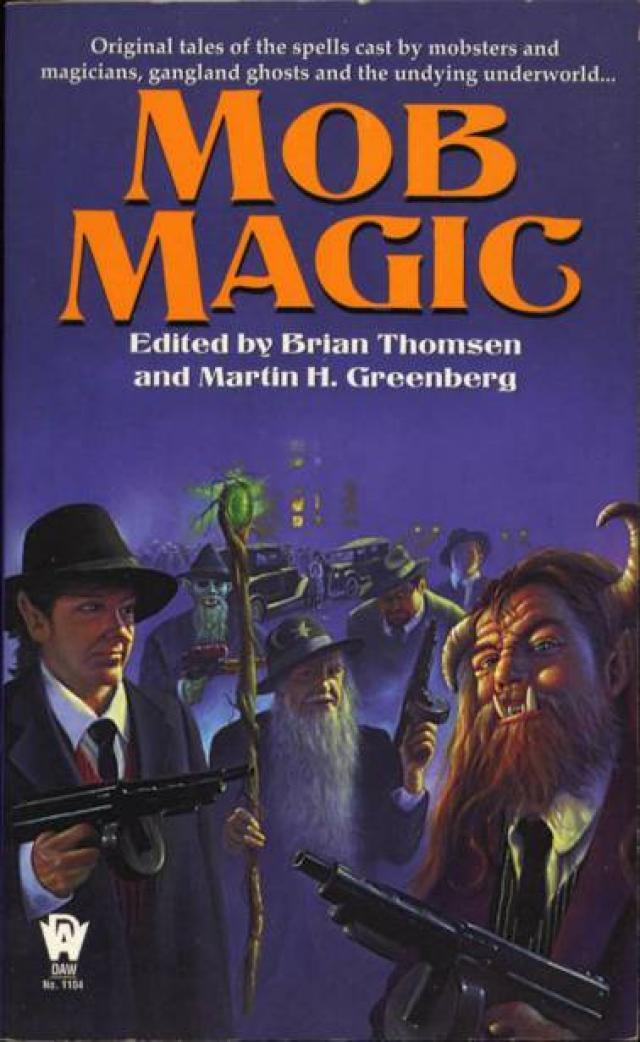
Table of Contents
INTRODUCTION
Gods & Godfathers
THE FAERIE GODFATHER
ODIE AND THE ZOO
SAINT AL
MONEY WELL SPENT
Assassins & Hitmen
A DYING LIFE
SOLO
CYCLE OF HORROR
Gumshoes & Gangs
MY CLAW IS QUICK
THE QUICK WAY DOWN
A BIRD FOR BECKY
THE DREAM JOB
Dons & The Damned
POWER CORRUPTS
WHADDYA SEE?
SASHIMI
LIVE BAIT
Crimes & Corporations
STAN
WITH A SMILE
* * *
Copyright © 1998 by Tekno Books and Brian M. Thomsen.
All Rights Reserved.
Cover art by Jim Warren.
DAW Book Collectors No. 1104.
DAW Books are distributed by Penguin Putnam Inc.
All characters and events in this book are fictitious.
Any resemblance to persons living or dead is strictly coincidental.
If you purchase this book without a cover you should be aware that this book may have been stolen property and reported as "unsold and destroyed" to the publisher. In such case neither the author nor the publisher has received any payment for this "stripped book."
First Printing, November 1998
123456789
DAW TRADEMARK REGISTERED U.S. PAT. OFF. AND FOREIGN COUNTRIES —MARCA REGISTRADA HECHO EN U.S.A.
PRINTED IN THE U.S.A.
* * *
ACKNOWLEDGMENTS
Introduction © 1998 by Brian M. Thomsen The Faerie Godfather © 1998 by J. Robert King Odie and The Zoo © 1998 by Jeff Grubb Saint Al © 1998 by Dennis O'Neil
Money Well Spent © 1998 by Janet Pack A Dying Life © 1998 by Fiona Patton Solo © 1998 by Robert Greenberger
Cycle of Horror © 1998 by Mickey Zucker Reichert My Claw Is Quick © 1998 by Simon Hawke The Quick Way Down © 1998 by P. N. Elrod A Bird for Becky © 1998 by Max Allan Collins The Dream Job © 1998 by Heidi E. Y. Stemple Power Corrupts © 1998 by Jody Lynn Nye Whaddya See? © 1998 by Randall G. Thomas Sashimi © 1998 by Brian M. Thomsen Live Bait © 1998 by Roland J. Green Stan © 1998 by Mike Resnick & Ron Collins With a Smile © 1998 by Tom Dupree
* * *
For
Francis Ford Coppola, Robert De Niro &
Martin Scorsese, who make their own kind of "mob magic" on the silver screen
* * *
INTRODUCTION
Originally the word "mob" was meant to mean an unruly mass or throng of people subject to spontaneous whims and demands. Both the Old and New Testaments make reference to mobs having influence on various significant events, and no less a writer than Shakespeare himself made frequent references to the psyche of the mob (eg., Mark Anthony winning over the mob at Caesar's funeral in "Julius Caesar," the Duke's address to the mob of Capulets and Montagues in "Romeo and Juliet," etc.). Mobs were usually destructive and were often used as a weapon by a persuasive orator or a charismatic leader.
Today when we say "mob," we are usually referring to "goodfellas," "wiseguys," "gangsters" or "hoods," or, as the less colorful refer to them, the practitioners of organized crime.
From Damon Runyon to Mario Puzo, the mob has been a subject of major fascination for most Americans, who seem to harbor an innate need to romanticize these outlaws of society. Some gangsters become folk heroes, pop icons no different from the latest rock star or sports hero. Fellows with nicknames like "the Teflon Don," "the Chin," and "the Bull" make the cover of Time magazine and are played by award-winning actors in big-money movies.
For twentieth-century U.S.A., the mob is every bit as American as baseball, and its presence in civilization itself is older than our country and the Holy Roman Empire combined. The first primate who realized that he had something that someone else wanted—and was willing to kill for—sought "protection" from the first primate who was willing to give that protection for a price (an extra banana a week or perhaps just a favor to be redeemed at some later date).
Thus civilization began with the social contract while organized crime began when the first social contract included interest (or, in the vernacular, "juice").
* * *
Gods & Godfathers
"Hey, Godfather! You owe me a favor."
Mario Puzo's Corleone family has become the seminal archetype for most people's conception of what a crime family is really like—close-knit, immigrant ethnic, and moral and religious in their own way. The now often used moniker of "godfather" is ripe in its own irony as both the title of a male sponsor in the sacrament of baptism and the title for the spiritual and authoritative head of an organized crime family.
The authors in the following section exploit this irony in their stories. Rob King's tale of a slightly different Camelot features a decidedly non-Christian godfather, while Jeff Grubb has a bit of fun with a pair of old Dons in quasi-retirement. Denny O'Neil and Janet Pack, on the other hand, focus on surrogate higher powers whose angelic assistance may not always be in the best interest of their clients.
* * *
THE FAERIE GODFATHER
by J. Robert King
The bishop rode his tiny gray donkey into the shadow of the city walls and reined it to a stop. Camelot. He'd never seen anything like it. He was used to Rome—sacked Rome. Crumbled buildings, scurrying rats, burned shacks, twisting catacombs—age and decay. There was nothing like that here: white turrets, snapping red pennants, cleanly cobbled streets, ladies in silken gowns, knights in shining armor, walls that fairly glowed with life... . Everything was new. Even the horses were brave.
The bishop sat there a moment before the main gate as other travelers filed past along the rising dirt road. He scratched his uneven tonsure, straightened a robe the same color as his donkey, and stared, astonished.
The pope was right. This was the New Jerusalem.
"Bishop Niccolai?" said a shining knight beside the gates. He had stood so still and shone so brightly that he had seemed a silver statue. Now he strode over to meet the meek-mannered bishop. "Welcome. I am Sir Kay, Seneschal of Camelot and stepbrother to King Arthur. I am pleased to learn that the beautiful metropolis of our king is known even to Rome."
Niccolai gave the knight a pleasant smile. Here was a beautiful creature, a veritable angel on earth. Beneath a planished helm, Kay's blond hair was delicately coifed, and enough lines creased his high brow to make him appear intelligent but not brooding. His blue eyes glimmered with wit, his teeth were perfectly white, and his smile was ready. A neatly trimmed mustache and goatee showed his dedication to grooming. "Yes, well, as the scriptures say, 'A city on an hill cannot be hid,' and then again, 'For nothing is secret, that shall not be made manifest; neither any thing hid, that shall not be known and come abroad.' "
Sir Kay laughed a little at that. "No, indeed. But the exact reason you have 'come abroad' is, I confess, still a mystery to me."
With a gentle nudge of his heels, the bishop headed his mount toward the gates. "Let us walk as we talk, for I am eager to see your beautiful city." Sir Kay happily fell into step beside the donkey and leaned in, somewhat conspiratorially, as they passed over the drawbridge and beneath the first of two portcullises. Niccolai continued. "There is considerable pressure on the church of Rome—especially after the move of the capital to Constantinople and the plague of pretender popes spreading across the land—to come up with some definitive sign of God's approval—"
"If you are interested in signs from God, perhaps you are looking in the wrong—"
"And many among the laity and the clergy themselves feel that the Second Coming is overdue. Some wonder if we've missed it. After all, no one has seen John the Beloved in centuries, and he is supposed to remain until Christ's return—"
Kay's laugh this time was explosive. "I've heard tales of a Joseph of Arimethea hereabouts, but no Beloved Disciple—"
"And so, a number of us have been dispatched to cities such as this, likely candidates for the New Jerusalem—"
"New Jerusalem?" Kay asked, wonderingly.
"Yes. And I quote:
'Behold, I come quickly: hold that fast which thou hast, that no man take thy crown. Him that over-cometh will I make a pillar in the temple of my God, and he shall go no more out: and I will write upon him the name of my God, and the name of the city of my God, which is new Jerusalem, which cometh down out of heaven from my God.'
"Quite possibly, your Arthur is 'Him that over-cometh.' Surely he has held fast his crown through the great tribulation that has come upon the world, and perhaps this earthly kingdom of his is the New Jerusalem, come down out of heaven from God."
The smile that crossed Kay's face was rueful. "Camelot, come down out of heaven? Ha!" He slapped a hand on the bishop's back as the two men entered the courtyard beyond the gate. An open-air market stood beyond, bright pavilions riffling beneath a gentle breeze. "I fear you've wasted your journey, Eminence. Arthur won this land through blood and battle. He was born a child of fornication—what would have been adultery except that the cuckold was a few hours dead at the time of conception—was raised by a meddling wizard, and he fathered a child by his half-sister. In fact, as Arthur has grown to embody all that is noble and good, his very son has grown to embody all that is wicked. It is as though the man you have heard of is split in half.
"No, Your Worship, if half of this grand city descended from heaven, the other half arose from hell. Abov
Bishop Niccolai did not seem to hear. "Ah, here is a clue, just here." He pointed to a mark upon a foundation stone of the gate they had just passed.
Sir Kay crouched down beside the stone, where some hoodlum had scratched his name. "Ah, you see? If this were the New Jerusalem, would there be defacing graffiti on the walls?"
"But, look what it says—'IAKOBVS.' Jacob—the name of Israel, father of the twelve tribes. Or it might be the name of James, the brother of John, or James the Less, brother of Jesus."
Kay could not contain his dubiety. "So?"
"The New Jerusalem—and I quote—
'had a wall great and high, and had twelve gates, and at the gates twelve angels, and names written thereon, which are the names of the twelve tribes of the children of Israel... . And the wall of the city had twelve foundations, and in them the names of the twelve apostles of the Lamb.'
"So, you see, this foundation contains the name of one of the twelve apostles—James," said Niccolai, his voice tinged in excitement.
"The James that wrote this—that is, the Jacobus—if I have it right, is no apostle of the Lamb but one of Mordred's crew. He is a strong-man, a bit of muscle used by fey racketeers. I suspect that, since his name is carved into this stone, this gate is his territory. He's got a list of folk, such as Arthur and his knights, from whom he does not extort a toll for safe passage, but anyone else who seeks entry must pay dearly."
"Such gate guards, too, were prophesied in the New Jerusalem, for:
'There shall in no wise enter into it anything that defileth, neither whatsoever worketh abominations, or maketh a lie; but they which are written in the Lamb's book of life.'
"Your king, you, and the other knights must be written in the Lamb's book of life, whereby Jacobus allows you passage. All others must pay dearly—must give away all they own and follow the Lamb—to enter the city."
Kay grew chagrined, and he removed his helm in order to scratch a tousled crown. "You don't seem to understand. These followers of Mordred do not believe in the Christian God, and Mordred is no divine ambassador. You would make him God, but he is more a hoodlum godfather. He rules this city from below as Arthur does from above. I would not be surprised if his coffers held more coin than Arthur's, so effective are Mordred's 'tax gatherers,' his 'water bearers,' and his illicit 'entertainers.' He is not even human, this Mordred—did you know that? Though he is Arthur's son, he is also the get of a witch woman, a pagan creature known in these parts as a faerie."
Blinking, Bishop Niccolai drew a deep, contented sigh, and reasoned, simplistically, "There are many pagan deities that the church has discovered in fact to be saints and angels." He reached into his pack and drew out a map of the countryside. "Now, by my rough calculations, the whole of Arthur's realm—including Eire, the Scottish Highlands, Northumberland, Snowdonia and Surrounds, Central Briton, Anglia, and Britanny—falls within a square that is twelve thousand furlongs, which is about five thousand leagues or fifteen thousand miles. That fits the prophecies exactly.
'... and the length is as large as the breadth: and he measured the city with the reed, twelve thousand furlongs... . And he measured the wall thereof, an hundred and forty and four cubits, according to the measure of a man.'
"And this wall here, if we count also the great earthwork upon which it is raised, measures one hundred forty-four cubits in width—one hundred sixty of my own armlengths, but I am a small man. Now, as to the gates, there are only four, one in each cardinal direction, though Revelation speaks of twelve total. Even so, I noticed an outer gate and two portcullises here, which makes three eastern gates—and if each of the four cardinal directions holds three such gates—"
"Look," Kay interrupted, "you can calculate and interpret yourself into believing that anyplace is your New Jerusalem, but once you've seen Mordred and his gang at work, you'll know this couldn't possibly be an earthly heaven. Come with me." Kay rather forcefully drew the bishop off his stamping ass, tied the mount to a nearby post, and led him toward the open market. "I do this, Eminence, because I am a pious man. I do not want a bishop of the church to be shamed by misapprehension."
"Where are we going?" asked the bishop somewhat nervously.
"Through one of the sorcerous portals that leads into Mordred's underworld," Kay said, distaste clear on his features. "Beyond those portals, fey gather, flaunt their pagan ways, practice magics, entice mortals, bottle intoxicating waters, hatch plans for confidence games, arrange 'hits.' You'll see what I mean. This is no heaven on earth."
The shining knight led the bishop among flapping awnings and particolored tents—Camelot's main market. Everything was for sale here, from Chinese silks and Persian carpets to African black wood and Icelandic cod. Here were penned sheep dogs from the borderlands, and there serpents driven recently from Eire by a certain priest of shamrocks. The lively banter of merchants and buyers filled the spaces between leaning poles and guy ropes. They spoke in tongues as varied as the wares they hawked.
Bishop Niccolai was mesmerized by the chanting sound of it all. "Again, the prophecies are fulfilled, as was said of old:
'And it shall come to pass in the last days, saith God, I will pour out my Spirit upon all flesh, and your sons and your daughters shall prophesy, and your young men shall see visions, and your old men shall dream dreams.' "
Sir Kay's spirits visibly slumped, and he caught up his drooping frame against a lamp post. "These folk aren't Pentecostals 'speaking in tongues.' They aren't drunk with the Spirit of God, Your Eminence. If they are drunk with anything, it is with the very stuff Mordred and his minions bottle in their realm and smuggle into Camelot."
"You cannot tell me," said the Bishop, gesturing excitedly about him, "that all this vitality, all this bounty, results from anything but the abundance of God. After all, in the book of Acts, God told Peter to embrace the gentiles and their strange ways, saying, 'What God hath cleansed, that call not thou common.'"
In exasperation, Kay flung his hands into the air. "But that's just it, Your Eminence. The beauty and perfection you see in this city comes only half from heavenly Arthur. The other half of it comes from vulgar, common, earthly Mordred. This can't be the New Jerusalem unless Satan is as much its founder as God."
The bishop made the sign of the cross. "I think I understand your hesitation. Don't worry, Sir Kay. If this is indeed the New Jerusalem, Arthur will be fully compensated."
"Compensated for what?"
"Well, if this is the New Jerusalem, the city and its inhabitants will, of course, become immediate property of the church," said Niccolai easily. "And by the city, I mean the great square that encompasses Arthur's kingdom, from Orkney in the north to Brittany in the South. Rome will reimburse him, if that is required, though I would think a good Christian king such as Arthur would be eager to grant the whole of his holdings to the pope."
Fury flared bright in Kay's face. "Neither Arthur nor Mordred would ever relinquish Camelot, let alone Britain. Not to the pope. Not to anyone."
"Then Arthur would be excommunicated and the church would be forced to take the land by might of arms, as it is written:
'From the days of John the Baptist, the kingdom of heaven suffereth violence, and the violent take it by force.' "
A growl mounted up in Kay's throat, and his eyes narrowed to slits. His hand strayed to the sword at his belt. This man threatened Camelot with invasion. With war—holy war! Even so, Kay knew he could never slay a bishop of the True Church. He would have to convince this man. "But this isn't the New Jerusalem."
"Take me to Mordred's underworld, and let me judge for myself."


