

The Clock of Dreams, page 1
part #3 of Titus Crow Series


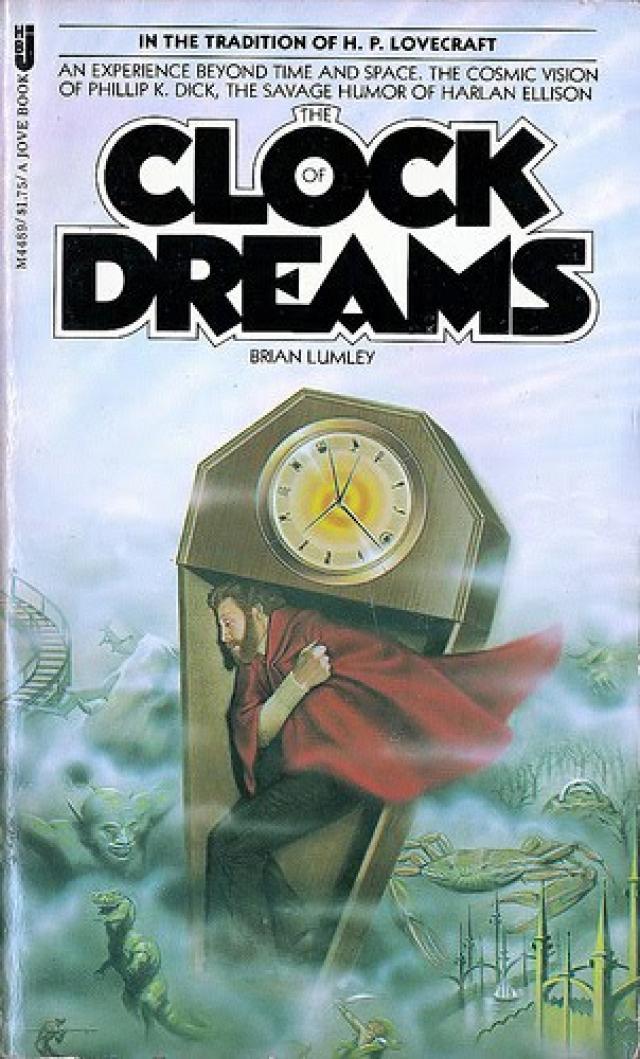
THE CLOCK OF DREAMS
BRIAN LUMLEY
Introduction
Myself, I’ve never been much of a dreamer, never traveled far past Ulthar; but I have watched caravans fording the Skai, and I have sat in the smokeroom of the Inn of a Thousand Sleeping Cats and listened to the tales of my betters. I suppose most dreamers have. It’s true, though, that there seem to be fewer of us around these days. Time was when a man of the waking world could guarantee that if he boarded at an inn in the land of Earth’s dreams, sure enough he would find a fellow dreamer or two from the world of waking mortals; and wouldn’t the tales fly thick and fast then? Yes, they surely would.
You would hear magical names of men and places – names to set your pulses pounding and your imagination tingling – and thrill to the telling of tales of heroic and fantastic deeds. And someone would be bound to mention Kuranes or Randolph Carter … or Richard Upton Pickman. And while you might shudder at the hinted fate of the latter, certainly you would also gasp in awe at the adventures of the others. Ah, those were the dreams …
Still, I suppose I shouldn’t complain too bitterly, for when I come to think of it I heard two of my favorite tales quite recently, and as coincidence would have it I heard them at the Inn of a Thousand Sleeping Cats … in Ulthar.
The first was a strange tale and complicated, a tale of all the worlds of space and time, of strange dimensions and planes of existence beyond the ken of most men. A tale of motes in the multiverse swirling beyond barriers neither spacial nor temporal, nor of any intermediate dimension recognized by mortal man except in the wildest theories of science and metaphysics. A tale of paths between the spheres, dim corridors leading to equally dim and conjectural lands of elder myth … And yet all of these seemingly inaccessible places were just around the corner to the time-clock.
Indeed ‘time-clock,’ as Titus Crow had long since recognized the fact, was a completely inadequate misnomer for that – machine? A plaything of the elder Gods come down the ages from lands beyond legend, from a time beyond time as men reckon it, the clock was a gateway on – on everything! It was a door to worlds of wonder, joy and beauty – but it was also a dark pothole entrance to caves of innermost, alien evil and shrieking, unnameable horror.
The first tale I heard was the story of how the clock came into Henri-Laurent de Marigny’s hands in the first place, and it is a tale already told. But for the sake of the unacquainted I will briefly reiterate it before taking up the second of the two stories proper. Before even that, however, I had better tell what little is known of the time-clock itself.
Certainly the clock’s history is strange and obscure enough to whet the mental appetite of any lover of mysteries or would-be sounder of unfathomable wonders (which you must be, else you would not be reading this). First, tracing the existence of the weird – conveyance?– back as far as possible in the light of incomplete knowledge, it seems to have belonged to one Yogi Hiamaldi, an Indian friend of the ill-fated Carolina mystic Harley Warren. Hiamaldi had been a member, along with Warren, of a psychic-phenomenist group in Boston about 1916-18; and he had sworn before all other members of that group that he alone of living men had been to Yian-Ho, crumbling remnant of eons long lost, and that he had borne away certain things from that grim and leering necropolis.
For reasons unknown, the Yogi had made a gift of the clock to one Etienne-Laurent de Marigny (perhaps the greatest ever American occultist and the father of one of the heroes of the story to follow), who kept it at the New Orleans retreat where his studies of the arcane sciences formed his primary purpose in life. How much he discovered of its secrets remains unknown, but after the elder de Marigny died the clock was sold, along with many another antique curiosity, to a French collector.
Here there is a gap in the history, for while many years later Titus Crow bought the clock at an auction of antique furniture in London, all of his subsequent attempts to discover the whereabouts of its previous Parisian owner were doomed to failure; it was as though the man had simply vanished off the face of the Earth.
Now then, of Titus Crow himself – a man with a positive genius for the discovery of dark lore, lost legends, and nighted myth-patterns, who will also feature prominently in my tale – much is known; but for now suffice it to mention that his protracted studies of the clock over many years of his life were such that the device became something of an obsession with him. Often in his earlier years Crow would sit in his study in the night, his chin in his hands as he gravely pondered the enigma of the peculiar, coffin-shaped, oddly-ticking monstrosity in the corner of the room; a ‘clock,’ of sorts, whose four hands moved in patterns patently divorced from any chronological system known or even guessed at by man, and his eyes would rove over the strange hieroglyphs that swept in intricate designs around the great clock’s face.
When he was not at work on less baffling cases, always Titus Crow would return his attentions to the clock, and though usually such studies were in vain, they were not always complete failures. Often he believed himself on the verge of a breakthrough – knowing that if he were right he would finally understand the alien intricacies governing his ‘doorway on all space and time’ – only to be frustrated in the final hour. And once he actually had the doubtful privilege of seeing the clock opened by two men of equally doubtful repute and intent, whose affairs in the world were fortunately soon terminated … but then at long last there came a genuine clue.
It was while he was working for the Wilmarth Foundation – a far-flung body of erudite men whose sole avowed intent and purpose was to rid the world, indeed the entire universe, of all remaining traces of an aeon-old evil, the surviving demonic forces and powers of the Cthulhu Cycle of Myth – that Titus Crow visited Miskatonic University in Arkham, Massachusetts. There, in one of the carefully guarded, great old occult volumes in the university’s world-renowned library, he finally recognized a sequence of odd glyphs which at first he was startled, then delighted to note bore a striking resemblance to the figures on the dial of his huge clock. Moreover, the book bore translations of its own hieroglyphed passages in Latin!
Armed with this Rosetta-Stone knowledge, Crow had returned to London, where soon he was at work again disinterring many of the clock’s centuries-buried mysteries. And he had been right, for that incredible device was indeed a vehicle: a space-time machine of sorts with principles more alien than the centers of stars, whose like we may at least conjecture upon.
Of his work on the clock at this time, he wrote to his friend and colleague, Henri-Laurent de Marigny: ‘I am in the position of a Neanderthal studying the operational handbook of a passenger-carrying aircraft – except I have no handbook!’ And Henri was unable to assist his learned friend, for while his father had once owned the selfsame clock, that had been when he was a boy, and he could remember nothing of it. Titus Crow, however, was never a man to be denied anything once he set his mind after it, and so he had persevered.
And little by little he discovered all of the clock’s peculiar secrets. He learned how to open its frontal panel, without suffering any of the many possible consequences, allowing the strange lights which invariably illumined its interior to flood out in eerie shades that dappled his study with alien hues. He knew how to attune himself ‘telepathically’ to the device’s sub-ethereal vibrations: how to ‘make himself one,’ as he had it, with the clock. He was aware of the nature of the ‘commands’ he must give to the clock to guide it on its journeyings through temporal and spacial voids, so that the time soon came when he believed he might attempt his first flight in the weird vehicle.
All of this knowledge came to Titus Crow in the very nick of time, for no sooner was he psychically ready to test his theories than just such a test was forced upon him. It happened when he and his young friend de Marigny (also a member of the Wilmarth Foundation) were staying at Blowne House, Crow’s sprawling bungalow home on Leonard’s Heath in London.
The two of them had grown to be very painful thorns in the sides of the deities or demons of the Cthulhu Cycle, and at last the prime member of that cycle, dread Cthulhu himself, had discovered a way to strike back at them.
Dreaming hideously in R’lyeh, his ‘house’ drowned somewhere in the vast Pacific, Cthulhu worked his evil plot through Ithaqua the Wind-Walker, Lord of the Snows. For while Ithaqua himself was unable to go abroad beyond barriers immemorially imposed by the Elder Gods – that is, while he was restricted in his movements to the Arctic Circle and its adjacent environs, and to strange Boreal starlanes and alien worlds – nonetheless he was still undisputed master of all the world’s winds. And now he sent elementals of the air from the four corners of the sky to attack Titus Crow’s home.
Left with no choice but to risk the doubtful sanctuary of the time-clock – as eerie shapes of evil formed beyond the shattering windows, monstrous forces that pounded at the shuddering frame of his bungalow retreat until Blowne House fell about his ears – Crow stepped beyond the open front panel of his vehicle and bade de Marigny follow him. And when that ‘freak localized storm’ had expired and the house was discovered in ruins, perhaps not surprisingly no trace could be found of the two friends; neither of them, nor of the weird clock.
Well, to cut a long story short, Titus Crow made good his escape from those monstrous minion winds of Ithaqua into the far future, traveling almost to the End of Time itself before finally he mastered the clock’s many intricacies to control its flight. But as for de Marigny, he was not the adept that his friend was. Barely was their craft ‘out of po
rt,’ as it were, before de Marigny was ‘washed overboard’ into terrible temporal tides – to be fished from the Thames more dead than alive ten years later! Though the flight in the time-clock had seemed to last mere seconds, and while Crow’s younger friend had aged not at all, nevertheless ten years had sped by; which caused de Marigny to wonder just how far his friend had finally traveled – and was he perhaps still traveling?
It was not long before he was to learn the answers to these and to other questions.
Upon recovering from his fantastic ordeal, de Marigny went back to his old London home, and there one night a short time later Titus Crow also returned to the world of men. Ah, but this was a much-changed Titus Crow, for he had undergone a transition. Younger, stronger, wiser (though de Marigny found the latter hardly credible), the new Crow had seen marvels beyond belief, had traced his own lineage back to the very Elder Gods themselves. And now he had returned to Earth for one reason only: to offer Henri-Laurent de Marigny the opportunity to join him in Elysia, the home of the Great Gods of Eld. As an inducement, if such were needed, this is how Crow had told his friend of his adventures:
‘… I’ve been trapped on the shores of a prehistoric ocean, Henri, living on my wits and by hunting great crabs and spearing strange fishes, dodging the dinosaurs which in turn hunted me. And a billion years before that I inhabited a great rugose cone of a body, a living organism which was in fact a member of the Great Race that settled on Earth in unthinkable abysses of the past. I’ve seen the cruel and world-spanning empire of Tsan-Chan, three thousand years in the future, and beyond that the great dark vaults that loom at the end of time. I’ve talked telepathically with the super-intelligent mollusks of soupy Venusian oceans, which will not support even the most primitive life for another half-billion years; and I’ve stood on the bleak shores of those same seas ten million years later when they were sterile, after a great plague had destroyed all life on the entire planet…
‘Why, I’ve come close to seeing the very birth of the universe, and almost its death! – and all of these wonders and others exist still just beyond the thin mists of time and space. This clock of mine sails those mists more bravely and surely than any Viking’s dragonship ever crossed the gray North Sea. And you ask me what I mean when I talk of another trip, one involving yourself?
‘When I return to Elysia, Henri, to the home of the Elder Gods in Orion, there will be a place for you in my palace there. Indeed, you shall have a palace of your own. And why not? The Gods mated with the daughters of men in the old days, didn’t they? And won’t you only be reversing the process? I did, my friend, and now the universe is mine. It can be yours, too …’
Soon after that Titus Crow took his departure from Earth yet again, but this time he used the time-clock more properly as a ‘gateway,’ passing through it but yet leaving it behind until de Marigny should make up his mind one way or the other. If he decided to brave the machine’s dark unknown, the way would not be easy. De Marigny knew that. But visions previously undreamed of had opened in his mind, and wonders beckoned and enticed him more magnetically than ever the Sirens lured Ulysses.
For de Marigny was a lover of mysteries no less than you, the reader, and as such could he possibly refuse the proffered challenge? Could you?
PART ONE
I
The Call of Kthanid
De Marigny had first flown the time-clock two weeks earlier under Titus Crow’s expert tutelage. Now Crow was gone – back to Elysia and the incredible girl-goddess he loved there, Tiania – and de Marigny had decided to follow him, alone.
Crow had done a marvelous job of instruction during the brief flights he had shared with his friend in the clock, and de Marigny was by no means lost in regard to controlling that fantastic machine. It was simply a matter of ‘meshing oneself’ with the thing, so that the clock became an extension of its passenger’s body and mind, an extra limb or sixth sense … or both.
Thus, while half the world slept and darkness covered the land, Henri-Laurent de Marigny set out to prove himself worthy of a new and higher life in Elysia; and he did so in the only way open to him, by pitting himself and his vessel against all the currents of space and time. The world, all unawares, dwindled behind him as he cruised out into the void in his strangely hybrid craft, his almost ‘human’ machine, and a wild enthusiasm and exhilaration filled him as he piloted that vessel in the direction of Orion. Somewhere out there– somewhere in the distant void, behind invisible hyperdimensional barriers – he knew that faerie Elysia waited for him, and it seemed only reasonable to de Marigny that since Elysia lay ‘adjacent’ to Orion, that star should mark his starting point.
On one thing de Marigny had already and irreversibly made up his mind: though Titus Crow had told him that in the event of insurmountable difficulties he could always contact him through the clock, he would not do so unless his life itself were threatened.
From what he knew of it there seemed to be only one way into Elysia for a creature not born to it, and that was the way of peril. Only those who deserve Elysia may ever enjoy her elder wonders, and de Marigny did not intend to be dependant upon Titus Crow for his – birthright?
His birthright, yes – Elysia was his birthright, Crow had hinted as much. What was it his friend had said to him? ‘Lover of mysteries you are, Henri, as your father before you. And I’ll tell you something, something which you really ought to have guessed before now. There’s that in you that hearkens back into dim abysses of time, a spark whose fire burns still in Elysia. And one more thing you should know.
‘Those places of fantasy and dream I’ve mentioned– they’re all as real and solid in their way as the very ground beneath your feet. The Lands of Dream, after all, are only dimensions lying parallel to the Worlds of Reality. Ah, but there are dreamers and there are dreamers, my friend, and your father was a great dreamer. He still is – for he is a Lord of Ilek-Vad, Counselor to his great friend Randolph Carter, who is himself a just and honored king!
‘I intend to visit them there one day, in Ilek-Vad deep in Earth’s dreamland, and when I do you can be with me …’
Musing on these things that Crow had told him, physically and emotionally weary now that the initial stage of his flight was successfully completed and the journey safely underway, de Marigny lay back and watched with his mind’s eye – which was now a part of the time-clock’s equipment, a mental ‘scanner’ of sorts – as the stars visibly moved in the inky blackness about him, so tremendous was the velocity of his craft as it hurtled through the airless, frozen deeps.
‘As real and solid as the very ground beneath your feet,’ Crow had said of dreams. Well, if Titus Crow said it was so, then it was so. And hadn’t Gerhard Schrach hinted much the same thing back in the thirties, and other great thinkers and philosophers before him? Certainly they had. De Marigny could remember Schrach’s very words on the subject:
‘… My own dreams being particularly vivid and real – to such an extent that I never know for sure whether or not I am dreaming until I wake up – I would not like to argue which world is the more vital: the waking world or the world of dream. Certainly the waking world appears to be the more solid – but consider what science tells us about the atomic make-up of so-called solids . . . and what are you left with?’
And with thoughts such as these swirling in his head, and the fascinating panoply of vasty voids sprinkled with a myriad jewels in his mind’s eye, de Marigny bade the clock speed on and drifted into a sleep; a sleep which seemed eagerly to open its arms to him, and one which was far from dreamless.
Beyond the slightest shadow of a doubt the slumbering de Marigny’s dreams were not natural ones, and but for his previous knowledge of Elysia, passed on to him through Titus Crow – particularly of the Hall of Crystal and Pearl, wherein Kthanid the Elder God Eminence had his seat in an inviolable sanctuary beneath a great glacier– certainly he must have considered himself the victim of vilest nightmare. For the thing upon which he suddenly found himself gazing was a shape of primal horror, the blasphemous shape of Cthulhu himself – except that it was not Cthulhu but Kthanid, and where the former was black as the pit the latter shone with the light of stars.


