Hole in the World, page 1


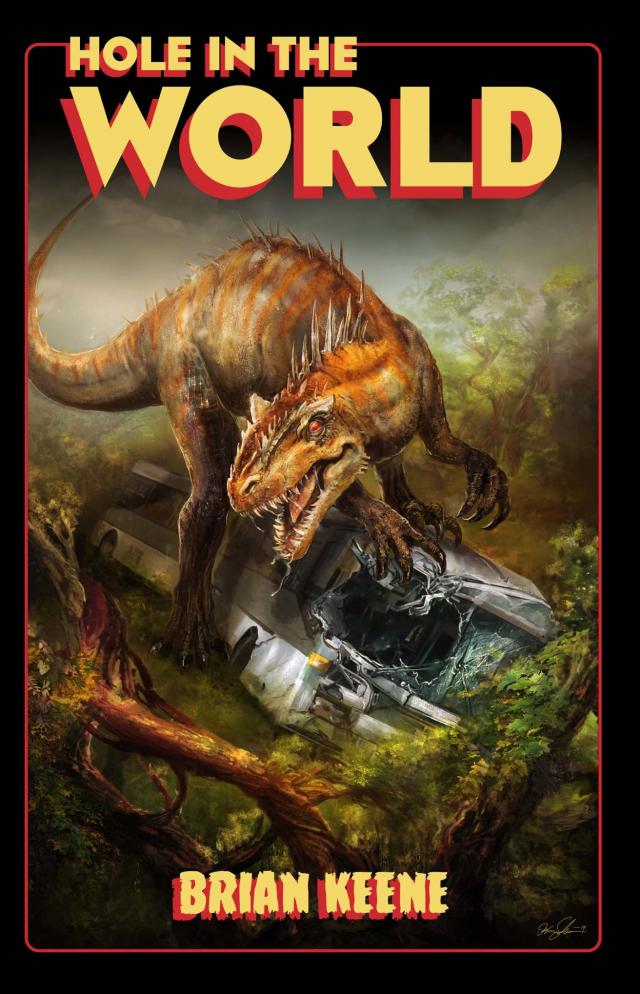
Hole in the World
A Novel of the Lost Level
Brian Keene
Copyright © 2019 by Brian Keene
Jacket art © 2019 by Kirsi Salonen
Jacket design by Mikio Murakami (based on an original design by Geoffrey Blasiman)
All rights reserved.
No part of this book may be reproduced in any form or by any electronic or mechanical means, including information storage and retrieval systems, without written permission from the author, except for the use of brief quotations in a book review.
ISBN 978-1-937009-72-4 (TPB)
Apex Publications, LLC
PO Box 24323
Lexington, KY 40524
* * *
Also available as a DRM-free eBook.
* * *
Visit us at www.apexbookcompany.com.
This one is for Paul Campion, through thick and thin.
Contents
Chapter 1
Chapter 2
Chapter 3
Chapter 4
Chapter 5
Chapter 6
Chapter 7
Chapter 8
Chapter 9
Chapter 10
Chapter 11
Chapter 12
Chapter 13
Chapter 14
Chapter 15
Chapter 16
Chapter 17
Chapter 18
Chapter 19
Afterword
Acknowledgments
Also by Brian Keene
About the Author
The Lost Level
Return to the Lost Level
1
Riders on the Storm
At least they’re not talking much, Lucinda Hawkins thought as she eased the airport shuttle bus through the blizzard. Lucinda had been awake for seventeen hours straight, was well into overtime, and had a vicious migraine forming behind her temples. The coffee cup in the drink holder beside her was cold, the coffee inside it was even colder, and the bus’s heater was lethargic at best. It wheezed like an asthmatic robot, belching out pitiful, lukewarm drafts of air. Lucinda gripped the steering wheel and stared straight ahead into the storm. She couldn’t see more than a few feet ahead of her, and although the plows had gone through only moments before, the road was already covered again with drifting, blowing snow. Lucinda was tense, tired, and pissed off. Yattering passengers, angry over their flight cancellations, would have only added to her stress levels. A few of them murmured into their cell phones, but for the most part, they sat in uneasy silence, watching the snow fall.
As often happened while she was driving, Lucinda’s thoughts turned to her granddaughter, Mikya. Her mother, Lucinda’s daughter, had passed away two years ago after a quick and unexpected battle with ovarian cancer. The girl’s father was currently serving twenty-five to thirty years at the Maryland Correctional Institution in Jessup. He was allowed two visits per week, but had expressed no interest in seeing his daughter, and indeed, hadn’t even added Mikya or Lucinda to his approved visitor list. Lucinda was raising the five-year-old on her own, something she hadn’t expected to be doing at this stage of her life. Raising children was hard enough when you were in your twenties or thirties. To be doing it again at age forty-eight? That was exhausting.
Mikya was with a neighbor tonight, one that Lucinda trusted, but she also knew that the little girl would be upset about spending the night there. Since the loss of both parents, she’d clung even tighter to her grandmother. Lucinda hadn’t minded, though. After two ex-husbands and the death of her only daughter, Mikya was pretty much all she had. Mikya was Lucinda’s whole world, along with her few friends from church, and this stupid job.
A snapshot of the little girl was taped to Lucinda’s dashboard. Next to it, tucked into the console, was a paperback copy of And Then There Were None by Agatha Christie. Lucinda had checked it out of the library last week, and read it during her lunch breaks. Judging by the weather, she’d be lucky to get a lunch break tonight.
A passenger seated behind her raised his voice, apparently losing his cell phone signal. “Buzz? Buzz, are you there? Oh, you stupid fucking cock-sucking phone!”
Lucinda frowned. She debated asking the man to watch his language, but she didn’t want to start an altercation. He already seemed wound up. If he became any more belligerent, it could distract her from the road. The storm seemed to be growing worse.
Across from Lucinda, beneath a blue handicapped sign, a bespectacled man in a wheelchair stared at the angry caller, his expression impassive. Seated next to him was a short, thin man, who was nodding off and apparently oblivious to the commotion. Lucinda glanced at them and then turned her attention back to the road. She wondered how anyone could be sleepy in the midst of a blizzard. Then she remembered that she had heard him speak when they first boarded the shuttle. He’d had an Australian accent. The time zone difference was probably catching up with him. Poor thing.
“Buzz?” The irate passenger’s voice grew louder. “Shannon? Are you there? Goddamn it! This fucking phone …”
Sighing, Lucinda focused on guiding them safely through the storm, and tried to tune the man out.
The snow fell harder.
Paul Legerski stared at his phone in annoyance. He had three bars of coverage, yet the call had dropped. Noticing that the screen was smudged, he wiped it off on his San Jose Sharks jersey, and then tried redialing Shannon again. He watched as the signal bars rose to five, then dipped to one, before finally settling on three again. It looked like the call was connecting, so he brought the phone to his ear.
“Buzz,” he said, calling Shannon by her nickname. “You there?”
“I’m here, Paul,” she replied, “but I can barely hear you over the noise.”
“What noise?”
“There’s a weird background noise. It was there before the call dropped, and now it’s back again. Don’t you hear it?”
“No.”
“You sound like you’re in a wind tunnel.”
“More like a blizzard,” Paul said. “Listen, let me tell you what’s going on in case the call drops again. They’ve cancelled all flights out of Baltimore. The airport is shut down. I tried to get a flight out of Washington-Dulles, but apparently they’re closed down, too. The airline is putting us up in a hotel tonight, at least. I’m on the shuttle now, heading to it.”
“That sucks.”
“Tell me about it. What’s the weather like back there in Corona?”
“Sunny and warm. You know how it is. Typical California day.”
“Wish I was back home.”
“I wish you were, too. Oh, and I forgot to tell you! Guess wh—”
Shannon’s voice was suddenly replaced by another, as if their call had intersected with someone else’s. The new speaker was male, his tone gravely and harsh. It reminded Paul of the Klingon’s on Star Trek. Paul frowned as the voice overrode Shannon’s. The language was like nothing he recognized.
“Garblish farhtuk! Diaber thunkinct!”
“Buzz,” Paul said into the phone, “if you can still hear me, I’ll call you back when I get to the hotel.”
“Manush klepti! Sinkavitch ganuk!”
“Yeah, fuck you, too, buddy. Cocksucker …”
Paul disconnected the call and stuffed his phone in his pocket. Then he glanced across the aisle and noticed a paralyzed man in a wheelchair staring at him.
“Phone,” Paul said with a shrug. “Bad connection. Must be the storm. I’ve got a signal but the fucking call keeps dropping.”
The man smiled, indicating what Paul assumed was sympathy. For a moment, Paul imagined pushing the man out into traffic, or straddling his wheelchair and slowly strangling him to death. His penis began to stir and twitch in his pants.
Careful, he thought. You keep daydreaming about shit like that, you’ll get a hard on right here in the shuttle. That wouldn’t do. That would attract the wrong kind of attention, and you can’t afford that …
Paul looked out the window, watching the snow fall. He’d never seen anything like this. Snow, yes. As the owner of his own environmental consulting service since 1997, he’d travelled all over the world, and seen plenty of snow. But he’d never experienced a storm like this one. It felt almost apocalyptic. He marveled at the size of the drifts along the road and idly wondered how his Tesla Model S would perform in such conditions. Probably not very well.
He considered the flask of Maker’s Mark in his suitcase—checked with his luggage so it wouldn’t get pulled by security when he was boarding—and debated having a drink. Then the bus slid to the right, jolting all of the passengers before it lurched back into the lane. A few passengers gasped in alarm, and murmured among themselves. Paul decided against standing up and rummaging through his suitcase. There would be time enough for a nightcap when they reached the hotel.
No time for killing, but time for a drink.
When Gregorio Lopez overheard the man seated next to him mention Corona, California during an apparently ill-fated phone call, he felt an immediate and overwhelming wave of homesickness. Gregorio wasn’t from Corona. He lived much further north, in San Francisco. But just the mention of his home state filled him with a deep sense of sadness and longing. He’d been due to arrive back there in the morning, and had been looking forward to seeing his wife, Tania, and their beautiful fifteen-year-old daughter, Maricela, soon after landing.
Instead, because of the blizzard, he now found himself stranded on the other side of the country in Maryland, packed into
an overcrowded shuttle bus, with no idea of when he’d be able to catch another flight. The harried ticket agent at the airport had told him to check back with the airline in the morning. Before Gregorio could get further clarification, another passenger had begun arguing with the ticket agent. The exchange quickly grew heated. He’d slumped away, dejected and confused, and boarded the shuttle with a large group of disgruntled passengers.
Outside, the snow swirled, obscuring everything—buildings, trees, even the road signs. It looked like they were driving through a desert of white. Indeed, the only thing not white was the darkness beyond the snow.
The bus suddenly slid again, lurching to one side. Several of the passengers gasped aloud. Gregorio clutched his seat, holding his breath and waiting for the skid to subside. He heard gears grinding, as the driver reduced their speed. Then, the moment passed and they continued on as if everything was normal. He exhaled slowly.
His thoughts returned to his family once again. He missed Tania and Maricela. It felt as if they were a million miles away. He found himself wondering if he had been a good husband and a good father. Had he done everything for them that he should? Did they know he loved them?
What the hell is wrong with me? Why would I think that?
Gregorio frowned, disturbed by these sudden self-doubts. Where were they coming from? He chalked it up to fatigue and the overall uncertainty of his current travel plans. Of course his family knew that he loved them. It was ridiculous to think otherwise.
Trying to shrug off the sadness, he pulled a graphic novel from his carry-on bag—The Infinity Gauntlet by Jim Starlin. He was looking forward to the eventual—seemingly inevitable—Marvel Studios film adaptation, but nothing would ever compare to the actual comic. He’d read the series many times before, but there was comfort in the familiarity of it. Except that when he opened the book, Gregorio realized that it was far too dark inside the bus to actually read it. He could barely see the small print in the word balloons. He’d just have to wait until he got checked in to his room at the hotel.
Gregorio sighed, and his thoughts once again returned to his family.
Parked across the aisle, Chris Hansen sat in his wheelchair and thought about how fucked up things had quickly become. Cities, airports—any place where there were a lot of people—had always made him claustrophobic and tense, especially nowadays that he was a self-imposed, housebound hermit. A resident of Cashmere, Washington, it took Chris a considerable amount of willpower just to venture into a city like downtown Wenatchee, let alone one as big as Baltimore. He’d come here under protest, ultimately giving in to the insistence of his wife, Francesca, and his friends, H Michael Casper, Paul Goblirsch, Mark Sylva, and Leigh Haig.
Chris smiled. He referred to them as friends, although—before the last few days—none of them had ever met in person. Their friendship had been limited to online interactions. They’d all just attended a book collector’s convention together—BiblioCon XVII. Leigh had even flown from his home in Australia to Chris and Francesca’s home in Washington state in order to accompany Chris on the trip, since Francesca was unable to go.
Chris had been hesitant, reticent, and (in truth) fearful about the excursion, but in hindsight, he was truly glad he’d come. It was well worth it. He’d had a good time. Yes, there was too much noise and too many people, some of whom had gawked at him (“Look, Mommy,” one child had shouted. “It’s Professor X!”), but the time spent enjoying real-life camaraderie with the others had made it all worthwhile.
Until now. Now, everything was fucked.
It wasn’t the blizzard that worried Chris. It was the delays the blizzard had caused. As a quadriplegic who couldn’t walk and couldn’t feel from his armpits down to his feet, travel was always a nuisance for Chris. His catheter and colostomy bag were always a consideration. The catheter went through a suprapubic cystostomy—a hole midway between his navel and pubic bone, and then plugged into a longer tube that ran along the outside of his leg and attached to a bag that was strapped to his lower leg by a strip of Velcro. His colostomy pouch hung on the left side of his abdomen, just below his ribcage. Sores from inactivity were also always a concern, and even more so when traveling long distances. He had to constantly be vigilant of them, and often relieved the pressure on his bottom and the back of his legs by leaning side-to-side or leveraging on his elbow and raising his ass up off the chair. Luckily, Leigh and the others had been understanding and accommodating, and had helped him with these tasks as best they could. Chris had been grateful for the assistance, and was reminded once again of just how much he appreciated Francesca—and how much he loved her.
But the potential delays caused by this storm were of more serious concern to him. Although he hated to admit it, Chris was in decline. His spinal cord was a mess, with a bulging disc at the C5-6, a certain amount of unraveling as liquid built up over time, bone spurs, and arthritis. He was losing wrist flexion, along with his left triceps, as his C7 nerve slowly grew strangled and pinched. As a result, he took a lot of medication—Baclofen for muscle spasticity, Vicodin for pain, Gabapentin for neuropathic pain, Vitamin D, and amitriptyline. Francesca had packed enough to last him for the trip, plus spares enough for three days. If their delay took longer than that, he’d be in serious trouble.
As if on cue, he felt a burning cramp, similar in sensation to a low-voltage electric shock, as his intestines did their normal job. This was neuropathic pain. His nerves sent pain signals to his brain from stimuli that weren't necessarily pain causing. Grimacing, he sighed.
“You okay, mate?” asked Leigh, seated beside him and stirring from his half-asleep state.
Chris did his best to smile. “Yeah, I’m okay. I just hope we get to the hotel soon.”
“It sucks that Macker couldn’t make the trip.”
“I know,” Chris agreed. Macker was another of their online friends, and had been unable to attend the convention. “But then again, he’s at home and we’re not. Hopefully, it’s not much farther to the hotel.”
Leigh Haig echoed his friend’s wish. Not only was he exhausted, but his ass and back were sore from sitting. It occurred to him that over the last week, he’d done more sitting than at any other time in his life. He’d sat on a plane from Australia to Los Angeles, and then another plane from there to Washington state. He’d sat in Chris’s home while Francesca had helped familiarize him with everything Chris would need. Then the two of them had sat on yet another plane as they flew across the United States on their way to Baltimore. There had been several nights of sitting in the hotel bar, sitting in the hotel restaurant, sitting in conference rooms listening to panelists, and sitting in their shared hotel suite, talking late into the night. And now, here he was, sitting on an airport shuttle bus as it lurched and bounced and slid through steadily worsening road conditions. Each jolt sent a new wave of pain coursing up his spine.
He thought about how good a massage would feel, which in turn, led him to think about his wife, Penny. She was back home in Victoria, watching their daughter, Erin. He missed them both terribly. Leigh had always loved to travel, and he and Penny had done quite a bit of it together, with trips to China, Japan, and America. They’d only managed one great trip since Erin was born, but now that she was getting older, they intended to start again, taking a few weeks off every couple of years and visiting overseas, with Canada and more of the United States being prominent destinations. Journeying by himself was certainly different than traveling with Penny. Despite the excellent company of his friends, Leigh was lonely. Without his wife and daughter, he felt incomplete.