

The Shards, page 1


Also by Bret Easton Ellis
White
Imperial Bedrooms
Lunar Park
Glamorama
The Informers
American Psycho
The Rules of Attraction
Less Than Zero
THIS IS A BORZOI BOOK
PUBLISHED BY ALFRED A. KNOPF
Copyright © 2023 by Bret Easton Ellis Corporation
All rights reserved. Published in the United States by Alfred A. Knopf, a division of Penguin Random House LLC, New York, and distributed in Canada by Penguin Random House Canada Limited, Toronto.
www.aaknopf.com
Knopf, Borzoi Books, and the colophon are registered trademarks of Penguin Random House LLC.
Grateful acknowledgment is made to the following for permission to reprint previously published material:
Hal Leonard LLC: Excerpt from “Vienna,” words and music by Warren Cann, Christopher Allen, William Currie, and Midge Ure. Copyright © 1981 by Hot Food Music Ltd., Sing Sing Songs Ltd., Jump-Jet Music Ltd., and Mood Music Ltd. All rights in the U.S. and Canada administered by Universal-Polygram International Publishing, Inc. All rights reserved. Reprinted by permission of Hal Leonard LLC. ∙ Peermusic (UK) Ltd.: Excerpt from “Beach Baby” by John Shakespeare and Gillian Irene Shakespeare. Copyright © 1974 by Peermusic (UK) Ltd., copyright renewed. All rights reserved. Reprinted by permission of Peermusic (UK) Ltd.
Library of Congress Cataloging-in-Publication Data
Names: Ellis, Bret Easton, author.
Title: The shards / Bret Easton Ellis.
Description: First edition. | New York : Alfred A. Knopf, 2023. | “This is a Borzoi book published by Alfred A. Knopf”—Title page verso.
Identifiers: LCCN 2022014761 (print) | LCCN 2022014762 (ebook) | ISBN 9780593535608 (hardcover) | ISBN 9780593535615 (ebook) | ISBN 9781524712426 (open market)
Subjects: LCGFT: Novels. | Thrillers (Fiction).
Classification: LCC PS3555.L5937 S53 2023 (print) | LCC PS3555.L5937 (ebook) | DDC 813/.54—dc23/eng/20220406
LC record available at https://lccn.loc.gov/2022014761
LC ebook record available at https://lccn.loc.gov/2022014762
Ebook ISBN 9780593535615
This is a work of fiction. Names, characters, places, and incidents either are the product of the author’s imagination or are used fictitiously. Any resemblance to actual persons, living or dead, events, or locales is entirely coincidental.
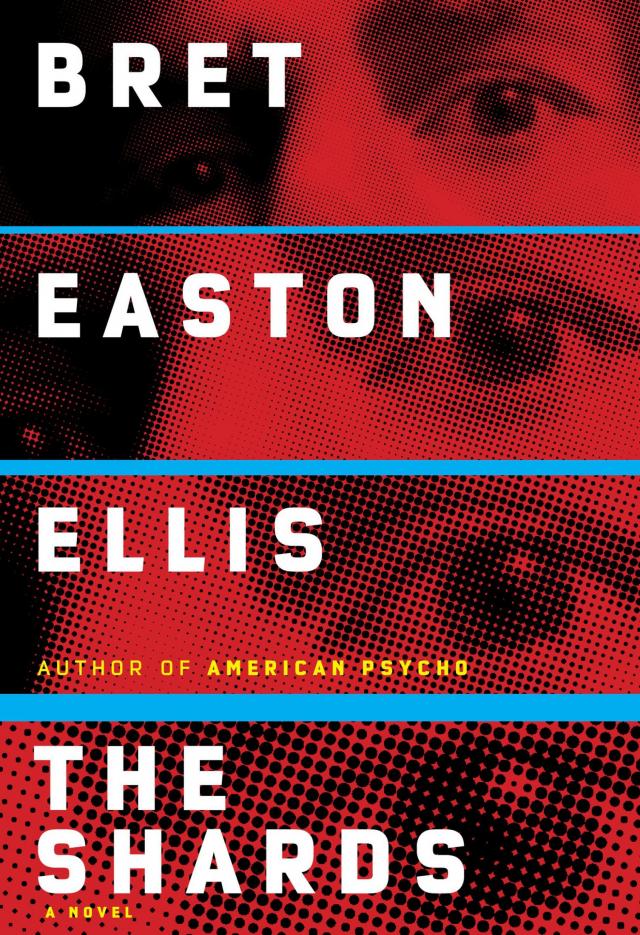
Cover image based on a photograph by Steve Speller / Alamy
Cover design by Chip Kidd
ep_prh_6.0_142242128_c0_r0
Contents
Cover
Also by Bret Easton Ellis
Title Page
Copyright
Dedication
Epigraph
Introduction
FALL/1981
Chapter 1
Chapter 2
Chapter 3
Chapter 4
Chapter 5
Chapter 6
Chapter 7
Chapter 8
Chapter 9
Chapter 10
Chapter 11
Chapter 12
Chapter 13
Chapter 14
Chapter 15
Chapter 16
Chapter 17
Chapter 18
Chapter 19
Chapter 20
Chapter 21
Chapter 22
Chapter 23
Chapter 24
Chapter 25
Chapter 26
Chapter 27
Chapter 28
Chapter 29
Chapter 30
Chapter 31
Author's Note
A Note About the Author
_142242128_
For no one
Do you remember back in old L.A.
When everybody drove a Chevrolet?
Whatever happened to the boy next door
The suntanned, crew-cut, all-American male?
“Beach Baby”
The First Class
If you want to keep a secret you must also hide it from yourself.
1984
George Orwell
MANY YEARS AGO I REALIZED THAT A BOOK, a novel, is a dream that asks itself to be written in the same way we fall in love with someone: the dream becomes impossible to resist, there’s nothing you can do about it, you finally give in and succumb even if your instincts tell you to run the other way because this could be, in the end, a dangerous game—someone will get hurt. For a few of us the first ideas, images, the initial stirrings can prompt the writer to automatically immerse themselves in the novel’s world, its romance and fantasy, its secrets. For others it can take longer to feel this connection more clearly, ages to realize how much you needed to write the novel, or love that person, to relive that dream, even decades later. The last time I thought about this book, this particular dream, and telling this version of the story—the one you’re reading now, the one you just began—was almost twenty years ago, when I thought I could handle revealing what happened to me and a few of my friends at the beginning of our senior year at Buckley, in 1981. We were teenagers, superficially sophisticated children, who really knew nothing about how the world actually worked—we had the experience, I suppose, but we didn’t have the meaning. At least not until something happened that moved us into a state of exalted understanding.
When I first sat down to write this novel, a year after the events had taken place, it turned out that I couldn’t deal with revisiting this period, or any of those people I knew and the terrible things that befell us, including, most crucially, what had actually happened to me. In fact without even writing a word I shut the idea of the project down almost as soon as I began it—I was nineteen. Even without picking up a pen or sitting at my typewriter, only gently remembering what happened proved too unnerving in that moment and I was at a place in my life that didn’t need the added stress and I forced myself to forget about that period, at least for a while, and it wasn’t hard to erase the past in that moment. But the urge to write the book returned when I left New York after living there for over twenty years—the East Coast was where I escaped almost immediately upon graduation, fleeing the trauma of my last year at high school—and found myself living back in Los Angeles, where those events from 1981 had taken place, and where I felt stronger, more resolved about the past, and that I was capable of steeling myself from the pain of it all and entering the dream. But this turned out not to be the case then either, and after typing up a few pages of notes about the events that happened in the autumn of 1981, when I thought I had numbed myself with half a bottle of Ocho in order to keep proceeding, letting the tequila stabilize my trembling hands, I experienced an anxiety attack so severe that it sent me to the emergency room at Cedars-Sinai in the middle of that night. If we want to connect the act of writing with the metaphor of romance then I had wanted to love this novel and it seemed to be finally offering itself to me and I was so tempted, but when it came time to consummate the relationship I found myself unable to fall into the dream.
* * *
—
THIS HAPPENED WHEN I WAS WRITING specifically about the Trawler—a serial killer who had been haunting the San Fernando Valley starting in the late spring of 1980 and then announcing their presence more strongly in the summer of 1981 and who was frighteningly somehow connected to us—and a wave of stress so severe crashed over me that night I began making notes I actually moaned with fear from the memories and I collapsed, retching up the tequila I’d been gulping down. Xanax I kept in the nightstand by my bed was no help—I swallowed three and knew they weren’t going to do anything quickly enough. In that moment: I was sure I was about to die. I dialed 911 and told the operator I was having a heart attack and then fainted. The landline I was calling from—this was in 2006, I was forty-two, I lived alone—alerted them as to where the location was and an alarmed doorman from the front desk of the high-rise I lived in escorted the EMTs to the eleventh floor. My apartment was unlocked by the doorman and they found me on the floor in the bedroom. I regained consciousness in an ambulance as it sped along San Vicente Boulevard toward Cedars-Sinai, a short distance from the Doheny Plaza, where I lived, and after I was wheeled into the emergency room prone on a stretcher and had reoriented myself as to what had happened, I became embarrassed—the Xanax had kicked in and I was calm and I knew there was nothing physically wrong with me. I knew the panic attack was directly related to the memories I had of the Trawler and more specifically of Robert Mallory.
A doctor checked me out—I was basically fine but the hospital wanted me to stay the night so they could perform a battery of tests, including running an MRI, and my primary physician agreed, reminding me over the phone that my health insurance would cover almost all of the stay. But I needed to get home and opted out of whatever tests they wanted to administer because if I had stayed at Cedars that night I was sure I’d slip into madness, knowing that what happened to me had nothing to do with my body or any mal
* * *
—
AFTER THAT NIGHT I abandoned the project and instead wrote two other books during the following thirteen years, and it wasn’t until 2020 that I felt I could begin The Shards, or The Shards had decided that Bret was ready because the book was announcing itself to me—and not the other way around. I hadn’t reached out to the book because I spent so many years pushing myself away from the dream, from Robert Mallory, from that senior year at Buckley; so many decades spent pushing away from the Trawler, and Susan and Thom and Deborah and Ryan, and what happened to Matt Kellner; I had relegated this story to the dark corner of the closet and for many years this avoidance worked—I didn’t pay as much attention to the book and it stopped calling out to me. But sometime during 2019 it began climbing its way back, pulsing with a life of its own, wanting to merge with me, expanding into my consciousness in such a persuasive way that I couldn’t ignore it any longer—trying to ignore it had become a distraction. This particular timing had coincided with the fact that I wasn’t writing screenplays anymore, that I had decided at a certain point to stop chasing that game—a decade of being well compensated for TV pilots and scripts for movies that would mostly never be made—and I briefly wondered if there was a connection between the book beckoning to me and the new lack of interest in writing for Hollywood. It didn’t matter: I had to write the book because I needed to resolve what happened—it was finally time.
* * *
—
THE SPARK FOR MY RENEWED INTEREST in the novel was initiated by a brief moment years after that anxiety attack landed me in Cedars. I’d seen a woman—I was going to say a girl, but she wasn’t any longer; she was a woman in her mid-fifties, my age—on the corner of Holloway and La Cienega in West Hollywood. She was standing on the sidewalk outside the Palihouse Hotel, wearing sunglasses, a phone pressed against her ear, waiting for a car, and even though this was a much older version of the girl I used to know when we were in high school it was unmistakably her. I knew it even though I hadn’t seen her in almost forty years: she was still effortlessly beautiful. I had just made a left turn onto Holloway and was stopped in traffic when I noticed the figure on the deserted sidewalk beneath the umbrella at the valet stand—she was maybe twenty feet away from me. Instead of the happy surprise at seeing an old friend I was frozen with a sheet of dread—it draped over me immediately and I went ice cold. That glimpse of this woman in the flesh caused the fear to return and it started swallowing everything—just like it had in 1981. She was a reminder that it had all been real, that the dream had actually happened, that even though four decades had passed since we last saw each other, we were still bound by the events of that fall.
I didn’t suddenly pull over to the side of Holloway, near the mouth of the garage of the CVS across the street from the Palihouse, and present myself to the woman, exclaim surprise, get out of the car and offer her an embrace, marvel at how beautiful she still looked—I had successfully avoided contact with any of my classmates from our senior year on social media, with only a few having reached out to me over the years, usually in the weeks after I published a book. Instead I just stared through the windshield of the BMW I was driving as she stood on that deserted sidewalk, holding the phone to her ear, listening to whoever was talking to her, not saying anything, and even with the sunglasses on, there was something haunted in the way she held herself, or maybe I was imagining this was true—maybe she was fine, maybe she had completely adjusted and had processed what happened to her in the fall of 1981, the terrible injury she suffered, the awful revelation she experienced, the losses she endured. I was on my way to Palm Springs with Todd, someone I’d met in 2010 and who’d been living with me for the past nine years, to spend a week with a friend flying in from New York who had rented a house on the edges of the movie colony in Palm Springs before heading to San Diego to attend a series of conferences. I’d been having a conversation with Todd when I saw the woman in front of the Palihouse and was shut down mid-sentence. A car suddenly blared its horn behind me and when I glanced at the rearview mirror I realized the light on Holloway had turned green and I wasn’t moving. “What’s wrong?” Todd asked as I accelerated too quickly and lurched toward Santa Monica Boulevard. I swallowed, and numbly offered, trying to sound utterly neutral: “I knew that girl…”
* * *
—
OF COURSE SHE WASN’T a girl any longer—again, she was almost fifty-five, as I was—but that was how I’d known her: a girl. It didn’t matter. Todd just asked, “What girl?” and I made a vague distracted motion with my hand—“Just someone outside Palihouse.” Todd craned his neck but didn’t see anyone—she was already gone. He shrugged and looked back at his phone. I realized that the satellite radio was tuned to the Totally 80s station and the chorus from “Vienna” by Ultravox was playing—It means nothing to me, the singer cried out, this means nothing to me—as the fear kept swirling forward, a variation on that same fear from the fall of 1981, when we played this song near the end of every party or made sure of its prominence on every mixtape we compiled. Letting the song take me back on that December day, I thought I’d acquired the tools to cope with the events that happened when I was seventeen and I even thought, naïvely, foolishly, that I had worked it out through the trauma in the fiction I published years later, in my twenties and thirties and into my forties, but that specific trauma rushed back to me, proving that whatever I thought I’d worked out on my own, without having to confess it in a novel, I obviously hadn’t.
That week we were in the desert I couldn’t sleep—perhaps a couple of hours each night at the most even with a steady intake of benzodiazepine. I might have knocked myself out with the Xanax I’d overdosed on but the black dreams kept me from sleeping for more than one or two hours, and I would lie awake exhausted in the master bedroom in the house on Azure Court combating the rising panic tied to the girl I had seen. The midlife crisis that began after that night in 2006 when I tried to write about what happened to us our senior year at Buckley, completed itself roughly seven years later—seven years spent in a fever dream where the free-floating anxiety alienated everyone I knew and the accompanying stress caused me to drop forty pounds—waned away with the help of a therapist, a kind of life coach whom I dutifully saw every week for a year in an office off Sawtelle Boulevard just a block past the 405 who was the only one out of half a dozen shrinks I’d seen not afraid of the things I was telling him. I had learned from the previous five therapists that I had to downplay the horror of what had happened—to me, to us—and that I had to rearrange the narrative so that it was more palatable in order not to disturb the sessions themselves.
I was finally in a long-term relationship and the minor problems that never actually threatened my life—addiction, depression—crept away. People who had been avoiding me those last seven years, when I was emaciated and furious, would run into the new Bret in a restaurant or at a screening and seemed confused when they saw I wasn’t as freaked out and messed up as I used to be. And the prince-of-darkness literary persona readers thought I had always embodied was now vanishing, being replaced by something sunnier—the man who wrote American Psycho was actually, some people were surprised to find out, just an amiable mess, maybe even likable, and not nearly the careless nihilist so many people mistook me for, an image that I perhaps played along with anyway. But it had never been the intended pose.





