At the Jerusalem, page 1


Praise for
At the Jerusalem
‘I recommend it to everyone.’
Arthur Calder-Marshall
‘A remarkable first novel.’
Evening Standard
‘A laconic, merciless, appallingly accurate description of life in an old people's home... It is so well done that it is often not bearable.’
Spectator
‘It extends human sympathy beyond the point where it normally comes to a stop.’
Observer
‘At the Jerusalem, Paul Bailey's first novel, would be remarkable as the work of a writer over middle age; from so young a man it is astounding in its empathy.’
Financial Times
‘It would be difficult to praise this novel too highly.’
Daily Telegraph
‘A display of pure style... A high-wire act, with not a sound or a piece of dialogue left unchiseled, not a false note.’
Colm Tóibín
At the
Jerusalem
At the Jerusalem
Paul Bailey
www.headofzeus.com
First published in 1967 by Jonathan Cape
This edition published in the United Kingdom in 2019 by Head of Zeus Ltd
Copyright © Paul Bailey 1967
Introduction © Colm Tóibín 2019
The moral right of Paul Bailey to be identified as the author of this work has been asserted in accordance with the Copyright, Designs and Patents Act of 1988.
All rights reserved. No part of this publication may be reproduced, stored in a retrieval system, or transmitted in any form or by any means, electronic, mechanical, photocopying, recording, or otherwise, without the prior permission of both the copyright owner and the above publisher of this book.
This is a work of fiction. All characters, organizations, and events portrayed in this novel are either products of the author's imagination or are used fictitiously.
A CIP catalogue record for this book is available from the British Library.
ISBN (HB): 9781789545715
ISBN (E): 9781789545708
A Note on the Artwork:
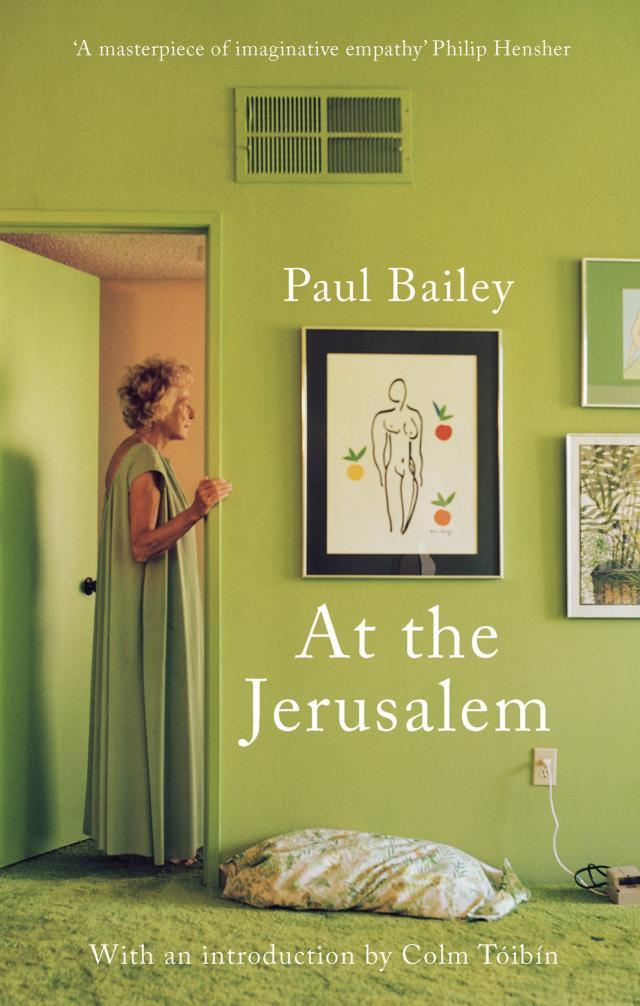
Mom in Doorway, 1992 from the series Pictures from Home © Larry Sultan.
Courtesy of the Estate of Larry Sultan.
www.larrysultan.com
Head of Zeus Ltd
First Floor East
5–8 Hardwick Street
London EC1R 4RG
WWW.HEADOFZEUS.COM
Contents
Praise for At the Jerusalem
Title Page
Copyright
Introduction
Dedication
Part One
Part Two
Part Three
About the author
About the introducer
An Invitation from the Publisher
At the
Jerusalem
Introduction
In his poem ‘The Old Fools’, Philip Larkin imagines old age:
Perhaps being old is having lighted rooms
Inside your head, and people in them, acting.
People you know, yet can’t quite name, each looms
Like a deep loss restored…
Paul Bailey’s novel At the Jerusalem is both a portrait of the dissolving mind of an old woman and a display of pure style. The novel is mainly dialogue, with a cacophony of voices in a home for elderly ladies. Each has her own personal ailment; each is amused or annoyed by different things; each is ready to interject, demand attention, make jokes, slobber at meals, drool while pretending to listen, offer insults, fall asleep, become noisy in the night, have bad dreams, entertain old memories, take out false teeth.
Among the voices comes the sound of what is not being said, what appears as memory, or as a remark that might be made but is being withheld. In general, this sound belongs to Mrs Faith Gadny, the most recent arrival at the Jerusalem.
Mrs Gadny has, as Larkin puts it, a lighted room inside her head. While the others have become accustomed to the Jerusalem, she notices with all the intensity of a newcomer. And she experiences the memory of her husband and her daughter with more urgency than any of the voices that she hears around her. Her husband and daughter are like a deep loss restored.
The memory of her stepson Henry and his ghastly wife Thelma is made more present by their visit. Up until recently, Mrs Gadny has been living with them, but then they decided that it would be better for everyone if she were moved to a home. Also, Mrs Gadny imagines that her old friend Mrs Barber is still alive – she isn’t – and she writes her forlorn letters.
The tone Paul Bailey wields with such skill and control in the novel is dry and brisk and distant, understated and filled with implication and irony. He writes sharp sentences and manages to make the reader not know quite what to feel. When Miss Trimmer, for example, one of the inmates, is performing her ablutions, she gets soap in her eye. There is much fuss. And, then, to end the scene and this section of the book, Bailey writes: ‘After shaking some talcum powder into her knickers, Miss Trimmer dressed.’ (p. 25)
The novel is a high-wire act, with not a sound or a piece of dialogue left unchiselled, not a false note. It moves from registering the most mundane activities – small arguments, communal meals, walks in the garden, talks with Matron – with relish and impetus to entering into Mrs Gadny’s mind with empathy and a kind of sympathy.
Mrs Gadny is easily bored and irritated. She really does want to be let alone, especially by Mrs Capes, who seeks to befriend her. The dead speak to her more and more. Scenes from the past come to torment her; she has bad dreams. She is becoming a difficult patient, neither too frail to be fully pitied nor sociable enough to enter into the general cheery spirit of the Jerusalem.
Bailey handles Mrs Gadny’s losing her mind with subtlety; he integrates the ebb and flow of her consciousness with waves of good sense and ordinary appetites. It isn’t that he normalizes her dementia; rather, he makes everyday speech and everyday patterns of activity in the novel so brittle and weird that Mrs Gadny’s failing mind seems merely another aspect of the way things are.
The minimalism in the novel, so edged and barbed, has some of the same textures as scenes in Waiting for Godot, scenes in which lines of dialogue are repeated until they seem strangely resonant or oddly nonsensical, or in which banality holds sudden sway until the most ordinary remark or question can have a shivering aura. Bailey’s use of short, clipped sentences and quickly moving dialogue with much repetition also takes its bearing from a tradition in English fiction that runs from Ronald Firbank through Ivy Compton-Burnett to Muriel Spark, fiction in which the reader is spared unnecessary detail, where the dialogue is sharply inconsequential until it suddenly becomes outlandishly comic or completely shocking. Nothing seems to be happening until a sentence or a line of dialogue swoops down on you, the gentle reader.
Since At the Jerusalem was published in 1967, the elderly residents would have been born in the Victorian age when many of them worked as servants. While a few inmates can be vulgar, others are prudish, not least Mrs Gadny herself. She thinks of her stepson and his wife involved in conjugal coupling with something less than equanimity: ‘She suddenly imagined him on top of Thelma, misbehaving himself. How could she, scarcely more than a bean-pole, suffer all that weight?’ (p. 111)
While many episodes in the book move between the funny and the sad, there are other scenes that are brilliantly and openly comic. Mrs Hibbs’s ninetieth birthday is one such scene, the celebration not helped by the fact that Mrs Hibbs is herself more or less asleep and cannot be easily woken, even by ‘a trickle of sherry’ (p. 199). All around her there is good cheer, the sort that would make you want to weep.
Paul Bailey does nothing obvious to make us like Mrs Gadny or want her not to suffer. She shuts out the world of the Jerusalem, her universe is increasingly circumscribed, as she herself is less and less amenable to kindness and care. She is seldom funny and often irascible. She gives the nurses a bad time. Yet slowly, the more her mind dims, the more she emerges as fully present in the novel. Because she is not predictable, because her suffering is never exaggerated or sentimentalized, then she is a memorable protagonist, a character whose feelings and experience seem increasingly complex and demand close attention.
The structure of the novel helps us to see Mrs Gadny and her predicament clearly. It moves from her daily life at the Jerusalem back to her efforts to live with her stepson and his wife. Rather than offering high drama, Bailey dramatizes small moments of pure tedium, moments that exude minuscule forms of pain that slowly add up to an urgent need for Mrs Gadny’s departure.
It is hard to think of another novel about an elderly character not in full possession of her wits that is written with the same amount of compassion and sensitivity. Bailey’s genius in this book was to find a style supple enough to contain the tragedy befalling his heroine but also ambiguous enough to suggest a great deal about her mind and how it moves as it begins to fail her.
COLM TÓIBÍN, 2019
For my mother
Part One
Then there was a dazzle of green and white, white and green. Then the colours separated, became clear: the white was above, the green below. Tile, she saw, followed tile. Once she’d blinked, she realized that she stood in a corridor.
The nurse, who had walked some paces ahead of her, stopped and called: ‘Mrs Gadny, you must come with me.’
Mrs Gadny moved towards the nurse, who smiled.
‘Matron’s waiting to welcome you.’
So they walked together along the corridor: the nurse looking at Mrs Gadny, Mrs Gadny staring ahead.
A window to Mrs Gadny’s right gave her a view of the grounds at the back of the Home. She was surprised to see that there were graves. She walked to the window and looked out. Beyond the graves, women were seated on benches, enjoying the sun. One woman’s skirt was drawn up above her knees, which shone in the strong light.
The nurse said gently: ‘We won’t stay cheerful – will we? – if we stare at the graveyard. Even though it’s a pleasant sight on a fine day like this: the white stones and all the flowers. You come with me, Mrs Gadny. Matron’s waiting to welcome you.’
But Mrs Gadny continued to stare. The sun shone on the graves, the women, the pair of knees. Like the tiled walls, they became confused before her. She had to blink to make certain that a gravestone wasn’t grinning.
‘The two of you will have a long talk. A nice chat, dear. Woman to woman.’
The nurse guided her forward.
‘Smile. Let yourself smile. She’s human, Matron. A widow like yourself. Her name’s Mrs Ricks. You’ll find her sympathetic, full of warmth.’
The nurse decided that a little humour would set Mrs Gadny’s mind at rest. ‘I’m Nurse Trembath,’ she said, hoping her companion would smile. ‘Some people find the name amusing. It isn’t a common name, is it – Trembath? One of the ladies who used to be here hooted with laughter whenever she heard my name. She roared. It kept her happy.’
Mrs Gadny, the nurse noted, was not amused, as the expression went about Queen Victoria.
‘And you’ll be happy in no time. Oh, yes. I can see you don’t believe me. Just wait. You’ll settle. You’ll grow accustomed.’
Nurse Trembath led her into another corridor.
‘It’s a big event – isn’t it? – at your age. An upheaval. Almost as if you were starting a new life.’
She tightened her grip on Mrs Gadny’s left hand.
‘In a way, it will be a new life: the comfort, the care, the friends you’ll have about you.’
They stopped at a dark-green door. Nurse Trembath said ‘We’re here’ and knocked, listened, knocked again.
‘Not a sound. She must be on her travels. I’ll take you in, Mrs Gadny. You can sit and wait for her. Open, Sesame,’ Nurse Trembath said.
She took Mrs Gadny into the Matron’s office.
*
She sat and waited. A fly buzzed near her face. It landed on her nose. She didn’t bother to brush it away. It pulled in its wings and rested. She closed her eyes.
‘You have a fly on your nose.’
She heard a sharp voice. Turning in the chair, she saw a tall woman in a white dress. The tall woman leaned towards her; she brushed the fly away; she smiled as she said ‘Good morning’.
Mrs Gadny attempted to rise.
‘Remain in your seat. Good morning.’
‘Good morning,’ Mrs Gadny managed.
‘And what a good morning it is. Wouldn’t you agree?’
‘Yes.’
‘That sun out there. The birds.’
‘Yes.’
The matron drew herself up; walked to her desk; sat behind it. ‘Are you nervous? Do I frighten you?’
‘No.’
‘Am I an ogre?’ She corrected herself. ‘Ogress?’
‘No.’
‘You’re wearing a very pretty hat.’
‘Thank you.’
‘It’s most becoming.’ The matron smiled, shut the smile off quickly. ‘Shall we have tea? Would you like some tea?’
‘Thank you.’
‘Tea would be pleasant.’ The matron picked up the telephone, spoke into it. ‘Tea, please. For two.’ She put down the receiver. ‘Mrs Gadny.’
‘Yes.’
‘Tell me your Christian name. Or names.’
Mrs Gadny thought this strange. Henry must have filled in papers; he must have told this woman about her. She said, ‘Faith Ethel.’
‘Raise your voice.’
‘Faith Ethel.’
‘Faith Ethel. Yes.’ She smiled, shut the smile off quickly. ‘I have the facts about you here. I shan’t need to ask you questions.’
The fly settled on Matron’s bun.
‘We can talk together. Over tea.’
Mrs Gadny watched the fly; saw there were grey streaks in Matron’s hair.
‘Smile.’
Mrs Gadny smiled. Matron smiled, shut off the smile quickly.
‘How was your journey here?’
‘All right. Thank you.’
‘How did you travel? Train?’
‘My stepson brought me. He drove me. He has a car.’
‘So you arrived in style?’
‘Yes. Yes.’
The fly set off again. Silence, apart from its buzzing. Matron sighed.
‘You mustn’t be sad. The Jerusalem’s your home now.’
With green and white tiles, with graves.
‘I understand your sadness. These last few hours must have been terrible for you. A terrible wrench.’ Matron stopped. She spoke in a quieter voice: ‘After so many years… I do realize. Believe me. Do believe me, Mrs Gadny. You’ll be at ease. You’ll settle. Adapt.’
The fly was on the window.
‘Think of me as a friend.’
‘Yes.’
‘I am quite sincere. As a friend.’ She was emphatic. ‘I may be Matron but I’m also Mrs Ricks, another woman like yourself. If you find you have troubles, you must bring them to me. Without hesitation.’ She smiled, shut the smile off quickly. ‘Nothing’s so dreadful it can’t be talked about.’
‘No.’
‘Nothing. Remember.’
‘Yes.’
‘Your hands are clutching the chair. Look.’
‘Oh? Yes.’
‘Be comfortable. Sit back.’
‘Yes.’
‘I’m not commanding you.’
‘No.’
Matron laughed, so Mrs Gadny smiled.
*
Tea was served from a trolley by a Nurse Perceval. There were biscuits and a cake.
‘Take a plate, Mrs Gadny,’ Matron said.
‘I couldn’t eat. I couldn’t.’
‘Couldn’t?’
‘I couldn’t.’
‘Not some cake?’
‘No, thank you.’
‘Have this wafer. It’s thin.’
‘I—’
‘There you are.’
‘Thank you.’
Nurse Perceval placed a cup of red tea on the desk in front of her.
Matron was a noisy drinker.
‘Most people find our name curious.’
‘Name?’
‘The Jerusalem.’
‘Oh?’
‘You find it curious?’
‘Yes. Very unusual.’
‘New arrivals always ask me how it came about.’
‘Do they?’
‘How we acquired such an extraordinary title.’ Matron smiled, shut the smile off quickly. ‘All my ladies were intrigued by the story.’
They looked at each other.
‘Would it interest you? The story?’
Mrs Gadny could not say ‘No’.
‘Yes.’
‘Really? Truly?’
‘Yes.’ Matron still looked at her. ‘Yes.’
‘Did you notice the bust in the entrance hall?’
‘I can’t say I did.’
‘It’s in a prominent position. It’s rather imposing.’
‘I don’t think I did notice.’
‘Ah, well. It will strike your eye some time.’
In the future.
‘It represents our founder, the bust. Lord Endon. He lived from 1857 to 1888. Not a long life and not a happy one.’
‘Thirty-one years.’
‘Very bright, Mrs Gadny. Very bright of you… However, to go on…’
Lord Endon, Matron told her, had a wretched childhood. Both his parents died before he was ten. He was a lord at nine and a half. An uncle then took charge of him: a man of loose morals who drank and gambled. By the time Lord Endon inherited his father’s fortune, he himself was a drunkard. He had wasted his youth in low dens and such places. (Here Matron smiled.) At the age of twenty-eight His Lordship, on an impulse, went to the East. In 1885 he saw the Light. In Jerusalem. He returned to England to spread the Word. He lived among the London poor. He bought a property, a workhouse at the time, and made it into a home for the elderly and dying. He called it the Jerusalem.