

Magic City Blues, page 22


Hell, as far as I knew, she might not even remember what I’d said. Or maybe she didn’t want to remember it. We slept in separate beds in the rented house, and in the dark hours of the night I thought I could hear her breathe in the next room.
D’Agostino finished her dinner and asked for more, which I took as a good sign. After I refilled her plate, I passed by the window in the kitchen.
I want to say that there was something that warned me. I want to tell you that it was training and toughness and pure street smarts that saved my life. But it wasn’t. I felt the bullet strike home at the same time I heard the glass in the window break, a millisecond after I heard the sound of the gun.
It was like I’d been punched hard in the top of the shoulder. I fell, dropping D’Agostino’s plate, and I can remember thinking oh no I’m going to have to clean that up. And then time caught up with me and I hit the floor, rolling over onto my hurt shoulder and coming level with my own gun, firing wildly, fear and anger overtaking me as I put six shots into the blackness where the kitchen window had been.
The silence following the gunfire was eerie. I could smell the spent rounds in the air, that peculiar burnt gunpowder smell that everyone assumes is cordite, but it’s not. Cordite went out of use after the 1960s. I was pretty sure I was in shock, but that wasn’t going to last. I could feel the pain from my shoulder seeping in, and there was blood on the floor around me where I’d been shot.
“Kincaid?”
D’Agostino’s voice came from the kitchen, and I hated the fear I heard in her voice.
“Still here,” I moaned, and scrambled on my knees to the little dining room we’d shared. D’Agostino was under the table, trying to keep to the shadows. Her face was pale, with bright spots of color under each eye. It might have been pain from her bad arm or shock or both. Blood from my own wound leaked from my shoulder onto the hardwood floors.
Thank god there was no carpet. I’d lose my deposit. I giggled madly in the dark, the sound just on the wrong edge of sanity.
“Doyle?”
“Has to be,” I said. “Do you still have your coat hanger?” She did. I took it from her and pressed my revolver into her hands.
“Get upstairs. Reload.”
“What are you going to do? Jesus, you’re bleeding. You didn’t tell me you were hit.”
I stared intently at the front door as I wrapped the unwound clothes hanger around my right forearm.
“When I say, run for the stairs,” I said. “Don’t stop for anything. I don’t care what you hear.”
“Jesus fucking Christ, are you crazy?”
“I’m in love with a cop,” I said. “Of course I’m crazy.”
D’Agostino narrowed her eyes and shifted her weight so that she favored her injured arm. She held my weapon in her right hand.
“Ready?” I asked. She nodded. There was a moment more of silence that seemed to stretch out forever, and I heard a hesitant, tentative step outside the house.
“Now,” I screamed, “go, go.”
D’Agostino bolted for the stairs, and I ran straight for the front door. I clawed at the knob and yanked it open to see Carlton Doyle standing there, a raised gun in his hand. He pulled the trigger, and I threw myself aside. He was so close that the muzzle flash from his weapon caught the front of my shirt on fire, and I felt the bullet sear my side as it went past.
He had been no more ready for me than I was for him. I could see that he was off-balance, so I helped him along by driving a shoulder into his armpit. He twirled an ungainly turn on the porch, flapping his arms and trying to get his balance, and then I kicked him hard, straight up the ass with one of my pointed-toe cowboy boots—god, that was satisfying—and he launched off the little porch and into the bushes that surrounded the house. In an instant he was up and running, and so was I. We splashed into the water that separated our houses, and I caught up with the son of a bitch at last.
His gun was gone. My shirt was wet and still smoking. I grabbed him by the throat, and he tried to gouge my eyes with his thumb. His nails tore grooves into my cheek, and they welled with fresh blood. He tried to knee me in the groin, but I turned my thigh to block it and took the knee on the big quadriceps muscle there. The blow was so hard that it made my leg spasm in a charley horse, and I nearly lost my grip on Doyle’s throat.
But I didn’t. I head-butted him in the face instead, what the old-time brawlers used to call the Liverpool kiss. He tried to claw at my arm, and I head-butted him again. This time there was the satisfying crunch of a bone breaking. It got him on the cheekbone, so maybe I’d exploded his orbital socket. I tried for his nose next, and pulped it. I knew I’d feel those head-butts in the morning, but at that moment I didn’t let myself care. I couldn’t.
My wound hurt like fire, and I could tell that it was still bleeding. I had to end things quickly, or else I’d pass out from blood loss and exhaustion, and then Doyle would be alone with Laura.
I wasn’t going to let that happen. Not that night. Not any night.
He bit me hard when I got a little too close, and that’s when I let him go. He scrambled toward the shore and I followed, unwinding the coat hanger that I’d managed to carry with me through the fight. I couldn’t see well in the dark, but Doyle was splashing and thrashing so much that it didn’t matter.
In the end, I wrapped the wire coat hanger around my hands and looped what was left over his head. A hard twist and the makeshift garotte was tight. I dragged him to shore, then turned and got my uninjured shoulder underneath his back and lifted him bodily out of the water so that he hung himself with the weight of his struggling body against the wire.
It didn’t take long. It never does. The wire bit into his throat and into my palms. It hurt, and I could feel my hands bleeding from where the nasty narrow wire hanger cut into my palms. It couldn’t have taken Doyle five minutes to stop struggling as the life force left his body, but by the time he was done, so was I. My hands let go, but I couldn’t get the wire unwrapped. My fingers wouldn’t work. In the pale moonlight they looked like thick purple sausages.
I collapsed next to Doyle on the shore. His eyes were blank and empty. Whatever evil had lurked in the man, it had left along with his soul. Good fucking riddance.
And then I closed my eyes and there was nothing left.
Thirty Three
The afterlife, or what I thought it was, turned out to be pretty uneventful. I woke up in a room I didn’t recognize. The bed was huge, the size of a football field, with clean white sheets and thick, heavy blankets. Above me there were cedar roof beams and a ceiling fan that turned as slowly as the hands of time. My shoulder itched, but when I tried to scratch it, I discovered it was covered with a pressure bandage. My hands were bandaged, too, with particular care taken with each of my palms.
I tried to get up, but there wasn’t enough strength in my body. So I settled back onto the fluffy pillows and did what I did best: I waited for what came next.
When D’Agostino opened the door a little while later, I wasn’t surprised. Her arm was still covered in a cast above the elbow. In her other hand, she carried a rectangular-shaped white bag with a red cross-shaped logo on the side. A first-aid kit. Of course. But for D’Agostino to administer first aid, she would have had to have some help. At first she didn’t realize I was awake, so I could look at her without her knowing.
I liked what I saw. She didn’t look haunted the way she had as we waited to make our move against Doyle, and she moved better. I was willing to bet that she was on her road to recovering, not just physically, but mentally, too.
“Hey,” I said. The words came out in a croak, but she jumped anyway.
“Oh my god,” D’Agostino gasped. She dropped the first-aid kit to the floor and held her right hand to her mouth. “It’s about time.”
Abby came in a moment later with a bowl of steaming broth on a sterling silver platter.
“Oh,” she said, watching Laura and I stare at one another in silence. “I can come back.”
I looked over. I could smell the broth. My stomach growled at the thought of food, and my mouth watered.
“Don’t you dare leave,” I said.
Abby helped me sit up, plumping pillows behind me until I was mostly comfortable, and then putting the bowl—platter and all—onto my lap. I wasn’t sure I could manage a spoon, but the bandages on my hands worked fine as oven mitts. I lifted the bowl to my lips and drank some broth.
“How long have I been out?”
“You went into the lake with Doyle on a Thursday,” D’Agostino said. “It’s Tuesday now. Do you remember anything?”
I thought about it, then shook my head. The entire time between then and now was one dark, blank space on the map of my brain. I wasn’t sure I wanted that place filled in, either.
“I came out of the cabin and there you were. Doyle was dead, and I thought you were, too. Then you coughed, and I nearly jumped into the lake myself.”
I grinned weakly.
“Shut up,” she said. “I couldn’t handle you on my own, so I did the only thing I could think of.” She turned to Abby, who had resumed her place near the door of the room.
“I … I didn’t know what to do,” Abby said. “But Laura said you needed help. That my—that my father was dead—and that I didn’t have to be scared anymore.”
“She came back with me,” D’Agostino said. “Helped me fish the bullet out of your shoulder, helped me patch it up, whole nine yards.”
“Jesus Christ,” I said.
“Yeah, you jumped a lot when we poured alcohol on the wound,” Abby said. “I mean, I thought you’d come out of it then, but you were way, way under.”
“It was just a little bullet,” D’Agostino said. “A twenty-two. I found Doyle’s gun in the bushes afterward. I thought you were tougher than that.”
I snorted, a hollow half-laughing sound that made D’Agostino giggle. When she did that, her whole face brightened, and she looked younger again, lighter, as if the weight of some of the events over the last few days had been lifted from her shoulders.
I hoped they had.
I drank some more soup, right down to the bottom of the bowl. My stomach, which had felt shriveled and empty, now felt full. The room was warm and clean and I was safe. I shifted a little in the big bed, snuggling down onto my back again and looked up at the ceiling fan. It wasn’t on very high, just enough to keep the air circulating in the room.
“You’re all right,” I said to Abby, and she nodded.
“Yes,” she said in a very small voice. “I am.”
Something hit me, and I struggled to sit up.
“Shit,” I said. “The body.”
D’Agostino had a hand on my chest in an instant, pushing me back down.
“Taken care of,” she said, and looked purposefully at Abby. The younger woman studied the nap of the plush carpet on the floor. She wouldn’t meet our eyes. I had no idea how hard the last few days must have been on her.
“Can you give us a minute alone?” Laura asked. Abby nodded, took the silver tray with the bowl on it, and stepped out of the room. She closed the door firmly when she left.
“Middle of the lake is a hundred and ten feet,” D’Agostino said. “We dragged his body onto their boat and then drove out to the middle of the lake around midnight the next night. Abby tied him to an anvil and we pushed him over the side.”
“Jesus,” I said. “I can’t even imagine the kind of therapy that kid’s gonna need.”
“Me either,” Laura said quietly. “But she’s got enough money for it, for the rest of her life.”
“And her father isn’t around to molest her anymore,” I said. “I guess that’s something.”
“Yeah, something. You know, she cried the whole time she was tying him down. We had to both do the lifting to get him overboard, but the cinderblocks? That was all Abby. She’s stronger than either one of us gave her credit for being, I think.”
I didn’t know what to say. While I’d been lying on the ground unconscious, D’Agostino had rousted Abby and gotten her to help dispose of her father’s body. And she did everything with only one arm to work with. Maybe she really was Wonder Woman.
And then there was Abby, who was some kind of superhuman herself. Even though her father had been her molester, he was still her father. It couldn’t have been easy to do what they did, under cover of darkness, under the demanding pressure of a time crunch to get the body tied down enough to actually sink … and then to help muscle him overboard.
We didn’t talk about the fetus Abby carried in her belly. We knew that, no matter what the law said, she would have enough money to go away and have her little problem solved. Hemingway had written that it was a really a very simple procedure, and maybe it was. Abby was able — because of her race, because of her wealth, because of her status — to deal with her problem in a way that many women couldn’t. But the psychological damage from her father would be harder to undo.
Maybe she had grieved in the days since. But in the few minutes she had been in the room with us, I had seen no evidence of it. I closed my eyes and tried to relax against the pillows. It was more difficult than I had imagined it would be.
“I’m sorry,” I said.
“What, for getting shot?”
She punched me playfully in the uninjured shoulder, and I grinned up at her. Then we were quiet for a little while, the two of us just sitting there and getting used to one another’s presence. D’Agostino held one of my hands in her good hand. Even through the bandages, her hand felt warm and full of life, and I knew that no matter what happened from here on out, I was better off for having known her.
“You talked a lot in your sleep, you know.”
“Oh. Uh. I did?”
D’Agostino smiled.
“You did.” She waited for a beat. “So you meant what you said before you got shot? That you’re in love with a cop? Is it anyone I know?”
We both laughed. Now it was my turn to go quiet. D’Agostino looked away until I squeezed her hand.
“I meant it,” I told her. “I love you. I don’t know where this will lead, but I want us to figure it out together.”
“Together?”
I nodded.
“Together.”
ACKNOWLEDGMENT
While I was writing this book, I had The Drive-By Truckers playing on a nearly continual loop. Their Southern gothic brand of rock-and-roll really powered me through the writing process, especially the song ‘Birmingham’ from the album Southern Rock Opera. Many thanks to my friends and fellow writers, Emily Guy Birken, J.B. Stevens, James D.F. Hannah, and Mark Westmoreland for their ideas, insightful readings, and encouragement. Having writer friends means that someone cheers you on during the hard times. I have been inspired by a long line of writers like Donald Westlake, Robert B. Parker, Elmore Leonard, and Lawrence Block. If some of this work feels like an old friend, it’s because I wrote the book in homage to them. Thank you to Ron Phillips, who believed in my work and offered me the chance to show it to the wider world.
In 2022, I lost my mom, Mavis Mathews. This book is dedicated to her, and I wish she was around to see it come to fruition. She was the first person to believe that I had some small talent for writing, and she always encouraged me to write and tried to nurture my interest in it. I owe so many other people, like Janice Morgan at Enterprise High School, who encouraged me and believed in me even when I was a terrible and recalcitrant student. Gil Kelly is another one of those teachers, and Jim Strength, too. It’s probably cliche’ for a writer to say how much their high school English teachers affected them, but there’s a reason it’s cliche’: It’s true.
And, of course, thank you to Misty, who does so much stuff behind the scenes that allows me to “be a writer.”
ABOUT THE AUTHOR
Bobby Mathews knew exactly what he wanted to be when he grew up: a writer. That led him into a career path as a journalist in Alabama, New York, Wyoming, Georgia, and finally back to Alabama before he called it quits. He’s won General Excellence, column-writing, newswriting, and sportswriting awards from press associations in all four states. In addition to his journalism career, Bobby has been a PR flack, a bartender, an investigator, and roustabout.
Bobby lives in suburban Birmingham, Alabama—which truly is the Magic City in more ways than one—with his wife and two sons.
ABOUT SHOTGUN HONEY BOOKS
Thank you for reading Magic City Blues by Bobby Mathews.
Shotgun Honey began as a crime genre flash fiction webzine in 2011 created as a venue for new and established writers to experiment in the confines of a mere 700 words. More than a decade later, Shotgun Honey still challenges writers with that storytelling task, but also provides opportunities to expand beyond through our book imprint and has since published anthologies, collections, novellas and novels by new and emerging authors.
We hope you have enjoyed this book. That you will share your experience, review and rate this title positively on your favorite review sites and with your social media family.
If you did enjoy this book, please consider purchasing more Shotgun Honey Books.
Visit ShotgunHoneyBooks.com
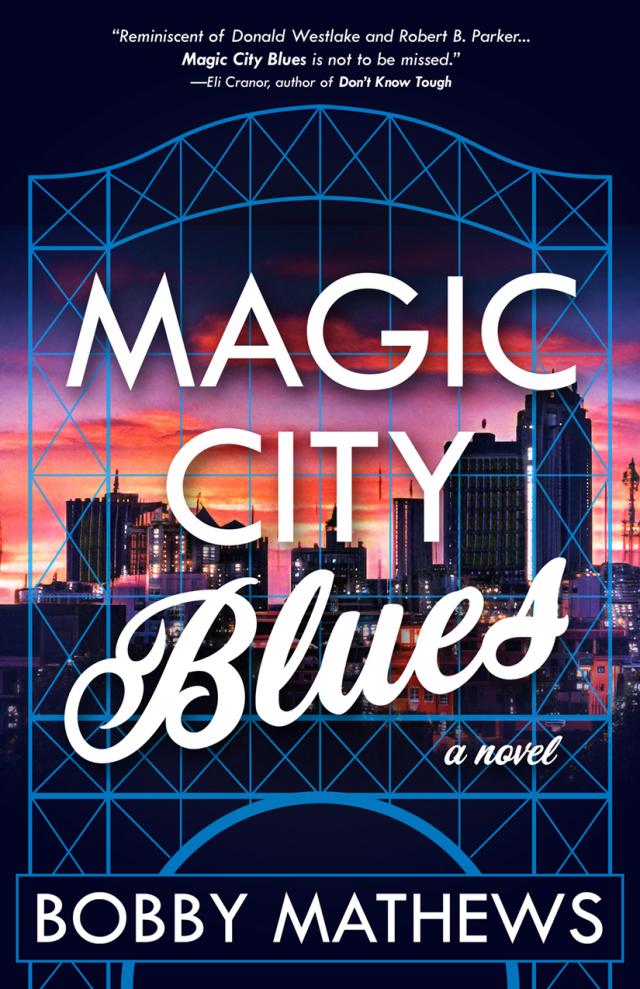
Bobby Mathews, Magic City Blues


