Expendable for the Cause (Josh Stuart Thriller Book 2), page 1


PRAISE FOR BOB HAMER
“Realism only an undercover FBI agent can bring…will grab you from word one.”
- Vince Flynn, New York Times #1 best-selling author
“Knowing Hamer ‘walked the talk’ as an FBI undercover agent gives this thriller a genuine edge that rings like a struck bell.”
- Kevin Sorbo, producer/director and star of Hercules: The Legendary Journey
“It’s a story of dedicated people who battle bureaucrats and terrorists to keep America safe.”
- Charlie Daniels, country-western legend
“...a page-turning roller coaster that feels like Jack Bauer’s 24 without sailing over the top...”
- Publishers Weekly
A POST HILL PRESS BOOK
ISBN (eBook): 978-1-68261-170-8
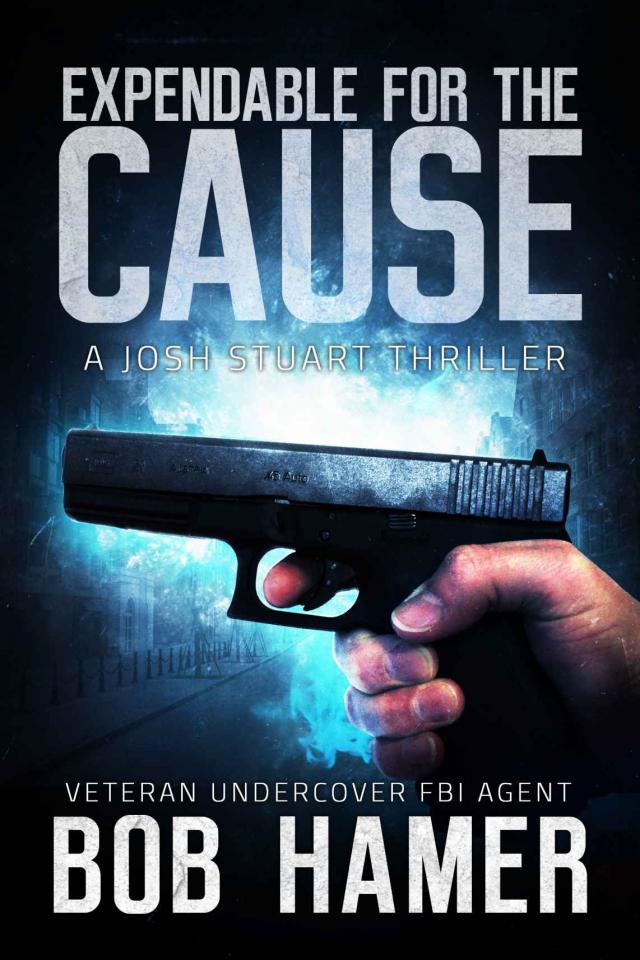
EXPENDABLE FOR THE CAUSE
A Josh Stuart Thriller (Book Two)
© 2016 by Bob Hamer
All Rights Reserved
Cover art by Christian Bentulan
This book is a work of fiction. People, places, events, and situations are the product of the author’s imagination. Any resemblance to actual persons, living or dead, or historical events, is purely coincidental.
No part of this book may be reproduced, stored in a retrieval system, or transmitted by any means without the written permission of the author and publisher.
Post Hill Press
posthillpress.com
CONTENTS
Chapter One
Chapter Two
Chapter Three
Chapter Four
Chapter Five
Chapter Six
Chapter Seven
Chapter Eight
Chapter Nine
Chapter Ten
Chapter Eleven
Chapter Twelve
Chapter Thirteen
Chapter Fourteen
Chapter Fifteen
Chapter Sixteen
Chapter Seventeen
Chapter Eighteen
Chapter Nineteen
Chapter Twenty
Chapter Twenty-One
Chapter Twenty-Two
Chapter Twenty-Three
Epilogue
CHAPTER ONE
It was the smell of death; not the odor of rotting corpses, I had experienced that stench during my time in Iraq more than a decade earlier. This was the death of hope: where far too many lived for the next ten-dollar fix, just enough “tar” to dull a shattered existence. A butane lighter, a bottle cap, and a fairly clean needle were the only cooking utensils needed or desired. Everything else took a backseat to the warm feeling a heroin-hit brought every few hours, a sensation that destroyed any thoughts of sobriety.
As I learned on this assignment, the people on Los Angeles’s Skid Row didn’t come here to live. Their optimism, expectations, and potential came here to die. Success meant a daily meal at the mission, a “new” frayed shirt, and a shower every couple of weeks to wash away humanity’s pollution. Here, where the city hemorrhaged poverty, dreams died as well: a grocery cart with four working wheels was a luxury vehicle and a cardboard box, a Beverly Hills condominium.
I had been on the streets for five weeks— it seemed like a lifetime. I hadn’t shaved or bathed in six days and the oversized sweat-stained clothes clung to my body on this unusually humid summer night. This was my urban camouflage; I had to blend in.
I ambled past the dozens of refugees camped on the sidewalk. Ragged tents and torn tarps served as their dwellings. My walk was staged and deliberate. It couldn’t be strong or quick. Not quite a shuffle, I had to be one more victim of society where nothing went right and everything had gone wrong. I had joined the pool of life’s losers.
Some, who were trying to medicate the pain of shattered relationships, were here by choice, refusing to take responsibility for their lives, failing to ever seek or even desire rehab. Others were mentally ill and needed more than the streets could offer; help was available only if someone took the time to care. Still others were genuinely down on their luck, victims of a financial downturn, an abusive spouse, a medical illness that drained a meager bank account. With God’s help and human intervention they might make it.
I was part of the invisible masses who occupied Wall Street—not New York’s affluent Wall Street but L.A.’s Wall Street. It was a vast contrast to the wealth exhibited on the East Coast; almost as if the city planners were making fun of the Big Apple. If the City of Angels needed an enema, look no further than this section of municipal blight, a mere block from the Los Angeles Police Department’s Central Division.
I kept moving, refusing to make eye contact, yet still maintaining situational awareness. People died for a pair of shoes, an errant glance, or for no reason at all.
In a few blocks, I could pick up the pace once I distanced myself from the city’s homeless. I dodged a few grocery carts, overflowing with the belongings of the wasted. Just bumping into one was inviting a confrontation, and I wasn’t interested in engaging some psychopath in a bout of street justice.
I’d grown immune to the pleas of the men and for the most part, the women. Their arms had track marks over track marks; scarred and collapsed veins evincing decades of abuse. They had neither the desire nor the will to recover. But the children were another story. They broke my heart. What chance did they have growing up in squalor, filth, and degradation? The kids didn’t choose this lifestyle. They were the true victims. Maybe in a few weeks I could do something for them. Maybe then I could make a difference.
A couple blocks north of Wall Street, I knew I was beyond the purview of the destitute. There was a feeling of momentary freedom. My pace quickened. In a few more blocks I’d be at the storage garage housing the technical equipment needed for this assignment. It was my only respite from the shallow world of L.A.’s inner city.
There was almost a sense of peace as I cut down a side street, welcoming the darkness, blotting out the desperation of the community I just left. Though the distant noises could still be heard, there was always calm as I neared my urban retreat.
***
“No!” came an accented scream from the alley across the street, shattering tonight’s tranquility.
It took me a moment to identify the direction of the shout as it echoed off the buildings. A second shriek provided the answer. I raced toward her continued wails.
The half-moon and a dim street light at the end of the trash-strewn alley provided limited illumination. In the backlit shadows, I could see a man on top of a woman as she struggled to survive. His fist slammed into her face as the attacker ripped at her clothing. This was rape, cold and calculating.
I grabbed the baby Glock secreted in the small of my back and added to the evening’s mayhem. “Hey, get off her,” I shouted, running toward the assault, garbage and broken glass crunching beneath my shoes. Now, I was out of character, no longer society’s victim, the role I played minutes before. I was fully engaged in saving a life.
The rapist was startled by the intervention and jumped off his prey. Wearing a tattered UCLA t-shirt, he grabbed at filthy cargo shorts hanging below his knees. Awkwardly reaching deep into his right front pocket, he pulled out a small semi-automatic pistol, visible even in the diminished light of the evening. Rather than stand his ground and confront me, the rapist chose to run. He broke into a short sprint and after only a few steps turned, firing a single errant shot from the “Saturday Night Special.”
I stopped momentarily, gaining a “flash sight picture” as training and muscle memory took over. I squeezed the trigger twice and felt the explosions as two 9mm rounds discharged from the Glock 26.
A loud obscenity pierced the night air. The man was hit, at least once.
I could hear the sound of metal, clanking on the pitted asphalt and assumed the attacker dropped his weapon. Continuing to give chase, I stopped only briefly to check on the woman.
With long black matted hair, dark eyes, and leathery mocha skin, she seemed numbed by the attack. She was wearing a tatty blue flannel shirt, the buttons ripped off during the assault. Her shorts and panties were pulled down to her knees. When I asked, she merely nodded, her eyes cautiously thanking me for interrupting the attack.
I continued the pursuit, racing out of the alley and down the street. Turning north on Winston, I found—nothing! The man was gone. The street was clear. I paused, hoping to hear any noise betraying the man’s location. Only distant sounds penetrated the silence. The attacker had just disappeared, nowhere to be seen.
I didn’t spend much time looking for the ghost and quickly made my way back to the alley, hoping to give whatever assistance the victim needed. But now the alley was empty. No woman, no gun, no evidence of an attack.
CHAPTER TWO
I didn’t have the luxury of time. If someone heard the shots and called 9-1-1, I would have a lot of explaining to do and the only explanation making sense meant compromising the case.
Trying not to block out the faint illumination of the moon and street light, I repositioned myself in the alley. Squatting down almost in a catcher’s stance, I strained to find a clue. Still nothing.
Then, just a few feet away I spied a fresh substance on the pockmarked pavement near where I assumed the attacker dropped his weapon. Using my index finger, I cautiously took a sample of the warm, thick, moist liquid. In the night’s limited lighting, I saw red plasma staining my skin. It was fresh blood. I
The alley catered to industrial businesses and at this hour no one was at work. The homeless seldom ventured this far from the missions and cheap hotels. No one seemed to be around to have heard the evening’s turmoil. I scanned the rooflines and garage doors looking for security cameras. No surveillance equipment was in sight. Apparently, the large metal gates spanning the alley business entrances provided the owners with sufficient protection from would-be burglars.
A quick search of the area revealed three spent cartridges, both of mine and the one from the attacker. I pocketed all three, then listened for sounds of approaching sirens, barking dogs, or bystanders. Again nothing. It was as if it never happened and that’s just the way I was going to play it.
I headed toward the storage facility, still several blocks north. Turning right at the third alley, I approached the second unit on the left. A purposely battered metal sign “S.M.C. Cartage” hung at eye level. No one ever asked, but it was the name of Bugs Moran’s front in Chicago, a warehouse where the St. Valentine’s Day massacre occurred in 1929. Bugs slept in that day and missed the 10:30 a.m. party, where on Al Capone’s orders seven members of Moran’s gang were slaughtered. What can I say, I’m a mob history buff!
Rather than open the galvanized steel garage door, I entered through the doorway on the left, both protected by a folding accordion gate stretching across the front of the storage facility. I punched in the code on the digital lock. Four numbers—4-7-2-7. Again, my way of paying “homage” to the bureau’s Puzzle Palace in D.C. The numbers, easy to remember, corresponded to the letters on the phone pad: H-Q-B-S. The distinctive click signaled the lock disengagement.
This was my undercover lair; if you can call a dusty, grease-laden, grimy-walled, sixty by twenty foot garage, a lair.
I always hoped for a Batman-type hideout trimmed in all the bells and whistles, but with FBI budgetary restraints I was lucky the bureau sprang for this refuge. At least I had a computer, a refrigerator, and the all-important private bathroom. Here I could conduct my personal business without interference from some hype trying to shoot-up in a public stall. Even the Wag Bags of Iraq beat some of the places I’d taken a dump since beginning the assignment.
I frequented the garage two to three times a week, with two distinct missions on each nocturnal visit. One was to place in an FD-504 ELSUR (electronic surveillance) evidence envelope, the microchip from the recording device I wore to each targeted meeting. Thus began the chain of custody process making the recording admissible in court should this matter ever get litigated. Secondly, I’d climb on the computer to complete the investigative reports, known in the FBI as FD-302s. These reports, once uploaded, allowed the office-bound investigators living in the luxury of the “teachers’ lounge” to access the file.
Since beginning the undercover operation, I only met once with the case agent. That meeting occurred after four days into the downtown assignment. She was incredulous I hadn’t made more progress. She expressed her disgust with the late night rendezvous, the offsite, and my pungent aroma. She made it clear she had no intention of ever making another voyage to L.A.’s inner city jungle at night. My reminder that a “homeless man” would draw too much attention accessing the garage during the day because the alley was busy with viable neighboring businesses, fell on deaf ears.
Rather than subject the Porcelain Princess, as she was known in the office, to the drudgery of L.A.’s slums, I suggested we communicate by email. She could pick up the microchips at her leisure, during normal work hours, from the two-foot square safe bolted to the garage floor, where I stored them after completing the chain of custody. She and her supervisor could keep current by reading the 302s I would upload on the Bureau supplied computer. Pleased with my initiative, the pressure was off. Since she could make the trek to the garage at her convenience, the progress of the investigation took a backseat to her shopping at Nordstrom’s and Bloomingdale’s.
The blood at the scene wasn’t much so I assumed the wound was minor, maybe that favorite of all-time warrior phrases, “just a flesh wound.” I pulled the Glock 26 from my waistband. I was two rounds down and needed to top off the ten round magazine from a box of ammunition I kept in the safe.
We discussed the weapons issue before the assignment began. The police took an active interest in the area surrounding their Central Division. The law enforcement presence was strong and I couldn’t afford a routine “stop and frisk.” The Princess was concerned if I got caught with a gun it would compromise her investigation. Her anxiety was administrative but mine was personal. I wasn’t interested in being victimized by a violent street hustler; or as evidenced tonight, I might need to protect others. Without waiting for her input or approval, I told her I could easily conceal the baby Glock and the issue was settled.
Our evidence custodian in Memphis, my home office, found an older 26 in the inventory. I wasn’t all that concerned with barrel length as I was lethality. The weapon had just the right amount of scratches and wear, far from something fresh out of the box. I wrapped black tape around the grip to make it appear more like a gun you would purchase off the street. Before the assignment began I spent a long day at the range and got familiar with my new best friend. Tonight, that friendship saved the life of someone I might never see again.
I completed all the administrative information on the manila evidence envelope, dropped the microchip inside, signed and sealed the outside, and placed the package in the floor safe. Before securing the door, I took a new chip out of the vault and prepared anew the efforts in collecting criminal proof of a federal violation.
Working undercover meant more than a fake driver’s license and a fictitious name. It was living life as a liar for hours, days, even months at a time. It was becoming one of them without being one of them. Distance offered detachment, but when you went undercover it became personal. It was getting close to people whom you will ultimately betray and probing the darkest side of humanity, including your own. It was playing Judas to those you befriended. And unlike Hollywood, there were no retakes—a botched line or a missed mark—could mean instant death.
In the past, I’d played the Ritz-Carlton high-roller, the sophisticated international arms merchant, even a moneyed white-collar mark, but now I was thrift store chic. I was dirty, broke—and loving the challenge!
***
Prior to pounding out my report on the computer I punched in a familiar number on the cell phone.
Will Terashita answered on the fourth ring.
“You awake, crime fighter?” I asked.
“What phone are you using?”
“It’s a throw away. My case agent has a serious case of the for-reals and supplied me with another Walmart special.”
“Only the best for the bureau’s answer to James Bond,” said Will in his native smartass.
“You got that right. So what’s the dragon-slayer up to on this beautiful Southern California evening?”
“Actually you caught me at a great time. I’m working a four to midnight shift and we just learned our tango missed his flight. I’m at LAX trying to figure out how to waste a couple more hours. What’s up?” said the former Marine and FBI Academy classmate.
“I’ve got a couple of beers cooling in a seized refrigerator if you want to stop by.”
“Are you still camped out in shantytown?”
“Yeah, almost five weeks now, just kickin’ back, down and out in Beverly Hills Light, livin’ the life in my warehouse garage.”
“I remember it well. S.M.C. Cartage, if I recall,” said Will.
“You got it.”
“I’ll be there in about twenty. Traffic shouldn’t be bad at this hour.”
“Great, that’ll give me enough time to finish up a 302 and check emails.”
“You want me to pick up the Porcelain Princess and make this a threesome?” joked Will.
“Come alone. Her Royal Highness doesn’t understand the vagaries of my work and I need to share a cold one with someone who does.”