

The Scent of Burnt Flowers, page 1


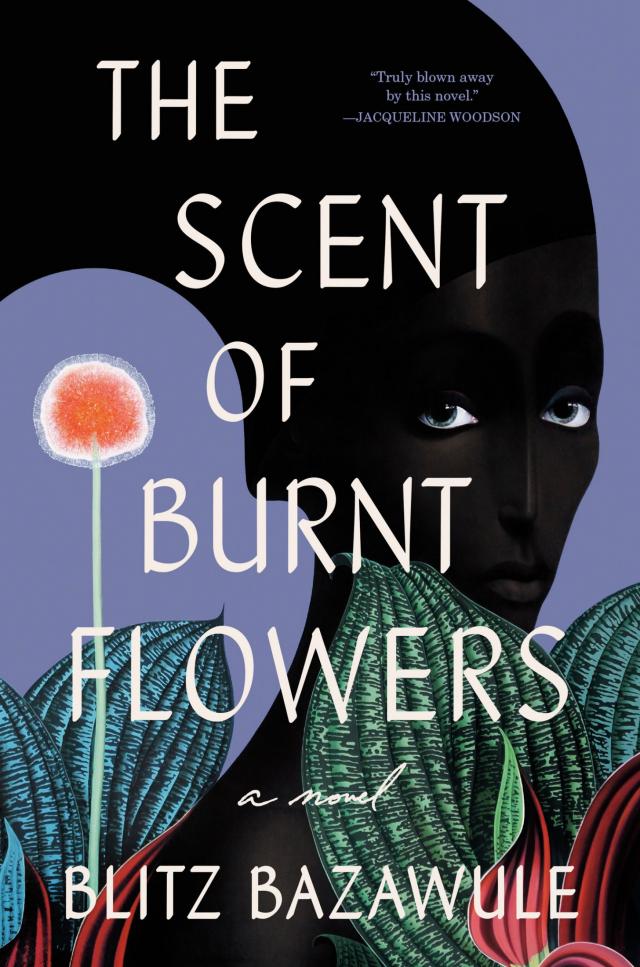
The Scent of Burnt Flowers is a work of fiction. Names, characters, places, and incidents are the products of the author’s imagination or are used fictitiously. Any resemblance to actual events, locales, or persons, living or dead, is entirely coincidental.
Copyright © 2022 by Blitz Baza, Inc.
All rights reserved.
Published in the United States by Ballantine Books, an imprint of Random House, a division of Penguin Random House LLC, New York.
Ballantine and the House colophon are registered trademarks of Penguin Random House LLC.
Library of Congress Cataloging-in-Publication Data
Names: Bazawule, Blitz, author.
Title: The scent of burnt flowers : a novel / Blitz Bazawule.
Description: New York : Ballantine Books, [2022]
Identifiers: LCCN 2021054440 (print) | LCCN 2021054441 (ebook) | ISBN 9780593496237 (hardcover) | ISBN 9780593496244 (ebook)
Subjects: LCSH: African American couples—Fiction. | Fugitives from justice—Fiction. | Ghana—History—Coup d’état, 1966—Fiction. | LCGFT: Magic realist fiction. | Historical fiction. | Novels.
Classification: LCC PS3602.A9935 S27 2022 (print) | LCC PS3602.A9935 (ebook) | DDC 813/.6—dc23/eng/20211124
LC record available at https://lccn.loc.gov/2021054440
LC ebook record available at https://lccn.loc.gov/2021054441
Ebook ISBN 9780593496244
randomhousebooks.com
Book design by Victoria Wong, adapted for ebook
Cover design: Tristan Offit
Cover art: Slava Fokk
ep_prh_6.0_140224945_c0_r0
Contents
Cover
Title Page
Copyright
Epigraph
Part 1
Chapter 1
Chapter 2
Chapter 3
Chapter 4
Chapter 5
Chapter 6
Chapter 7
Chapter 8
Chapter 9
Chapter 10
Chapter 11
Part 2
Chapter 12
Chapter 13
Chapter 14
Chapter 15
Chapter 16
Chapter 17
Chapter 18
Chapter 19
Chapter 20
Epilogue
Dedication
Acknowledgments
About the Author
“Aboa bi beka wo a, ne ofiri wo ntoma mu.”
Akan proverb
“If an animal will bite you, it will be from your cloth.”
PART 1
CHAPTER 1
Accra, 1966
Bernadette awoke to the sound of a loud blast and thought Melvin had shot himself. She had feared this day would come, yet nothing could prepare her for it. The flickering light that illuminated the small hotel room blinded her as she slid off the bed trembling. She could feel her heart pounding through the silk nightgown she had hurriedly packed the night they fled Philadelphia for Accra, a city she had only read about in the newspapers.
The story was about a young boxer who won a gold medal at the 1964 Olympic games. “Accra,” she had said out loud, finding the name fascinating. She never imagined that she would be a fugitive in that same city just two years later.
The sound of gunfire piercing the air jolted Bernadette once more. The hotel balcony door swung open, sending in a rush of light. Melvin leaned in and smiled. “It’s just fireworks, babe. Happy New Year!” She sighed, deeply relieved. The sky burst into a thousand shimmering colors silhouetting Melvin’s towering frame. Even then, she could still see his bright piercing eyes, gazing ardently at her. Bernadette wrapped her arms around his broad shoulders and sobbed quietly.
“It’ll all work out, babe, I promise,” Melvin whispered.
This wasn’t the first time Bernadette had heard those words, but tonight she believed him. Maybe it was the cacophonous crowds celebrating the new year or the ephemeral fireflies floating through the night sky. She truly believed it would all work out. Melvin poured Bernadette a glass of water and they sat on the hotel balcony watching the fishermen stagger in a drunken stupor. A crackling bonfire brightened the canoe sails that billowed at the mercy of the wind, casting an ominous shadow on the beach. Occasionally, a young couple or two would stroll hand in hand toward the crashing waves, avoiding the large groups of women clad in all white who had congregated for a new year’s prayer meeting. Amid the pulsating atmosphere, a somber highlife tune seeped out of a nearby transistor radio, captivating Melvin and Bernadette. Melvin held his hand out to her, a small assurance. They swayed in each other’s arms, overlooking the glimmering fireworks that brightened the city that had given them temporary refuge. Bernadette felt the ocean breeze and mosquitoes buzzing around her ear, and she thought about how similar Accra was to her childhood home of Baton Rouge, Louisiana. The humid smell that lingered after a brief downpour reminded Bernadette of a story her grandmother told her about the day she was born. A day she thought about more frequently as she worried her days were drawing nigh.
* * *
—
It was the summer of 1935, and a season of hurricanes and heavy rains had flooded the Mississippi River. Bernadette’s mother, Alice Broussard, was already in labor when news of the broken levees spread like wildfire. Bernadette’s father, Bernard Broussard, had died earlier that summer in a bizarre boat accident on the same Mississippi River that would soon swallow Baton Rouge. The only family Alice had was Bernadette’s grandmother, Ma’ Susan. The two lived in a small shotgun house near Magnolia Mound Plantation, an edifice that conjured the enduring legacy of chattel slavery. The flood soon overwhelmed everything south of Merrydale, and the ineptitude of the state relief agency guaranteed a muddled rescue effort.
When it finally began, the evacuation was for white residents only. Alice and Ma’ Susan hid in the attic, hoping the top floor would serve as safety, but they were soon submerged. The ferocious thunderstorm that battered the house that night drowned Alice’s screams as she pushed new life into the world. Ma’ Susan held her breath underwater long enough to cut the umbilical cord and wrap baby Bernadette in a wet blanket. That was when she witnessed a moment so magical that she never told anyone, except Bernadette.
Alice began to drift below the attic, which had mysteriously collapsed into a vast ocean. An otherworldly light emanated from her torso, transforming her into a mermaid. As Ma’ Susan struggled to keep Bernadette afloat, a force lifted them above the water. Alice smiled, waved, and disappeared into the deep dark ocean, leaving Ma’ Susan forlorn and grief-stricken. Her tears were swallowed by the deluge, which had now reached the ceiling. Then Wilbert Benoit, a beloved Negro businessman, floated to the attic window with his paddleboat. He had been circling West McKinley Street searching for survivors when he heard the wailing cries of a baby. It took almost an hour of prying and sawing to bring baby Bernadette and Ma’ Susan safely aboard.
The subsequent scale of destruction was overwhelming. It took six months of dredging for the floodwater to recede. When it finally did, Alice’s body was never found. Ma’ Susan remained unequivocal about what she had witnessed that night. She called Bernadette “Water Baby” and often recounted her mythical birth story.
Of course, Bernadette didn’t believe a word of it, but her affinity for water was evident nonetheless. She spent countless hours in the beige clawfoot bathtub her grandmother had bought at a yard sale. Bernadette often passed out while submerged. On more than one occasion her grandmother walked in and thought she had drowned. It seemed Bernadette could breathe underwater as easily as she did above it. Now, with her present predicament, she wished for that same ease of breath.
* * *
—
A gentle tug on Bernadette’s shoulder woke her up. She turned to see Melvin fully dressed and lighting a cigarette nervously. “We gotta go, babe,” he stammered.
Bernadette sprang to her feet. “They found us?”
“Not sure, but it’s best we go now.”
Flustered, Bernadette dashed into the hotel room, leaving Melvin to languish on the balcony. He took an anxious drag, exhaled, and cast his gaze across the street, where the fishermen had celebrated the new year. The first light of sunrise blinded him. Abrasive sounds of cars honking and haggling street vendors added to his throbbing headache. Accra was indeed a sprawling metropolis, and from where Melvin stood, he could see it all. The stoic police officer in his crisp colonial uniform, overwhelmed by the traffic. Motorcycles and rickshaws, zigzagging past frustrated passengers in boneshaker buses. European businessmen ill-adjusted to the tropical heat. And in the middle of it all stood the statue of the man who had brought independence. The reason Melvin and Bernadette had fled to Ghana in the first place—Kwame Nkrumah.
* * *
—
“I’m ready,” Bernadette said as she stepped onto the balcony wearing a colorful floral dress. She adjusted her wide-brimmed hat that rendered her inconspicuous. Her smooth brown skin glowed in the humid equatorial heat, as she dabbed beads of sweat trickling down her forehead. Bernadett
“How many of them you see?” Bernadette asked, grabbing her suitcase.
“Two, maybe three. If they ain’t FBI, they sure dress like ’em,” Melvin said, adjusting his pastor’s collar in the mirror. The same pastor’s collar he had bought at the Snyder Avenue Costume Shop in Philadelphia. The Christian missionary disguise was the best option he could find. To Melvin’s surprise, he actually looked the part. His dark shaven face, precisely parted hair, and general fastidiousness gave him the air of a clergyman. Melvin had just turned forty-two and his Sidney Poitier–esque posture made his costume fit like it was tailored. Bernadette was supposed to play the pastor’s wife, even though they were only engaged. Melvin flipped the suitcase buckle and grabbed a .38-caliber Ruger. He tucked it in the small of his back and recalled how simple it was to smuggle a loaded gun on an international flight. As long as the customs officers saw his Bible and pastor’s collar, he was exempt from all scrutiny. It also helped that all the men were distracted by Bernadette’s perfect hourglass figure, a sticky point for Melvin in their otherwise stable relationship.
A knock on the door startled Melvin and Bernadette. They exchanged nervous looks as the knock echoed again. Melvin dug out the revolver and aimed it steadily at the door.
“Who is it?”
“Cleaning, sah,” a languid voice replied.
Bernadette sank into the bed, relieved. Melvin lowered the revolver. “No cleaning today, ma’am.”
They waited until they heard the cleaning lady wheel her cart to the next room, then grabbed their bags and snuck out through the hotel balcony. Melvin and Bernadette hurried down a spiral staircase that wrapped around a large neon sign that read SEA VIEW HOTEL.
The diagonal arches led to the hotel lobby, where Melvin had gotten in the habit of scouring through local Ghanaian newspapers. He feigned curiosity about local news, but his real objective was to make sure there was no mention of either him or Bernadette. That was where he struck up a conversation with the front desk receptionist about Cape Coast.
She was a tall woman with tight braids that appeared to pull her large eyes farther apart.
“Yes sah, Cape Coast is where most of our guests go for sightseeing,” she told Melvin in an affable tone. “It’s not too busy as Accra and the beaches are cleaner.” She scribbled a list of accommodations and sightseeing options on a hotel pad, then told him where he could catch the bus.
* * *
—
As Melvin and Bernadette approached the bus station, a group of head porters jostled to offer their services.
“Pastor, make I carry give you,” they muttered in a chorus.
“Pastor wife, I beg make I carry.” They turned their attention to Bernadette when they realized Melvin was unyielding.
He had been warned by the same receptionist never to let go of their bags, especially the one that hung on his shoulder where he carried all his money. So Melvin declined the head porters, much to their chagrin. They meandered through a queue of passengers engulfed in billowing smoke from a vendor selling roasted bush meat. A repugnant air hung over the bus station. A rare blend of sweat, frustration, and indifference. Bernadette kept her white handkerchief blocking her nasal passages, breathing only through her mouth. The occasional hurling of insults between a group of bus drivers punctuated the riotous passengers.
Melvin finally spotted the ticket counter, a makeshift stall that hadn’t seen a coat of paint in years. The man sitting behind it was a sort of relic himself. His faded oversized cap, a hand-me-down from a former British administrator, covered his deep sunken eyes.
He lifted it when he asked, “Where to, sah?”
“Cape Coast,” Melvin answered, digging in his wallet.
The ticket agent pointed ahead. “You want coach, boneshaker, or bus?”
The coaches had been imported by the British colonial government. Although they were more luxurious, they took twice the amount of time to get to their destination. The boneshakers were used to transport farm produce and the few passengers brave enough to share close quarters with goats, chickens, and sometimes wild boars.
“We’ll take the bus, please,” Bernadette said.
The ticket agent nodded and ripped out two tickets. “Good choice.”
The aroma of roasted plantain and groundnuts filled the bus as Melvin and Bernadette climbed aboard. Bernadette slid into the window seat, fanning herself vigorously. Her efforts only exacerbated Accra’s sweltering heat, which she was beginning to detest. A young vendor approached Bernadette’s window carrying a stack of freshly baked bread that seemed to reach the heavens. She mumbled something in a local dialect, and Bernadette shook her head. “My dear, I don’t understand.”
A woman wearing a large headscarf turned to Bernadette. “She said she likes your hat.”
Bernadette thanked her and bought a loaf of bread she didn’t intend to eat. The passengers jolted forward as the driver put the bus in motion. Loosely welded seats squeaked with each pothole they encountered, competing with the fluttering sound of the diesel engine that left a pungent smell in the bus. To make things worse, a discordant highlife song blared out the janky speakers as the bus sped down the dusty road.
* * *
—
Melvin’s headache had subsided when the bus passed a sign reading YOU ARE LEAVING ACCRA REGION. Bernadette was fast asleep, slumped over her seat. Melvin glanced at the empty road and it made him nostalgic. He pulled out an old photograph from his wallet and rubbed his thumb across the worn edges. The feeling transported him as he gazed at himself, twenty-five years younger, standing next to his then best friend and now president of Ghana, Kwame Nkrumah.
How Melvin and Nkrumah met on the front steps of Lincoln University was a case of serendipity. Melvin had never dreamt of going to college. In fact, no one in his family had ever made it past the sixth grade. It was expected that Melvin would join his father at Mr. Moretti’s sawmill, which had already employed two generations of Johnsons. Melvin’s grandfather, Otis Johnson, had worked at the sawmill after he saved enough money to purchase his wife’s and son’s freedom from a Virginia plantation. Otis was a master saw operator and soon trained his son, Earl, as his assistant. Melvin was next in line, or at least he thought so, until the day of the accident. Everyone knew his father was an alcoholic, but it never affected his work. He must have been inebriated beyond what was usual, because one afternoon, he ran the saw without lumber. When the metal blade started shooting sparks, Earl stuck his hand inside to stop it. Needless to say, it was a bloody mess when the ambulance finally arrived. As Melvin stared at his father’s bloody tourniquet and heard the sirens wailing down the road, he made up his mind right then, anything was better than Mr. Moretti’s sawmill.
That summer, Melvin applied to Lincoln University after discovering that his favorite poet, Langston Hughes, was an alumnus. He had very little hope of being accepted, however. So when the letter came in a white paper envelope, it took him a whole week to open it. When he finally did, he found a full-ride scholarship and a bus ticket from Virginia to Pennsylvania.


