

All That It Ever Meant, page 1


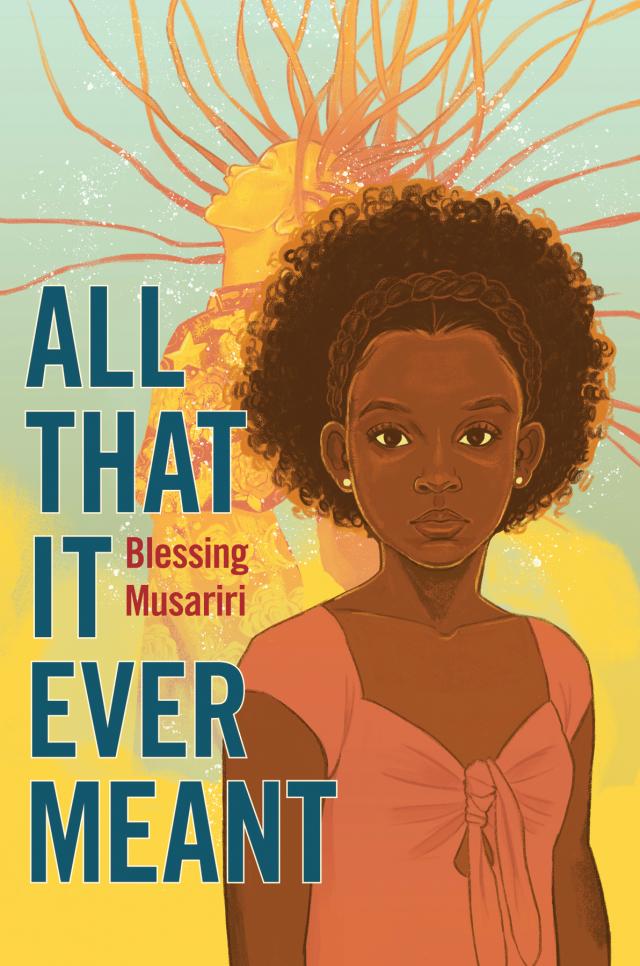
ALL THAT IT EVER MEANT
A NOVEL
Blessing Musariri
ACCORD BOOKS
NORTON YOUNG READERS
An Imprint of W. W. Norton & Company
Celebrating a Century of Independent Publishing
To my favorites, my fam away from fam, the best and beautiful Sophia, Bert, Lindi, and Yande Haitsma. Thanks for the spark that got the fire going.
CONTENTS
Prologue
Chapter One
Chapter Two
Chapter Three
Chapter Four
Chapter Five
Chapter Six
Chapter Seven
Chapter Eight
Chapter Nine
Chapter Ten
Chapter Eleven
Chapter Twelve
Chapter Thirteen
Chapter Fourteen
Chapter Fifteen
Chapter Sixteen
Chapter Seventeen
Chapter Eighteen
Chapter Nineteen
Chapter Twenty
Chapter Twenty-One
Chapter Twenty-Two
Chapter Twenty-Three
Chapter Twenty-Four
Chapter Twenty-Five
Chapter Twenty-Six
Chapter Twenty-Seven
Chapter Twenty-Eight
Epilogue
Acknowledgments
About the Author
About Accord Books
ALL THAT IT EVER MEANT
PROLOGUE
HERE is the short version. Chichi swore at Baba and he went mental.
CHAPTER ONE
AND, she’s still swearing, but he’s ignoring her. He’s ignoring all of us. Baba hasn’t spoken to us since we left England. Only to give instructions. I don’t blame him. I don’t feel like speaking either. Only it’s hard times for Tana, but he’s tired of hoping things will change and has given in.
“Dad! What is this? I mean really Dad! This is fucked up.” Chichi is walking around the vehicle, throwing her long braids back as she peers into the door in the side. It looks like an army truck, if they were having a mobile sleepover. I want to feel some kind of way about everything but not right now.
I don’t swear. I’m not cool enough and never angry enough. They’re just not my words. I’d have to practice saying them, become comfortable with them, try them out and then make that commitment. I’m not looking for relationships of any kind right now.
The “what” Chichi is asking about is an overland expedition truck. Baba and Babam’kuru Alois are walking around it kicking tires (as if), checking this and that and watching the gardener load up supplies.
It would be exciting and fun, if everyone weren’t so angry and raw in the middle. Tana’s eyes are huge in his little face and for the first time in days, he’s buzzing. He’s never ever been this buzzed his whole life I don’t think. I’m happy for him.
Our cousins are away at boarding school, so we won’t see them. We’re missing them by a few days. Babam’kuru says when we get back, we’ll see them. I feel like he’s maybe glad they haven’t come back because he’s been commiserating with Baba since he picked us up from Robert Gabriel Mugabe airport. This morning Baba told Chichi, “Those shorts are too short.” She muttered under her breath, flipped her braids at him as she walked away, but didn’t change. I saw the look on Babam’kuru’s face. It said, “No child of mine would ever!” He opened his mouth to speak but Baba put a hand on his shoulder and he kept the steam inside his own head. He’s Baba’s older brother. His wife, Maiguru Anesu, goes to work really early, but even if she had been here she wouldn’t have said anything. She’s very soft and smiley and doesn’t take anything too serious. When Chichi was huffing around their house being a monster, she just carried about her business being nice and smiley about everything. Tana melted himself into her and soaked up all the good vibes. I want to be better to him, but it’s not a good time.
I’m having a kind of problem that no one would believe, so I’ve not said a word. Also because we’ve all been so angry, I’ve felt that I have to respect that dynamic for us right now. There’s good reason. If I’m honest, though, I stopped being angry before we even got to Heathrow—a day or two before actually, because I don’t really do long-range things. There’s just so much going on, who has the bandwidth for things from yesterday?
It happened for the second time the night of the “BIG FIGHT,” as I call it. Not during, or before, but after. Way after. In fact, even the house had finally settled itself down after all the agitation and things were quiet quiet. I thought I’d fallen asleep, but obviously not because I sat right up in my bed when I smelled it. Smoke, a dank kind of greenish heavy smoke coming from the chair at my small desk.
Now let me tell you something about me: nothing I feel actually ever comes out right then. Inside, it will be fight of the century—heart being all crazy in my rib cage and knocking itself about its walls, tongue in a kind of torture chamber where it’s being pricked by a million hot needles, head being squeezed by an invisible vise while somewhere a bass drum is reverberating through my bowels, threatening to evacuate things without notice—but if you look at me, I will be still and watchful like I’m not bothered.
There is a part of me that wasn’t surprised. It’s a small part that only ever raises its hand much later on after all the rest has calmed down. What I saw, when my eyes adjusted to the dimness of the night light, was the same thing I saw the day the world turned upside down, and that was in broad daylight, so how and why was this strange-looking person sitting in my room, at my desk, long into the night, smoking some ganky pipe? They hadn’t looked like this that day—all dressed up in layered tassels of shimmering threads, a Viking helmet on a head of waist-length dreadlocks. I wanted to say something, but my heart got all breathless, so we looked at each other for a moment. Something in me, very far away, heard them speak—I couldn’t tell you what they said, I just heard my own voice say no, and I turned away.
CHAPTER TWO
I’M going to tell you exactly how everything happened. Baba always says, Mati mwana’ngu, I love a good story but I don’t have time for a long one, so make it short. When I was three, I used to tell people that my name was Matiponesa Mwana’ngu Mufanani. Mama and Baba used to laugh their heads off. Of course, it turns out, mwana’angu is what you say to your child to let them know they’re yours and you love them but you don’t want to hear a long story, or you want to sweeten them up to pass you the remote or get you a glass of water, even though you could do it yourself. “Matiponesa, my child, I’m in a hurry so make it quick.”
Some stories can’t be “made quick” because you wouldn’t even want to tell them if you didn’t have to, so you start with the things that are easy, like, how it was in our house. I’ll start with Chichi. Chichi will tell you all about music, remixes, mixed tapes, long play, ee pees, studio time ee tee cee ee tee cee. She’s going to be discovered any day now and go and be in a girl group. Tana is her biggest fan, but to be honest I think he’s just scared of her. She’s a mixed bag and you’ve always just got to be ready for what you’ll get—there’s no putting your hand in to look for the one you like, on any day, you get what you get and that’s that. On some days you can get more than you would really want, ever.
Normally I might tell you that Mama was arguing with Chichi about rolling up her skirt at the waist to make a mini of her school uniform, and calling Tana down for almost the tenth time—she always says, I’ve called you almost ten times now, COME. DOWN. NOW! The last three words are always big letters, it’s like you can see them come barking out and up the stairs to bump, smack-dab into Tanatswa. You can talk to Tanatswa all you like in capital letters, it’s all the same to him if you’re Mama or Baba and sometimes me, he will do what you ask when he feels like it and not one second before. If you’re Chichi, you can give him your lunch pack as we go in to school and tell him to hold on to it for you until lunchtime but not to look inside and he would hear every word the first time and know that it’s probably more than better for him to look as soon as he can.
This kind of normal ended for us months ago. It was break time when the Head sent messages to come to his office without delay. Auntie Monica was waiting for us. It made no sense, she’d never picked us up before and certainly we’d never had to go home before time unless one of us was sick. All present were in good health so what was Auntie Monica doing in our lives, out of step?
“What’s happened? Why are you here, Auntie?” Chichi doesn’t chew her words, especially when things are out of kilter.
“Your father asked me to pick you up, we need to go home.”
“Why? What’s happened?” Chichi doesn’t just do things because you tell her to, Auntie Monica knows this but that day, she wouldn’t have been able to tell you if it was wet or dry outside, she was there in body and that was it. She opened her mouth, then closed it again, saying nothing. Chichi backed away from her shaking her head. “No! No! No! No!” she said, waiting for Auntie to say it was okay. But it wasn’t. Me and Tana, we were statues, we had done the math. Maybe if we said nothing, if we stayed perfectly still, things would right themselves again.
At home, we went from room to room looking for her—Chichi thundering through doors and cupboards—as if she would find Mama hiding in a chest of drawers any minute, saying how it was just a prank, me and Tana in her wake, a wide-eyed, breathless tail, fear floating behind us like a superhero cape and some far-away high sound in my
When someone dies, it’s the death of everything the way you knew it. The Death stains everything and there’s no washing it out. I was struck dumb. Nothing was real to me anymore.
CHAPTER THREE
NO one wanted to go back to school after the funeral. It didn’t seem right that everything had changed and yet nothing had changed. Even though people at school said, Sorry for your loss and all, it meant nothing to them that Mama was not in any of the places she was supposed to be, that it was a real problem for us. Baba had come back from Zimbabwe drifting. Without Mama he had to find what could take the place of the part of him that was no longer there, and he was failing. He’d never not known what came next. What he didn’t realize is that whether he knows it or not, it comes anyway, especially with Chichi and Tana doing shenanigans. One day Tana was eating peanuts by throwing them in the air and catching them in his mouth, only he caught one high up in his nose and it wasn’t inclined to come out no matter how hard he blew. He was frantic. Baba was so irritated that he shouted in a completely over the top way, even sending Tana to his room and muttering under his breath about stupid stunts and recklessness. But when Tana made a bomb in the kitchen with sugar and other things, in a jar (an experiment), and exploded it against the neighbor’s fence, Baba just shook his head, went to his room, and shut the door. And Chichi? Well, she went above and beyond, as if doing all the things Mama wouldn’t have liked might bring her back just so she could scold her. But Baba either was not home to see it or didn’t have the bandwidth when he did. I would see his breath gathering and then ebb away, falling short of the finish line. It was like Mama had been our meeting place and now that we had no place to meet up anymore, we kept to our own corners, words and all.
It’s not nice to think this, but sometimes I even wonder why Mama had Tana. I mean, I love him and all and he’s usually kind and sweet, but he needs too much love and I think that’s why when he was little, Mama was always shouting at him. It could also be because that wasn’t a good time in her life and he didn’t have the good sense to stay out of her way. Me and Chichi, we knew when it was stormy weather in the house. Mama would put on a lot of makeup and look at herself in the mirror. Really look, as if she had lost something inside herself and was hoping to one day catch it unawares. She would spray a cloud of Issey Miyake, put on her high heels, and stomp around in the house muttering to herself. We would always have microwave fries, frankfurters, and beans on a day like this, because Chichi would have to cook. Baba would look after his own dinner when he got home, but we would have escaped into our rooms long before then—quiet as dust.
When the season of storms passed, she became Mum, not Mama. “We’ve been in England since you were born, you should call me Mum. It’s the Queen’s English and we are in Rome so we must do as the Romans.” This didn’t make sense to me at all but we called her Mum and she stopped speaking to us in Shona altogether. Neither to us nor Baba. She even wouldn’t speak it to her family back in Zimbabwe when they called. She was spending a lot of money on clothes she’d put away in the spare bedroom, until there wasn’t any space and Baba said, “Mufaro, this has to stop!” She looked at him, he looked at her, and then she started to cry—just tears running down her cheeks. Baba sighed and took her in his arms. He rubbed her back and said, “I’m sorry, it’s not easy, I know.”
That’s when the cleaning started. You wouldn’t think a clean house would be a problem, but I got to thinking that she wished she could vacuum us right up with the crumbs we left on the sofa. If you were eating anything, you had to better finish it right there and then because if you blinked and looked away the plate would be in the dishwasher so fast and whatever was left would be sitting nicely in the bin already doing meet and greet with the rest of the rubbish. Those were hard days. We were almost afraid for our feet to touch the floor. Chichi said she felt she shouldn’t even be there, like she was messing up by even breathing wrong. Tana would sit as still as a post, and not even one of those that has a lamp at the end of it, that would be too bright and promising; no, he would sit like concrete inside of concrete, the very heart of a post.
But the storms were fun times compared with the absence that took over after The Death. For some time after, the house was full and funereal. It belonged to Auntie Monica, ’Nini Saru, Babam’kuru Alois, and Baba’s friend Mr. Joe. Baba didn’t want to be in it and when he was, he would be lost in the space behind himself or lying down on Mama’s side of the bed. He heard nothing anyone said to him, nodded and said okay a lot. Even at the funeral, Babam’kuru Alois and Mr. Joe made the speeches for him. Then everyone left for Zimbabwe to continue the funeral there, except Auntie Monica, who stayed with us. It was going to be too much: dead bodies cost an arm and leg to take back to their motherlands, and even though Baba made good money Babam’kuru Alois did not feel he should get a matching set of deep holes—one of debt to go with the one of grief. Plus, he said, funerals back home are now three days at least and the kids are already past their limit. He wasn’t wrong: Chichi was the quietest she’d ever been, Auntie Monica had to sweet-talk her like a toddler to eat, to bathe, to get up and get dressed. Tana was a robot that only needed someone to enter the commands. And me? I was caught up in the absence—the forever silence of my mother’s voice.
CHAPTER FOUR
WHEN Baba told us we were coming to Zimbabwe, no one said anything, not even Chichi, and not only because she wasn’t talking to anyone but because even Chichi knows when she’s pushed too far. Baba was not putting up with any more from us. All that was left was for ash to start spewing into the air and cover us. He was molten inside. We could all feel the heat.
We took an Uber to the train. Baba packed for Tana and dealt with his luggage. Me and Chichi, we packed our own bags and pulled them along. Baba told us if our bags were overweight it would be our own problem, so we’d better listen to him when he said no more than twenty-three kilos apiece. I didn’t blame him for not liking us. I blamed Chichi, so I didn’t mind that we were not talking and when she asked for help to put her bag on the scale I pretended not to hear her and went downstairs for a long time. It should have been exciting that we were going to Zimbabwe because we’d been before and we’d liked it, but this time it felt like a punishment. Also after The Death, everything was unsteady, it felt like anything bad could happen any time. I was scared that maybe Baba planned to leave us somewhere out there and return to live a peaceful life without us. I think Tana feared the same.
When Chichi hasn’t driven him around the bend and back again, Baba is really nice. He’s very clever and interesting and he laughs a lot. Well, he used to laugh a lot. Between Mama and Chichi, they managed to show him that if you are too happy, they know what to do about that. I think they felt that he didn’t deserve to be so happy if they weren’t, and if you asked me why they were so mouth in their noses about everything, I really couldn’t tell you. I don’t remember the last time I was really happy, but I’m not going to drag people into the pit with me anytime I feel some kind of way about it.
Baba is a boffin. He grew up in the village with his grandma, but some people visited there who saw that he was too clever to be stuck in the back of the boonies reading from candles at night. They sent him to school in Harare and then found him a scholarship to go and study medicine in England. Only he took Mama with him, because even though he was a boffin he wasn’t smart enough to not give her the gift of Chichi before he left and so they got married and decided they might as well have me and Tana and create a little Zimbabwe of their own in England—country population of which was five, now four.


