

The Plot Against Native America, page 6
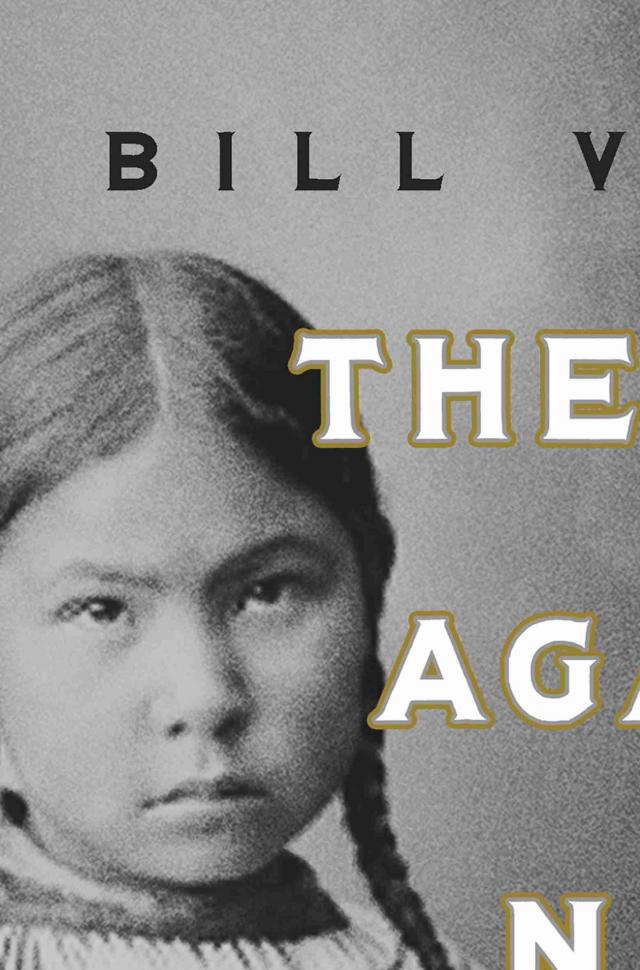


The cousins watched as archeologists and a forensic anthropologist from the U.S. Army Corps of Engineers unearthed Shorty’s grave and took his bones to a laboratory for cleaning and analysis. After determining that these bones were those of a male Shorty’s age they transferred them to a simple wooden casket measuring eight inches deep and thirty-three inches long. The calcium deposit on his ribs was likely produced by a lung infection. The cousins were also told that deer, cattle, and pig bones were found in his grave, the result of that fact that the cemetery grounds had previously been used as a dump for animal scraps from the school’s kitchen.
Shorty was buried in Holy Family Mission Cemetery on the reservation as a gathering of Blackfeet people looked on. “We are the same as him,” Gladstone said. “That could be me. That could be Joe. That could be my cousin. His life was just as important as any member of our tribe.” Because the cousins had learned at Carlisle that one of the few things Shorty liked about Carlisle was its sports programs, they put a football and a baseball mitt in his casket before it was lowered into the ground.11
Chapter Three UNDER THE BIRD TAIL
In November 1892 Nancy Bird entered Mount Angela Institute at St. Peter’s Mission the same way she entered Carlisle—with a lice check, a bath, and a change of clothes that included boots and a heavy, ankle-length wool dress. This time her parents had no choice about enrolling her in school. Congress had passed a compulsory attendance law the year before that authorized the Commissioner of Indian Affairs to withhold rations, clothing, and other annuities from families who did not offer to send their children to an assimilation center. Fathers who refused could be jailed. Nineteen Hopi leaders from the village of Orayvi in what is now Arizona were arrested in 1894 after refusing to send their pueblo’s children to a government boarding school thirty miles away. They spent almost a year at hard labor on Alcatraz Island. Perched on a mesa, the 1,200-year-old adobe town is the oldest continuously inhabited built community in North America.
The Blackfeet Indian Agent, George Steell, ordered tribal police armed with rifles and revolvers to round up kids at gunpoint if necessary and ship them to one Montana school or another. Besides St. Peter’s those included Holy Family Mission on the reservation, which was operated by the Jesuits, and the federal government’s Industrial Indian School at Fort Shaw. Steell continued shipping Piegan children to Carlisle until he quit his job in 1896 after realizing he could make more money selling his ranch’s beef to the reservation than administering Indians for the government. Because the spirituality of the Birds included both Blackfeet and Catholic elements, and because unlike some other Métis girls Nancy could speak English, she was shipped to St. Peter’s, where she joined 110 Métis and full-blooded Native American girls. The school also boarded or day-schooled children from White settler families in facilities strictly segregated by sex and race. Records indicate that Nancy left Carlisle because of ill health. If her malady was diagnosed the results were never recorded. But it’s likely she wasn’t suffering from a physical ailment. She was probably homesick.
The daily routine was similar to that of Carlisle. In the morning and afternoon sessions Ursuline nuns showed the girls how to sew, make dresses, cook American food, sweep, and do the laundry. Once they got the hang of these tasks they were shown how to bake bread, skim the cream from raw milk, and churn butter, alien food Nancy would eat only if she had nothing else. There would be some minimal instruction in arithmetic, reading, and penmanship. More “advanced” girls might also get some experience playing instruments, singing, painting, drawing, and carving wood. Three periods of manual labor occupied hour-long slots throughout the day beginning at 8:00 A.M and ending at 6:00 P.M. Nancy and the others were put to work cutting and hemming sheets, pillow cases, bedspreads, and towels. The goal was to teach these daughters of animistic, seminomadic hunter-gatherers the skills required of housewives and domestic servants. Very few of the hundreds of thousands of Native American girls forced into government and denominational institutions during the boarding school era actually found domestic work because it didn’t exist on the reservations most of them returned to after their stints in the boarding schools.
St. Peter’s, however, differed somewhat from Carlisle in both philosophy and practice, mirroring the divide between government schools and those of the denominations. Although the girls wore matching dresses, these were not military uniforms and there were no forced marches. Also, neither girls nor boys were “outed” to White families to work as indentured servants, and many of them stayed at St. Peter’s during the summer. Although they were obliged to sit through a half-hour of religious indoctrination every day they were not prohibited from speaking their own languages while also learning English. At a recital on a spring day in 1897, for example, the nuns were greeted by Native girls in their own languages. Louise Pepion spoke in Siksiká, Aliza Azure in Nakota, and Jennie Heureux in Cree. In allowing children their native tongues the Jesuits and nuns ignored the Indian Bureau’s orders to allow only English. This flaunting of the rules made St. Peter’s more palatable to the tribes, and it reflected the fact that some of the Jesuits attempted to learn Indigenous languages.
The girls despised their household chores. For one thing, they were carried out behind locked doors instead of under the sheltering sky where they had spent their first years blowing here and there like little whirlwinds. Learning English was essential to this campaign mostly because literacy would allow girls to read the Bible, which the nuns believed would facilitate their complete acceptance of Catholicism and a total rejection of Native spirituality. However, like the staff at Carlisle, the nuns harbored no pretense that they were preparing their charges for higher education. They did their best, however, to immerse the girls in the canon of White American history. For example, On October 21, 1892, the girls were obliged to celebrate the four-hundredth anniversary of the “discovery” of America by putting on a play titled Christopher Columbus. It’s unlikely the nuns had read accounts of the 500 Taíno Indian slaves Columbus shipped back to Spain from the island of Hispaniola, many of whom died on the voyage, or the enslaved natives whose hands he ordered chopped off because they failed to bring him any gold. It is estimated that in two years under the Columbus regime the island lost a quarter of a million of its aboriginal inhabitants, killed by European violence and disease.
Advocates for Indian boarding schools believed that their campaign of assimilation should focus on the daughters. “The girls will need the training more than the boys & they will wield a greater influence in the future,” a Wisconsin Presbyterian missionary named Isaac Baird wrote in 1883. “If we get the girls, we get the race.” Richard Pratt believed incorrectly that because Plains Indian women were “drudges” who did most of the work, their men withheld them from his recruiters. He told a reporter that the reason his first conscripts for Carlisle in 1879 included three times as many Lakota boys as girls was due to the fact that girls “bring, in open market, after arriving at marriageable age, a certain price in horses or other valuable property.” In that regard boys, he said, were “valueless.” But he maintained that in order to “lift up the Indian Race” converting girls was crucial because it was Native women more than men who were responsible for passing on the culture from one generation to another.1
Although Nancy Bird was enrolled in St. Peter’s under the Christianized name her parents gave her, other girls arrived at the Institute with their Piegan names, onto which the Ursulines appended the monikers of saints—Isabelle, Ursula, Francesca, Elizabeth and so on. Sister Zita saw this renaming as proper and beneficial. After all, she had been baptized Sarah A. Chance by her White Catholic parents, and like all Ursulines had taken the name of a martyr or a confessor whose good qualities were believed to match their own. Saint Zita endeavored to perform ordinary tasks extremely well and was the patron saint of maids and domestic workers. Considering the nature of her work at St. Peter’s this was a prophetic choice for Miss Chance. Saint Zita was also appealed to in prayer when keys were lost. However, something about the life she had chosen must have troubled Sister Zita. A year after freighting Nancy Bird across Montana in that horrific blizzard Sister Zita, according to a diarist, was “dismissed” from St. Peter’s. She renounced her vows, left St. Peter’s a month later and booked a room at the McDermott Hotel in Butte, Montana. Then she disappeared from the records.
A photographer recorded Nancy Bird soon after her arrival using a camera that exposed glass plate negatives lit with a magnesium flash. That is to say, she is probably pictured in an arranged group of some eighty unnamed girls ranging in age from five or six to seventeen or eighteen. It’s possible she also appears in a photo of girls working at sewing machines, or in another group pictured with musical instruments and art supplies staged to make the scene appear as if they are being guided by three nuns, one of whom, according to a diarist, is “teaching catechism to Big Eyes” (Lizzie Big Eyes, one of the girls who arrived with Bird). None of the girls looks happy. But then, almost no one in early American photographs smiled. That affectation didn’t appear until the 1920s, when showing one’s teeth in photographs was no longer believed to be a symptom of insanity or drunkenness.
The nuns may have rationalized keeping their charges indoors so much of the time by citing the weather or the danger of wolves, mountain lions, and rattlesnakes. Montana’s climate in the 1890s was much colder than it is now. On January 31, 1894, the Academy’s thermometer registered minus 39 degrees; the temperature in Helena, Montana’s capital 60 miles south, dropped to minus 52 degrees. Nuns venturing outside in the winter were sometimes blown over by the wind. However, the Native American girls were taken on sleigh rides in the winter and were allowed to go out “sliding” on a pond that was created by damming Mission Creek. In the summer they played tennis on the lawns in their heavy wool dresses and were driven by wagon to various streams for picnics. But they were closely watched to prevent them from running away.
Because St. Peter’s was dependent on the Mission farm for much of its food most of the ninety boys enrolled in 1892 were required to work in the barns, the kitchen garden, and the fields during growing season—planting, weeding, harvesting, and operating the irrigation ditches. Both summer and winter they tended to the Mission’s horses, herded, and fed its 133 head of beef cattle, including twenty-one calves, and milked its thirty-one dairy cows. This was forced labor, but the Jesuits rationalized the practice as essential in preparing a boy for what they believed would be a farmer’s life. This goal was a delusion propagated by people who didn’t understand that most of the Blackfeet Reservation is short grass prairie unsuited for planting. Some Piegan and Métis, however, became successful ranchers on land that once fed vast herds of bison, and by 1890 was supporting 25,000 head of cattle. Because St. Peter’s was chronically underfunded—like most Indian boarding schools—the unpaid labor of students was essential to keep the place afloat, which allowed the nuns and Jesuits to believe that they were doing good work. A diarist reported that the nuns observed New Year’s Day 1893 “without a cent of money in the treasury.”2
The St. Peter’s method of forced learning for both girls and boys was the opposite of how Blackfeet children were taught to be Blackfeet adults. Children wandered around the village, dressed in soft moccasins and loose clothing, watching as their elders made pemmican, tanned hides, beaded with dyed porcupine quills, crafted tools and weapons, practiced with them, trained horses, and prayed. For the girls, grandmothers were their primary teachers. Their goal, besides passing on practical skills, was to teach cooperation, tradition, and spirituality. The widespread corporal punishment of children administered in Indian boarding schools—and in White society, as well—was a rarity among most tribal societies. The Blackfeet considered spanking or slapping as abusive, preferring instead to admonish, tease, ridicule, or frighten with outcomes involving wild animals or scary spirits.
Like Carlisle, St. Peter’s had a problem with runaways, although the school didn’t call them deserters. Soon after Nancy Bird arrived, Francesca Sleeping Bear and Susie Lard slipped out of the Institute during evening prayers and made their way to a nearby horse ranch, where they spent a frigid December night in a haystack. A ranch hand discovered the girls in the morning and returned them. They were lucky; many runaways during the boarding school era died of exposure because they chose winter to make their escape. A Métis named Carrie Belgarde recalled her lonesome first weeks at St. Peter’s. “I had never been away from my parents. My sister, Jenny was with me at the time. I told her ‘Let’s run away.’ She said ‘If you want to go, go ahead.’ After I stayed there awhile, and after I got acquainted with all the girls, I liked it.”
The first Native American children conscripted by the Mission were rounded up on the Blackfeet Reservation in 1885. A newspaper recorded the event: “Father Imoda last week visited the Piegan agency and selected 22 little reds, whom he took with him to St. Peter’s where they will at once commence going to school.”3 Thereafter, while some children tried to flee St. Peter’s others were regularly freighted in. Some of these new conscripts included not just Piegan and Métis but A’aninin (Gros Ventre) and those of nine other tribes. A diarist recorded on that on September 18, 1893, “A wagonload of children reached us from Depuyer. Four were girls.” On October 11 five girls from the Blackfeet Reservation arrived by wagon. A priest named Markham brought a load of nine Piegan boys and two girls in January 1893.
A Jesuit named Schuler arrived with a cargo of eleven boys and three girls in December 1892, and nine months later returned with twenty-two boys and eleven girls. These were the children of the Spring Creek band of Métis, who in 1879 founded Lewistown, 135 miles east of St. Peter’s. Trailing after the dwindling herds of bison that were at the center of their culture and economy, in the 1860s the Métis began moving west from the Red River to the Milk River country of northern Montana, where they built a permanent community of cottonwood cabins on Frenchman’s Creek. Both men and women processed the bison they hunted into hides and pemmican. Some of this bounty they kept for their own use, but most of it was traded for hardware, weapons, cloth, and horses. The tribes were not amused by the depletion of the herds these commercial hunters caused. It was reported that when smallpox was spreading across the Northern Plains, Indians visited the Métis camps hoping to infect them with the disease, but the plan didn’t work. After the Métis began hunting bison on the newly formed reservations the U.S. government ordered them to leave the Milk River. Under the leadership of Pierre Berger some twenty-five families loaded their Red River carts with their meager possessions and headed south to the Judith Basin, where they had been told that there was an abundance of bison.
Unlike the Plains tribes these Métis were not nomadic. Their moves were attempts to find a place where they could create a permanent settlement and continue to hunt buffalo. Forested and watered by a ring of mountain ranges, they saw Judith Basin as their Shangri-la. The first to arrive at Spring Creek filed homestead claims. The government awarded land to the Métis who looked more White than Indian and denied claims to those deemed to look more like Indians. Those who failed to earn a land patent moved onto the reservations or became part of a growing population of landless Indians, many of whom took up residence in the shacks and later abandoned cars in a hilltop squatter’s camp called Hill 57 on the edge of Great Falls, Montana (so named after a salesman for the Heinz food company arranged rocks on the hill in a huge “57” shape and painted them white).4 Hill 57 also became home to landless Ojibwe and Cree people. Along with the Métis, they were finally recognized in 2019 by the Federal government as the Little Shell Tribe and awarded 718 acres of land in and around Great Falls. Named Montana’s poet laureate in 2023, Chris La Tray is one of some 6,500 Little Shell members.
By 1880 there were 150 families living in settlements along Spring Creek. They built their log cabins in a circle around a dance hall, a testament to the centrality of jigging and fiddle playing in Métis culture. They buried their dead in a cemetery on land that was later bought by a White rancher and County Commissioner named Jacob Corbly, who wanted the remains moved off his property. Working for three days and at night by the light of bonfires, the Métis built wooden caskets and exhumed the remains. They were reburied in what would become Lewistown’s Calvary Cemetery on land donated to the Catholic Church by a Métis family. Records of who was reburied exist for only half of the seventy-five deceased, of whom a dozen were infants. In September 2023 Métis descendants gathered at the cemetery for the unveiling of a monument to the dead.
In the winter of 1880–1881 the Spring Creek Métis traded 3,200 buffalo robes and as many pelts, a result of their successful hunts. But by 1893 the bison were gone. Without their reaffirming connection to the bison trade the Métis floundered and turned for comfort to their faith in Catholicism. Some of the most ardent wore crucifixes. Their children were prepared for their first communion with instructions in both French and Cree, which had been developed as a written script a half century earlier. In 1889 a Jesuit named Leopold Van Gorp persuaded the Spring Creek Métis to send their sons and daughters to St. Peter’s. That autumn some thirty children were taken in Red River carts across Montana to the boarding schools in the Mission Valley.5 By 1895 St. Peter’s enrolled more than 200 boys and girls, including Métis day students from the area and Native American and Métis boarding students, each one earning the Catholics a monthly $9 voucher. In addition to this income, the schools took in a few White boarders. Also, settlers in the area paid St. Peter’s to have their children educated in the White schools. The Catholics believed this arrangement would benefit both races and would help prepare Indian children for their inevitable life in the predominant society.


