Tricks and Treats, page 1


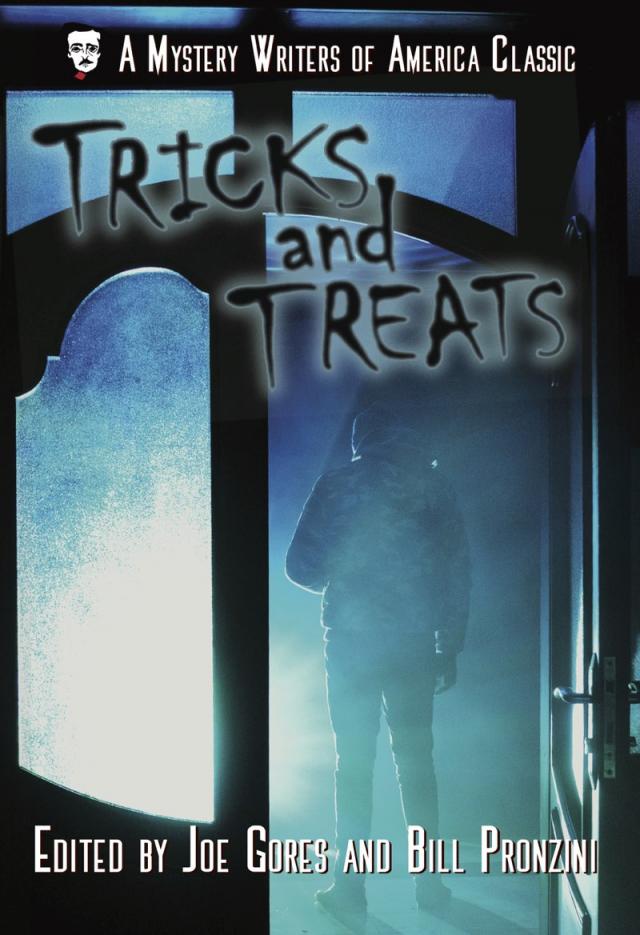
Tricks and Treats
A Mystery Writers of America Classic Anthology
Jean L. Backus
Anthony Boucher
Betty Buchanan
John Dickson Carr
William Chambers
Stanley Ellin
Richard Ellington
Harlan Ellison
Joe Gores
Len Gray
Joe L. Hensley
Edward D. Hoch
James Holding
John Lutz
Elizabeth A. Lynn
John D. MacDonald
Dan J. Marlowe
Arthur Moore
William F. Nolan
Stephen R. Nowak
Albert F. Nussbaum
Bill Pronzini & Barry N. Malzberg
Ellery Queen
S. S. Rafferty
Jack Ritchie
Henry Slesar
Pauline C. Smith
Edward Wellen
Jessamyn West
Donald E. Westlake
Edited by
Joe Gores and Bill Pronzini
This is a work of fiction. Names, characters, places, and incidents either are the product of the authors’ imaginations or are used fictitiously, and any resemblance to actual persons, living or dead, business establishments, events, or locales is entirely coincidental.
* * *
TRICKS AND TREATS
Copyright © 1976, 2019 by Mystery Writers of America.
A Mystery Writers of America Presents: MWA Classics Book published by arrangement with the authors
Cover art image by Ilkin Zeferli
Cover design by David Allan Kerber
Editorial and layout by Stonehenge Editorial
* * *
PRINTING HISTORY
Mystery Writers of America Presents: MWA Classics edition / February 2019
All rights reserved.
This book, or parts thereof, may not be reproduced in any form without permission. The scanning, uploading, and distribution of this book via the Internet or via any other means without the permission of the publisher is illegal and punishable by law. Please purchase only authorized electronic editions, and do not participate in or encourage electronic piracy of copyrighted materials. Your support of the authors’ rights is appreciated.
Mystery Writers of America gratefully acknowledges the permission granted to reproduce the copyrighted material in this book.
Every effort has been made to locate the copyright holders or their heirs and assigns and to obtain their permission for the use of copyrighted material, and MWA would be grateful if notified of any corrections that should be incorporated in future reprints or editions of this book.
For information contact: Mystery Writers of America, 1140 Broadway, Suite 1507, New York, NY 10001
Contents
Foreword
Introduction
The Donor by Dan J. Marlowe
The Pill Problem by Pauline C. Smith
I Always Get the Cuties by John D. MacDonald
The Crooked Picture by John Lutz
Night Piece for Julia by Jessamyn West
No More Questions by Stephen R. Novak
Violation by William F. Nolan
Hollywood Footprints by Betty Buchanan
The Time of the Eye by Harlan Ellison
Face Value by Edward Wellen
The Leopold Locked Room by Edward D. Hoch
If I Quench Thee... by William E. Chambers
The Spoils System by Donald E. Westlake
Rope Enough by Joe Gores
Robert by Stanley Ellin
My Mother, The Ghost by Henry Slesar
Murder by Scalping by S. S. Rafferty
We All Have to Go by Elizabeth A. Lynn
The Little Old Lady of Cricket Creek by Len Gray
You Can Get Used to Anything by Anthony Boucher
Miser’s Gold by Ellery Queen
The Girl Who Jumped in the River by Arthur Moore
Hand in Glove by James Holding
The Silver Curtain by John Dickson Carr
Shut the Final Door by Joe L. Hensley
The Counterfeit Conman by Albert F. Nussbaum
My Sister and I by Jean L. Backus
Goodbye, Cora by Richard Ellington
Multiples by Bill Pronzini and Barry N. Malzberg
The Deveraux Monster by Jack Ritchie
Afterword
The Mystery Writers of America Presents Classic Anthology Series
For the Memory of LEO MARGULIES (1900-1975)
* * *
Editor, Publisher, Gentleman, and Friend and Benefactor to Countless MWA Members and Other Writers for Nearly Fifty Years
* * *
His life was gentle, and the elements
So mix’d in him that Nature might stand up And say to all the world, “This was a man!”
* * *
Julius Caesar, Act V, Scene V
—William Shakespeare
Foreword
Joe Gores (1931-2011) and Bill Pronzini (1943- ) had both been active in the mystery field less than a decade or so when Tricks and Treats was published in 1976, but they were already major names. Joe had won two Edgar awards, and Bill had turned out more novels and short stories than many of us (me, for example, born the same year) would accomplish in a lifetime. While Joe is gone, Bill, recipient of the MWA Grand Master Award in 2008, is still going strong and prolific as ever.
The theme of their anthology was McGuffins (more commonly spelled MacGuffins), a term sort of like noir, that has a very specific meaning for purists, but is generally used to mean just about anything you want it to mean. The Hitchcock anecdote in their introduction hints at without spelling out both the narrow and the broad definitions. According to Wikipedia, the MacGuffin is “a plot device in the form of some goal, desired object, or another motivator that the protagonist pursues, often with little or no narrative explanation. The MacGuffin's importance to the plot is not the object itself, but rather its effect on the characters and their motivations.” The Meriam-Webster definition, more inclusive if a bit vaguer: “an object, event, or character in a film or story that serves to set and keep the plot in motion despite usually lacking intrinsic importance.” It’s easiest to think of in terms of an object (sources differ on whether it should be something really important like the formula for world peace or trivial but tantalizing like the meaning of “Rosebud”) that the protagonist and other characters are after. Some examples: the Maltese Falcon, the Ark of the Covenant in the Raiders of the Lost Arc, the NOC list of informants in the first Mission Impossible feature, the Holy Grail, military plans, weapons designs, or other vital papers. Readers of this anthology are invited to consider in each of these stories whether there is really a MacGuffin and if so, what it is.
Mystery Writers of America anthologies have changed since their mid-1940s launch. Early volumes in the series consisted entirely of reprints, all donated by their authors for the good of the organization. Recent volumes have been comprised entirely of new stories, either commissioned by the editor or selected by a panel of judges from anonymous submissions, and now contributors are paid rather well. Tricks and Treats belongs in a transitional period: the stories were still donated, but some originals were included. Both editors of the volume offer new stories, Pronzini in collaboration with Barry N. Malzberg, along with previously unpublished work by Betty Buchanan, William E. Chambers, Elizabeth A. Lynn, and Jean L. Backus. The reprints represent Golden Age old-timers (Ellery Queen, Anthony Boucher, John Dickson Carr), stalwarts of the magazine market (Edward D. Hoch, Henry Slesar, James Holding, Jack Ritchie), novel-writing royalty (John D. MacDonald), and one surprise from the mainstream (Jessamyn West). The introductions to each story by Joe or Bill show that they were conscientious editors. Forty plus years after its first publication, their anthology stands the test of time.
—Jon L. Breen
Introduction
Since this anthology depends on tricks and treats, surprise endings, twists, gimmicks—in a word, McGuffins—we had best define for you, Gentle Reader, just what a McGuffin is. The best, in fact to our knowledge the only, definition was given by the Master himself, Alfred Hitchcock, during a discussion of his films. We can only paraphrase his remarks, of course, but they went something like this...
* * *
It seems that an American in London got on a train which was bound for the Scottish Highlands. He found himself sharing a compartment with a grizzled British sportsman of the sort who consistently drops his “g’s”; a sportsman loaded down with huntin’ and fishin’ gear who was obviously heading north for a bit of a shoot.
On the overhead rack, however, this gentleman had placed a rather strange-looking box. The American, unable to contain his curiosity, finally leaned forward and said, “I beg your pardon, but could you possibly tell me what that odd-looking box is?”
The sportsman looked at the American, transferred his gaze to the box, and then fixed it again on the American.
“That’s a McGuffin,” he said.
“A...McGuffin? Ah...what purpose does a McGuffin serve? What is it used for?”
“Why, a McGuffin is indispensable when one is hunting lions and tigers. Since I am going to the Scottish Highlands to hunt tigers...” He stopped there, as if he had explained sufficiently.
After a moment, the American felt impelled to lean forward again. “I don’t know how to tell you this, sir, but there aren’t any tigers in the Scottish Highlands.”
“You don’t say.” The grizzled sportsman stared at him for several seconds in surprise, then looked up at the box again. Contemplatively he said, “Then that can’t be a McGuffin, can it?”
* * *
Now that we—and Mr. Hitchcock—have explained to you exactly what a McGuffin is, you know all about the stories in this anthology. But if some whisp of confusion lingers in your mind, let us assure you that we know a McGuffin when we see one. And all of the wonderful and talented writers who appear herein, who have donated this use of their work to Mystery Writers of America without pay or recompense, they know what a McGuffin is.
After all, they’ve collectively written a whole book about the bloody things.
Haven’t they?
* * *
Bill Pronzini and Joe Gores
San Francisco
December 1975
The Donor
Dan J. Marlowe
SURPRISE!
We chose “The Donor” to lead off this anthology because it is the very essence of the McGuffin, with an understated symmetry and a whiplash ending which leaves the reader breathless as a roller-coaster ride. Great McGuffins demand great artistry, a quality not always in evidence in the paperback original novels which are Mr. Marlowe’s chosen arena. But the growing talent he displayed in 1962 with the unforgettable The Name of the Game is Death was confirmed in 1970, when his Operation Flashpoint was awarded the Edgar. Today his Earl Drake series enjoys booming sales and reprinting in over a dozen foreign countries. So any would-be or want-to-be writers reading these words take heart: Dan Marlowe is an ex-professional gambler who didn’t write a word for money until he was pushing fifty! - J.G.
I went to reform school when I was twelve, prison when I was eighteen, and I’ve spent most of my life in one penitentiary or another. I’ve stolen cars, cashed bad checks, burglarized stores, and committed armed robberies. During any given ten-year period, I was seldom outside the walls of an institution for more than a few months at a time.
Then I took a trip west to change my luck. It changed it for the worse. I took another fall, and then in prison one day I was standing alongside another con when he was knifed in the back. I was tried for his murder. It didn’t matter that for once I was innocent; the judge pronounced the mandatory death sentence. I couldn’t help thinking that it seemed to be what I had unconsciously been preparing myself for all my life.
So, at forty-eight, with the handwriting on the wall, I made up my mind to leave life with more style than I’d lived it. When the automatic appeal had been denied, I told my court-appointed lawyer I wouldn’t need him anymore. I settled down to the death row routine of tearing pages from a calendar and waiting for the big day.
I thought the warden would be happy to have a prisoner who wasn’t always bugging him for some privilege, but he wasn’t. For some reason my attitude seemed to concern him.
“It’s not natural for a man in your position to show so little concern,” said Warden Raymond.
“How would you know what’s natural, warden?” I asked. “You’re young. All you know about prison you got out of books. You’ve only had your appointment for about a year. You’ve got a lot to learn.”
He shook his head. He looked like a tired David Niven except that his hair was reddish-brown. He had dark circles under his eyes most of the time. There was a prison joke about the dark circles. Warden Raymond had a young wife. I’d never seen her, but the men who had said she had an unconsciously sexual appeal.
The chaplain came to see me a few times, but I always ran him off. “It’s got to be better the second time around, Pilot,” I told him. The men called him the Sky Pilot. He couldn’t cope with my theories on reincarnation, but he didn’t stop coming.
My only other visitor was Warden Raymond. He would have himself admitted by the ever-present guard, and I’d set down the book I’d been reading. The warden made more frequent trips from his office to my cell as the big day grew closer. Each time I saw him he looked worse. It was going to be the first execution for each of us, but to look at him you’d think he was the one who was going to ride the lightning.
“You know that the-uh-execution is only a short time away,” he said to me one day.
“I know.”
“Have you decided upon which-uh-which method you want us to use?”
I stared at him. “Which method? I don’t get it.”
“There are two approved methods of execution in this state, hanging and the firing squad.” I must have looked blank. “I thought you knew.”
I tried to sound flippant. “Is that what happens when there’s no more cheap power? I thought it would be electrocution.”
“You have a choice, as I indicated,” he answered. He didn’t sound happy even telling me about it.
“It’s not going to be hanging, warden,” I said positively. “Have the firing squad oil up the rifles.”
The warden spoke urgently. “Doesn’t this bother you at all? Don’t you feel-uh-odd, having to choose the way you’re going to die?”
“Why, no. If I’ve got to go, and I don’t seem to have much say about that, what’s so hard about selecting the method?”
He grimaced and left the cell.
During the next couple of weeks I ate well and got plenty of rest. I gained five pounds and the warden lost ten. He obviously spent more time thinking about my execution than I did. The man had too much empathy for his own good. He even tried to get the governor to commute my sentence to life imprisonment. He came to my cell almost in tears when he failed. He was really getting on my nerves a little bit, although it’s difficult to dislike a man because he doesn’t want to kill you.
The warden showed up in front of my cell with a stranger when the execution was a week away. His usual uneasiness seemed to have been replaced by embarrassment. “This is Dr. Sansom,” he said to me. “He’d like to talk to you.”
I looked Dr. Sansom over. He had to have some kind of clout. Not every doctor makes it onto death row. The guard came over and unlocked the cell door, but only the doctor came inside.
“I’ll leave you two alone,” Warden Raymond said quickly, and hurried away.
“Come to see if I’m healthy enough to kill, Doc?” I asked as he sat down. His mouth smiled, but his eyes didn’t. He was young, but he had the coldest-looking eyes I’d ever seen on a human being.
“You don’t want to mind him,” I went on, nodding in the direction of the warden’s departure. “He’s taking all this pretty hard.”
“And you’re not?”
“That’s right.”
“That’s what they told me, and that’s why I’m here.” He crossed his legs leisurely. “I’m chief of neurosurgery at Mercy Hospital in town. I want you to donate your body to science. Specifically, I want you to donate it to me.”