

Sing a Battle Song, page 1


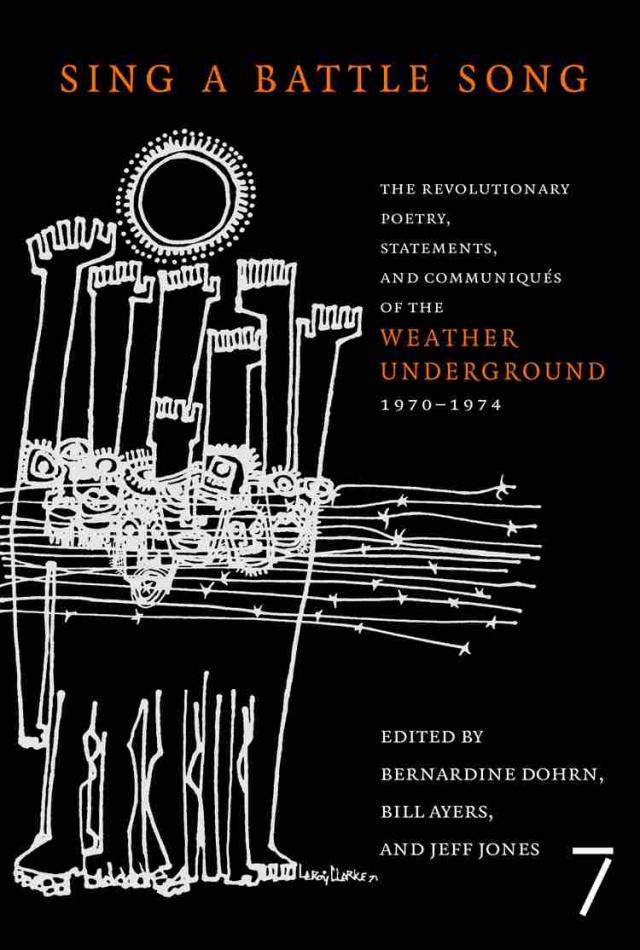
Table of Contents
Title Page
EDITORS’ PREFACE
Acknowledgements
WHEN HOPE AND HISTORY RHYME
REVISITING THE WEATHER UNDERGROUND
FROM WEATHER TO CLIMATE
TIMELINE
YOU DON’T NEED A WEATHERMAN TO KNOW WHICH WAY THE WIND BLOWS
PART I
sing a battle song
SONG
SISTERHOOD IS NOT MAGIC
WAITING
FOR ASSATA SHAKUR
PEOPLES’ WAR
DAY OF THE MONSOON
SPIDER POEM
PRAIRIE JANE
IN MY STEEP AND SCARY PATH
RIDING THE SUBWAYS
FOR A TROUBLED SISTER
WOMANCHILD’S POEM
FOR OUR STREET
MALTHUSIAN MYTHOLOGIES
FOR E.
FOR A FRIEND WHO DIDN’T KNOW WHO I WAS
STRAIGHT TALK
FOR TWO SISTERS
FOR L.
WOMEN’S LAMENT
OPEN OPEN OPEN
RETURN OF THE POWS
FOR OUR MEN
SPRING 1974
NIGHT IN CHILE
THOUGHTS ON BLOOD DEBTS
POEM
FOOD LINES IN OAKLAND
FOR THE SLA
AVOCADO TREE
VENOM I
VENOM II
REUNION
COMMON VICTORIES
WELCOME
BATTLES
PART II
LOOKING BACKWARD - Personal Reflections on Language, Gesture, and Mythology in ...
THE WEATHER EYE COMMUNIQUÉS FROM THE WEATHER UNDERGROUND - MAY1970-MAY1974
INTRODUCTION
CHRONOLOGY AND TABLE OF CONTENTS
A DECLARATION OF A STATE OF WAR - May 21, 1970
HEADQUARTERS - New York June 10, 1970
HONK AMERIKA - Detroit July 25, 1970
DR. TIMOTHY LEARY - San Luis Obispo, California September 15, 1970
MESSAGE TO DANIEL BERRIGAN - Catonsville, Maryland October 8, 1970
FALL OFFENSIVE - Chicago October 8, 1970
HALL OF INJUSTICE - Marin County, California October 8, 1970
CRIMINAL COURTHOUSE - Long Island City October 9, 1970
NEW MORNING—CHANGING WEATHER - December 6, 1970
THE BOMBING OF THE CAPITOL - Washington, D.C. February 28, 1971
GEORGE JACKSON - San Francisco August 30, 1971
ATTICA - New York September 17, 1971
THE BOMBING OF THE PENTAGON - Washington, D.C. May 19, 1972
COMMON VICTORIES - February 23, 1973
CLIFFORD GLOVER 103RD PRECINCT - New York City May 18, 1973
ACOLLECTIVE LETTER TO THE - WOMEN’S MOVEMENT July 24, 1973
MARY MOYLAN’S LETTER
THE BOMBING OF ITT HEADQUARTERS FOR LATIN AMERICA - New York City September ...
HEALTH EDUCATION AND WELFARE - An Enemy of Women San Francisco March 6, 1974
ROCKEFELLER AND THE DRUG LAW - New York City March 14, 1974
VICTORY TO THE PONCE CEMENT STRIKE - New York City June 16, 1975
WEATHER UNDERGROUND ORGANIZATION BOMBS KENNECOTT CORPORATION - Salt Lake City, ...
PART III
PRAIRIE FIRE - THE POLITICS OF REVOLUTIONARY ANTI-IMPERIALISM
I. ARM THE SPIRIT
II. VIETNAM
III. ON THE ROAD: IMPRESSIONS OF US HISTORY
IV. IMPERIALISM IN CRISIS: THE THIRD WORLD
V. IMPERIALISM IN CRISIS: THE HOME FRONT
VI. AGAINST THE COMMON ENEMY
BIBLIOGRAPHY
ABOUT THE CONTRIBUTORS
Copyright Page
EDITORS’ PREFACE
THIS VOLUME CONTAINS SELECTIONS from the writings of the Weather Underground Organization (WUO), a homegrown radical anti-imperialist collective that was formed in the beginning of 1970 and dissolved six years later. Weather, which emerged out of the mass student organization Students for a Democratic Society, had as its program militant opposition to the war in Vietnam, and support by all means for the liberation of African-Americans.
This collection is not intended to be comprehensive: it includes only a very brief excerpt, for example, of the founding document of the Students for a Democratic Society (SDS) faction that went on to become the WUO—You Don’t Need a Weatherman to Know Which Way the Wind Blows, a position paper written in the spring of 1969 in the final ideological paroxysm of SDS. This collection includes most of the statements and publications issued by the organization. It is intended to provide the basic historical documents for students of the period, and for today’s activists wondering what those crazy kids were up to in the sixties.
Each of us has included our reflections on that period, and on these writings, and we share the common sense that they are of historical value, and although we each cringe at the overheated rhetoric and the “bombast” (Bernardine’s word), we all rejoice at the militant resistance to war, racism, and imperialism. We also include a new piece by Jonah Raskin, who edited and published Weather Eye, a collection of WUO communiqués in 1974; the original introduction he wrote to that collection is also included here.
Some recent and excellent sources have added to the scholarly and popular literature and art about this period, and we urge you to explore the context of the writings included in this volume with, among other things, the documentaries The Weather Underground, by Sam Green and Bill Siegel, and Rebels with a Cause, by Helen Garvey and Bob Pardun; Fugitive Days, by Bill Ayers, A Radical Line, by Thai Jones, Outlaws of America: The Weather Underground and the Politics of Solidarity, by Dan Berger, Bringing the War Home: The Weather Underground, the Red Army Faction, and Revolutionary Violence of the Sixties and Seventies, by Jeremy Varon, The Way the Wind Blows, by Ron Jacobs, and The Sixties Papers, edited by Stew Albert and Judy Gumbo.
ACKNOWLEDGMENTS
MANY PEOPLE MADE EXCEPTIONAL sacrifices to create and sustain the Weather Underground. In the years 1969 through 1976, we were one of many radical groups trying to find the right mix of militancy, strategy, and ideology that could produce revolutionary structural change. That the movements of the sixties and seventies largely failed in that ambitious effort does not mean it was wrong to try. Indeed, it is our observation that virtually everyone we know from those days is still active in today’s progressive movements and that this combined experience has helped keep alive the ideas of liberation that motivated hundreds of thousands of young Americans to break with the dominant culture and to look to the margins for leadership and inspiration.
Friends, family, and editors contributed to gathering this collection and refining our pieces.
Greg Ruggiero, our editor at Seven Stories Press, had a vision and helped us realize it. It was his idea to publish a volume of the primary documents of the Weather Underground. Greg believed that, as demonstrated by recent books, films, documentaries, and our experiences speaking on campuses and elsewhere about the organization’s history, it was time to republish in one collection these primary documents from the Underground and to share them with new generations of activists. Zayd Dohrn, Rachel DeWoskin, Thai Jones, Eleanor Stein, and Harriet Beinfield read, contributed, commented, researched, and supported this effort from the beginning.We also thank the Labadie Collection, University of Michigan, and its curator Julie Herrada, for providing documents from the collection. We are also grateful to historian activists Dan Berger, Andy Cornell, and Ron Jacobs, for their help in completing this collection.
Prairie Fire: The Politics of Revolutionary Anti-imperialism, which is included in this collection, was written and released in 1974. It begins with a list of political prisoners and prisoners of conscience and it is unconscionable that many of those named then remain jailed today. These are committed activists of the sixties, seventies, and eighties who are aging in prison for actions taken in pursuit of peace and an end to racism. And yet so many war criminals—guilty in Vietnam and guilty in Afghanistan, Guantánamo, and Iraq—today enjoy their freedom at the highest levels of U.S. government.
The editors undertook this project, in part, because we were three publicly identified leaders of the organization during its fugitive days. We were not, in fact, the only leaders of the Weather Underground. No one person or group of individuals owns this history or these historical documents. They belong to everyone who helped create them. Therefore all proceeds from the sale of this book will go to support the work of the Rosenberg Fund for Children (RFC). Since 1990, the RFC has provided support for the children of targeted progressive activists and targeted activist youth. We encourage you to learn more about and contribute to this project at www.rfc.org.
We have each found ways to carry forward the values of the historical period reflected in this volume into the new millennium. Bernardine Dohrn is a law professor and activist in the international struggle for human rights. Bill Ayers writes books, teaches education, and fights to empower students and teachers through democratic education. Jeff Jones is an environmental organizer and educator. Collectively and individually, we continue to place opposition to imperialism and racism at the heart of what we do. This book does not answer the big question: what is to be done? But we hope it is of use to new generations of militant activists and organizers, to historians, and to those simply curious about those times.
WHEN HOPE AND HISTORY RHYME1
Bernardine Dohrn
FOR REASONS BOTH OBVIOUS and mysterious, there is today a renewed interest in the Weather Underground, a
Hopefully, there will be a blizzard of memoirs, films, and historical inquiries into the rainbow of other activities of equal or greater importance that were embarked on in that zesty, defiant era known as the sixties. When Weather decided to go underground to forge a clandestine, revolutionary resistance network, hundreds of thousands of others decided to go into factories to organize and recast unions, to create communes and cultivate the land, to invent women’s health clinics and feminist consciousness, to dig in as local community organizers, to invent the environmental movement, to break out into the gay and lesbian movement, or to engage electoral politics and fight for a progressive agenda. Those stories too deserve loving attention, scrutiny, and lessons learned. Not from a nostalgic longing for past glories, which were never all that, but as segue to the urgent imperatives of today.
Renewed relevance is inevitable in large part because we are again in a moment of U.S. global domination and permanent war, militaristic triumphalism, and U.S. occupation of ancient cultures and nations. Today, search and destroy has been supplanted by shock and awe aerial bombardments of civilian populations in Baghdad and Fallujah and reactionary fundamentalisms so deliberately intimidating, so insistent and so totalizing that we are meant not to see.
The gritty domestic consequences of revived American empire include economic collapse, job flight, a national-security state, unprecedented caging of people of color, renewed assaults against women, gays, and fundamental liberties, ecological plunder and catastrophic collapses, forced displacement of hundreds of thousands of African-Americans and the poor from the Gulf Coast, barricaded and isolated North America as a fortress against immigrants, torture, incarceration without rule of law, and the pandering of fear. In counterpoint, we have outpourings for peace and justice on an unprecedented global scale, once marginalized indigenous struggles (such as the one in Chiapas) assuming international significance, world social forums, hip-hop and spoken word, and international human rights. New forms of anarchists, queering, and world music abound, as well as instant communication, which means that a speech by Arundhati Roy, Noam Chomsky, Rashid Khalidi, Eduardo Galeano, or Harry Belafonte will be read by millions within hours.
Communities of resistance—contested spaces—are ignited in New Orleans, the border, and the barrios. The forecast is hopeful. Once we think about our circumstances, then we can wonder about how it could be otherwise. New uni-ties, bridges, and networks are afoot, if we seek and listen.
“YOU DON’T NEED A WEATHERMAN TO KNOW WHICH WAY THE WIND BLOWS”2
—Grasping Three Notions—
These writings from three decades ago reveal the Weather grasp, almost obsession, with three great ideas. The prose can be pretentious and bombastic. There is plenty to laugh at, even ridicule. But Weather had an unequivocal lucidity about white supremacy and race, rare enough in American life among whites. Race, slavery, and racism are at the silent center of American life, and nothing escapes their searing reality. We rediscovered John Brown and the Grimke sisters, that thread of history in which a handful of white people recognized that American slavery and its legacies are not about “others” but are the complex and intricate manifestations of power and powerlessness embedded in every economic, social, cultural, and political relationship, thoroughly implicating and diminishing whites as well.
One cannot talk separately about class, gender, culture, immigration, ethnicity, or biology without being intertwined with race, as Katrina and the systematic destruction of a major black U.S. city reinforms us. We were waking up. What to do once we had knowledge of the dimensions of white skin privilege? How to destroy white supremacy? Well, that is another matter. And as burning today as it was then.
It is impossible to overstate the impact of the police/FBI murders of Black Panther Party leaders throughout 1969, in the wake of the prior assassinations of Malcolm X and Martin Luther King Jr. Weatherpeople recognized that there were two forms of state repression at work: murder and brutality of African-Americans, arrests/indictments/dirty tricks of white activists.3 Our analysis of white supremacy seemed to require that we act to reject our position of privilege, that we put our bodies on the line, that we intervene to open a new front in the struggle with repressive forces. The Chicago police/ FBI murders of Black Panther Party leaders Fred Hampton and Mark Clark in Chicago on December 4, 1969, gave new urgency to the already escalating relationship with authorities. Thirty-six years later, without defending our heated rhetoric, sectarian divisiveness, tactics, or literal responses, I understand and endorse Weather’s fervent resolve to act against the structures of white supremacy. It was our tentative path to humanization then—and it still is, every day.
The second domain of clarity among Weather was simply anti-imperialism. Here we had more company. It was the great strength of the sixties that millions of students, hippies, feminists, GIs, youths, and citizens—inspired by the early war resistance of the Black Freedom Movement4—came to reject the U.S. invasion and occupation of Vietnam. We (the broad “we”) challenged the Cold War rhetoric that explained racist slaughter and empire in the name of anticommunism. Too slowly, the majority of people saw through ten years of successive public relations’ justifications for empire and war. Official rationales and rhetoric about strategic hamlets, defoliation, light at the end of the tunnel, hearts and minds, Vietnamization, promoting democracy, and American honor were rejected by the patent reality of foreign occupation and resistance. To an extent largely still ignored, returning GIs contributed truth, racial reality, class analysis, and a militant rejection of their assigned role in the slaughter of civilians in the name of empire. The returning soldiers risked everything when they joined with draft-resisters, deserters, and antiwar organizers to speak truth to power.
The vast popular opposition to the Vietnam War involved a dynamic political analysis of what was at work, as well as revulsion at the inhuman violence of war. We saw the circle of U.S. military bases in Thailand, the Philippines, and the Pacific; the degradation of women and girls that is constructed in the wake of troop concentrations; the [secret] expansion of the war into Cambodia and Laos; the napalm; the corporate profiteering; the drug industry and trafficking; the palpable global isolation of the U.S.
It became widely acknowledged that the U.S. had been an expansionist power since its beginnings: continental, hemispheric, and global. This growing, popular comprehension about the imperatives of empire in Southeast Asia compelled a fresh look at U.S. interventions in Latin America and the Mideast, the replacement of the British and French empires by the U.S. empire post-World War II. That knowledge encouraged international solidarity movements with radical forces in Mexico, South Africa, Palestine, Chile, Bolivia, Puerto Rico, Mozambique, and Guatemala, and that very engagement opened up new spaces. We were beginning to live differently, so that others could live.
By 1973, it was not considered extreme, incredible, or anti-American to denounce the U.S./Kissinger role in the murder of democratically elected Chilean president Salvador Allende,5 because by then the famously ill-informed American people understood U.S. imperialism as a structure of domination and control involving military, economic, corporate, and cultural forces. A Weather communiqué quoted Pablo Neruda about empire:But we have to see behind all them, there is something
behind the traitors and the gnawing rats,
an empire which sets the table
and serves up the nourishment and the bullets . . .
It is a modest comfort that this anti-imperialism of Thoreau, Mark Twain, and Emma Goldman took such deep root in the sixties. Although we were not able to end the Vietnam War or make a revolution, the U.S. was politically restrained from openly invading another country from 1975 until the Gulf War of 1991 (Grenada and Panama excepted), and was required to act through covert wars/proxy wars. Among the legacies of sixties anti-imperialism were measures that lasted until 9/11. Examples include the War Powers Act and legal constraints on the FBI and CIA, the abolition of the draft, voting rights for eighteen-year-olds, and failures to win convictions in scores of conspiracy trials, to silence people through grand jury investigations, or ultimately to create a climate of fear. Anti-imperialism, antiracism, feminism, and internationalism flourish as vibrant threads within the multiple progeny of sixties movements. Freedom, indeed, is contagious. Descendants include liberation and rights movements of women, gays and lesbians, environmentalists, the disabled, HIV-AIDs activists, and immigrants. Central American solidarity, prison activism, renewed labor organizing, human rights, women’s safety (domestic violence and rape), midwives and acupuncture, children’s rights, and activism for land rights, education, health, and housing.





