

How the West Brought War to Ukraine, page 1


Praise for
How the West Brought War to Ukraine
“This is a splendid little book, tautly written, logically organized, easy to read, and persuasive but appropriately caveated. It is an invaluable primer on the trends and events that produced the escalating warfare in Ukraine. Without understanding the history documented in this book, there will be no de-escalation of the U.S.-Russian confrontation on Europe’s eastern borders.”
—Chas Freeman, previously Assistant Secretary of Defense for International Security Affairs, author of Arts of Power: Statecraft and Diplomacy
“A brilliant, remarkably concise explanation of the danger that U.S. and NATO military involvement in Ukraine has created. Needs to be read and pondered by every citizen capable of thinking rationally and responsibly about American and European security.”
—Jack F. Matlock, Jr., U.S. Ambassador to the Soviet Union, 1987-1991, author of Superpower Illusions
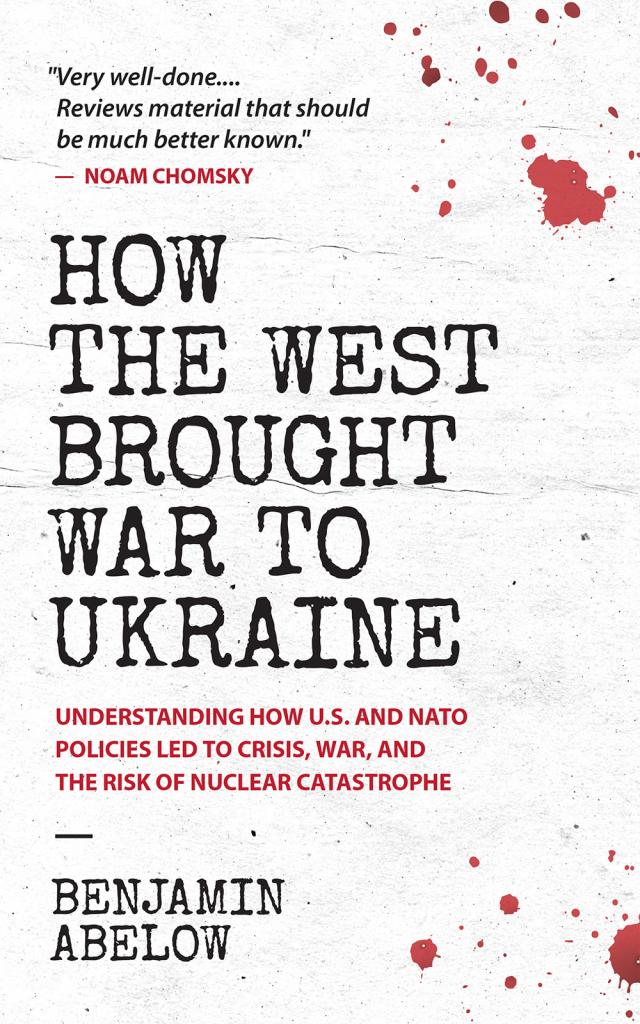
“Very well-done, very reasonable. Reviews material that should be much better known.”
—Noam Chomsky, Institute Professor emeritus, Massachusetts Institute of Technology, and Laureate Professor of Linguistics, University of Arizona
“For those concerned about U.S. national security and the peace of Europe, this book is essential reading.”
—Douglas Macgregor, Colonel (Retired), U.S. Army, author of Margin of Victor, was decorated for valor in the Battle of 73 Easting in Iraq and served as Director of NATO’s Joint Operations Center at SHAPE (Supreme Headquarters Allied Powers Europe)
“For anyone interested in understanding the true causes of the disaster in Ukraine, How the West Brought War to Ukraine is required reading. Abelow makes a clear and compelling case that the United States and its NATO allies—not Vladimir Putin—are the principal culprits.”
—John J. Mearsheimer, author of The Tragedy of Great Power Politics, is the R. Wendell Harrison Distinguished Service Professor of Political Science at the University of Chicago
“A concise yet comprehensive and accessible overview. Invaluable for understanding how war once again came to Europe. Benjamin Abelow demonstrates that the crisis in Ukraine was predictable, predicted—and avoidable.”
—Richard Sakwa, author of Frontline Ukraine and The Putin Paradox, is Professor of Russian and European Politics, University of Kent
“Ben Abelow takes us beyond the false narratives and into the truth of the Ukraine crisis.”
—Krishen Mehta, Senior Global Justice Fellow, Yale University, and Director, American Committee for US-Russia Accord
“In the Ukraine proxy war between the United States/NATO and Russia, we face a threat of nuclear escalation that could end human civilization. Abelow’s book is essential reading for all who wish to understand this threat and why, 30 years after the collapse of the Soviet Union, it has re-emerged.”
—Gilbert Doctorow, author of Memoirs of a Russianist, is an historian and independent Russia specialist based in Brussels Headquarters Allied Powers Europe)
Copyright © 2022 Benjamin Abelow.
All rights reserved. No part of this book may be copied, recorded, scanned, transmitted, downloaded, or distributed in any form or by any means, or stored in a data base or retrieval system, without written permission of the author. Short text passages may be reproduced with appropriate citation as part of larger works, such as reviews, articles, books, websites, and blogs. For clarifications, questions, and inquiries, please email the publisher.
Siland Press
Great Barrington, Massachusetts
Info@SilandPress.com
Disclaimer: Careful efforts have been made to ensure the accuracy of the information contained in this book. However, because human error can occur, and because underlying source documents or secondary sources sometimes contain mistakes, no guarantee can be offered about the accuracy of everything contained herein.
Cover design by Boja@99designs.
ISBN: 978-0-9910767-1-0
Library of Congress Control Number: 2022911492
Publisher’s Cataloging-in-Publication Data
Names: Abelow, Benjamin, author
Title: How the West brought war to Ukraine : understanding how U.S. and NATO policies led to crisis, war, and the risk of nuclear catastrophe / Benjamin Abelow
Description: [Great Barrington, Massachusetts] : Siland Press, [2022] | Includes bibliographical references and index.
Identifiers: ISBN: 978-0-9910767-0-3 (paperback) | 978-0-9910767-1-0 (ebook) | LCCN: 2022911492
Subjects: LCSH: Ukraine Conflict, 2014- | United States—Foreign relations—Russia (Federation) | North Atlantic Treaty Organization. | North Atlantic Treaty Organization—Ukraine. | Europe—Foreign relations—Russia (Federation)—21st century. | Western countries—Foreign relations—Russia (Federation)—21st century. | National security—Europe. | National security—United States. | Russia (Federation)—Foreign relations—21st century. | Security, International—Europe—History—21st century. | Cuban Missile Crisis, 1962. | South Ossetia War, 2008. | Nuclear arms control. | Nuclear crisis control. | Nuclear warfare. | Geopolitics. | Baltic States—Strategic aspects. | World politics. | International relations. | Political science. | BISAC: HISTORY / Wars & Conflicts / General. | POLITICAL SCIENCE / International Relations / General. | POLITICAL SCIENCE / Security (National & International) | POLITICAL SCIENCE / World / Russian & Former Soviet Union.
Classification: LCC: DK508.852 .A24 2022 | DDC: 947.7086--dc23
Acknowledgements
For answering technical questions, commenting on previous drafts, or providing other kinds of help, I wish to thank Major Brennan Deveraux, Jay R. Feierman, Richard Sakwa, Gilbert Doctorow, George Goss, Viktoryia Baum, Pam Auerbach, Mark McCarty, John Hayden, Alex Tabarrok, Adam Abelow, Kimberly Peticolas, and Jonathan Rubin. The inclusion of a name here does not imply endorsement of the ideas expressed in this book. All views, as well as any errors of fact, interpretation, or judgment, are the sole responsibility of the author.
Contents
Overview
Introduction: How the Narrative Drives the War
1. Western Provocations: 1990–2014
2. Western Provocations: 2014–2022
3. Putting the Shoe on the Other Foot
4. Russian Concerns About a U.S. First Strike
5. Policy Experts Warned Against NATO Expansion
6. Russophobic Policy Makers Double Down on Past Mistakes
7. How Overly Pessimistic Narratives Become Self-Fulfilling Prophecies
8. A Counterfactual History—and Conclusion
Citations
Index
About the Author
Overview
For almost 200 years, starting with the framing of the Monroe Doctrine in 1823, the United States has asserted security claims over virtually the whole Western hemisphere. Any foreign power that places military forces near U.S. territory knows it is crossing a red line. U.S. policy thus embodies a conviction that where a potential opponent places its forces is crucially important. In fact, this conviction is the cornerstone of American foreign and military policy, and its violation is considered reason for war.
Yet when it comes to Russia, the United States and its NATO allies have acted for decades in disregard of this same principle. They have progressively advanced the placement of their military forces toward Russia, even to its borders. They have done this with inadequate attention to, and sometimes blithe disregard for, how Russian leaders might perceive this advance. Had Russia taken equivalent actions with respect to U.S. territory—say, placing its military forces in Canada or Mexico—Washington would have gone to war and justified that war as a defensive response to the military encroachment of a foreign power.
When viewed through this lens, Russia’s invasion of Ukraine is seen not as the unbridled expansionism of a malevolent Russian leader but as a violent and destructive reaction to misguided Western policies: an attempt to reestablish a zone around Russia’s western border that is free of offensive threats from the United States and its allies. Having misunderstood why Russia invaded Ukraine, the West is now basing existential decisions on false premises. In doing so, it is deepening the crisis and may be sleepwalking toward nuclear war.
This argument, which I now present in detail, is based on the analyses of a number of scholars, government officials, and military observers, all of whom I introduce and quote from in the course of the presentation. These include John Mearsheimer, Stephen F. Cohen, Richard Sakwa, Gilbert Doctorow, George F. Kennan, Chas Freeman, Douglas Macgregor, and Brennan Deveraux.
Introduction:
How the Narrative Drives the War
In the months since Russia invaded Ukraine, the explanation offered for America’s involvement has changed. What had been pitched as a limited, humanitarian effort to help Ukraine defend itself has morphed to include an additional aim: to degrade Russia’s capacity to fight another war in the future.
In fact, this strategic objective may have been in place from the start. In March, more than a month before the new U.S. policy was announced, Chas Freeman, previously Assistant Secretary of Defense for International Security Affairs, observed,
Everything we are doing, rather than accelerating an end to the fighting and some compromise, seems to be aimed at prolonging the fighting, assisting the Ukrainian resistance—which is a noble cause, I suppose, but…will result in a lot of dead Ukrainians as well as dead Russians.1
Fre
America’s new military objective places the United States into a posture of direct confrontation with Russia. Now the goal is to cripple a part of the Russian state, its military. Since the start of the war, the Biden administration and Congress have allocated over 50 billion dollars in aid for Ukraine, the majority of it military. U.S. officials have revealed that American intelligence enabled the killing of a dozen Russian generals in Ukraine, as well as the sinking of the Moskva, the flagship of Russia’s Black Sea fleet, killing 40 sailors and wounding 100. America’s European allies fell into line, greatly increasing the number and lethality of the weapons they are shipping. British leaders have sought to expand the battlefield, openly encouraging the Ukrainian military to use Western weapons to attack supply lines inside Russia.
On February 27, three days after the Russian invasion began, Russian president Vladimir Putin announced that, in response to “aggressive statements” from Western leaders, he had raised the alert status of Russia’s nuclear forces. In May, a close media associate of Mr. Putin warned the British prime minister that his statements and actions risk subjecting England to a radioactive tsunami from one of Russia’s land-attack nuclear torpedoes. This and other Russian warnings about nuclear war have been dismissed by most of the Western media as mere propaganda. Yet within 24 hours of Mr. Putin’s February 27 announcement, the U.S. military raised its alert status to Defcon 3 for the first time since the 2001 attack on the World Trade Towers.2 The result is that both countries are closer to a hair-trigger launch policy, increasing the chance that an accident, political miscalculation, or computer error could lead to a nuclear exchange.
Further, one must consider what would happen if Russia started to lose, and its overall military capacity was degraded to the point where Moscow perceived itself as vulnerable to invasion. In that situation, Russian planners would surely contemplate using low-yield battlefield nuclear weapons to destroy enemy forces. Thus, the U.S. Director of National Intelligence, in testimony before the Senate Armed Services Committee in May, stated that Mr. Putin might use nuclear weapons if there was “an existential threat to his regime and to Russia, from his perspective.” This could occur if “he perceives he is losing the war.”3 If Russia did use nuclear weapons, the pressure for a Western nuclear response, followed by further escalation, might be irresistible. Yet that situation—Russian loss and depletion—is exactly what the new U.S. policy is seeking to achieve.
Finally, we must ask what would happen if the war dragged on to the point where opposition to Mr. Putin within Russian elites led to his removal from power. Here we are talking about the vaunted goal of “regime change,” which in the United States is sought by an informal alliance of Republican neoconservatives and Democratic liberal interventionists. The assumption seems to be that Mr. Putin would be replaced by a docile, effete puppet subservient to American interests. Gilbert Doctorow—an independent, Brussels-based political analyst whose Ph.D. and post-doctoral training are in Russian history—comments:
Be careful what you wish for. Russia has more nuclear weapons than the United States. Russia has more modern weapons than the United States. Russia can level to the ground the United States in 30 minutes. Is this a country in which you want to create turmoil? Moreover, if [Mr. Putin] were to be overturned, who would take his place? Some little namby-pamby? Some new drunkard like [first Russian president Boris] Yeltsin? Or somebody who is a Rambo and just ready to push the button? … I think it is extremely imprudent for a country like the United States to invoke regime change in a country like Russia. It’s almost suicidal.4
Whether or not eviscerating Russia’s military has been the American plan from the outset, the policy is not surprising because it follows logically, even predictably, from an overarching Western narrative about Russia that has already been widely accepted. According to this narrative, Mr. Putin is an insatiable expansionist who lacks any plausible national security motivations for his decisions. This narrative portrays Mr. Putin as a new Hitler, and the Russian move into Ukraine as akin to the Nazi aggression of World War II. Likewise, the narrative portrays any Western desire to compromise and negotiate a quick end to the conflict as wishful thinking and appeasement. America’s new military objective thus emerges directly from Western perceptions about Moscow’s motivations and the causes of the war.
And so a crucial question comes into focus: Is the Western narrative about the Ukraine war correct? If it is, then Western policies might arguably make sense, even if they entail some risk of nuclear conflict. But if the narrative is wrong, then the West is basing existential decisions on false premises. If the narrative is wrong, a quickly negotiated compromise, one that would spare the lives of combatants and civilians alike, and simultaneously greatly reduce the risk of nuclear war, would not represent appeasement. Rather, it would be a practical necessity, even a moral obligation. Finally, if the Western narrative about Russia’s motivations is wrong, then the actions the West is taking now are likely to deepen the crisis and may lead to nuclear war.
In this book, I argue that the Western narrative is incorrect. In crucial respects, it is the opposite of truth. The underlying cause of the war lies not in an unbridled expansionism of Mr. Putin, or in paranoid delusions of military planners in the Kremlin, but in a 30-year history of Western provocations, directed at Russia, that began during the dissolution of the Soviet Union and continued to the start of the war. These provocations placed Russia in an untenable situation, for which war seemed, to Mr. Putin and his military staff, the only workable solution. In arguing this case, I pay special attention to the United States—and subject it to particularly sharp criticism—because it has played the decisive role in shaping Western policy.
In criticizing the West, it is not my aim to justify Moscow’s invasion or exonerate Russia’s leaders. I have no brief for Mr. Putin. Notwithstanding all I will say, I believe he had alternatives to war. But I do want to understand him—in the sense of seeking to rationally assess the causal sequence that led him to launch the war.
What do I have in mind when I speak of Western provocations? It is often suggested that the expansion of NATO into the countries of Eastern Europe has contributed to tensions. This assertion is correct but incomplete. To begin with, the implications of NATO expansion too often remain abstractions, with the actual threat to Russia not appreciated. At the same time, the United States and its allies, both individually and in coordination with one another, have taken provocative military actions that are not directly tied to NATO. Focusing on NATO is important, but attending only to NATO obscures the full scope and seriousness of the predicament that the West has created for Russia.
As a preview for what is to come, I list here key Western provocations, which I will explain and comment on over the course of this book. During the past three decades, the United States, sometimes alone, sometimes with its European allies, has done the following:
Expanded NATO over a thousand miles eastward, pressing it toward Russia’s borders, in disregard of assurances previously given to Moscow
Withdrawn unilaterally from the Antiballistic Missile Treaty and placed antiballistic launch systems in newly joined NATO countries. These launchers can also accommodate and fire offensive nuclear weapons at Russia, such as nuclear-tipped Tomahawk cruise missiles
Helped lay the groundwork for, and may have directly instigated, an armed, far-right coup in Ukraine. This coup replaced a democratically elected pro-Russian government with an unelected pro-Western one


