

Val Vega, page 32


“Miguel!” says Mami. “Don’t be rude to our guests. Spanish isn’t their first language. Why, it’s not even their second language. Johnny, how many languages do you speak?”
Johnny lifts his eyes toward the ceiling as if counting. Timoteo elbows him and says, “Many. Johnny speaks many languages and let’s leave it at that. No need to brag, Johnny.”
“This has been simply lovely, Tía Ana,” says Wasala. These regular dinners were her idea. The regular phone calls home from a computer simulation of mine and Timoteo’s voices just weren’t enough to stop Mami from worrying during our long trips to “Istanbul.”
“Your mother’s mind works based on relationships,” Wasala said. “If she trusts the three of us then she won’t worry so much when you’re away with us.” Even without telepathy, Timoteo and I knew that was true. These dinners have become a near-weekly tradition.
Pash-Ti rises from the table. Even with the holographic technology that makes them look human, their head nearly touches the low ceiling. “Thank you again for hosting us, Ms. Vega. But I’m afraid we must leave now to catch our flight.”
“Of course,” says Mami, reluctantly. The farewell hugs and kisses begin, each of them accompanied by the same whisper from my mother. “Take care of my children, bring them home safe, God willing.”
I’m standing with hands clasped behind me on the hover-platform, with Timoteo, Johnny, Pash-Ti, and Wasala just behind me. The Etoscan contingency is on my left, the Hoshans to my right, and the Levinti ambassador and her kiromakee are floating just beside the platform. On the floor far beneath us, the tentacled shadow of the Levinti is nearly as large as the one cast by the dais itself. This Levinti conference center in Southern Hosh is the only facility on the planet large enough to hold such an enormous crowd. Apparently, it’s the standard layout for a multi-species interstellar gathering: a super-sized arena with a central open space for the speakers, surrounded on all sides by a multi-level globe to accommodate the spectators. But unlike any arena on Earth, this one is segmented into dozens of sub-sections, accommodating species of all sizes and atmospheres.
The Levinti section is the largest, so crowded that some Levinti have to float above and below each other, which, in their culture, is unorthodox. The other sections—even the aquatic and ammonia levels—are just as crowded. I’ve heard there was a waiting list for seats. No one in the Galaxy expected the peace talks to succeed, making this treaty the biggest news story in a century—literally. Sentients from across the Galaxy have travelled hundreds of light years to witness Galactic history unfold.
The official treaty is displayed in the center of the platform, more than twice my height. I’ve seen the draft before, but there’s something awe-inspiring about seeing the original in all its rich complexity. The document is filled with the full text of the treaty in eight languages: Northern and Southern Hoshan, the standard dialects of all five of the Great Powers, and Centronian. The phosphorescent colors of the Levinti-language column run alongside the Sufri column, whose tactile language is rendered in contours, like a topographic map of a mountainous land. The treaty has even been translated into the coded language of the Synthetics, which, though not visible, is included in the digital file embedded in the document. Even the digital file is stamped with a unique code so it can never be precisely duplicated; this is the one true original for posterity.
Peltiquinas, the new Levinti ambassador, is assigned to speak first, and to sign the treaty first—which is apt, since the Levinti have pretty much dominated the final phase of the negotiations. After Commander of War’s subterfuge was revealed, the Levinti happily renewed negotiations—knowing that they now had the leverage to get nearly everything they’d wanted, while maintaining their strategic advantage of controlling the planet’s only Interstellar Subway Station—without a long and costly war.
Peltiquinas’s skin glows with a dance of color as she addresses the crowd. “Honored colleagues, we are here today not merely to sign a historic treaty. We are here today not merely to maintain peace. We are here today to celebrate a victory for scientific inquiry! No longer will Tumasra be sequestered beyond our reach, where none can study its unique properties. No longer will Tumasra be merely a shrine dedicated to folk rituals and the worship of primitive deities. Today, the Tumasra storm becomes a beacon for scientific learning, not only for the Levinti, but for all species—for we have won the right for all who come in the name of scholarly inquiry to enter Tumasra.”
The entire Levinti section of the arena lights up in a glowing cascade of lights, and there are eruptions of noise and motion from other sections in various gestures of applause—except, notably, the Etoscan section. I join in, clapping my hands, knowing my actions are on display for all to see. Deep down, some part of me wants to laugh. It was my idea to open up Tumasra for other species, not just the Levinti, though I was happy to let Peltiquinas claim it as her own.
Peltiquinas basks in the applause for a few moments before gliding over to the side of the platform. “On behalf of the Levinti people, it is my honor to certify the Treaty of Hosh.” She lifts a single tendril and releases a thin layer of phosphorescent fluid onto the over-sized document. It looks more like a painting than a signature, its glowing colors still fluctuating even after the ink has dried.
Next, Reconciler, the new Etoscan ambassador, strides toward the imposing document. His skin is a shimmering dark black, like obsidian crystal. The Etoscan Fellowship says Commander of War was acting alone, a rogue leader who violated not only interstellar law but Etoscan tradition. It does seem like Commander’s actions were never officially endorsed by the Etoscan leadership, but some were also happy to look the other way—right up until Commander got caught. Then the Etoscans sent in Reconciler to finish the treaty negotiations and salvage the Etoscans’ reputation in the interstellar community.
Reconciler raises his trunk, like a priest lifting his arms to the heavens. “In the language of my people, the word for treaty is said to originate in prehistoric times, before we had ventured from our homeworld to explore the stars, and even before the great Seeker revealed the sacred truths of Synchronus. Thus, ‘treaty’ is said to derive from two ancient words, meaning ‘sharing’ and ‘gods.’ For in ancient times, when two rival villages would form an alliance, they would consecrate that pact by sharing their gods, by recognizing that the gods they worshipped were but two faces of the same divinity. In so doing they foreshadowed the truth that Seeker would one day reveal to our people: that all gods are but faces of Synchronus in all Its splendor.
“What we do here today is much the same. We recognize that many of you do not share our understanding of Synchronus. But you all share our awe of the universe, our pursuit of truth in all its wonderful varieties, and so you also pursue Synchronus by a different path, just as our ancient tribes prayed to It by different names. In recognition that we have more in common than we know, we proudly sign this historic treaty. In that spirit, we warmly open Tumasra for all peoples, so that we all may learn and grow together, to better understand the Tumasra storm and the wondrous mystery of Synchronus it represents.”
“Wow,” Johnny whispers from behind me, “unlike some Etoscans, Reconciler lives up to his name. You’d never guess they only opened up Tumasra because they’ve become an object of interstellar ridicule.”
“I thought it was a nice speech,” whispers Wasala.
“I did like the historical allusions,” Timoteo says.
“All of you, hush,” Pash-Ti says.
“On behalf of the peace-loving Etoscan people,” Reconciler goes on, “it is my sacred honor to place my stamp upon the Treaty of Hosh.” He places his front left foot on the slab before him, creating a massive footprint in the clay-like substance. Gently gripping the slab with his trunk, he lifts it up and affixes it to the treaty. The slab’s clay sinks into the rigid document, Reconciler’s footprint merging into it, not a single seam visible.
After a brief, polite applause from the arena, Trimana steps forward, remaining upright on her hindmost legs. “I ask my fellow Hoshan leaders and friends, Charism and Kettle, to step forward with me.” Charism glides forward with his usual ease and smile. Kettle totters close behind, her steps heavy and firm.
I smile. We’d talked about doing it this way, but I wasn’t sure if they could work it out.
“We stand side by side in the spirit of the unam,” Charism says, “in the name of the shared siblinghood of the Hoshan people.”
“Hoshans of North, of South, and of Outlands,” Kettle says.
“For the first time, this treaty recognizes the Outlands as a legitimate, self-governed region of Hosh,” Trimana says. Their speech flows so smoothly from one speaker to the next that they must be syncing with each other.
“And,” says Charism, “it grants greater autonomy to both Southern and Northern Hosh. For although our Etoscan and Levinti stewards shall remain with us, this treaty recognizes that one day it must be—and can only be—Hoshans ourselves who rule Hosh.” From the Hoshan section of the arena, there’s a massive collective hiss of applause. It’s amazing how hard we had to fight for that simple clause! After Commander got caught, I was hoping we could get full independence for both North and South, but it was immediately clear there was no way the Levinti—or even the humiliated Etoscans—would concede that much. But we did win a handful of symbolic gestures toward autonomy, and the clause recognizing that eventually Hoshans must be granted self-rule—which Pash-Ti says is no small victory, since Hoshan autonomy is now a matter of interstellar law, however vague and open-ended.
The hissing subsides, and Kettle speaks. “And now our children, our lost children, can come home. All Hoshan children welcome in Outlands with arms wide open.” With that, there’s an even more overpowering hiss from the Hoshan section.
Goosebumps dance down my arms as I join in the applause with both a hiss and a Terran hand-clap. The open existence of autonomous Outlands can prove to the Galaxy—and, maybe just as importantly, to Hoshans themselves—that Hoshans are fully capable of self-governance. As the lost children come home to Hosh, they’ll bring with them stories and experiences from across the Galaxy. And what Trimana, Charism, and Kettle aren’t mentioning—for political reasons—is that any Hoshan can now move to the Outlands at any time, creating a refuge for Hoshans seeking independence for their world, without joining the Hosh-Unam Front or risking arrest.
As Trimana, Charism, and Kettle finish their speech, they speak simultaneously in each of their languages, which Checkers interprets: “We sign this treaty together, as the leaders of Hosh’s three peoples, in the unity and spirit of the unam, and with the hope that one day all of Hosh will be free.”
With that, Trimana signs the treaty with a pen that leaves a phosphorescent signature much like that of the Levinti, and Charism and Kettle stamp their claw-prints on a slab of clay, much as Reconciler had done. Even today, as they take such an important step toward autonomy, the most basic rituals reveal the legacy of their colonizers …
Now all that’s left is for me to certify the treaty as the official mediator.
I step forward to stand before the treaty, the enormous document towering over me. My hands are trembling, but instead of clasping them behind my back, I lift them up toward the crowd. Long speeches aren’t my style, but I’ve known for a long time now what I have to say.
“I sign this treaty today not only for myself, but for my predecessor, Ambassador Umberto Olmeda. Umberto had a dream that all sentient beings, whatever our origins and whatever our limitations, should have the opportunity not only to live but to explore, to stretch beyond the things that are easy for us to reach, to discover the infinities of the universe and the infinities within ourselves. He died for that dream. And today, with this treaty of peace and possibility, we make his dream more real.”
I love you, tío Umberto. I promise I’ll never stop fighting for the dream.
With that, I sign the treaty in big, swooping letters: Valeria Vega, Ambassador of Earth.
Acknowledgements
This book was years in the making, and I am so appreciative of the many writing partners, teachers, friends, family, and chosen family who have supported me and my writing in so many ways.
I’m eternally grateful to my Cake writing group, a team of superpowered writers who critiqued the first draft of this novel chapter-by-chapter, month-by-month as I wrote it. Daniel Braum, M.M. De Voe, John C. Foster, Nicholas Kaufmann, Sarah Langan, Chandler Klang Smith, and David Wellington—thank you for teaching me to be a better writer and for the unforgettable dinner conversations.
Fifteen years ago, I got on a plane and flew for 24 hours to Brisbane, Australia, for the Clarion South writing workshop, where I learned to get a story from inception to completion in seven days or less, made life-changing friendships, and played too many games of mafia. Thank you to my classmates, teachers, and all the people who made that workshop possible.
I’m also appreciative for The Taos Toolbox workshop (I’m promiscuous when it comes to writing workshops!), which was equally formative and introduced me to yet another brilliant set of people, who gave insightful notes and guidance on the early rough outline and opening chapters of Secret Ambassador.
Through these workshops, I’ve been blessed to have some instructors who are not only great writers but also gifted teachers—and all-around wonderful people. Thanks especially to Kelly Link, Gavin Grant, Margo Lanagan, Walter Jon Williams, Lee Battersby, and the late Gardner Dozois for offering me so much wisdom.
I am also appreciative of my extended writing community, all of my writer friends who have shared critiques, resources, and comradery, especially Steve Berman, Rick Bowes, Chris Green, J.J. Irwin, David Levine, Will McIntosh, Nathan Long, Chris Lynch, Charles Rice-Gonzalez, Cindy Rizzo, and Charlie Vazquez.
A special thanks to Peter M. Ball for being a great friend and publishing coach, especially in the final sprint to the finish line.
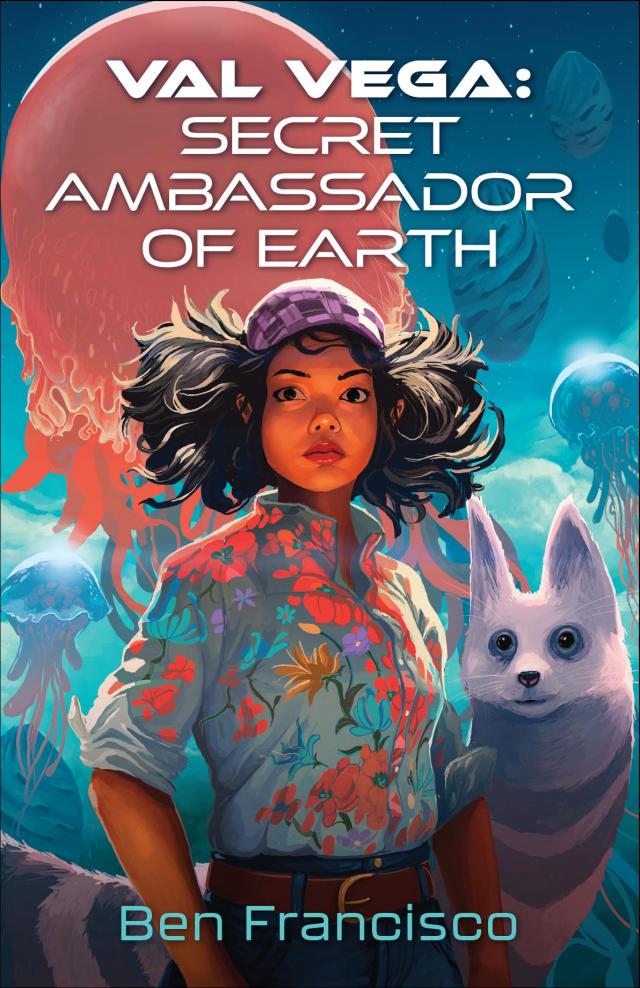
It was an unexpected blessing to connect with Luis Carlos Barragán Castro, who not only created a gorgeous cover, but is also a kindred spirit and brilliant writer of queer Latin American fiction.
Many thanks to Todd Cooper for his lovely design for the cover and interior, especially the awesome science-fictional realia.
Thank you to all my writing buddies and dear friends who read various drafts of this novel in its entirety and offered thoughtful, insightful feedback: Jennifer Lauren Brown, Corey Datz-Greenberg, Janice Gallagher, Lyle Matthew Kan, Matthew Hro Lehosit, Omri Navot, Marcus Pereira, Dashboard Yaron Schweizer, and Daniel Tamulonis. I am so appreciative of the time and love that all of you gave to this novel—and that you’ve given to me.
Thanks to all my other friends and chosen family who have supported me throughout the long journey of writing this novel: Gaby Garcia-Vera, peter panZy, Marco Antonio Quiroga, Felipe Sousa-Lazaballet, and Isabel Sousa-Rodriguez.
And thank you to the siblings I was born with but would have gladly chosen—Dave, Val, and Jo—and to my parents, who have nurtured all our creative spirits with affirmation and love.
Finally, to my partner, my husband, mi amor: mil gracias, Juan, por siempre empujarme a perseguir mis sueños.
About the Author
Ben Francisco (they/them) is a queer Puerto Rican writer born in the Bronx and raised in New Jersey. They encountered the original Star Wars movie in the womb and remain convinced it left a permanent imprint. Ben grew up watching Star Wars and Star Trek: The Next Generation and reading space adventure novels by authors like Isaac Asimov and Robert Heinlein. They thrilled to the possibilities of science fiction, but rarely saw their mixed Latinx family or LGBTQ lived experience reflected in those imagined futures. Val Vega: Secret Ambassador of Earth is the book their younger self longed for, affirming that the wonder of the stars belongs to all of us.
Ben’s short stories have been published in Strange Horizons, PodCastle, and From Macho to Mariposa: New Gay Latino Fiction. They won the Indiana Review 2022 Fiction Prize, and their work has been featured in several year’s best anthologies of LGBTQ fiction and in Locus Magazine’s recommended reading list. Secret Ambassador of Earth is their first novel.
Outside of writing fiction, Ben has two decades of experience in nonprofits working for immigrant rights, LGBTQ rights, and racial justice. They’ve also worked as a church receptionist, middle school teacher, and highly unsuccessful gardener. They live with their husband, Juan, in Brooklyn.
www.benfrancisco.net
Ben Francisco, Val Vega





