

Ghost Years, page 1


Copyright © 2024 by Barry Gifford
All rights reserved.
No part of this book may be reproduced,
stored in a retrieval system, or transmitted in any
form or by any means, including mechanical, electronic,
photocopying, recording, or otherwise, without the
prior written permission of the publisher.
seven stories press
140 Watts Street
New York, NY 10013
www.sevenstories.com
College professors and high school and middle school teachers
may order free examination copies of Seven Stories Press titles.
Visit https://www.sevenstories.com/pg/resources-academics
or email academic@sevenstories.com.
Library of Congress Cataloging-in-Publication Data is on file
ACKNOWLEDGMENTS
“Pops” and “Castor and Pollux in America” originally appeared in Southwest Review (Dallas); “Another Irishman” originally appeared in Narrative (San Francisco); and “Big Hands” originally appeared in the Santa Monica Review.
Drawings on pages 179 and 180 by Scott Gillis. All other drawings by Barry Gifford.
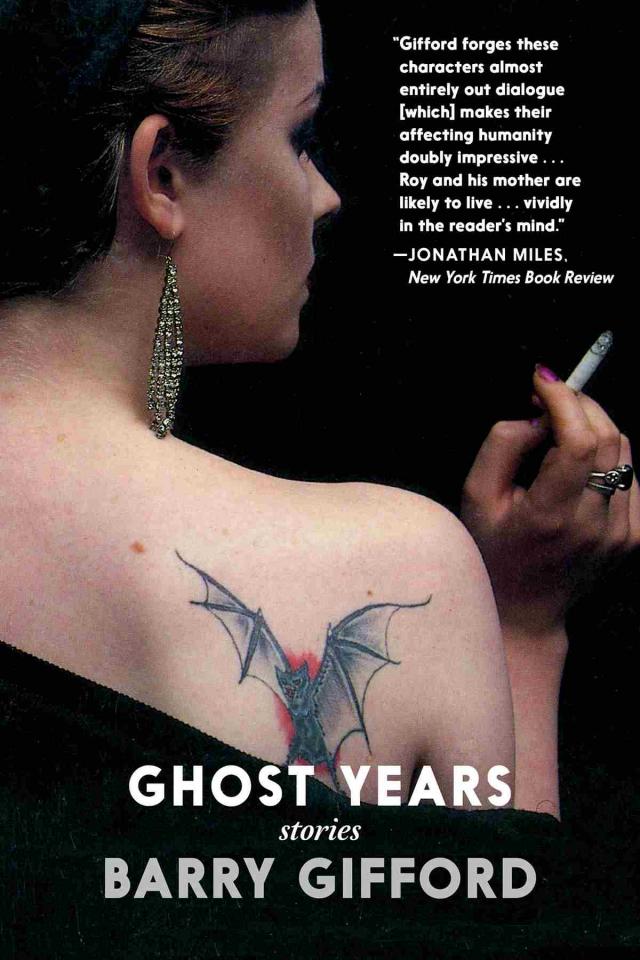
Cover photograph “Charlotte” (Tattoo by Lal Hardy, London) © Chris Wroblewski 1987
This book is for Jimbo
“Each artist seems . . . to be the
native of an unknown country, which
he himself has forgotten . . .”
—Marcel Proust, The Captive
“The hand that wounded you
shall also heal.”
—Claudius, Emperor of Rome,
quoting from the tale of
Telephus and Achilles
“nothing counts save the quality of the affection”
—Ezra Pound, Canto LXXVII
CONTENTS
author’s note
Secrets of An Actress
Worrying About the Weather
744 North Rush Street
A No Good Kid
Ghost Years
At Ciro’s
Lake Superior
ADW
Anything
Chicago 1956
Parris Island
Beautiful Enough
Lefty’s Hat
An Argument for the Existence of God
Detective Story
The Old Graveyard
Yukon Story
Arthur The Wolf Wolf
Visitors
Who Shot John
Saturday in the House of God
Big Things
Baseball
Catholic Girls
Back Street
Fencing
Pops
Sons and Sins of the Prophets
Comancheros
Better Than School
Another Irishman
The Bravest Boy in the World
White Roses
Crépuscule with Kitty
Kitty and Kay
Rough Night in La Zurrona
Somewhere Else
The Coolest Cats
Wupa: A Love Story
The Devolution of the Snout Turner
Satan’s Prisoners
Cop Killer
Kidnapped (Ancòra)
No Telling
A Quart of Milk for Mother
To Beat the Devil
Big Hands
Chinese Necklace Mystery
The Swimming Lesson
The Romantic
Bring Me the Head of Mangas Coloradas
Life Is Like This Sometimes
The Tiger
Mary Ann Wilson
The Promise
The Recital
Castor and Pollux in America
The Chinese Shadow
Her Diary
The Pillow
Uncle Buck’s Last Words
La hombrada
The Window
Epilogue: Strange Cargo
AUTHOR’S NOTE
This book is about the “ghost years, that time in your life you don’t know won’t never come again,” as Mrs. Cunningham tells Roy and her son, Tommy, in “Ghost Years.” Almost all of Ghost Years takes place in the 1950s. No doubt in the present day certain points of view taken by various characters as well as some of the language will be considered politically incorrect, even racist or sexist, by discerning readers. This is part of the verisimilitude, it’s intentional. That’s the way it was.
—b.g.
roy’s chronology
A Boy’s Novel (1973)
A Good Man to Know (1992)
The Phantom Father (1997)
Wyoming (2000)
Memories from a Sinking Ship (2007)
Sad Stories of the Death of Kings (2010)
The Roy Stories (2013)
The Cuban Club (2017, 2018)
Roy’s World: Stories 1973–2020 (2020)
The Boy Who Ran Away to Sea (2022)
Ghost Years (2024)
Secrets of An Actress
Kitty’s friend May June, whom Kitty had met before her son Roy was born, when both women were hat and glove models in New York, was an actress who had recently suffered a nervous breakdown. May had come to Chicago, where her mother and sister and Kitty lived, to rest and recover. She was living in Hollywood at the time of her collapse, following a bad divorce and forced withdrawal from the movie she was working on.
Kitty and May were the same age, twenty-eight. They had kept in touch by correspondence and occasionally by telephone during the six years since Kitty had gotten married and moved to Chicago. Now separated from her own husband, Kitty kept busy raising her son, who was five years old, and working part-time modelling fur coats at the Merchandise Mart.
May was staying with her unmarried sister, Mona, who worked as a registered nurse at Edgewater Beach Hospital, where May was being treated for her unstable condition. It wasn’t until almost a month after her arrival in Chicago that she felt well enough to meet Kitty for lunch at Armando’s Restaurant, which was next door to Kitty’s husband Rudy’s liquor store and pharmacy.
“Kitty, can Rudy give me some pills?”
“Don’t you get medication from the hospital?”
“Yes, but they’re not enough. I need something stronger.”
Both women were drinking martinis and May was chainsmoking Lucky Strikes.
“Are you allowed to drink alcohol while you’re on medication?” asked Kitty.
May exhaled a cloud of smoke before saying, “My doctor asked me what I like to drink. I told him gin martinis, very dry, and he said to limit myself to one.”
May quickly polished off the martini she had in hand, held up her glass and signalled to their waiter.
“May, you just said that your doctor limited you to one.”
“I took it to mean one at a time.”
Kitty took a sip from her glass, then said, “I’m sure Rudy won’t give you anything while you’re under a doctor’s care. He could lose his pharmacist’s license.”
May’s second martini arrived. She stubbed out her cigarette and lit another.
“Did something bad happen to you in Hollywood?”
“Too many things. After I got fired from Don’t Say No, I was broke and lonely, drinking too much, not thinking straight. I made a few regrettable decisions. More than a few.”
May picked up her glass, looked into it as if it were a crystal ball, then put it down.
“I turned some tricks. Slept with guys who’d been after me, not really strangers, but men I never would have gone with had I not been desperate and friendless.”
“Surely you have friends there, people who could have helped you out.”
“I was humiliated. I didn’t want to beg. It was an easy way to get money.”
“Begging would have been better than prostituting yourself.”
“Every girl out there prostitutes herself one way or another, most often by marrying men they don’t love.”
May lifted her glass again and drank a little.
“You’re right, Kitty, I won’t ask Rudy, or bug you to.”
“Trust your doctor, May. Mona knows who’s best at Edgewater. And just rest, you’ll get better.”
May smiled for the first time since she’d been with Kitty. Her eyes were bloodshot and her cheeks were pale. Hollywood had fled from her face.
“I was sorry to hear about you and Rudy separating. Any chance you’ll get back together?”
“I don’t think so. We’re friends, good friends, and he’s very good to Roy. Also generous. I’m going through with the divorce. What happened to Bob?”
“He blamed me for walking out on him. Told the judge I’d made a play for a rich producer friend of his.”
“Did you?”
“I don’t really know. I might have. Whatever I did, it wasn’t serious. And Bob had his peccadillos, some I knew about, some I didn’t.”
Kitty laughed. “That’s a good word for it. Everyone has their secrets.”
“In Hollywood somebody always has the goods on you and uses it sooner or later. I’m so glad you didn’t follow me there. Rudy will always be your friend, and you have Roy.”
Their waiter came over.
“Are you ladies ready to order lunch? The kitchen closes in fifteen minutes.”
“What’s your name?” May asked him.
“Roberto.”
“You have lovely, wavy hair, Roberto,” said May. “Do you dye it?”
“We aren’t staying,” Kitty told him. “Bring me the check.”<
He walked away.
May lit another Lucky Strike off of her half-smoked one. She tossed back her head and her hair fell over one eye like Rita Hayworth’s did in Gilda.
“Do you remember in Streetcar Named Desire when Stanley Kowalski is terrorizing his shaky sister-in-law and shouts in her face, ‘Ha, ha, ha, Blanche!’ That’s what I say to myself after I realize I’ve done something terrible. I’m not Blanche DuBois, I’m a beast. There’s no forgiveness in me, Kitty, at least not for myself.”
May’s hand holding the cigarette was trembling. She tried to put it to her lips but couldn’t find them.
“Come on, May, I’ll drive you back to Mona’s.”
“My secret is that I don’t have one. I can’t keep anything to myself. Or is it from myself?”
Roberto came back.
“There’s no charge for the drinks,” he said.
“Bring me another,” said May.
Worrying About the Weather
The first thing Roy’s mother, Kitty, read in the Tribune every morning was the weather report. After that she read Jenny Knight’s gossip column, Knight Out. Most of the time that’s all she read in the newspaper.
“Mom, why do you only read about the weather?”
“I read Jenny Knight, too. The rest isn’t worth bothering with. If the sky’s going to fall or already has there’s nothing we can do about it. I can’t control whatever else happens.”
“You can’t control the weather, either.”
“No, but I can prepare myself for it. Not yesterday’s, of course, but today’s and tomorrow’s.”
The only part of the paper Roy looked at was the comic strip page. He didn’t understand all of them but he liked the different ways the characters looked and how animals spoke like people.
“If the newspaper says it’s going to be a stormy day do you get worried?”
“No. Well, sometimes. It depends on what my plans are, if the weather will affect them. Here in Chicago the weather can change in a hurry. When we’re in Key West it’s not the same, we have more time to get ready.”
“Would you rather be in a hurricane or a blizzard?”
“Oh, definitely not a hurricane, it lasts too long. Sometimes the sky sits on top of you for days and the rain doesn’t stop, it makes me crazy.”
“It can snow for days, too.”
“I like the snow on the first day, maybe even the second. After that it gets dirty and it’s hard to get around, to drive or even walk. A hurricane can make you feel like it’s the end of the world.”
“Is it possible for the world to end?”
Kitty got up from her chair at the kitchen table.
“I’m going to make coffee for myself. Do you want cereal? We have Raisin Bran and Cheerios. Or I can make oatmeal.”
“Raisin Bran with a banana cut up in it. Dad said he liked when it snowed a lot because it reminded him of being in the old country. He told me the Gypsies put hats with large brims on their horses’ heads to keep snow out of their eyes when they have to pull carts and wagons around the villages. They cut holes in the hats so the horses’ ears could poke through.”
“Sometimes I think your father would have preferred to stay in Bucovina with the Gypsies rather than go with his family to America.”
“How old was he when they left the old country?”
“Ten, four years older than you are now.”
“What language do the Gypsies speak?”
“Romany, I think it’s called.”
“How come Dad never spoke it?”
“Who could understand him if he did? He probably forgot most of it.”
“Did he teach you any words?”
Kitty laughed. “Dja devlesa! Goodbye! That’s all I can remember.”
“Dja devlesa!” said Roy.
“Look out the window, honey, it’s really coming down.”
“If Dad were alive I’d ask him how to say it’s raining in Gypsy.”
744 North Rush Street
“Where’s your pay phone?”
“Haven’t got one.”
“Every place got one.”
“Not this place. There’s one across the street in Tony Zale’s restaurant.”
“Tony Zale? I remember when he decked Baby Kid Chocolate, fourth round. He won the title after that. Man of steel, hardest punchin’ middleweight I ever seen. He’s from Gary, you know. I’m from Whiting, steel towns.”
“Tony’s usually around this time of day. Stop in and say hello to him.”
“I’ll bet he’s got a phone in the bar.”
The man left Rudy’s liquor store.
“Who was that guy, Dad?” asked Roy.
“Guy lookin’ for a phone.”
“You’ve got lots of phones in the basement.”
“Those are private lines, Roy. Not for customers.”
Rudy and Roy, who was seven and a half years old, were standing together in the doorway to Lake Shore Liquors on the corner of Chicago Avenue and Rush Street. It was almost noon on a Saturday in October. The store wasn’t busy. Most of the people who resided and/or worked in the nightclub district weren’t even awake yet. Lake Shore Liquors stayed open twenty-four hours.
“Dad?”
“Yes, son?”
“Are you ever afraid someone’ll come in with a gun and rob the store?”
“There are too many cops comin’ in and goin’ out. Nobody from around here would try it.”
“What about a stranger? Somebody not from this neighborhood.”
“That’s only happened once, on a weekday night, ten o’clock.”
“Did he get the money?”
“No, Eddie shot him. One in each leg from behind. The guy never saw him. Lou was at the register with a .38 pointed at him.”
“He must have been scared.”
“You know your Uncle Lou, he doesn’t spook easy.”
“Maybe because he was in the war. He told me he shot a lot of Krauts.”
“Eddie got the guy before he could fire a shot. Lou called the cops.”
“When Tony Zale let me try on the gloves he used when he knocked out Rocky Graziano I asked him if Rocky scared him.”
“What did he say?”
“He said Rocky threw punches even when he was falling down. Tony was afraid he’d get hit below the belt.”
“Those boys fought each other three times, they know every trick in the book. Rocky could land one accidentally on purpose.”
Roy laughed. “That’s funny, Dad. How could something be an accident if someone did it on purpose?”
“You’ll find out.”
A hard wind was blowing debris in from the street.
“Come inside,” Rudy said, and closed the door.
A No Good Kid
When Eddie Metz was thirteen years old he set fire to a bum sleeping in an alley. The bum was passed out drunk on cheap wine or whiskey. At nine o’clock one night Metz bought a gallon of gas for twenty-one cents at the Mohawk station on the corner of Ojibway and Rockwell, carried it in a plastic kids’ pail he’d found in a sandbox at a park playground and went in search of a bum to burn. He found him collapsed in the weeds of an empty lot on the fringe of an alley between Mohican and Laramie streets, poured the gas on the guy over his legs and up to his neck, tossed the pail into the weeds, then took out a book of matches from a coat pocket, struck several of them and ignited the gas. Eddie backed away and watched the flames engulf the bum’s body before running down the alley. He was never caught and he never knew if his victim had died or not. Eddie didn’t care, he’d done what he wanted to do.
Roy and his friends in the neighborhood, all of whom were nine, ten and eleven years old, knew who Eddie Metz was and they didn’t mess with him. He supposedly attended Stambolov Vocational, a school for retarded and so-called problem boys whose behavior was considered unfit for public or parochial schools. Stambolov was named for a Bulgarian statesman of the previous century who had sponsored a law separating inferior and unruly children from their families and banished them to labor camps until the age of eighteen, at which time the boys were conscripted into the Bulgarian army and the girls forced to work as street cleaners. Eddie and the other throwaways from Chicago schools called Stambolov “Stumblebum” prep. They knew their next misstep would cause them to be sent either to a state reformatory or, if they were at least sixteen, to the men’s prison in Joliet, Illinois.
Roy had only one personal encounter with Eddie Metz. On a morning before school Roy went into Kapp’s sandwich shop and school supplies store across the street from Torquemada Elementary to buy some pencils and found Eddie arguing with the owner, Wilbur Kapp, about the price of a powdered doughnut.


