

The Long Wire, page 1
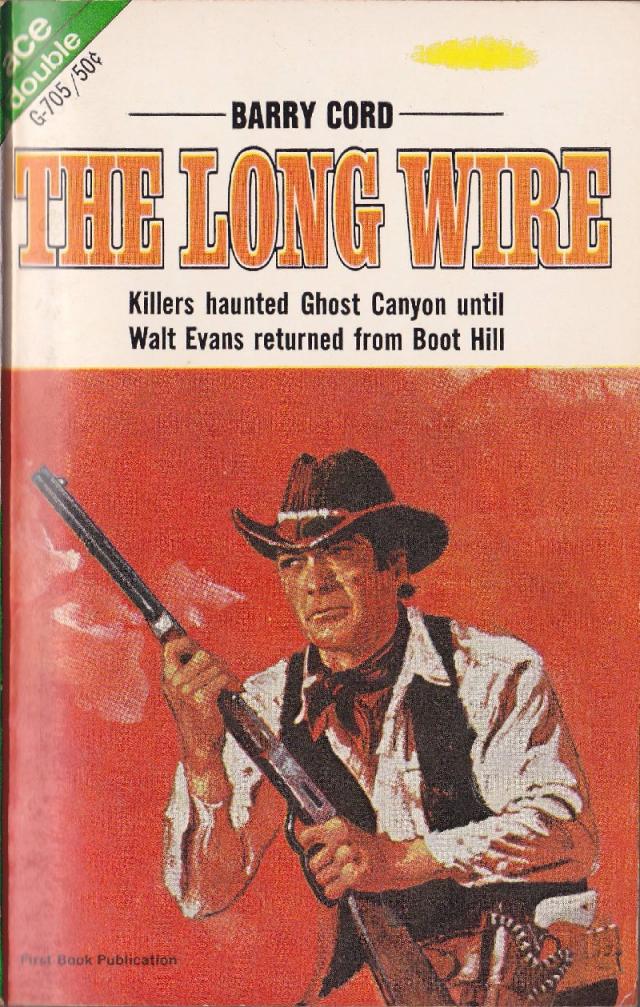


URGENT MESSAGE TO BOOT HILL
The long wire was the telegraph from Junction City to Cochise, Texas, and it was going to get through for the Trans-Pecos Company even if it took the lives of both Davis brothers to do it…
Bill Davis had started bossing the crew that was stringing the wire—and he was found dead in Ghost Canyon without a mark on him. Jim Davis didn’t know too much about telegraph work but he knew plenty about other things—like double-crosses, dirty competition, and hired guns.
He would find out why and how his brother met his mysterious death—and at the same time he was going to see that the telegraph got through Ghost Canyon.
Turn this book over for second complete novel
BARRY CORD
ACE BOOKS, INC.
1120 Avenue of the Americas New York, N.Y. 10036
The Long Wire
Copyright ©, 1968, by Ace Books, Inc.
All Rights Reserved
killers’ corral
Copyright ©, 1968, by Ace Books, Inc.
Printed in U.S.A.
I
The fire gutted ruins of the old ranch house showed like blackened bones through the thin grove of cottonwoods. Beyond the grown-over com field behind the house the slope pitched steeply upward, breaking against the sheer face of Frenchman’s Canyon.
“The bluff’s our only obstacle,” Davis said. “We lick that and we’ve got a fifty mile shortcut. That’s a week off our completion schedule.”
His companion, a thin man with an old face, shrugged. “The bluff isn’t all we have to lick, Bill. There’s old Frenchy’s ghost—”
Davis interrupted with a snort. “Don’t tell me the stories got to you, too, Steve?”
Steve Orville, timekeeper and assistant to Bill Davis, construction foreman for the Trans-Pecos Telegraph Company, smiled wryly. “Must be something to it,” he insisted. “Take a real close look. Good spot for a ranch—natural grazing, good soil. But nobody’s taken over since that Frenchman hung himself—”
Davis shook his head. He was a rough-hewn, blunt man in his late thirties, a good construction boss and a practical man. He did not believe in ghosts.
“Frenchy’s ghost or not,” he growled, “were stringing wire through this canyon. We’ll lay twenty-five poles to the mile, and string it free up the bluff until we can work out better supports. We’ve got a time schedule to meet and by hell we’ll meet it. I promised Mr. Simpson we could do it—” He turned and glanced at Steve, who looked troubled. “Look, Steve,” he said slowly, “it won’t be Frenchy’s ghost who’ll give us trouble. I saw Mike Donovan in town. He wasn’t exactly pleased when Trans-Pecos beat Overland out of the bid on this job. I know Mike, and if we run into trouble I know who’ll be behind it I”
Steve shrugged. “It’s still a long jump to Fort Cochise.” He glanced up to the clouds edging the sky over the bluff. “We’ll be running into rainy weather any day. We’ll be lucky if we make it before the ground starts to freeze—” Davis cut him off. “We’ll make it!” he said grimly. “If I have to work the pole setters day and night. We’ll string that wire to Cochise on time or Trans-Pecos folds. Reckon that ain’t no secret,” he added bitterly.
Steve shook his head. “Guess it isn’t,” he admitted. He glanced up at the threatening sky again. “Let’s get back to camp, Bill.”
They swung away. The afternoon sun was low over the eastern rim of the canyon, shooting its rays under the cloud mass. The road back brought them in close to the eastern rim where mesquite and thorn shrubs clung to the friable slope. An old miner’s cabin leaned on a shelf of stone, long deserted, its glassless window peering like a dark eye on the trail below.
They jogged on. The wind rose now and up among the jumbled rocks it was twisted and buffeted until it set up a high, tortured wailing, like some mortal in agony.
Steve licked his lips. ““I’ll be glad when we get through here, Bill. They say that Frenchy—”
He heard the foreman grunt and turned to see the construction boss slap at the side of his neck. “Damn gnats!” Bill said. He caught the look on Steve’s white face and laughed. “Cripes!” he jeered. “You look like you spotted Frenchy’s ghost—”
Steve took a deep breath. “You sure scared me,” he admitted. “I thought—”
He felt the sting at the back of his neck and his motion was reflexive. He slapped at it and felt something small and hard roll against his fingers; he looked down on the ground below him, but didn’t see anything.
But an unknown fear suddenly gripped at his bowels with icy fingers.
“Damn, let’s get out of here,” he muttered, and touched spurs to his cayuse.
Bill Davis laughed. “Hey, wait for me!” He rode quickly, catching up to Steve within a quarter of a mile. The mouth of the canyon was ahead of them, and the construction camp was less than five miles beyond this point, along the south bank of Cottonwood Creek.
“Steve, wait…” Bill felt suddenly tired, unable to breathe. He put his hands around the saddle horn to hold on. He saw Steve turn to face him. The timekeeper was swaying in his saddle. Suddenly he tilted sidewise, away from Bill, and fell…
Davis kneed his horse up close. Steve was on his back, he seemed to be fighting for air. His mouth was open and his eyes were wide, distorted with agony.
Fear twisted its knife in Davis’ gut. He turned his horse away and raked its flanks. He tried to cling to the saddle horn, but the horse’s gallop jolted him loose. He fell less than four hundred yards from Steve Orville.
The two horses drifted slowly back toward the construction camp. By sundown Moss Sevart, night telegrapher, saw them grazing along the Cottonwood. He rounded up some men and rode back.
They found Bill Davis’ body first, and later, Steve’s. There wasn’t a mark on either man they could see. But they were dead. As dead as any man could be.
One of the construction workers looked down the darkening canyon. The wind up along Organ Rock made its deep-toned wail of despair. They shivered.
“Frenchy’s ghost for sure. I ain’t working through here—”
They brought the bodies back to camp. The night operator, his face white, tapped out a message to Paul Saint, Trans-Pecos Division Manager in Junction City, twenty-one miles away.
Then he came out of the tent and looked down at the bodies. “Can’t understand it,” he said. “Looks like they strangled to death. But there isn’t a mark on them.”
“Someone strangled them, all right!” Murdock, a wire stringer, said. “Frenchy’s hands…He stepped back from the bodies and looked into the darkness, toward Frenchy’s Canyon. “I didn’t want to work in that canyon in the first place. If Trans-Pecos is set on building through there, I’m quitting!” He looked around, his face flushing. “I’ll string wire with any man here!” he snarled. “I’ve strung wire in a blizzard and in rainstorms! But I draw the line at stringing wire in a dead man’s canyon!”
The muttering that rose from the other men leaned in his favor.
The night telegrapher shrugged. “Mr. Saint is sending a doctor out. We’ll just sit right here, until we get further orders…
II
The thin rain came swirling down between the day coaches to spray the big man who lurched out to the small platform. He put his back to the wet door and took a deep breath; his eyes were small and bloodshot under knuckle-scarred brows.
“Gotta sober up quick,” he thought dismally. “Can’t walk into the Trans-Pecos office looking like this.”
He wasn’t drunk. But he knew he had been hired on as construction chief for Trans-Pecos with the condition that he leave the whiskey bottle alone.
“I can use a man like you,” Warren Simpson had told him. Mr. Simpson was the big boss of Trans-Pecos. “I want that wire through to Fort Cochise on schedule. You can do it for me, Evans—if you’ll lay off the bottle!”
Walter Evans put a calloused palm to his craggy features and scrubbed them. He was a burly, thick-shouldered man —a brawling, two-fisted individual who had started out as a pole-setter with Overland Telegraph and worked his way up to construction boss—and then drank his way out of the job.
The chill wind revived him somewhat after the stale tobacco fumes of the smoker. He studied the rugged terrain flanking the railbed with a wire-stringer’s eye. The train was picking up speed on a downgrade, making a long curve between rock-studded hills. The smoke of the big Mallet engine up front whipped back over the coaches, thick with cinders.
Be in Junction City in fifteen minutes, he thought. This was his chance to get back on his feet. It wouldn’t be like working for Overland or Western Pacific. Trans-Pecos was a small, independent outfit. Purely a Texas outfit. Sooner or later Western Union would swallow Trans-Pecos. The big man had seen it happen to Pacific Telegraph and Overland.
Trans-Pecos would break itself trying to fulfill its contract on time. A wire to Fort Myers and Cochise, up in wild rugged terrain. When it was strung Western Union would step in and buy Trans-Pecos out…or take over the line when Trans-Pecos went bankrupt.
Walt Evans shrugged. He had no real loyalty for Trans-Pecos. But Warren Simpson had hired him when no one else would even consider him for a pole-setter’s job. Hired him on as construction chief for the company. Walt licked his lips. There was a catch in it somewhere. But he was thankful for the job.
He reached inside his back pocket for the flask he carried, shook it. Not more than one good swallow left. No sense wasting it. He hesitated only briefly, then uncapped it and brought it to his lips.
He saw the rider then as the railbed curved in close to a road snaking through the hills. A young man on a big black horse with four white stockings—an easy-riding man covered by a poncho. They topped the trail some fifty feet above the railbed. The man waved in friendly gesture, then the curving train pulled Evans away from the road and the rider.
Evans finished his drink and tossed the flask away. He wiped his lips, feeling the dampness soak through his new suit coat. The door to his coach opened and two men came out to the jolting platform. Walt had seen them before. They had gotten aboard at Verne’s Pass, the last stop.
One was tall and somewhat cadaverous-looking. A man with long arms, hairy hands and a dull, horsey face. The other was shorter, wiry, with a small round face on which nose, mouth and eyes were bunched together. Both men were dressed in ill-fitting store clothes.
They seemed about to pass through to the next car. The taller man suddenly eased his back against the door and the wiry man turned and tapped Evans on the arm.
“Got a match, Mr. Evans?”
Walt nodded. “Sure have.” He reached into his pocket and the muzzle that prodded his side stiffened him. He didn’t have time to think. The gun blast twisted him around, his face shocked into a mask of pain. The taller man jammed his palm into Evans’ face and the construction boss fell backward. Blind instinct made him reach for the handbar.
He clung there, vaguely conscious of the clicking, deadly wheels below him. The smaller man’s gun blasted again. Evans’ grip loosened and he fell backward. A tiny warning flickering in his head made him jump at the last moment.
He landed heavily on loose earth and gravel and slid down the rail embankment into thick bushes which halted his descent. He lay for a few moments in a gray world of pain. The rain fell softly on his upturned face.
He knew he was dying. He rolled over and started to crawl. Dimly he remembered the trail flanking the roadbed, remembered the rider who had waved. He kept crawling, blindly, until his strength gave out.
The train swept past, going into an S-bend down the desolate slope. The tall man gripped the handbar and leaned way out, trying to spot Evans. But the curve of the train hid the spot where the Trans-Pecos construction boss had fallen.
“Better make sure of him, Pete,” he said harshly. “We don’t want anyone finding him still alive.”
Pete shrugged. He eyed the weather and there was distaste in his regard. But he knew better than to argue with the taller man.
He stepped down the iron ladder and waited, judging the speed of the train and picking out a soft spot. Then he jumped. He landed and rolled, skinning his knees and the palms of his hands. He cursed grimly.
The tall man waved to him. Pete flattened down behind the wet bushes as the rear of the train swung past; he didn’t want anyone to see him. The windows were rain-streaked and blurred—the coaches swept by and then the train was gone. The flat, lonely sound of its whistle, announcing its arrival to Junction City only minutes away, came back to him.
Pete drew his gun and headed back up the tracks, looking for Evans…
Jim Davis heard the shots whip on the wind: faint pops that drifted up to him through the rain.
He reined his black stud in to the side of the road, the rain sifting against his poncho. There was an autumn chill in the rain and the slope was gray and dismal under the lowering sky.
He leaned forward over the horn, peering between two huge boulders and he could see the train moving like some dull black sidewinder over the curving steel rails below. Smoke lay thick and black over the coaches.
Davis ran his gaze to the platform of the third car where lie had seen the big man and surprise etched a small furrow above his cold gray eyes. The big man was gone. But there were two other men there now, a tall man and a short one. And even as he looked the smaller man jumped.
Then the train curved away, around a rock outcrop, and the flat mournful whistle lay heavy on the air.
Davis studied the scene for a long moment, a hardness in his eyes. He was twenty-five, but he looked older, harder. He had knocked around a good deal since he and his brother had split up five years before, and the interval had put a cynical glint behind the coldness in his eyes.
His brother had been working for Western Pacific then. “You know this business as well as I do,” he had told Jim. “But you’re old enough to find out what you really want to do with your life. Go ahead—get it out of your system. When you’re ready, come back. I’ll have a job for you.”
He had seen his brother once in those five years, a brief meeting at Promontory Point during a celebration of Union Pacific. His brother Bill was the same, but Jim had changed …he knew it and Bill knew it and Bill had said goodbye when Jim left.
“You won’t be coming back,” he had told Jim. “In a way, I’m sorry. I hope you find out what you really want to do some day.” They had shaken hands. “Keep in touch, kid,” Bill had said.
But the next time Jim heard from his brother he was dead.
He swung the big restless black horse away from the edge of the road and rode slowly until he found an opening off trail. He rode the black down here, heading for the railbed.
Part way down the slope the horse shied away from something ahead. Jim came out of the saddle and walked to the man who lay face down in a small clearing between the rocks.
Walt Evans had crawled almost a hundred feet upslope from the rails. He had clawed the earth in a blind effort to live, an organism that moved only because movement was a part of life. He was still breathing when Jim crouched over him.
But Davis saw immediately there was nothing he could do for this man. He listened to Evans* agonized breathing for a moment, then the slide of a man’s boot on rain-slickened rock jerked his head around.
His hand reached under his poncho for his holstered Colt; he was remembering the wiry man who had jumped from the train a few minutes before…
Pete came into view a few moments later. He was following Evans* trail up the slope, a shallow groove in the wet earth seemingly made by some giant slug. Pete’s gun was held ready in his hand. He came around the wet rocks and froze, eyeing Jim crouched beside Evans’ now still body.
Jim Davis said grimly, “You should have remained on the train, Mac. He’s dead."
Pete’s gun muzzle came up and he thumbed a quick shot at Jim. But Jim’s fire spun him around. He stumbled and slipped, plunging headfirst against a nearby boulder.
Jim flinched at the gory splat. Rising, he walked slowly over to Pete and turned the limp figure over. Pete’s bloody head rolled loosely.
Davis had shot only to wound the man, but it was Pete’s bad luck that he had fallen and smashed his head against the rock. Jim squatted by the small man and went through his pockets, looking for identification.
He found the usual personal items the man carried, but nothing to indicate who he was. Yet there was two hundred dollars in the man’s wallet in crisp new twenty dollar bills. This was something a man did not usually carry.
Davis walked back to Evans. The construction boss had little on him. A few dollars, a watch with a heavy gold chain. Inside the back watch cover was an engraved message: To Walter Evans, in grateful appreciation, from Overland Telegraph.
Jim pocketed the watch. His face held a small frown as he searched the dead mans coat pockets.
He found a letter in an inside pocket and read it with interest.
It was addressed to Paul Saint, Division Head, Trans-Pecos Telegraph Company, Junction City, Texas. It read:
Dear Paul: This will introduce Walter Evans, your new construction boss. He’s worked for Overland and for Western Pacific for years. He’s rough and bullheaded, but he knows wire. If you can keep him off the bottle he’ll get our line through on schedule. I don’t have to remind you how important it is that we hook up with Fort Myers before October first. Im negotiating for more time on the loan and will have supplies you requested shipped to you by weekend. Will see you personally before the end of October.


